

Solar Panels and Shade: Trees, Chimneys & Neighbors
Straight answer: shade costs a solar array in two ways — the sunlight it blocks, and the mismatch it forces on panels wired together. Microinverters and DC optimizers fix only the second part: in NREL testing they recovered about 25–35% of annual shading losses. So the real fixes start with design — measure the shade on each roof face, keep panels out of the worst of it, trim where you can — and, for a neighbor’s tree planted after your panels, California’s Solar Shade Control Act.
Get a free estimate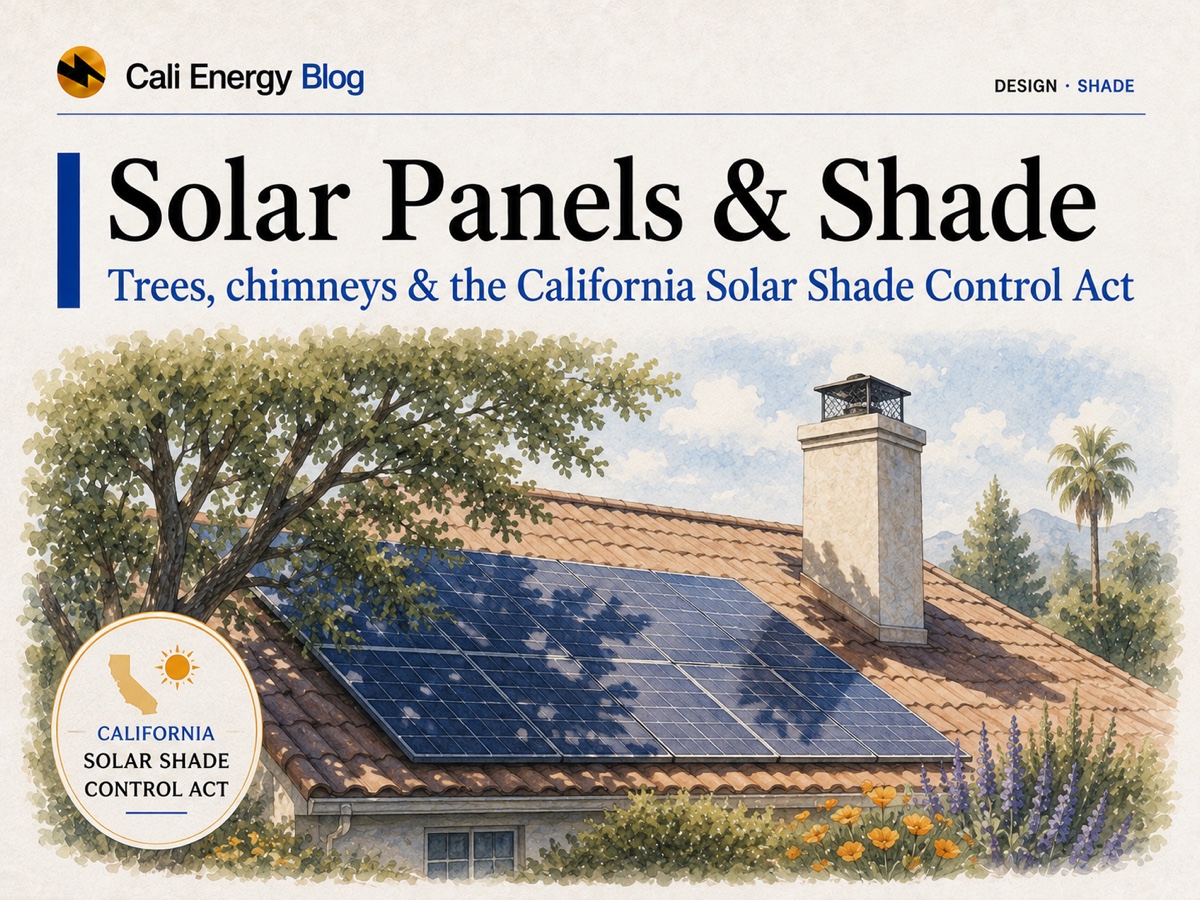
- A small shadow can cost more than its size: a typical 60-cell panel is split into three sections, each behind a bypass diode, and shading a few cells can switch a whole section off.
- Microinverters and optimizers recover the mismatch, not the blocked light: 25–35% of annual shading losses in NREL testing, about a third in NREL’s modeling guidance.
- Los Angeles shadows are long in winter: on December 21 a shadow is about 1.6 times the height of whatever casts it at noon, and 2.0–2.2 times at 10 a.m. and 2 p.m.
- Ask for a shade report with annual solar access for each array — the measure California’s energy code uses for new homes.
- The Solar Shade Control Act covers only trees and shrubs placed after your panels, has broad exemptions, and lets cities opt out. In Los Angeles, removing a street tree or a protected native tree takes a city permit, and so does trimming a street tree.
Why a small shadow can cost more than its size
Shade takes energy in two ways: the sunlight it blocks, and the mismatch it creates between panels wired together.
On a string-inverter system, panels are wired in series, and every panel in a string carries the same current. The same thing happens inside each panel: in NREL’s description of a typical 60-cell module, the cells form three 20-cell sections, each protected by its own bypass diode (NREL, 2012). When shade keeps a few cells in a section from carrying the string’s current, the diode routes the current around that whole section — so a shadow on a few cells can take a third of the panel offline while the rest of that section sits in full sun. NREL notes that in some layouts a shadow blocking as little as 25% of the light on a single cell can be enough to start a bypass diode conducting. Bypass diodes keep one shaded section from throttling the whole string, but they don’t make shade free.
That gives shade two costs: the direct loss of the light it blocks, which no electronics can recover, and the mismatch loss it forces on sunlit cells and panels wired with the shaded ones. The second part is what module-level electronics are built to win back. For the basics of cells, strings and inverters, see how solar panels work.
What microinverters and optimizers actually recover
Module-level power electronics let each panel run at its own best operating point. NREL has measured what that is worth under shade.
A microinverter under each panel, or a DC optimizer on each panel feeding a string inverter, keeps a shaded panel from setting the pace for its neighbors. In NREL’s side-by-side test both did about the same — and both recovered only part of the loss:
| Shade profile (annual sun lost to shade) | String inverter | DC optimizers | Microinverters |
|---|---|---|---|
| Light (7.6%) | 6.5% lost | 4.6% lost | 4.7% lost |
| Moderate (19.0%) | 18.7% lost | 14.6% lost | 14.9% lost |
| Heavy (25.5%) | 25.6% lost | 19.4% lost | 19.8% lost |
| Share of shading loss recovered (average) | — | 25% | 23% |
Losses calculated from the weighted energy values in Table 6 of NREL’s 2016 shading testbed update: two 6.24 kW arrays and a string-inverter reference in Davis, California, tested in June 2013 with SolarEdge OP250 optimizers, Enphase M215 microinverters and an SMA string inverter. The three shade profiles come from site surveys of homes. Newer hardware differs, but module-level electronics still recover mismatch, not blocked light.
With module-level electronics the arrays produced about 2%, 5% and 8% more energy than the string-inverter reference under light, moderate and heavy shade. Across NREL’s trials the devices recovered 25–35% of annual shading losses, and the spread came mostly from how many parallel strings the test array had rather than from the brand (NREL, 2016). For estimates, NREL suggests assuming they recover about a third of the shading loss a site survey measures, within a range of 25–40% (NREL, 2015). So a roof face with a measured 12% annual shading loss would be modeled at about 8% with microinverters or optimizers (12% × [1 − 0.33]).
They help in two quieter ways as well. NREL expects them to eliminate the small mismatch between panels that exists even without shade — PVWatts budgets 2% for it by default — and they report every panel’s output, so a new shadow or a failing module shows up in the app. What they can’t do is make light: a panel in deep shade still produces little. For the two main platforms side by side, see Enphase vs SolarEdge.
How long shadows get in Los Angeles
The same tree can miss your panels in June and cover them in December, because the winter sun stays low in the southern sky.
| Date | 10 a.m. | Solar noon | 2 p.m. |
|---|---|---|---|
| Dec 21 (lowest sun) | 2.0 ft (sun 27° up) | 1.6 ft (33°) | 2.2 ft (25°) |
| Jan 21 / Nov 21 | 1.7–1.8 ft | 1.4 ft | 1.8–2.0 ft |
| Mar 20 / Sep 22 (equinoxes) | 0.9–1.0 ft | 0.7 ft (56°) | 1.0 ft |
| Jun 21 (highest sun) | 0.5 ft (63°) | 0.2 ft (79°) | 0.6 ft (61°) |
Our calculation with NOAA’s solar-position equations for downtown Los Angeles (34.05° N, 118.24° W): shadow length = height ÷ tan(sun elevation), measured along the ground in the sun’s direction. Real roofs slope and trees have width, so treat this as a first check, not a shade report.
Read it as a multiplier. A tree whose crown rises 20 feet above your panels casts a noon shadow about 31 feet long in late December (20 × 1.57), about 13 feet at the equinoxes and under 4 feet in late June. Shadows point away from the sun — north-northwest at 10 a.m. and north-northeast at 2 p.m. in winter — so the long winter shadows come from whatever stands to the south, southeast and southwest of the array; in summer, trees to the east and west matter early and late in the day. California’s energy code makes the same point from the other side: obstructions north of every panel need not be counted as shading at all (JA11.3). How much the winter dip matters depends on the rest of the year — see solar panels in winter and Los Angeles sun-hour data.
Shade sources and how a design handles them
California’s energy code lists what a shade analysis for a new home has to account for. It works as a checklist for any roof.
| Shade source | What to know | Usual design response |
|---|---|---|
| Trees already mature when the panels go in | Shadows grow with the tree and swing with the season | Leave the worst faces empty; trim; module-level electronics for what remains |
| Trees planted on your lot or a neighbor’s | The code says to judge them at mature height, not today’s | Design for the tree it will become; the Solar Shade Control Act may cover a neighbor’s tree planted after your panels |
| Chimneys, vents, dormers, rooftop equipment, a dish | On your own roof; the shadow sweeps across nearby panels during the day | Set panels back; lay out around vents; module-level electronics for any panel still clipped |
| Neighboring buildings, existing or known to be planned | Worst under low winter sun; the Solar Shade Control Act does not cover buildings | Put panels on faces the building doesn’t reach |
| Terrain — hills, canyon walls | Cuts off low morning or evening sun on hillside lots | Nothing to trim; measure it and size the array to it |
| Utility poles closer than 30 ft | Counted by the code; a thin, predictable shadow | Usually a layout question |
Shade sources from Joint Appendix JA11.3 of the California Energy Commission’s 2025 Reference Appendices, written for new construction. The right response depends on your roof; a site-specific shade analysis is the only way to know.
How shade is measured before a quote
Guesswork is how panels end up in the shade. The number to ask for is annual solar access.
Annual solar access is the sunlight a spot receives over a year with shading, divided by what it would receive with no shading. California’s 2025 Energy Code uses it for new homes in two ways: roof areas below 70% annual solar access are left out of the solar access roof area that can cap the size of the required system (§150.1(c)14), and on the prescriptive path the finished array generally has to average at least 98%, weighted by panel count (JA11.3.1). The code also requires the check to be done with a CEC-certified solar assessment tool that reports annual solar access for each array, and says tools working from satellite or aerial images must give values comparable to on-site measurements (JA11.4).
Those rules are written for new construction, and a system added to an existing home generally isn’t held to them — but they are a good template for what to ask any installer for: a shade report with annual solar access for each array. The measuring ranges from a sun-path tool such as the Solar Pathfinder, which NREL’s solar-ready buildings guide suggests for reading the sky view at a panel location, to software that models shade from aerial data — Google’s Solar API, for one, publishes a digital surface model, annual and monthly flux maps and hourly shade layers. If a production estimate simply uses PVWatts’ default 3% shading loss, nobody has measured your roof yet. Orientation matters as much as shade when choosing faces — see which way solar panels should face.
Design fixes — before you touch a tree
Most shade problems are solved on the design side, not with a chainsaw. The main levers:
Module-level electronics
Microinverters or DC optimizers, so a shaded panel drops on its own instead of setting the pace for its string. Worth it on any roof with real shade.
Skip the bad faces
Sometimes the right move is to leave a heavily shaded plane empty and load up the sunny ones — fewer panels, more real production.
Smart panel placement
Set panels back from chimneys, vents and dormers so a midday shadow clips as few modules as possible.
String layout
On a string system, keep panels that see the same shade on the same string, so a shadow on one group doesn’t pull down panels in full sun.
Right-size the array
If shade trims output, a few panels on clear roof area can make up the target — see how many panels you need.
Per-panel monitoring
Module-level systems report each panel, so a new shadow (or a dirty panel) shows up instead of hiding inside a whole-system number.
Trimming vs. removing a tree
When a tree is the problem you have three honest options: design around it, trim it, or remove it — each with a real trade-off.
Trimming is the usual first move: often you only need to clear the branches that cross the sun’s path during the hours that matter, and in winter that path runs low across the southern sky. Trees grow back, so plan on trimming as ongoing maintenance. Shade tends to creep up over the years: in a study of 503 systems, home rooftops with medium or heavy shade lost energy yield at a median 2.1% a year, against 1.3% for home rooftops overall — a whole-system figure that includes growing foliage, dirt and inverter losses (Deceglie et al.).
Removal is permanent and can clear a whole roof face, but weigh what the tree does for you. California’s own shade law opens by saying the state encourages trees and shrubs that create shading, moderate outdoor temperatures and provide economic and aesthetic benefits (PRC §25980). Permits matter too. In the City of Los Angeles, a permit from the Board of Public Works, issued through StreetsLA’s Urban Forestry Division, is required before anyone removes, trims or root-prunes a street tree in the public right-of-way, and before anyone removes or relocates a native protected tree or shrub on private land: native oaks (except scrub oak), Southern California black walnut, western sycamore, California bay, toyon and Mexican elderberry, once they measure 4 inches or more in cumulative diameter 4½ feet above the ground. “Removal” includes anything that would cause the tree to die, such as damaging its roots (LADBS). Other cities and HOAs have their own rules.
A neighbor’s tree is a separate matter. Cutting it without agreement can be expensive: California law sets damages for wrongful injury to trees on someone else’s land at twice or three times the harm (Civil Code §3346). Often the best answer is a mix — trim what you can, with the owner’s agreement, design the array around what’s left, and let module-level electronics absorb the rest.
What to check on your own roof
- Look at the roof at 10 a.m., noon and 2 p.m. — shade moves through the day.
- Check again in winter, or use the shadow table above: at noon on December 21 a shadow is about 1.6 times the height of whatever casts it.
- Note trees, yours and your neighbors’, and picture them at mature height, as the state energy code does for new homes.
- Mark chimneys, vents, dormers, dishes and antennas near candidate panel areas.
- Ask your installer for a shade report with annual solar access for each array, not just a panel count or a default loss.
- Confirm the design uses module-level electronics where real shade exists, and leaves shaded faces empty where that makes sense.
- In Los Angeles, check whether a tree you want trimmed or removed is a street tree or a protected native before anyone cuts.
The California Solar Shade Control Act, in plain English
California has a law aimed at one situation: a neighbor’s tree or shrub, placed after your panels went up, growing to shade them.
The Solar Shade Control Act (Public Resources Code §§25980–25986) says that once a solar collector is installed, the owner of another property may not allow a tree or shrub to be placed, or once placed to grow, so that it casts a shadow over more than 10% of the collector’s absorption area at any one time between 10 a.m. and 2 p.m. local standard time (§25982) — 11 a.m. to 3 p.m. on the clock during daylight saving time. A tree kept in violation is a private nuisance if its owner fails to remove or alter it after receiving written notice from the collector’s owner (§25983). Until 2009 a violation was a public nuisance and an infraction, with a fine of up to $1,000 per violation; SB 1399 (2008) replaced that with today’s private-nuisance route and added several of the exemptions below, including the one for trees planted before the panels.
The details decide whether it applies at all. A “solar collector” under the Act is a system on the roof of a building; a ground-mounted system counts only if the roof can’t take it because of roofing material, slope, structural shading or orientation, and a system designed to offset more than the building’s electricity demand doesn’t count. The collector must also meet local building and setback rules and sit at least 5 feet from the property line and 10 feet above the ground, or lower only with an extra setback of three times the amount lowered (§25981). Before installing, you may send neighbors a formal Solar Shade Control Notice by certified mail, no more than 60 days ahead, using wording set out in the statute (§25982.1).
The Act does not apply to:
- Trees or shrubs planted before your collector was installed.
- Trees on timberland or on land producing commercial agricultural crops.
- A replacement for a tree or shrub that was there before your panels and later died or was removed for public health, safety or environmental reasons.
- A tree or shrub subject to a city or county ordinance — in Los Angeles that may include street trees and protected native trees.
- Buildings, additions and other structures: the Act covers trees and shrubs only.
A city, or a county for unincorporated areas, can also adopt an ordinance exempting its whole jurisdiction, and a local tree-preservation or solar-shade ordinance governs where one exists (§25985). Because of those carve-outs, the Act fits a fairly narrow set of cases. It is worth knowing, but it is no substitute for a good design.
Confirm the law before you rely on it
This is a plain-English summary, not legal advice. The Act dates from 1978 and was last amended in 2008. Whether it applies to you depends on your city or county, the specific trees and the facts, and enforcing it means a formal dispute with a neighbor. For anything real, read the current statute and talk to a qualified attorney. Cali Energy designs and installs the solar; we don’t give legal opinions.
Chimneys, vents, dormers — shade from your own roof
No shade law helps here, because the shade comes from your own house. The good news: these are the most designable shade sources of all.
A chimney, plumbing vent, attic vent, dormer or satellite dish casts a small shadow that sweeps across nearby panels through the day, and California’s energy code counts all of them as shading obstructions for new homes. The standard fixes are layout and electronics: set panels back so the moving shadow clips as few modules as possible, put panels on roof faces the obstruction doesn’t reach, and use module-level electronics so any panel that does get clipped drops on its own. Occasionally a vent or dish can be relocated — but vents tie into plumbing and attic ventilation, so that is a call for the installer to assess against the code and your roof, not a default move. In practice, a careful layout handles most of it without moving anything.
Measure first, then decide what goes where
On Los Angeles and San Fernando Valley roofs our designs start from a shade model of each roof face, not from a default loss. Faces that don’t earn their keep stay empty, panels are set back from chimneys and vents, and where real shade remains we use module-level electronics so a clipped panel drops on its own. We’d rather quote fewer panels in the sun than more in the shade. Our Northridge installs show the equipment on real homes.
Bottom line on shade
Shade is real, but it’s rarely a deal-breaker. Measure it for each roof face, design around it with placement and module-level electronics, leave faces empty that don’t earn their keep, and treat tree trimming as maintenance — leaning on the Solar Shade Control Act only in the narrow cases it fits. Get the design right and a partly shaded roof can still be a strong solar roof. Not sure how much sunny roof you have? Start with how many solar panels you need in California, and we’ll size a system around your real sun.
Get a shade-aware solar designFrequently asked
How much does shade reduce solar panel output?
It depends on how much sun is blocked and how the array is wired. In NREL’s side-by-side test, weighted to three homes that lost about 8%, 19% and 26% of their annual sun to shade, a string-inverter array lost about 6.5%, 19% and 26% of its energy, and arrays with microinverters or optimizers about 5%, 15% and 20%. At any given moment a small shadow can cost more than its size, because a bypass diode can switch off a third of a panel when a few of its cells are shaded. Only a site-specific shade report gives your roof’s number.
Do microinverters or optimizers fix a shaded roof?
They help, but only with part of the loss. Module-level electronics recover the mismatch that shade creates between panels, not the light it blocks: NREL measured them recovering 25–35% of annual shading losses (23% for Enphase and 25% for SolarEdge in one side-by-side test), and its modeling guidance assumes about a third. A panel in deep shade still produces little. See Enphase vs SolarEdge for the two main platforms.
How long are shadows in Los Angeles in winter?
Long. At solar noon on December 21 the sun is only about 33° above the horizon in Los Angeles, so a shadow is about 1.6 times the height of whatever casts it, measured from panel level; at 10 a.m. and 2 p.m. it is about 2.0 and 2.2 times. At noon in late June it is about 0.2 times. A tree that never touches your panels in summer can shade them in winter, which is why a shade analysis looks at the whole year.
Can I make my neighbor trim a tree that shades my solar panels?
Sometimes, but the rule is narrow. Under California’s Solar Shade Control Act, a neighbor may not let a tree or shrub placed after your panels grow to shade more than 10% of the collector at any one time between 10 a.m. and 2 p.m. standard time; after your written notice, a tree kept in violation is a private nuisance. Trees planted before your panels are exempt, as are trees subject to a local ordinance, and a city or county can opt out entirely. Don’t cut a neighbor’s tree yourself: California law sets damages for wrongful injury to someone else’s trees at twice or three times the harm. This is general information, not legal advice — talk to an attorney about your situation.
Does the Solar Shade Control Act cover a neighbor's new building or second story?
No. The Act addresses shade from trees and shrubs, not from buildings, additions or other structures. If a neighbor’s construction shades your panels, the fix is on the design side — sunnier roof faces and module-level electronics — and any property-line or zoning question is a matter for local rules and, if needed, an attorney. This is general information, not legal advice.
How do installers check for shade before installing solar?
With a shade analysis that reports annual solar access — the sunlight a spot gets over a year with shading, divided by what it would get unshaded — for each roof face or array. For new homes, California’s 2025 Energy Code requires a CEC-certified solar assessment tool and, on the prescriptive path, an array average of at least 98%; tools that work from satellite or aerial images must give values comparable to on-site measurements. For any home, ask for the per-array numbers, not just a panel count or a default loss.
Do I need a permit to trim or remove a tree in Los Angeles?
For some trees, yes. In the City of Los Angeles, a permit issued through StreetsLA’s Urban Forestry Division is required before a street tree in the public right-of-way is removed, trimmed or root-pruned, and before a native protected tree or shrub on private land is removed or relocated — native oaks (except scrub oak), Southern California black walnut, western sycamore, California bay, toyon and Mexican elderberry, once they reach 4 inches in cumulative diameter 4½ feet above the ground. Other cities, the county and HOAs have their own rules, so check before anyone cuts.
Should I remove a tree to install solar?
Not automatically. Weigh the production you’d gain against what the tree gives you — shade, cooler outdoor temperatures, privacy and curb appeal — plus the cost and any permit the tree needs. Trimming the branches that cross the low winter sun path, combined with module-level electronics and smart panel placement, can capture much of the benefit. A shade analysis puts real numbers on the trade-off.
Related reading
Sources & methodology
Figures on this page come from the primary sources below and, where noted, from Cali Energy calculations using the stated assumptions. Rates, incentives, and program terms change; each was verified September 30, 2026.
- California Legislative Information — Solar Shade Control Act, Public Resources Code §§25980–25986
- California Legislature — SB 1399 (2008), Chapter 176: chaptered text and Legislative Counsel’s Digest
- California Legislative Information — Civil Code §3346 (damages for injury to trees)
- NREL — Photovoltaic Shading Testbed for Module-Level Power Electronics (NREL/TP-5200-54876, 2012)
- NREL — Photovoltaic Shading Testbed for Module-Level Power Electronics: 2016 Performance Data Update (NREL/TP-5J00-62471)
- NREL — Modeling Microinverters and DC Power Optimizers in PVWatts (NREL/TP-5J00-63463, 2015)
- NREL — PVWatts Version 5 Manual (NREL/TP-6A20-62641)
- Deceglie et al. — Fleet-Scale Energy-Yield Degradation Analysis of Residential and Nonresidential PV Systems
- California Energy Commission — 2025 Building Energy Efficiency Standards, Title 24 Part 6 (CEC-400-2025-010-F)
- California Energy Commission — 2025 Reference Appendices, Joint Appendix JA11 (CEC-400-2025-010-AP)
- NOAA Global Monitoring Laboratory — Solar Calculator: calculation details
- NREL — Solar Ready Buildings Planning Guide (NREL/TP-7A2-46078)
- Google Maps Platform — Solar API overview
- LADBS — Information Bulletin P/ZC 2024-022: Guidelines and Requirements for Regulated Trees
Get a shade-aware solar design
Send us your address and a recent bill and we’ll model the shade on each roof face, design around your trees and chimneys, and size a system to the sun your roof actually gets — no pressure.
Get a free estimatePrepared by Cali Energy, September 30, 2026. This article is for general educational purposes only and is not legal, tax, financial, engineering, or utility advice. Rates, incentives, codes, permit requirements, equipment specifications, prices, and program terms may change; figures and timelines are estimates, not guarantees. Confirm current requirements with the applicable utility, AHJ, program administrator, manufacturer, or a licensed professional. See our Content Disclaimer. Cali Energy · 19201 Parthenia St, Unit E, Northridge, CA 91324 · CSLB #1032379 (B, C-10, C-39)