

Why Does My Roof Leak Around the Chimney?
Usually through one of four places: the flashing where the roof meets the chimney, the top of the chimney, the brick and mortar themselves, or the roof just uphill of a wide chimney, where water piles up. Where the water shows inside narrows it down. Water in the firebox or on the damper points up the chimney, to a missing cap, a cracked crown or soaked masonry; a stain on the ceiling or in the attic right beside the chimney points to the flashing or the cricket behind it. The flashing and the cricket are a roofer's work; the cap, crown, flue and masonry are a chimney professional's. In Los Angeles, a chimney rebuilt after earthquake damage may not be brick above the roof at all, but a chase around a factory-built metal flue, with its own ways of letting water in.
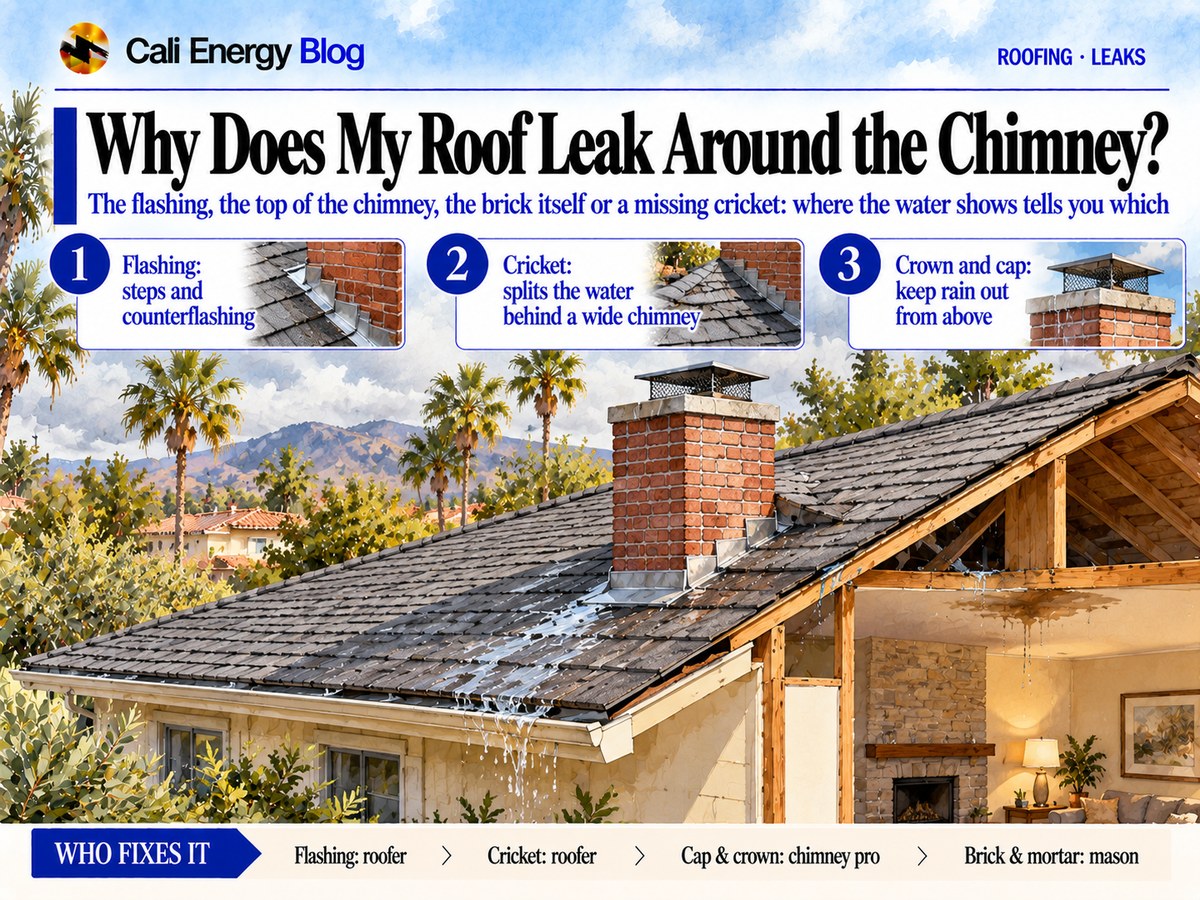
Where the water shows, and what it points to
A chimney leak can often be narrowed down from inside the house before anyone goes up.
| Where the water shows | Likely source | Who checks it |
|---|---|---|
| In the firebox, on the damper or the hearth | Water coming down the inside: no cap on the flue, a cracked crown or chase top, or wet masonry | A chimney professional |
| On the ceiling or wall right beside the chimney, or on the framing around it in the attic | The flashing: the steps and counterflashing on the sides, the apron at the front, the flashing at the back | A roofer |
| Below the uphill side, worst in heavy rain | Water damming behind a wide chimney with no cricket, or a cricket whose flashing has failed | A roofer |
| On the chimney's own face inside the house or in the attic, after long rain | Water soaking through the brick and mortar | A chimney professional or a mason |
If it shows only in storms, the wind and rain patterns in why a roof leaks only in heavy rain help, and tracing the wet trail in the attic is covered in how to find a roof leak.
How chimney flashing is supposed to work
A chimney and the roof around it move differently, so the flashing comes in two parts. The asphalt roofing industry's manual describes base flashings fastened to the roof deck, an apron across the front, step flashing up each side and flashing across the back, and counterflashings fixed into the chimney's masonry that lap down over them. When the house moves, the counterflashing slides over the base flashing without opening a path for water (Asphalt Roofing Manufacturers Association, ARMA). California's residential code requires flashing around every opening in the roof and says that on a shingle roof, chimney flashing follows the shingle maker's instructions (CRC R903.2.1 and R905.2.8.4). The other kinds of flashing on a roof, and the code's rules for them, are in roof flashing types and where each goes.
From the ground with binoculars, or in photos from a roofer, look for counterflashing that has come out of its joint in the brick, base or step flashing that is rusted or bent, and gaps held closed only by sealant. Sealant can be part of a flashing detail, but it doesn't replace the overlapping metal.
The cricket behind a wide chimney
Everything running down the roof above a chimney hits its uphill side. A cricket, also called a saddle, is a small ridge built behind the chimney that splits that water around it. California's code requires one on the uphill side of any chimney or penetration more than 30 inches wide, and its chimney section adds that the cricket's joint with the chimney is flashed and counterflashed like the rest (CRC R903.2.2 and R1003.20). The code also sets its height by slope: half the chimney's width on a 12:12 roof, a third on 8:12, a quarter on 6:12, a sixth on 4:12 and an eighth on 3:12. ARMA's manual goes further and strongly recommends a cricket on any chimney 24 inches wide or more.
Behind a wide chimney with no cricket, or a flat spot where water sits, the water collects in a downpour, so a leak there tends to get worse the harder it rains.
The top of the chimney and the brick
Water can also come in from above, through the chimney itself:
- The cap or crown. California's code requires a masonry chimney to have a concrete, metal or stone cap, sloped to shed water, with a drip edge and a caulked bond break around the flue liner (CRC R1003.9.1). The Chimney Safety Institute of America (CSIA) recommends a crown that projects about 2 inches past every side, and calls a cast crown with an expansion joint a long-lasting replacement for the more common mortar wash.
- The flue opening. CSIA recommends a cap over the flue to keep rain out, which also keeps animals out and works as a spark arrester.
- The masonry. CSIA compares common brick to a sponge that absorbs water and carries it inside, and says bad mortar joints make it worse. It also says water does more damage to masonry chimneys than fire, slowly and easy to miss until it's serious.
The City of Los Angeles allows an earthquake-damaged masonry chimney to be rebuilt above a new concrete bond beam as a factory-built metal chimney, installed to its listing and the maker's instructions, inside a chase, under a standard plan that also limits its height above the roof to 10 feet (LADBS Information Bulletin P/BC 2026-070). A chase like that is an enclosure around the flue rather than solid brick, so besides the flashing at the roof, check how its top is closed around the flue and how its walls are flashed where they meet the roof; the code's flashing rules for a roof meeting a stucco or sided wall apply there (CRC R905.2.8.3).
Fixing it
- Flashing. A roofer replaces the base and step flashing and resets or replaces the counterflashing, which means lifting the roofing around the chimney. On a tile roof that can mean lifting a lot of tile; the tile version is covered in why a tile roof leaks when the tiles look fine.
- No cricket. Building one behind a wide chimney is roofing and framing work, flashed into the chimney the same way.
- Cap, crown, flue and masonry. Those are for a chimney professional or a mason; CSIA recommends a yearly chimney inspection by a qualified chimney professional.
- At a re-roof. ARMA's manual says to examine the chimney flashing during a re-roof and, if it has deteriorated or the chimney has no cricket, to take it off and rebuild it, and, where needed, to refill the chimney's mortar joints and replace worn flashing before the new roof goes on.
- Before solar. A chimney near where an array will go is worth fixing first, because a repair under modules means taking part of the array off; how chimneys shape a layout is in skylights, chimneys and vents in a solar layout.
What we've seen on our jobs
On a Porter Ranch house in late 2023, the flashing around the chimney had to be replaced before the solar went on, and reaching it meant lifting about 400 square feet of tile. The array went on over new flashing, and the roof repair and the installation were finished by the same crew in the same month (the Porter Ranch case). Chimney flashing on a tile roof handles water from a large area at a joint that moves with the house, and it tends to fail slowly and out of sight, which is why it's usually found by someone walking the roof rather than looking from the ground.
Frequently asked
Is it the chimney or the roof that's leaking?
Can I just caulk around the chimney?
Does my chimney need a cricket?
Who fixes a chimney leak, a roofer or a chimney sweep?
Should the chimney flashing be replaced with a new roof?
Related reading
Sources & methodology
Code sections, rules and figures on this page come from the primary sources below. Codes, local requirements and product terms change; each was verified October 9, 2026.
- Asphalt Roofing Manufacturers Association, Residential Asphalt Roofing Manual: Design and Application Methods, 2014 edition (Chapter 10, Flashing…
- California Residential Code 2025, Chapter 9, Roof Assemblies (R903.2, R903.2.1, R903.2.2, R905.2.8.3, R905.2.8.4)
- California Residential Code 2025, Chapter 10, Chimneys and Fireplaces (R1003.9.1, R1003.20 and Table R1003.20)
- Chimney Safety Institute of America, Four Low-Cost Recommendations to Prevent Major Water Damage (June 11, 2010)
- Los Angeles Department of Building and Safety, Information Bulletin P/BC 2026-070, Reconstruction and Replacement of Earthquake Damaged Masonry…
We check the flashing and the cricket around your chimney
Call (323) 844-7777. We look at the flashing on all four sides of the chimney, the cricket behind it and the roof around it, from the attic and from the roof, and tell you plainly if the water is coming through the chimney itself, which is a job for a chimney professional. Have ready where the water shows, when it leaks and any photos.
Prepared by Cali Energy, October 9, 2026. This article is for general educational purposes only and is not legal, tax, financial, engineering, or utility advice. Rates, incentives, codes, permit requirements, equipment specifications, prices, and program terms may change; figures and timelines are estimates, not guarantees. Confirm current requirements with the applicable utility, AHJ, program administrator, manufacturer, or a licensed professional. See our Content Disclaimer. Cali Energy · 19201 Parthenia St, Unit E, Northridge, CA 91324 · CSLB #1032379 (B, C-10, C-39)