

Roof Underlayment: Felt vs Synthetic vs Self-Adhered
Any of the three can be right, as long as it's labeled to a standard the code lists for your roof covering and laid to the code's layering rules. Under asphalt shingles, the 2025 California Residential Code accepts asphalt-saturated felt (ASTM D226 or D4869), felt with inorganic fibers (D6757), synthetic underlayment (D8257) and self-adhered membrane (D1970); under clay and concrete tile it accepts D226 Type II felt, D2626 base sheet, D6380 Class M roll roofing, D8257 synthetic and D1970. The real differences are in how each is tested, how long it can sit in the sun before the roofing goes on, how it handles heat and nails, and whether it holds moisture in: Owens Corning rates its Deck Defense synthetic for up to 180 days of exposure and its WeatherLock Flex self-adhered membrane for 30, and GCP rates a high-temperature membrane for metal roofs to 260°F. A combination the asphalt shingle makers' manual points to is a felt or synthetic field with self-adhered membrane in the critical spots: valleys, around chimneys and skylights, low-slope sections and wherever debris can back water up.
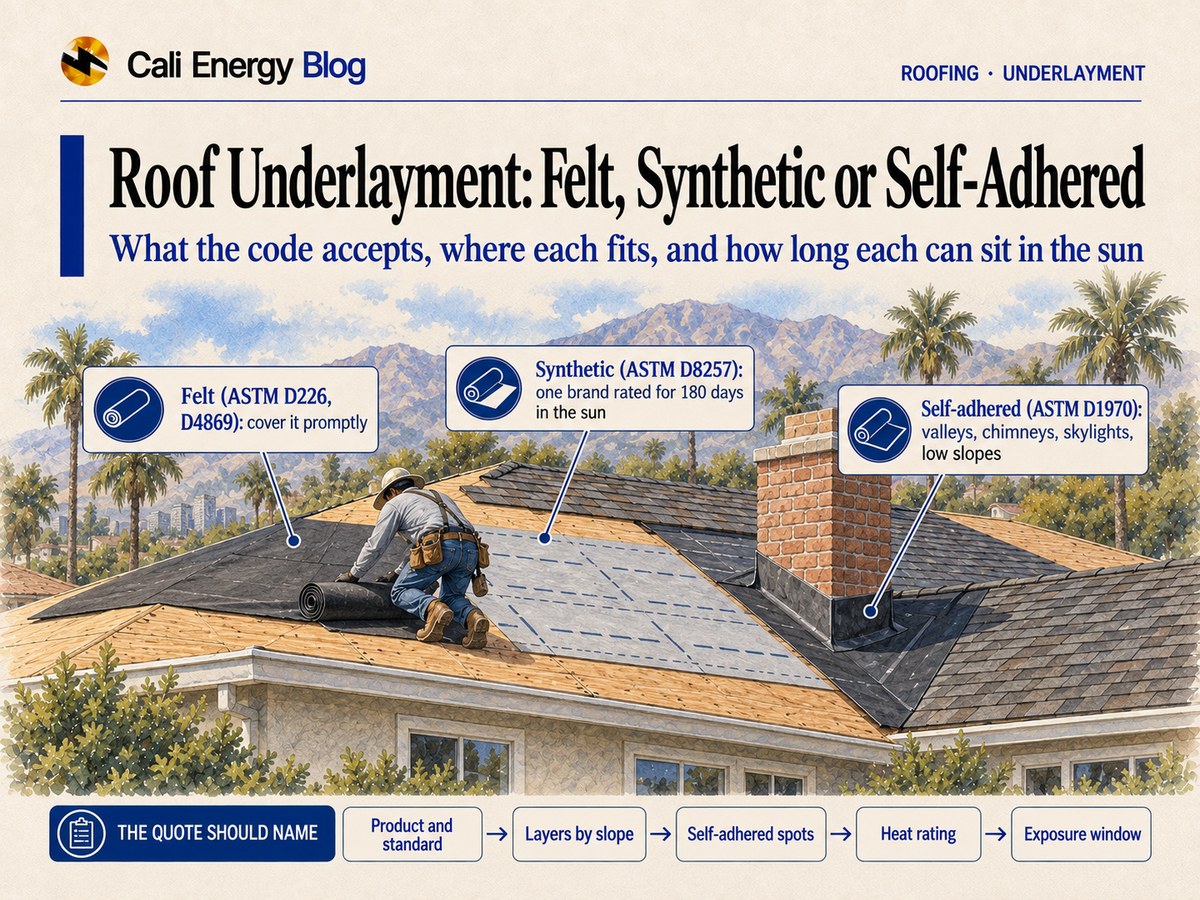
The three types, side by side
Underlayment is the sheet between the deck and the roof covering. The Asphalt Roofing Manufacturers Association lists what it does: it's a second line of protection against wind-driven rain, keeps the deck dry until the shingles go on, is part of the tested assembly that earns a fire classification, and helps keep the outline of deck panels from showing through.
| Felt | Synthetic | Self-adhered membrane | |
|---|---|---|---|
| What it is | Organic felt saturated with asphalt, or felt containing inorganic fibers | A polymeric sheet fastened to the deck | Polymer-modified asphalt sheet with an adhesive back, stuck to the deck |
| Standards the code lists | D226 Type I (No. 15) or Type II (No. 30), D4869, D6757; under tile, D226 Type II | D8257 | D1970 |
| Attachment | Fasteners | Fasteners, per the maker's instructions | Adheres to the deck; D1970 includes a test of sealing around nails |
| Time in the sun before roofing | The felt standards don't test weathering; cover it promptly | Up to 180 days for Owens Corning Deck Defense | Up to 30 days for Owens Corning WeatherLock Flex; 120 days for GCP's Ice & Water Shield HT |
| Heat | Check the maker's limits | Check the maker's limits | High-temperature grades exist for metal roofs; GCP's HT is rated to 260°F |
| Moisture | Not on ARMA's list of sheets that can hold vapor in | D8257 measures vapor transmission; check the product | Can trap moisture where the deck isn't properly ventilated, ARMA warns |
The standards also test different things. Owens Corning, which led the effort to write D8257, lists the tests it requires that the felt standards D226 and D4869 don't: fastener pull-through, water vapor transmission, accelerated weathering, dimensional change, hydrostatic resistance and thermal cycling. Synthetics used to be qualified against the felt standards, which were written for asphalt felt.
What the code requires
- A labeled product. Underlayment is required under shingles, tile, metal and most other steep-slope coverings, and products made to the listed standards have to carry a label showing the standard and type (CRC 2025, R905.1.1).
- Layers by slope. Under shingles, one layer on slopes of 4:12 and steeper, lapped 2 inches; two layers from 2:12 up to 4:12; or, instead, a single layer of D1970 self-adhered membrane installed per the underlayment and shingle makers' instructions for the deck, the roof's ventilation and the climate (Table R905.1.1(2)). Under tile, a double layer from 2½:12 up to 4:12 (R905.3.2).
- Fastening. Where the code's wind map doesn't require wind design, shingle underlayment is fastened enough to hold it in place (Table R905.1.1(3)).
- Fire class belongs to the assembly. A shingle doesn't carry a fire classification by itself, ARMA notes; the deck, underlayment, covering and fasteners do together. Owens Corning's Deck Defense, for example, is Class A only under asphalt shingles. Under tile in a wildfire zone, the code can call for a cap sheet or a listed Class A underlayment, as covered in when to replace tile roof underlayment.
The rest of a re-roof's checklist, from drip edge to valleys, is in California re-roof code requirements, and why Los Angeles roofs rarely need an ice barrier is in parts of a roof.
Where each fits on a Los Angeles roof
- The field under shingles. Felt or synthetic, both on the code's list. A synthetic rated for months of exposure suits a job where the roofing may not go on right away; felt should be covered promptly.
- Valleys, walls and openings. ARMA's manual names the places self-adhered membrane is commonly used: eaves, rakes, valleys, around skylights and chimneys, dormers, slope transitions and low-slope areas, and, in warmer climates, wherever leaves and pine needles can dam up water.
- Under tile. The tile list above, doubled on shallow slopes. When a tile roof's underlayment is due is covered in when to replace tile roof underlayment.
- Under metal. A high-temperature self-adhered membrane or what the panel maker specifies; GCP rates its HT membrane for standing seam metal, tile, slate and shakes. More on metal in standing seam vs exposed-fastener metal roofs.
- Self-adhered over the whole deck. The code allows it, but it can act as a vapor retarder; ARMA says to consult the maker, and the code ties the installation to the roof's ventilation.
What we've seen
On a 2024 Canoga Park re-roof, a complete tear-off of 18 squares, the shingles went over synthetic underlayment with self-adhering membrane at the vulnerable details (the Canoga Park case). On a Chatsworth clay tile roof in 2025–2026, we stripped the tile and underlayment from 17 squares where the solar array would go and laid synthetic underlayment and shingle there, reinstating the tile around it (the Chatsworth case).
What the quote should say
1. The product and its standard, as printed on the label.
- Layers by slope, including any sections between 2:12 and 4:12, or 2½:12 and 4:12 under tile.
- Where self-adhered membrane goes: valleys, chimney, skylights, sidewalls, low-slope sections.
- The heat rating of the membrane under metal or tile.
- The exposure window the maker allows, against the job's schedule.
- The fire classification of the covering with this underlayment, if your area requires Class A.
Frequently asked
Is synthetic underlayment better than felt?
Do I need ice and water shield in Los Angeles?
How long can underlayment be left exposed?
What underlayment goes under a tile roof?
Can a whole roof be covered in self-adhered membrane?
Related reading
Sources & methodology
Code sections, rules and figures on this page come from the primary sources below. Codes, local requirements and product terms change; each was verified October 8, 2026.
- California Residential Code 2025, Chapter 9 Roof Assemblies, R905.1.1 with Tables R905.1.1(1)–(3), and R905.3.2 (UpCodes)
- ASTM International, D8257/D8257M, Standard Specification for Mechanically Attached Polymeric Roof Underlayment Used in Steep Slope Roofing
- Asphalt Roofing Manufacturers Association, Residential Asphalt Roofing Manual, 2014 edition (Chapters 1 and 7)
- Owens Corning, New ASTM Standard Replaces Felt Standards for Qualification of Synthetic Underlayments (Pub. No. 10024756, 2021)
- Owens Corning, Deck Defense High Performance Roof Underlayment data sheet (Pub. No. 10010926-K, June 2025)
- Owens Corning, WeatherLock Flex Ice & Water Barrier data sheet (Pub. No. 10009579-O, December 2025)
- GCP Applied Technologies, Grace Ice & Water Shield HT data sheet
We name the underlayment, layer by layer, in the quote
Call (323) 844-7777. We look at the roof's slope, covering, valleys, walls and penetrations, and write into the quote which underlayment goes where, the standard on its label, the number of layers and where self-adhered membrane goes. Have ready the address and, if you have one, the quote you're comparing.
Prepared by Cali Energy, October 8, 2026. This article is for general educational purposes only and is not legal, tax, financial, engineering, or utility advice. Rates, incentives, codes, permit requirements, equipment specifications, prices, and program terms may change; figures and timelines are estimates, not guarantees. Confirm current requirements with the applicable utility, AHJ, program administrator, manufacturer, or a licensed professional. See our Content Disclaimer. Cali Energy · 19201 Parthenia St, Unit E, Northridge, CA 91324 · CSLB #1032379 (B, C-10, C-39)