

Coastal Roofing: What Holds Up to Salt Air in LA
Salt air goes after metal, so on a roof near the ocean the question is less the covering than the metal that holds it down and edges it: nails, clips, flashing, drip edge, vents and gutters, and the panels themselves on a steel roof. FEMA's technical bulletin on corrosion says salt spray is heaviest near breaking waves and falls off quickly over the first 300 to 3,000 feet inland, though faster corrosion has been measured 5 to 10 miles in. For roofs within 3,000 feet of the ocean, FEMA's coastal construction guide recommends stainless steel nails for shingles and stainless steel clips, straps and fasteners on tile and metal roofs. Read the warranty as well: Metal Sales' Galvalume warranty doesn't apply within 1,500 feet of salt water, and CertainTeed and Owens Corning warn that copper from algae-resistant shingles can corrode aluminum gutters in some coastal or low-rainfall areas, CertainTeed naming parts of the Southern California coastline.
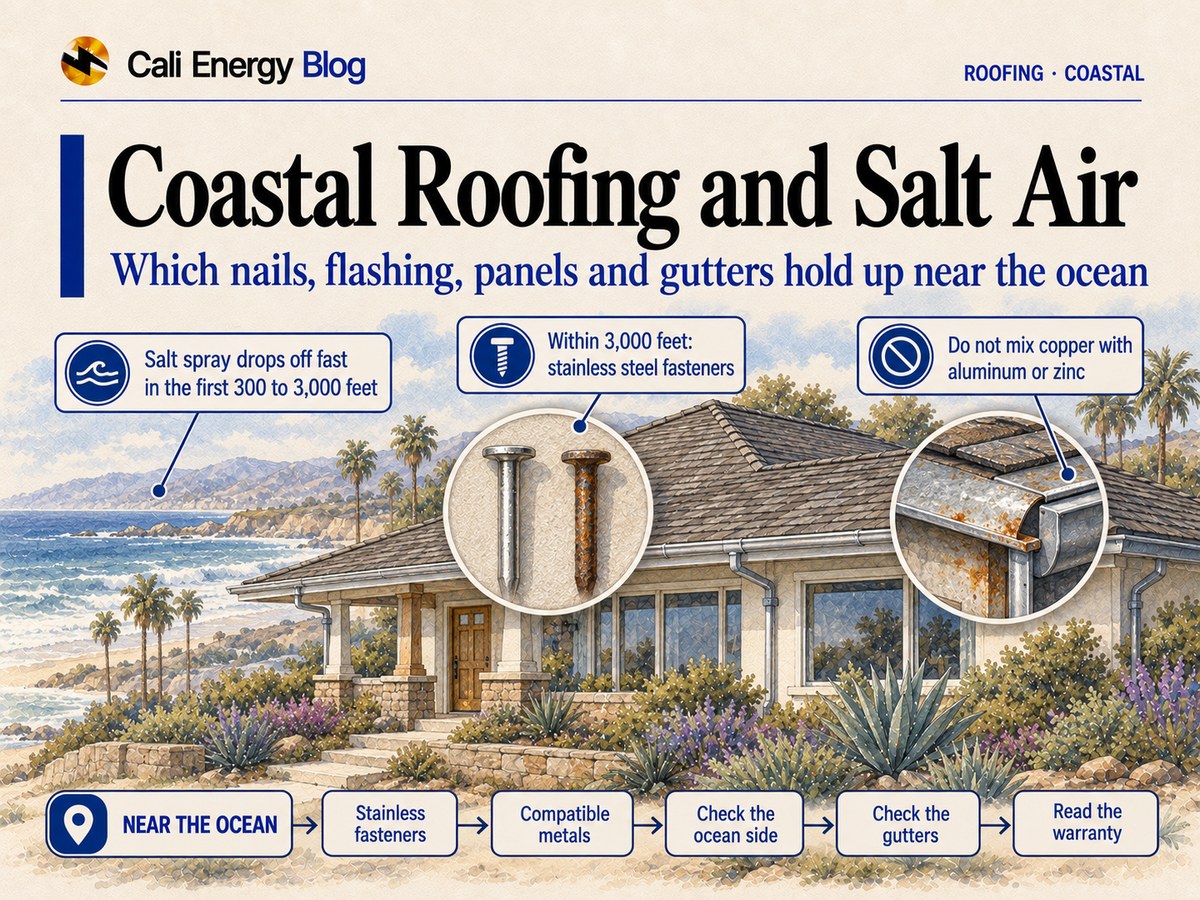
How far inland salt air reaches
FEMA's NFIP Technical Bulletin 8 (June 2019) is written for structural connectors in flood zones, but its account of salt corrosion applies to any exposed metal:
- Distance. Salt spray is greatest near breaking waves and declines rapidly in the first 300 to 3,000 feet landward of the shoreline. Studies it cites found accelerated corrosion as far inland as 5 to 10 miles; farther in, rates are like those in milder inland conditions.
- Close to the water, much faster. In tests in North Carolina in the 1940s, iron corroded 10 times faster 80 feet from the shoreline than 800 feet from it.
- Wind. Onshore winds carry salt and moisture inland, so shorelines with mostly onshore winds see more corrosion. At Los Angeles International Airport and Santa Monica Airport, the prevailing wind blows from the west-southwest and southwest, off the ocean, in most months, according to the Western Regional Climate Center's 1992–2002 records.
- Which side. Metal on the side of a building facing the ocean corrodes much faster than on the side facing away.
- Sheltered spots. Partly sheltered metal, such as under roof overhangs, can corrode faster than metal in the open, because rain doesn't rinse the salt off and it stays damp longer. There, thinly galvanized light-gauge connectors can be significantly weakened in 5 to 10 years or sooner.
The bulletin groups buildings as oceanfront and the next two rows, intermediate rows in corrosion-prone areas, and buildings farther landward, more than 3,000 feet from the shoreline. It recommends stainless steel connectors and fasteners on exposed metal of oceanfront buildings, thicker galvanizing with stainless steel as best practice in the intermediate rows, and code-required galvanizing farther landward, with thicker galvanizing or stainless steel as best practice there too. It also notes that the width of the corrosion-prone area varies and is best judged from field observations and the local building department.
Part by part: the code minimum and the coastal choice
The California Residential Code sets the minimum everywhere; FEMA's coastal guide and the manufacturers add what matters near salt water.
| Part | Code minimum (CRC 2025) | Near the ocean |
|---|---|---|
| Shingle nails | Galvanized steel, stainless steel, aluminum or copper roofing nails (R905.2.5) | Stainless steel nails within 3,000 feet of salt water (FEMA P-499, sheet 7.3) |
| Underlayment fasteners | Under shingles, fastened enough to hold it in place where wind design isn't required (Table R905.1.1(3)) | Stainless steel or hot-dip galvanized within 3,000 feet of salt water (FEMA P-499, sheet 7.2) |
| Tile fasteners, clips and straps | Corrosion-resistant nails at least 11-gage; tile wire at least 0.083 inch (R905.3.7) | Stainless steel within 3,000 feet of the ocean (FEMA P-499, sheet 7.4); hot-dip galvanized or stainless steel (FEMA P-2181) |
| Steel roof panels | Coatings such as Galvalume AZ50 or galvanized G-90, paint over those coatings (R905.10.3) | Check the warranty's salt-water distance; aluminum panels are often chosen for coastal sites (Metal Construction Association) |
| Metal panel clips and fasteners | Galvanized fasteners on steel roofs if the maker gives none; stainless steel acceptable on metal roofs (R905.10.4) | 300-series stainless steel within 3,000 feet of the ocean (FEMA P-499, sheet 7.6); stainless steel or aluminum on aluminum panels (MCA) |
| Flashing | Corrosion-resistant metal at least 0.019 inch thick (R903.2.1) | Keep it compatible with the metals it touches (MCA) |
| Gutters | No roofing rule | With algae-resistant shingles in salt-fog areas, vinyl or copper rather than aluminum (CertainTeed); vinyl (Owens Corning) |
The coverings near the ocean
Clay and concrete tile. Tile isn't metal; its weak points near the coast are the nails, clips, wire and flashing. Eagle Roofing's concrete tile warranty, for example, excludes damage caused by corrosives and the failure of other materials used as roof components, so corroded fasteners or flashing aren't the tile maker's to cover. How the two tiles differ is in clay vs concrete roof tile.
Asphalt shingles. The code allows galvanized, stainless steel, aluminum or copper nails; FEMA's coastal guide recommends stainless steel within 3,000 feet of salt water. Algae-resistant shingles carry copper-bearing granules, and both CertainTeed and Owens Corning warn that the copper can corrode aluminum gutters in coastal or low-rainfall areas, and disclaim the damage if aluminum gutters are used.
Metal. Steel panels rely on a metallic coating, usually Galvalume or galvanizing, and paint. Metal Sales' AZ55 Galvalume warranty doesn't apply in areas within 1,500 feet of salt water, marine atmospheres or salt spray; other makers set their own lines, and how the paint warranties compare is in standing seam vs exposed-fastener metal roofs. The Metal Construction Association notes that aluminum panels are often installed where corrosion is severe, coastal sites among them, and that aluminum moves about twice as much as steel with temperature, so its fastening has to allow for it.
Don't mix the metals
Where two different metals touch, or water runs from one onto another, the Metal Construction Association warns of galvanic corrosion:
- Copper on zinc. Copper, or water running off copper, quickly corrodes zinc and zinc alloys, the coatings on galvanized and Galvalume steel. Watch copper plumbing, HVAC lines and electrical parts that touch the roof or drain onto it.
- Copper on aluminum. The worst corrosion of aluminum comes from copper or its runoff, which is the reason behind the gutter warnings above.
- Aluminum and steel. Keep uncoated aluminum away from steel where moisture is present, and fasten aluminum panels with stainless steel or aluminum.
What to check on a roof near the ocean
1. The ocean-facing side first, then the rest: nail heads, clips, flashing, drip edge and vent caps for rust or pitting.
- Sheltered metal under overhangs and at eaves, which the rain doesn't rinse.
- The gutters, especially aluminum gutters under algae-resistant shingles.
- The attic near the vents. FEMA's bulletin notes that metal near attic vents, where outside air comes in, can corrode about as fast as metal under overhangs, while metal away from the vents or under insulation corrodes much more slowly.
- The warranty paperwork: the coastal terms for the exact covering, coating and paint, and the measured distance from the house to the water.
How long each covering lasts, with or without salt air, is in how long a roof lasts by material, and the wider choice of covering in the best roofing materials for Southern California.
Frequently asked
How close to the ocean does salt air affect a roof?
What roofing nails should be used near the ocean?
Is a metal roof a good idea near the beach?
Can I use aluminum gutters near the ocean?
Does tile hold up to salt air?
Related reading
Sources & methodology
Code sections, rules and figures on this page come from the primary sources below. Codes, local requirements and product terms change; each was verified October 8, 2026.
- FEMA, NFIP Technical Bulletin 8, Corrosion Protection for Metal Connectors and Fasteners in Coastal Areas (June 2019)
- FEMA P-499, Home Builder's Guide to Coastal Construction (December 2010), sheets 7.2, 7.3, 7.4 and 7.6
- FEMA P-2181, Hurricane and Flood Mitigation Handbook for Public Facilities, 3.3.1 Roof Systems—Sloped Roofs (March 2022)
- California Residential Code 2025, Chapter 9 Roof Assemblies, R903.2.1, Table R905.1.1(3), R905.2.5, R905.3.7, R905.10.3 and R905.10.4 (UpCodes)
- Metal Construction Association, Metal Roof Installation Manual, Chapter 3
- Metal Sales, AZ55 Galvalume Warranty
- CertainTeed, Asphalt Shingle Residential Products 2026 Limited Warranty (05/26)
- Owens Corning, Standard Product Limited Lifetime Warranty on Roofing Shingles and Components (Pub. No. 10023873-I, August 2026)
- Eagle Roofing Products, Transferable Limited Lifetime Product Warranty, sample (October 2024)
- Western Regional Climate Center, Prevailing Wind Direction (hourly data, 1992–2002)
We spec a coastal roof down to the nails and gutters
Call (323) 844-7777. We look at the roof's metal, from nails and clips to flashing, drip edge, vents and gutters, note what's corroding and on which side, and quote the covering with fasteners and metals suited to salt air and the warranty's coastal terms in writing. Have ready the address and roughly how far the house is from the water.
Prepared by Cali Energy, October 8, 2026. This article is for general educational purposes only and is not legal, tax, financial, engineering, or utility advice. Rates, incentives, codes, permit requirements, equipment specifications, prices, and program terms may change; figures and timelines are estimates, not guarantees. Confirm current requirements with the applicable utility, AHJ, program administrator, manufacturer, or a licensed professional. See our Content Disclaimer. Cali Energy · 19201 Parthenia St, Unit E, Northridge, CA 91324 · CSLB #1032379 (B, C-10, C-39)