

Does a New Roof Lower Your Electric Bill?
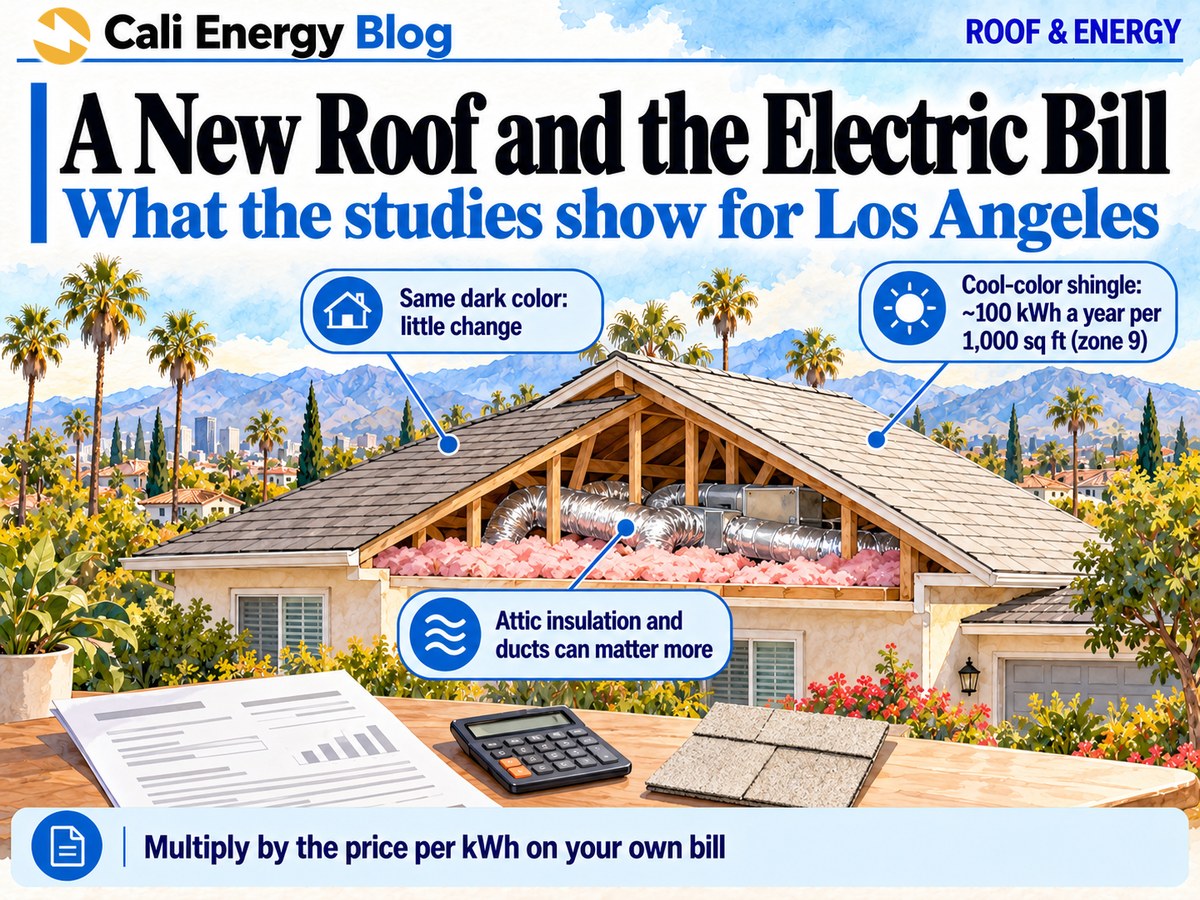
Mainly through what changes with it. The savings in the studies come from two things that can be done in the same job: a covering that reflects more sunlight, and insulation and attic work, such as air sealing and the ducts; a new roof in the same dark color reflects about as much sunlight as the old one. For a cool-color shingle over a vented attic in climate zone 9, which covers most of the Los Angeles basin and the San Fernando Valley, Lawrence Berkeley National Laboratory's California figures put the cooling saved at about 100 kWh a year for every 1,000 square feet of roof, with a slight rise in winter heating; near the coast it's about a fifth of that. A cool-color tile or metal roof saves somewhat more, a white one more again, and a thinly insulated attic or ducts in the attic generally make the effect larger. The Los Angeles figures here are modeled; the measured results come from Sacramento and Florida. This page sets out the evidence as of October 2026.
Which colors keep a roof cooler is in the best roof color for a hot climate, and how to read a product's rating in cool roof shingles and CRRC ratings.
What part of a re-roof changes the bill
The roof's color and the attic under it decide how much summer heat reaches the rooms. Attic ventilation moves some of that heat out too; the code minimum and when more helps are in attic ventilation requirements.
| Change | What the studies found | Conditions |
|---|---|---|
| A cool-color shingle, reflectance about 0.15 higher | About 22 kWh of cooling a year per 1,000 sq ft of roof in coastal climate zone 6, 91 in zone 8, 103 in zone 9 and 171 in the Antelope Valley's zone 14, with 1.4, 2.5, 2.1 and 4.9 more therms of heating | LBNL draft tables (2009) from the 2008 Title 24 study, standard insulation; roughly 35 to 40% less with a radiant barrier in the attic |
| A cool-color tile or metal roof, reflectance about 0.25 higher | Tile: about 28, 117, 136 and 232 kWh per 1,000 sq ft of roof in zones 6, 8, 9 and 14, with 2.3, 3.8, 3.3 and 7.8 more therms. Metal: about 41, 167, 188 and 308 kWh, with 3, 4, 4 and 8 more therms | Same LBNL tables and conditions |
| A white tile or metal roof, reflectance about 0.65 to 0.75 | About 1,200 to 1,380 kWh a year for white tile (17 to 20% of cooling) and 1,610 for white metal (23%), against 300 kWh (4%) for a white shingle | Per average-size South Florida home of about 1,770 sq ft, estimated from side-by-side test homes in Fort Myers with R-19 ceilings and ducts in the attic; not per 1,000 sq ft of roof, and a much longer cooling season than Los Angeles |
| Air sealing the house and insulating to code | About 14% of heating and cooling costs, 8% of the total energy bill, in the climate zone that includes Los Angeles County | ENERGY STAR modeling of a typical 1970–89 U.S. home: leaks cut by a quarter, insulation brought to 2012 code levels |
| Ducts in a vented attic | They raise heating and cooling energy by about 10%, and duct leakage commonly exceeds 20% of airflow | U.S. Department of Energy, Building America |
| A radiant barrier | About 40% less heat flowing from the attic into the house, typically 8 to 12% of annual cooling costs | Building America Solution Center; much less over deep insulation, more where ducts are in the attic; see radiant barriers in Los Angeles attics |
These figures are for a pitched roof over a vented attic. To get a rough number for your house from the LBNL rows, multiply the figure for your zone and covering by the roof area in thousands of square feet that isn't under solar panels (roof area, not floor area; it's on the roofing estimate), since panels already shade the roof under them; how they do is in solar panels and attic heat. Then multiply by the price you pay per kWh in summer, and subtract the extra heating: therms at your gas price, or a small kWh increase if you heat with a heat pump. A 2,000 sq ft roof in zone 9 going to a cool-color shingle comes to about 206 kWh of cooling a year and about 4 therms of extra heating; with 1,300 sq ft of it under panels, about 72 kWh.
On a flat roof with little or no insulation, a white membrane or coating changes cooling much more: a white coating cut cooling 43% in a flat-roofed Florida house with no attic insulation and ducts above the ceiling, and for attic-less, uninsulated flat roofs the same study's model predicted about 26% in Miami. When more than half of a low-slope roof is replaced, the cool-roof minimums in most Los Angeles climate zones effectively call for white or a very light surface; the options are in flat roof options in Los Angeles.
Why the percentages you see vary so much
A reflective roof can be quoted as anything from 4% to 80%, depending on the roof, the house and what was measured.
- "11 to 27 percent." The EPA cites peak cooling demand 11 to 27% lower in air-conditioned homes with a cool roof. The study behind it simulated a single-story house with a flat, thinly insulated roof (about R-7) whose reflectance rose from 0.2 to 0.85, a bright white coating, in five climates abroad, from Abu Dhabi to Tokyo; it's peak cooling load, not the bill and not Los Angeles.
- "80 percent." A Sacramento house measured in 1991 and 1992 saved 2.2 kWh a day in summer, 80% of its cooling use, after a white coating went on the roof. Its cooling use was small to begin with, so the percentage is large and the kWh are not.
- "58 percent." In a 1998 Florida Solar Energy Center and LBNL model of an existing house on the study's Los Angeles weather, with R-11 in the ceiling and ducts in the attic, a new white roof cut air-conditioning energy 58%; the house used only about 500 kWh a year for cooling. A light shingle that weathered to a reflectance of 0.175 cut it about 7%.
- "At most 8 percent." LBNL's 2019 modeling across California's 16 climate zones found that raising a home's roof reflectance from 0.10 to 0.40 cut its heating and cooling (HVAC) source energy by at most 8%, in the oldest homes in the San Diego zone.
What moves the result most is the house. Savings shrink as ceiling insulation grows and rise when ducts and the air handler sit in the attic: across 11 Florida homes whose roofs were coated white, the cut in cooling ranged from 2% in a house with R-19 in the attic to 43% in a flat-roofed house with no attic insulation. The Department of Energy's Building America program says the same about homes with ducts in the attic or less insulation.
Insulation or a reflective roof
In the same 1998 model of an existing house on Los Angeles weather, with gas heat, adding R-11 of ceiling insulation cut air-conditioning electricity about 22%: three times what a light shingle did (about 7%), but less than a white tile or metal roof (about 58% new, about 30% once weathered). Counting gas heating at 1996 national prices, the insulation came out slightly ahead on the combined heating and cooling cost (about 15% against 13% for a new white roof), because it lowered heating while the white roof raised it a little. The study found the balance depends on how much cooling a house needs against heating: the bigger the cooling load, the more the reflective roof gains.
- What can go with the re-roof. Air sealing the attic floor before adding insulation, since fibrous insulation isn't an air seal, and sealing the ducts that run through the attic or burying them in insulation. What the code asks for when the attic is opened is in attic insulation when you replace the roof.
- The two work together. A cool-color covering saves less over a well-insulated attic, and more over a thinly insulated one with ducts.
In Los Angeles the color may be decided for you
A re-roof that replaces more than half the roof often has to meet a cool-roof minimum anyway. California's Energy Code sets one for re-roofs in several climate zones, including zone 9, with alternatives such as more attic insulation. The City of Los Angeles adds its own rule for all its climate zones (LAMC 99.04.106.5), which accepts none of the state's alternatives, such as added attic insulation, and exempts a roof replacement where solar is being installed; that lifts only the city's rule, and the state's still applies. LADBS's express re-roof permit asks for a CRRC-labeled cool roof product on a residential replacement over half the roof without repeating that exception, so confirm with LADBS first. When each rule applies is in the cool roof requirement on a re-roof.
Before you count on savings
1. Know your climate zone. Zone 9 and the Antelope Valley gain several times what the coast does.
- Look in the attic. How deep the insulation is, and whether the ducts and air handler are up there, change the answer more than the shingle line does.
- Use the aged rating. Reflectance fades, and white surfaces can lose up to a fifth of it in two years; the Department of Energy says savings should be based on long-term values. The California Energy Commission notes that rating conditions may not reflect seasonal energy performance.
- Don't replace a sound roof for the color alone. LBNL and the Department of Energy both say it's rarely economical; choose a cool covering when the roof is due anyway. Cool asphalt shingles cost about the same as conventional ones, according to the Department of Energy.
- Price it with your own rate. Use the price you pay in summer, at the tier or time of day when the air conditioner runs; LADWP, SCE and city utilities bill in different ways, and how to read your electric bill shows where to find it.
Frequently asked
How much does a cool roof save on electricity in Los Angeles?
Will a new roof in the same color lower my bill?
Is attic insulation or a cool roof better for the electric bill?
Does a cool roof raise the heating bill?
Where does the 11 to 27 percent figure come from?
Related reading
Sources & methodology
Code sections, rules and figures on this page come from the primary sources below. Codes, local requirements and product terms change; each was verified October 15, 2026.
- Lawrence Berkeley National Laboratory, Heat Island Group, Cool Roof Q&A (draft, July 29, 2009), climate-zone tables
- Lawrence Berkeley National Laboratory, Heat Island Group, Cool Science: Cool Roofs
- U.S. Environmental Protection Agency, Using Cool Roofs to Reduce Heat Islands (updated June 18, 2026)
- Synnefa, Santamouris and Akbari, Energy and Buildings 39 (2007) 1167–1174
- Akbari, Bretz, Kurn and Hanford, Peak power and cooling energy savings of high-albedo roofs, Energy and Buildings 25 (1997)
- Parker and others, Measured and Simulated Performance of Reflective Roofing Systems in Residential Buildings, ASHRAE Transactions (1998),…
- Parker, Sonne and Sherwin, Comparative Evaluation of the Impact of Roofing Systems on Residential Cooling Energy Demand in Florida, FSEC-CR-1220-00
- Rosado and Levinson, Energy and Buildings 199 (2019) 588–607, doi 10.1016/j.enbuild.2019.02.028
- Building America Solution Center, Cool Roofs and Walls to Reduce Heat Gain (updated March 10, 2023)
- Building America Solution Center, Attic Radiant Barriers (updated December 4, 2022)
- Building America Solution Center, Attic Air Sealing and Insulation
- Building America Solution Center, Ducts Buried in Attic Insulation
- U.S. Department of Energy, Consumer Guide to Cool Roofs (DOE/EE-2478)
- U.S. Department of Energy, Unvented, Conditioned Attics: Building America Top Innovation
- U.S. Department of Energy, Building America Guide to Determining Climate Regions by County
- ENERGY STAR, Methodology for Estimated Energy Savings from Cost-Effective Air Sealing and Insulating
- California Energy Commission, 2025 Building Energy Efficiency Standards (Title 24, Part 6), CEC-400-2025-010, section 150.2(b)1I
- California Energy Commission, Energy Efficient Cool Roofs, Single-Family Residential (2022 Standards)
- California Energy Commission, 2025 Single-Family Residential Compliance Manual, Chapter 3
- Los Angeles Municipal Code, Section 99.04.106, including 99.04.106.5 (as amended by Ordinance 187,208)
- LADBS, Express Permits (No Plan Check Required), Information Bulletin P/GI 2026-003
We check the attic and the color rule when we price the roof
Call (323) 844-7777. We look at how deep the attic insulation is and where the ducts run, tell you which cool-roof rule applies to your address, and note each covering's rating on the estimate. Even after we see the attic, any saving is an estimate from studies like these, not a promise. Have ready the address and, if you can, photos of the attic.
Prepared by Cali Energy, October 15, 2026. This article is for general educational purposes only and is not legal, tax, financial, engineering, or utility advice. Rates, incentives, codes, permit requirements, equipment specifications, prices, and program terms may change; figures and timelines are estimates, not guarantees. Confirm current requirements with the applicable utility, AHJ, program administrator, manufacturer, or a licensed professional. See our Content Disclaimer. Cali Energy · 19201 Parthenia St, Unit E, Northridge, CA 91324 · CSLB #1032379 (B, C-10, C-39)