

What Roof Color Is Best for Los Angeles Heat?
The lightest color you're willing to live with, in a product rated as a cool roof. What keeps a roof cool in the sun is how much sunlight its surface reflects, and color drives most of that. Lawrence Berkeley National Laboratory's Heat Island Group puts a clean white roof that reflects 80% of sunlight about 55°F cooler on a summer afternoon than a gray roof that reflects 20%. Going white isn't the only way to gain: "cool-colored" pigments reflect the invisible near-infrared part of sunlight, so a cool-colored roof that reflects 35% stays about 22°F cooler than a roof of the same look that reflects 10%. In air-conditioned homes, the EPA cites cool roofs cutting peak cooling demand by 11 to 27%. In Los Angeles, color is also a code question: replacing more than half of a roof usually requires a cool-rated color, and the City of Los Angeles sets a higher bar than the state.
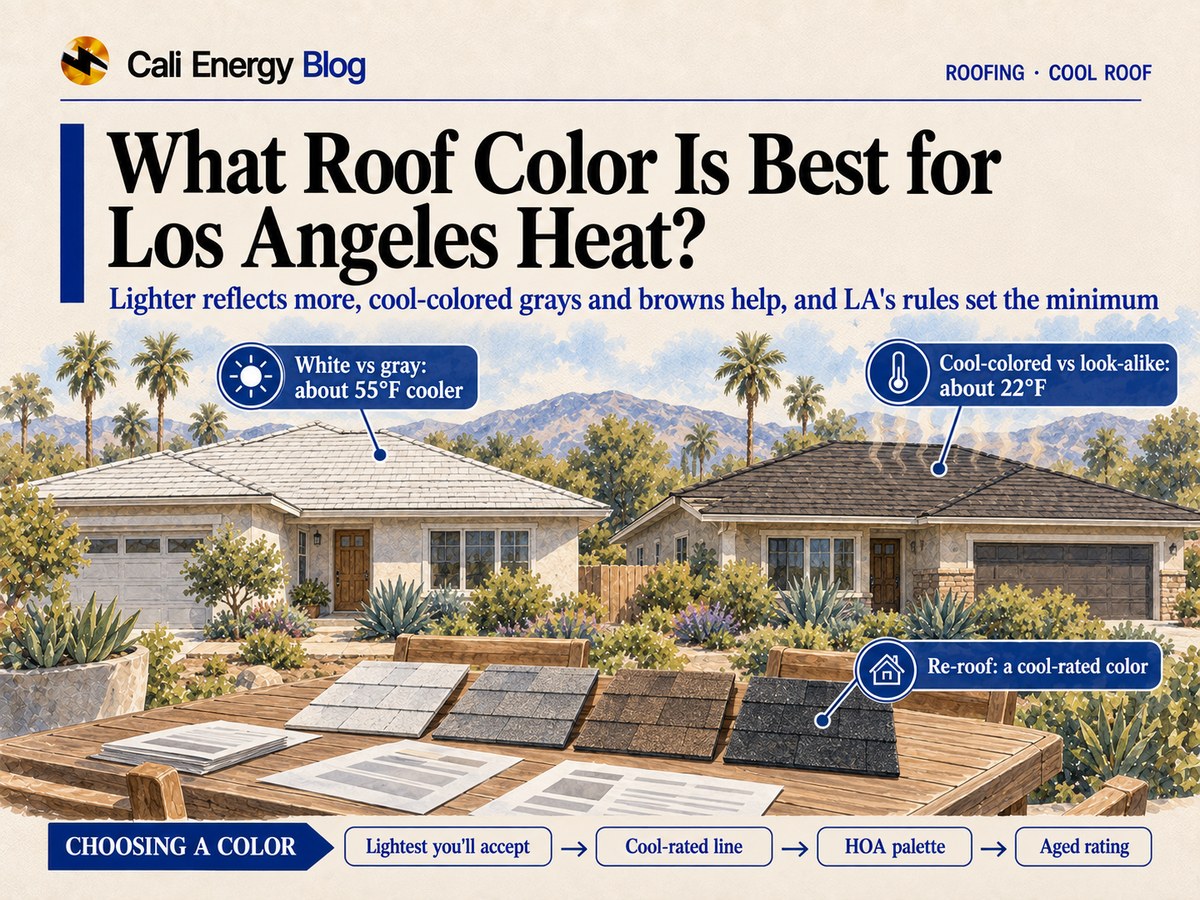
How much the color changes the heat
The figures come from federal research on cool roofs; what a particular house gains depends on its insulation, ventilation and how much it's air-conditioned.
| Comparison | Difference | Source |
|---|---|---|
| A clean white roof reflecting 80% of sunlight vs a gray roof reflecting 20% | About 55°F (31°C) cooler on a typical summer afternoon | LBNL Heat Island Group |
| A cool-colored roof reflecting 35% vs a look-alike reflecting 10% | About 22°F (12°C) cooler | LBNL Heat Island Group |
| A black roof vs a white roof, measured side by side | The black roof 54°F (30°C) warmer on a summer afternoon | LBNL, from a U.S. Department of Energy photo |
| Air-conditioned homes with a cool roof | Peak cooling demand 11 to 27% lower | EPA |
| Homes without air conditioning | Maximum indoor temperature 2.2 to 5.9°F lower | EPA |
What makes a color "cool"
Two properties do the work. Solar reflectance, the share of sunlight a surface sends back, is the most important one, the EPA says; thermal emittance, how readily the surface sheds the heat it does absorb, matters too, especially in warm, sunny climates. About half of the sun's energy arrives as near-infrared light that the eye can't see. Traditional dark roofs absorb it; cool-colored roofs look the same but reflect more of it, which is how a gray or brown can be cooler than it looks.
Both properties are measured new and again after three years outdoors, and the aged numbers are the ones that count, because dirt and weathering lower reflectance. How to read those ratings is in CRRC cool roof ratings.
Color by roof type in Los Angeles
- Shingles. Cool-rated lines come in grays, browns and tans as well as light colors. The rated colors we've looked at have aged reflectances from about 0.20 to 0.35; LBNL's example of a traditional dark roof reflects only 10%, which is why the choice narrows on a re-roof.
- Tile. The EPA lists terra cotta tile as naturally cool, and light, cool-glazed or reflective-coated tiles as alternatives; tile colors are rated the same way as shingles.
- Flat roofs. White single-ply membranes and coatings are the usual choice where the roof can't be seen from the street, and the minimums for low-slope roofs effectively call for white or a very light color; the options are in flat roof options in Los Angeles.
- Metal. Panels and shingles come with reflective paints or granules.
What the rules ask for on a re-roof
Replacing more than half of a steep-slope roof brings in a minimum, measured on the aged values: under California's energy code, in climate zones that cover most of the Los Angeles basin and San Fernando Valley, an aged solar reflectance of at least 0.20 with an emittance of 0.75, or an SRI of 16; in the City of Los Angeles, 0.25 with 0.85, or an SRI of 20. The details, including the state's alternatives such as added attic insulation, are in the cool-roof requirement on a re-roof and CRRC cool roof ratings.
The trade-offs
- Glare. LBNL notes that a bright white or silvery roof on a low house can bother people in taller buildings next door; a cool-colored, non-white roof is the alternative.
- Dirt. Reflectance drops as a roof weathers, which the aged ratings already account for.
- Winter. A cool roof can raise heating use in cold climates; the EPA says this "heating penalty" is typically offset by the summer savings, and good insulation reduces it.
- HOA palettes. An association can limit colors; what an HOA can require explains how far that goes.
- Solar. Panels cover part of the roof, and the City of Los Angeles exempts a roof replacement where solar is being installed from its cool-roof rule.
What we've seen on our jobs
Gray is where most owners run into the rule. On our 2024 re-roof in Canoga Park, in the City of Los Angeles, not one gray in the first shingle line we priced cleared the city's threshold; the only color in that line that did was a sandy tone, and a cool-rated line made in gray, Owens Corning's Duration COOL Plus in Mystic Gray, solved it (the Canoga Park case). On a partial tile-to-shingle switch in Chatsworth, the shingle came from a cool-roof approved line in a shade picked to sit against the tile (the Chatsworth case).
Frequently asked
Is a white roof worth it on a house?
Does a dark roof make the house hotter?
Will a cool roof lower my electric bill?
What color does Los Angeles require?
Do light roofs stay light?
Related reading
Sources & methodology
Code sections, rules and figures on this page come from the primary sources below. Codes, local requirements and product terms change; each was verified October 7, 2026.
- Lawrence Berkeley National Laboratory, Heat Island Group, Cool Science: Cool Roofs
- U.S. Environmental Protection Agency, Using Cool Roofs to Reduce Heat Islands (last updated June 18, 2026)
- Cool Roof Rating Council, Roof Rating Program
- Los Angeles Municipal Code, Section 99.04.106, including 99.04.106.5 (as amended by Ordinance 187,208)
- Malarkey Roofing Products, Vista Technical Product Data Sheet (effective February 2026)
- DaVinci Roofscapes, DaVinci and Inspire Cool Roof Colors (CRRC ratings)
We'll show you which colors keep your roof cooler and pass the rule
Call (323) 844-7777. We check which cool-roof rule applies to your address, bring samples of the qualifying colors in the product you want, and note each one's rating on the estimate. Have ready the address and any color rules from your HOA.
Prepared by Cali Energy, October 7, 2026. This article is for general educational purposes only and is not legal, tax, financial, engineering, or utility advice. Rates, incentives, codes, permit requirements, equipment specifications, prices, and program terms may change; figures and timelines are estimates, not guarantees. Confirm current requirements with the applicable utility, AHJ, program administrator, manufacturer, or a licensed professional. See our Content Disclaimer. Cali Energy · 19201 Parthenia St, Unit E, Northridge, CA 91324 · CSLB #1032379 (B, C-10, C-39)