

How to Read Your California Electric Bill
In Los Angeles the first question is whose bill it is. SCE bills monthly, with a fixed $24.15 Base Services Charge, time-of-use prices and, in many cities, generation from a community choice provider. LADWP prices most homes in tiers that depend on your zone, the season and whether you are billed monthly or every two months, adds a Power Access Charge set by your heaviest month of the past year, and a 10% city tax. Below, both bills line by line, and how to find what a kilowatt-hour really costs you.
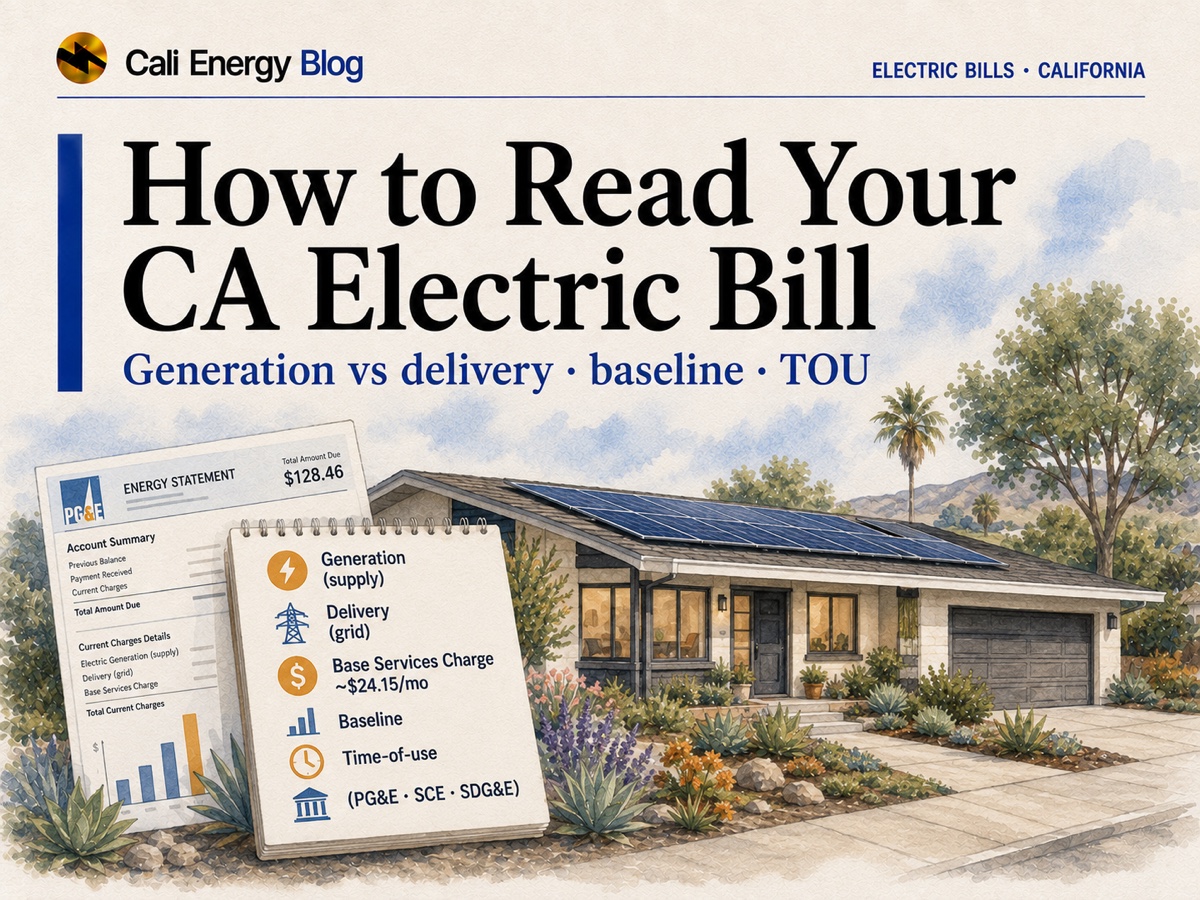
- SCE: generation plus delivery charges, a $24.15 monthly Base Services Charge, prices by hour on time-of-use plans, and a 10¢ baseline credit on the standard plans.
- CCA customers: a provider such as Clean Power Alliance supplies the generation on the same SCE bill, and SCE adds a Power Charge Indifference Adjustment.
- LADWP: three tiers by zone and season, doubled for two-month bills; a Power Access Charge from your highest month; a 10% city tax.
- Two prices per kWh: your average (total ÷ kWh) and your last kWh, which is what any change in use, an EV or solar actually moves.
First: SCE or LADWP?
| SCE | LADWP | |
|---|---|---|
| Who | Most cities around LA; parts of LA County | The City of Los Angeles |
| Energy pricing | Time-of-use plans; baseline credit on standard plans | R-1A tiers by zone and season, or opt-in R-1B time-of-use |
| Fixed charge | Base Services Charge, $24.15 a month | Power Access Charge $2.30 / $7.90 / $22.70 by tier (R-1A), or $12 a month (R-1B) |
| Tax | Local taxes vary by city | 10% City of Los Angeles tax |
| Generation | SCE, or a community choice provider | LADWP |
| State Climate Credit | Yes | No (not a CPUC-regulated utility) |
Sources: SCE Base Services Charge · LADWP residential rates · CPUC Climate Credit. Not sure which serves your address? See LA-area electric utility by city.
Reading an SCE bill
Base Services Charge
A fixed charge since November 2025: $24.15 a month, $12.08 for FERA and qualifying affordable housing, $6.00 for CARE, billed at about $0.80 a day for the days in your cycle (SCE).
Energy charges by hour
On time-of-use plans each kWh is priced by when you use it; on TOU-D-4-9PM the expensive window is 4–9 p.m. on weekdays (SCE). See SCE TOU plans compared.
Baseline credit
On TOU-D-4-9PM and 5-8PM, a credit of about 10¢ per kWh up to your baseline allocation, which depends on climate region and season; TOU-D-PRIME has none. See SCE baseline regions.
Climate Credit
A state credit from cap-and-trade: in 2026, $36.00 on the August bill and $36.00 on September’s, timed for high-bill months (CPUC).
If a community choice provider supplies your power, the bill has two parts: SCE’s delivery charges and the provider’s generation charges, consolidated on one statement. SCE also charges a Power Charge Indifference Adjustment (PCIA), which covers power SCE bought for you before the switch; Medical Baseline customers are exempt (CPUC). Solar customers get extra pages; see SCE solar billing explained.
Reading an LADWP bill
| Tier | Zone 1, monthly | Zone 1, two months | Zone 2, monthly | Zone 2, two months |
|---|---|---|---|---|
| Tier 1 | First 350 | First 700 | First 500 | First 1,000 |
| Tier 2 | Next 700 | Next 1,400 | Next 1,000 | Next 2,000 |
| Tier 3 | Above 1,050 | Above 2,100 | Above 1,500 | Above 3,000 |
Source: LADWP, residential electric rates. Zone 2 is the hotter part of the city and gets a larger Tier 1.
Prices change by season — high season is June through September. In summer 2026 the three tiers cost 26.408¢, 32.267¢ and 40.968¢ per kWh, in winter 24.771¢, 30.630¢ and 30.630¢ (LADWP rates), before the 10% city tax.
Power Access Charge. A fixed monthly charge of $2.30, $7.90 or $22.70 set by the tier of your highest month in the past 12 months and reset every October 1; a Zone 1 home that once hit 600 kWh pays the Tier 2 amount all year. R-1A also has a $10 minimum.
Time-of-use (R-1B). Optional, with no tiers: High Peak weekdays 1–5 p.m., Low Peak weekdays 10 a.m.–1 p.m. and 5–8 p.m., Base at all other times and weekends; in summer 35.124¢, 29.284¢ and 26.540¢, plus $12 a month. LADWP suggests it for homes that regularly reach Tier 3 or bank solar credits. See LADWP rates explained and LADWP net metering.
What a kilowatt-hour really costs you
Two numbers matter. Your average is the total bill divided by the kWh on it — it includes fixed charges and is what the household pays overall. Your last kWh is the price of the next unit you use, which is what an EV, a heat pump or solar actually changes.
Example, LADWP Zone 1, a summer month at 600 kWh: 350 kWh at 26.408¢ and 250 at 32.267¢ come to $173.10 in energy charges, before the Power Access Charge and tax. The last kWh costs 32.267¢, or about 35.5¢ with the 10% city tax. On SCE time-of-use, the last kWh’s price depends on the hour, which is why a 4–9 p.m. kWh and a noon kWh can differ by more than double.
For solar, take two things from the bill: 12 months of kWh (usually a chart on the statement or in the online account) and the exact rate plan name. See average home electricity use and why your bill went up.
Discounts and help
On SCE, CARE and FERA cut both energy charges and the Base Services Charge (to $6.00 and $12.08) (CPUC). LADWP runs its own low-income programs, including EZ-SAVE and Lifeline. If a bill is already past due, see what to do if you can’t pay your electric bill.
Where to go next
For what a typical bill comes to, see the average electric bill in California. Charge names and amounts follow the utilities’ current schedules and can change; check them against your own bill.
Frequently asked
What are the main parts of a California electric bill?
On SCE: generation and delivery charges for the kWh you used, a fixed Base Services Charge, taxes and any credits; with a community choice provider, its generation charges and a PCIA appear on the same bill. On LADWP: tiered or time-of-use energy charges, a Power Access Charge or service charge, and the 10% city tax.
What is the Base Services Charge on an SCE bill?
A fixed charge introduced in November 2025 under AB 205: $24.15 a month for most customers, $12.08 for FERA and qualifying affordable housing, and $6.00 for CARE, billed by the day.
What is the baseline allowance?
On SCE’s standard time-of-use plans it is a block of kWh, set by climate region and season, that earns a credit of about 10¢ per kWh; TOU-D-PRIME has no baseline credit. LADWP’s equivalent is Tier 1: 350 kWh a month in Zone 1, 500 in Zone 2.
Why are my LADWP tiers twice as big as I expected?
Because many LADWP accounts are billed every two months, and the tiers double: in Zone 1, 700 kWh of Tier 1 instead of 350.
What is the Power Access Charge on an LADWP bill?
A fixed monthly charge of $2.30, $7.90 or $22.70 on the standard rate, set by the tier of your highest month in the past 12 months and reset every October 1.
What is the PCIA on my SCE bill?
The Power Charge Indifference Adjustment, charged to customers of a community choice provider to cover power SCE bought for them before they switched. Medical Baseline customers are exempt.
When do SCE customers get the California Climate Credit in 2026?
$36.00 on the August bill and $36.00 on the September bill. LADWP customers don’t receive it.
Related reading
Sources & methodology
Figures on this page come from the primary sources below and, where noted, from Cali Energy calculations using the stated assumptions. Rates, incentives, and program terms change; each was verified October 6, 2026.
- SCE — Base Services Charge (amounts, November 2025, AB 205)
- SCE — Time-of-Use residential rate plans
- LADWP — Residential electric rates: zones, tiers, Power Access Charge, R-1B periods
- LADWP — Electric rate schedules (2026 residential prices)
- CPUC — Community Choice Aggregation FAQ (PCIA, consolidated billing)
- CPUC — California Climate Credit (2026 amounts and months)
- CPUC — CARE/FERA program
About this guide
An educational reference from Cali Energy’s research team. Charges follow the utilities’ current schedules and can change; check them against your own bill.
Prepared by Cali Energy, October 6, 2026. This article is for general educational purposes only and is not legal, tax, financial, engineering, or utility advice. Rates, incentives, codes, permit requirements, equipment specifications, prices, and program terms may change; figures and timelines are estimates, not guarantees. Confirm current requirements with the applicable utility, AHJ, program administrator, manufacturer, or a licensed professional. See our Content Disclaimer. Cali Energy · 19201 Parthenia St, Unit E, Northridge, CA 91324 · CSLB #1032379 (B, C-10, C-39)