

CRRC Cool Roof Ratings for Shingles and Tile
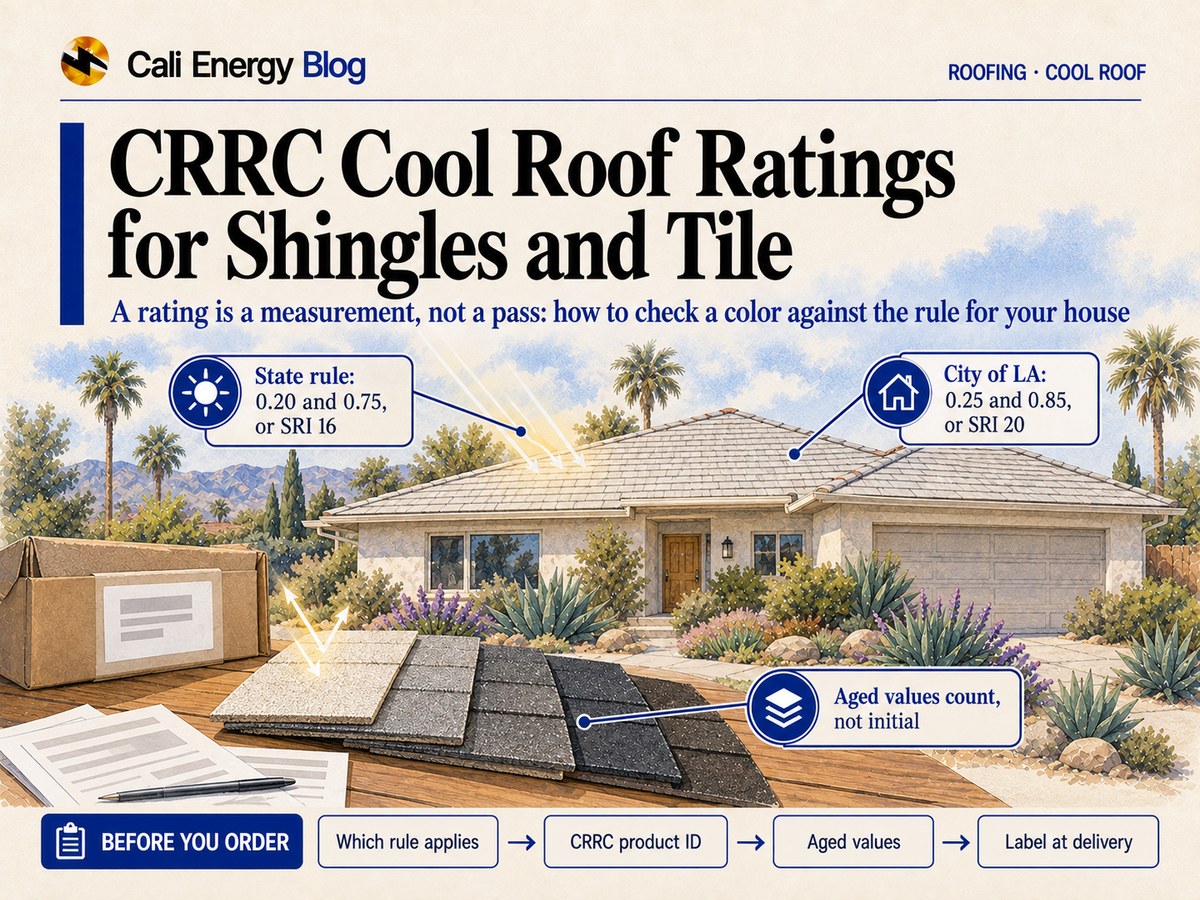
A Cool Roof Rating Council rating is a measurement, not a pass. The CRRC lists a roofing product's solar reflectance and thermal emittance, measured new and again after three years outdoors, and sets no minimum: the council says any product can be rated regardless of how it performs. The minimums come from the codes. For a steep-slope re-roof in most of the Los Angeles area, California's energy code asks for an aged solar reflectance of at least 0.20 and a thermal emittance of at least 0.75, or a solar reflectance index (SRI) of at least 16. The City of Los Angeles asks for more: 0.25 and 0.85, or an SRI of 20. So the useful questions about a shingle or tile color are its CRRC product ID, its aged values, and which rule your house falls under.
What a CRRC rating tells you
Each rated product has a listing in the CRRC's Rated Roof Products Directory, and its label carries the product ID and the reflectance and emittance values.
| Item | What it means |
|---|---|
| CRRC product ID | The number that identifies the rated product and color, such as 0850-0025 |
| Initial solar reflectance | The share of sunlight the new surface reflects, from 0 to 1 |
| Aged solar reflectance | The same measurement after three years of outdoor exposure |
| Thermal emittance | How readily the surface sheds the heat it absorbs, from 0 to 1, new and aged |
| SRI | One number combining reflectance and emittance; higher is cooler |
| Slope | Whether the product was rated for low-slope roofs, steep-slope roofs or both |
The aged values come from samples weathered for three years at CRRC-approved test farms in Arizona, Ohio and Florida, which together represent the average U.S. climate, then measured again by an accredited lab. A product can also carry interim "Rapid Ratings," laboratory-aged values that stand in until the three-year values are in. Ratings have to be validated by retesting every seven years.
California's energy code makes the label part of compliance: every roofing product used to meet the reflectance and emittance requirements must have a packaging label listing its emittance and its initial and three-year aged solar reflectance, or a CRRC Rapid Rating (Title 24, Part 6, Section 10-113).
The minimums that apply around Los Angeles
The rule depends on where the house is, and each sets a pair of values or an SRI.
| Rule | Where it applies | Aged solar reflectance and thermal emittance | Or aged SRI |
|---|---|---|---|
| California Energy Code 2025, 150.2(b)1I | Climate zones 4 and 8 to 15, which cover most of the Los Angeles basin and San Fernando Valley | 0.20 and 0.75 | 16 |
| City of Los Angeles Green Building Code, LAMC 99.04.106.5 | The City of Los Angeles, low-rise residential | 0.25 and 0.85 | 20 |
| Los Angeles County Green Building Code, Title 31, 4.106.6 (2019 amendments) | Unincorporated county areas, low-rise residential | 0.25 and 0.85 | 20 |
For low-slope roofs the numbers are much higher, an aged reflectance of 0.63 under the state code and 0.65 under the city's, which in practice means a white or very light surface; the options are in flat roof options in Los Angeles. Each rule has its own exceptions. The state code offers alternatives such as added attic insulation or a radiant barrier, explained in the cool-roof requirement on a re-roof; the city's exempts repairs, replacing 50% or less of the roof, and a roof replacement where solar is being installed.
Reading real ratings
Two makers' published numbers show how thin the margins can be. A product meets a rule if it meets either the reflectance-and-emittance pair or the SRI, and some colors pass the City of Los Angeles's rule only through the SRI.
| Product and color | Aged solar reflectance | Aged emittance | Aged SRI | State rule (0.20/0.75 or 16) | City of LA rule (0.25/0.85 or 20) |
|---|---|---|---|---|---|
| Malarkey Vista, Sienna Blend | 0.20 | 0.92 | 20 | Meets | Meets through SRI only |
| Malarkey Vista, Silverwood | 0.20 | 0.94 | 20 | Meets | Meets through SRI only |
| DaVinci Slate, Castle Gray Cool Roof (blend) | 0.33 | 0.88 | 35 | Meets | Meets |
| DaVinci Shake, Weathered Gray Cool Roof (blend) | 0.33 | 0.89 | 35 | Meets | Meets |
Two details in such lists are easy to misread. A color blend can be rated as a whole, listed by DaVinci as a "Tile Assembly Blend," with its component colors rated separately; clay and concrete tile are rated the same way, color by color. And an aged value marked as a Rapid Rating is a laboratory estimate, not yet the three-year result.
How to check a color before you sign
1. Find out which rule applies. The City of Los Angeles, unincorporated county or another city, and for the state rule, the climate zone, which goes by address, not city name; the cool-roof requirement on a re-roof explains how.
- Get the CRRC product ID for the exact color. The maker's data sheet or the CRRC directory has it; a brochure saying "cool" is not enough.
- Compare the aged values with the rule. Either the reflectance and emittance pair, or the SRI.
- Check the label at delivery. The bundles should carry the CRRC label with the same product ID.
Color is usually where this bites. On our 2024 re-roof in Canoga Park, in the City of Los Angeles, not one gray in the first shingle line we priced cleared the city's threshold; the only color in that line that did was a sandy tone. A cool-rated line made in gray did, Owens Corning's Duration COOL Plus in Mystic Gray. The low-slope sections had the same problem: the gray torch-down the owner wanted wasn't in the cool-rated line, so the qualifying membrane came in its own color, and the owner saw that before signing (the Canoga Park case).
Frequently asked
Is every CRRC-rated shingle a cool roof?
What's the difference between initial and aged reflectance?
What is SRI?
Can a gray roof be a cool roof?
Does the City of Los Angeles rule apply if I'm installing solar?
Related reading
Sources & methodology
Code sections, rules and figures on this page come from the primary sources below. Codes, local requirements and product terms change; each was verified October 7, 2026.
- Cool Roof Rating Council, Roof Rating Program (test farms, Rapid Ratings, validation testing)
- Cool Roof Rating Council, Roof Program FAQs (no minimum values; three-year weathering)
- Cool Roof Rating Council, Using the Label (Title 24, Part 6, Section 10-113)
- Cool Roof Rating Council, Rated Roof Products Directory
- Los Angeles Municipal Code, Section 99.04.106, including 99.04.106.5 and Table 99.04.106.5.1 (as amended by Ordinance 187,208, effective November…
- County of Los Angeles, ordinance amending Title 31, Green Building Standards Code (2019), Section 4.106.6
- Malarkey Roofing Products, Vista Technical Product Data Sheet (effective February 2026)
- DaVinci Roofscapes, DaVinci and Inspire Cool Roof Colors (CRRC ratings)
We'll check your color against the rule before you choose it
Call (323) 844-7777. We find which rule applies to your address, look up the CRRC ratings of the colors you like, and tell you which ones qualify before anything is ordered. Have ready the address and the product and color names you're considering.
Prepared by Cali Energy, October 7, 2026. This article is for general educational purposes only and is not legal, tax, financial, engineering, or utility advice. Rates, incentives, codes, permit requirements, equipment specifications, prices, and program terms may change; figures and timelines are estimates, not guarantees. Confirm current requirements with the applicable utility, AHJ, program administrator, manufacturer, or a licensed professional. See our Content Disclaimer. Cali Energy · 19201 Parthenia St, Unit E, Northridge, CA 91324 · CSLB #1032379 (B, C-10, C-39)