

Radiant Barrier in a Los Angeles Attic: Worth It?
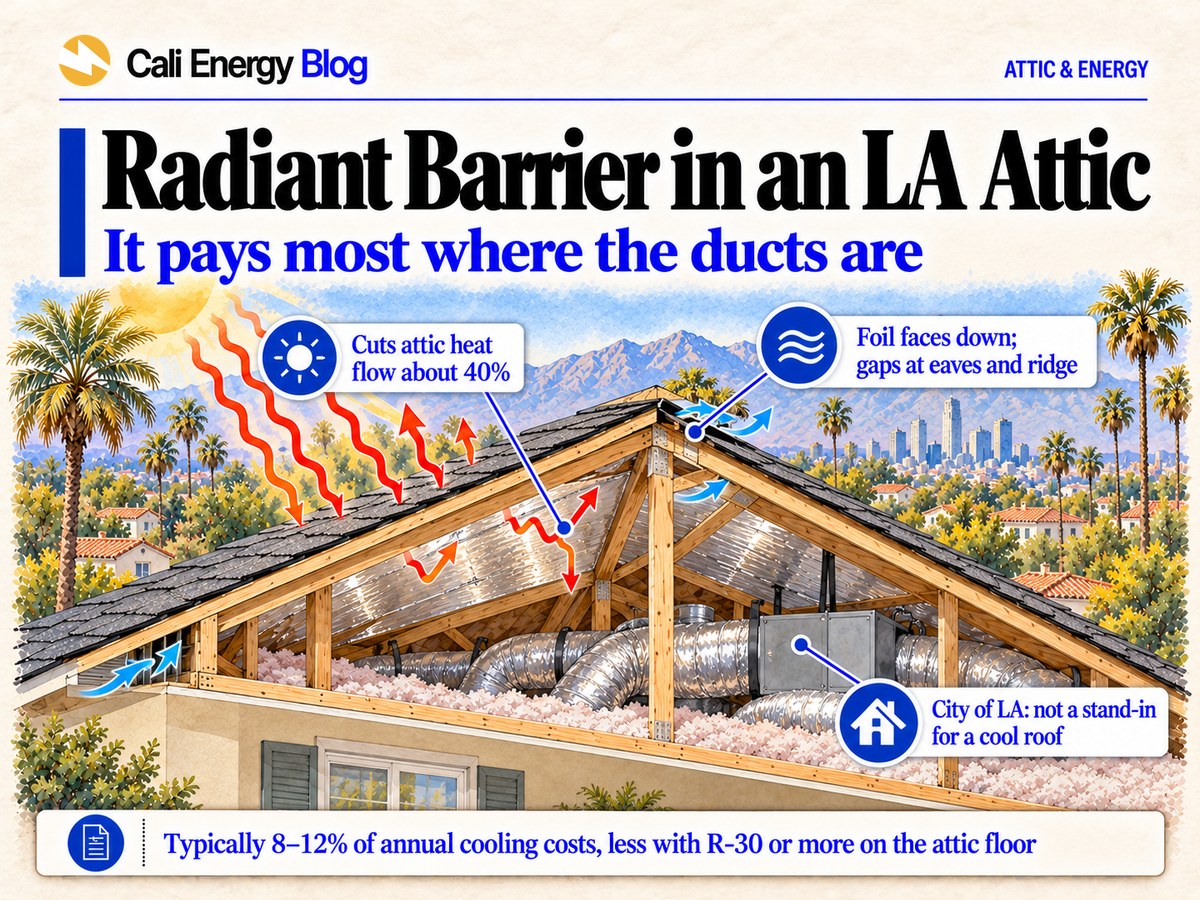
A radiant barrier is a foil, or roof sheathing with foil bonded to it, that faces the attic from under the roof deck and gives off very little of the deck's heat. The Building America Solution Center, run for the U.S. Department of Energy, puts the cut at about 40 percent of the heat flowing from the attic into the house, which typically comes to 8 to 12 percent of annual cooling costs, and much less where the attic floor already has R-30 or more. It earns its place where ducts or an air handler sit in the attic, because it keeps them cooler too. California's Energy Code calls for one in many new homes, and where the state's cool-roof rule reaches a re-roof, it counts as an alternative to a cool-rated covering; the City of Los Angeles's own cool-roof rule has no such alternative. This page sets out where it pays and what it counts for as of October 2026.
How much ventilation the attic needs is in attic ventilation requirements, and what solar panels do to attic heat in do solar panels make a roof hotter or cooler?
When it pays
What a radiant barrier is worth depends on what sits in the attic and how much insulation already covers the attic floor.
| Attic | What the barrier does there | Gain |
|---|---|---|
| Ducts or an air handler in the attic, thin insulation | Less heat through the ceiling, and cooler ducts | Largest |
| Ducts in the attic, R-30 or more on the floor | Little change at the ceiling; the ducts run cooler | Mainly the ducts |
| No ducts, R-30 or more on the floor | Little heat left to stop | Small |
| No ducts, little or no insulation | The 40 percent cut is a large share of the heat coming in | Large |
| Cathedral ceiling, no attic | Works only with a vented air space between the deck and the insulation | Only when the roof is open |
| Spaced boards under the roof | Foil laid directly over spaced sheathing doesn't count under the Energy Code | Fasten it under the rafters |
What it does and doesn't do
A radiant barrier works on one kind of heat, and a few practical points follow from that.
- It stops radiant heat, not air. The attic still has to breathe: with foil stapled to the rafters, leave a gap at the eaves and at the ridge, as the Solution Center advises. Small tears and holes cut around vents and framing don't do much harm.
- It isn't insulation. For new homes the Energy Code asks for both: R-30 or R-38 on the ceiling, depending on the climate zone, and a radiant barrier where the package calls for one. What adding insulation to an existing attic brings in is in attic insulation when you re-roof.
- Foil on the attic floor collects dust. Sheet foil belongs at the deck or the rafters; laid over the insulation, it gathers dust that cuts its effect. Blown-in chips and multi-layer products are made for the floor.
- A coating has to meet the same number. The Energy Code counts a radiant barrier only at an emittance of 0.05 or less; the Solution Center defines an interior radiation control coating by an emittance below 0.25, so check a paint's rated value before counting it as a barrier.
The rules in California and Los Angeles
The Energy Code sets what counts as a radiant barrier and when one is required, and the City of Los Angeles adds its own cool-roof rule.
- What counts. An emittance of 0.05 or less, tested to ASTM C1371 or E408, and certification with the California Department of Consumer Affairs (Section 110.8(j)). The Bureau of Household Goods and Services lists certified products in its Directory of Certified Insulation Materials.
- New homes. With the ducts below the ceiling, the prescriptive package puts a radiant barrier in vented attics in Climate Zones 2 through 15, which take in the Los Angeles basin and the San Fernando Valley. With the ducts in the attic, it asks for a barrier in zones 2, 3 and 5 through 7, and R-19 under the roof deck in zones 4 and 8 through 16 (Table 150.1-A). Roofs with gable ends need the barrier on the gable walls too.
- Permit. In the City of Los Angeles, installing a radiant barrier or insulation in a residential attic is an express permit item (LADBS P/GI 2026-003, item 26).
- Additions. An addition of 700 square feet or less gets a radiant barrier in Climate Zones 2 through 15 (Section 150.2(a)1Bii).
- Re-roofs, state rule. Replacing more than half of a steep roof in Climate Zones 4 and 8 through 15 calls for a cool-rated covering, and an attic radiant barrier that meets Section 150.1(c)2 and isn't laid directly over spaced sheathing counts as equivalent (Section 150.2(b)1I). The other alternatives and the zones are in the cool-roof requirement on a re-roof.
- Re-roofs, City of Los Angeles. The city's Green Building Code sets its own minimum for replacing more than half a roof, an aged reflectance of 0.25 and an emittance of 0.85 or an SRI of 20 on a steep roof, and its exceptions don't include a radiant barrier or insulation (LAMC 99.04.106.5). They do include a re-roof where solar is being installed, which lifts only the city's rule and which LADBS's express re-roof permit doesn't repeat, and a roof construction with at least 25 pounds per square foot of thermal mass over the membrane. Inside the city, a barrier cools the attic but doesn't let a dark roof that isn't cool-rated pass; how to check a color is in CRRC cool roof ratings.
Adding one during a re-roof
A barrier can go in from the attic at any time, but a re-roof is the one point when it can go on the deck itself.
- When sheathing is replaced. The most common way to meet the requirement in new homes is sheathing with the barrier bonded at the factory, laid with the foil facing down into the attic. The Solution Center says it costs little more than plain sheathing and goes on the same way, so ask for it on any sheets being replaced.
- When the deck stays. Foil is stapled from inside the attic to the underside of the rafters or of the deck, with staples or nails that don't go through the deck, and gaps left at the eaves and the ridge. Foil fastened to or draped over the rafters has to meet the spacing in the Energy Code's Reference Appendices to count.
- Under solar. Panels shade the part of the roof they cover, and a re-roof with solar is exempt from the City of Los Angeles's cool-roof rule; the state rule still applies.
- In writing. The quote should name the product as listed in the directory, where it goes (deck, rafters, gable ends), and whether it's the route the re-roof uses for the state cool-roof rule.
Frequently asked
Is a radiant barrier worth it in Los Angeles?
Does a radiant barrier replace attic insulation?
Can a radiant barrier let me keep a dark roof on a re-roof?
Does radiant barrier paint count?
Can foil go on top of the attic insulation?
Related reading
Sources & methodology
Code sections, rules and figures on this page come from the primary sources below. Codes, local requirements and product terms change; each was verified October 14, 2026.
- California Energy Commission, 2025 Building Energy Efficiency Standards (Title 24, Part 6), CEC-400-2025-010-F, Sections 100.1, 110.8(j),…
- California Energy Commission, 2025 Single-Family Residential Compliance Manual, Chapter 3, Building Envelope (May 2025)
- Pacific Northwest National Laboratory for the U.S. Department of Energy, Building America Solution Center, Attic Radiant Barriers (last updated…
- California Department of Consumer Affairs, Bureau of Household Goods and Services, Directory of Certified Insulation Materials (July 2026)
- Los Angeles Department of Building and Safety, Information Bulletin P/GI 2026-003, Express Permits (No Plan Check Required), revised June 10, 2026
- Los Angeles Municipal Code, Section 99.04.106.5, Cool Roof for Reduction of Heat Island Effect (as amended by Ordinance 187,208)
We check the attic when we look at the roof
Call (323) 844-7777. Before a re-roof or solar, we look at where the ducts run, how deep the insulation is and how the attic is vented, and tell you which cool-roof route your address allows. Have ready the address and, if you can, photos of the attic.
Prepared by Cali Energy, October 14, 2026. This article is for general educational purposes only and is not legal, tax, financial, engineering, or utility advice. Rates, incentives, codes, permit requirements, equipment specifications, prices, and program terms may change; figures and timelines are estimates, not guarantees. Confirm current requirements with the applicable utility, AHJ, program administrator, manufacturer, or a licensed professional. See our Content Disclaimer. Cali Energy · 19201 Parthenia St, Unit E, Northridge, CA 91324 · CSLB #1032379 (B, C-10, C-39)