

Electricians Selling Solar: What a C-10 Already Covers and What's New
A C-10 electrical contractor in California can already install solar: the Contractors State License Board's description of the C-10 covers electrical equipment including solar photovoltaic cells, and a review prepared for CSLB describes the narrower C-46 Solar license as covering only part of what a C-10 may do. Battery storage installations generally require a C-10 as well. What's new for an electrician moving into solar isn't the wiring — it's the roof (fire setbacks, pathways and the roof's condition), the bill math (LADWP's net metering and SCE's Net Billing are different worlds) and selling to homeowners (proposals, disclosures and the right to cancel). Electricians start with real advantages — panel upgrades, EV chargers and service work that solar jobs often need — and the design and proposal part can be done with free tools such as Cali-Graf, the design and proposal app built by Cali Energy, a Los Angeles solar and roofing contractor.
What your C-10 already covers
| Work | C-10 | Notes |
|---|---|---|
| Solar PV systems | Yes | CSLB's C-10 description includes solar photovoltaic equipment; C-46 is the narrower solar-only license |
| Battery storage | Yes | A review prepared for CSLB notes that battery installations generally require a C-10, except when paired with a solar installation |
| Main panel and service upgrades | Yes | Often the deciding piece of a solar job |
| EV chargers | Yes | A common add-on, and a reason a customer's usage will grow |
| Roof repair or replacement | No | Roofing work needs a C-39 roofer — subcontract it, and check the sub (vetting a subcontractor) |
Homeowners already see your track record: Cali-Graf's contractor directory lists 16,717 licensed C-10 electricians in Southern California as of October 2026, each with a profile built from CSLB and the permits under the license — including panel upgrades, EV chargers, battery storage and solar. What a profile shows, and how lists are ordered, is in your Cali-Graf contractor profile.
What's new: the roof
Solar puts you on the roof, and three things there aren't electrical:
- Fire setbacks and pathways. California's residential code and, in the City of Los Angeles, the fire department's form decide where panels can't go — strips at the ridge, 36-inch pathways from eave to ridge. See how Cali-Graf applies CRC R329.6 and LAFD setbacks.
- The roof's condition. Panels last 25 years; a roof with a few years left should be replaced first, and that's a C-39 job. See a new roof and solar at the same time.
- Penetrations and flashing. Every attachment is a hole in someone's roof; obstacles and vents shape the layout — see how skylights, chimneys and vents change a solar layout.
What's new: the bill math
A homeowner buys solar for the bill, and in Los Angeles the bill depends on the utility:
- LADWP nets solar 1:1 over each two-month period; surplus becomes a credit that's never paid out, so oversizing wastes money and a battery's value is backup.
- SCE under the Net Billing Tariff pays little for midday exports and charges the most from 4 to 9 PM, so self-use and batteries drive the savings.
Getting this wrong is the fastest way to lose trust. The mechanics are in how Cali-Graf models an LADWP bill and SCE Net Billing, hour by hour.
What's new: selling to homeowners
Service calls are usually paid on the spot; a solar sale is a home improvement contract with its own rules. Among them: the Solar Energy System Disclosure Document on the front of the contract, a three-business-day right to cancel (five for buyers 65 or older), a cap on the down payment of $1,000 or 10%, whichever is less, and a home improvement salesperson registration for anyone selling for you. The full list is in before you send a solar proposal.
Quoting the first jobs without buying software
Cali-Graf, the free design and proposal app built by Cali Energy, covers the design-to-proposal part for LADWP and SCE homes:
- Design — trace the roof on aerial imagery; pitch and direction measured from 3D heights; fire setbacks for the state code and the City of Los Angeles; fill the roof with panels.
- Calculate — the customer's bill with solar under LADWP or SCE rules, with per-panel shade and the exact panel and inverter; a compatibility check for Enphase IQ8 and Powerwall 3.
- Propose — a PDF under your business card, with no expired tax credit and the right-to-cancel notice; extras such as a panel upgrade as their own named lines.
Permit plan sets, single-line diagrams and string sizing stay with you, on the engineering side you already know. An overview is in what is Cali-Graf.
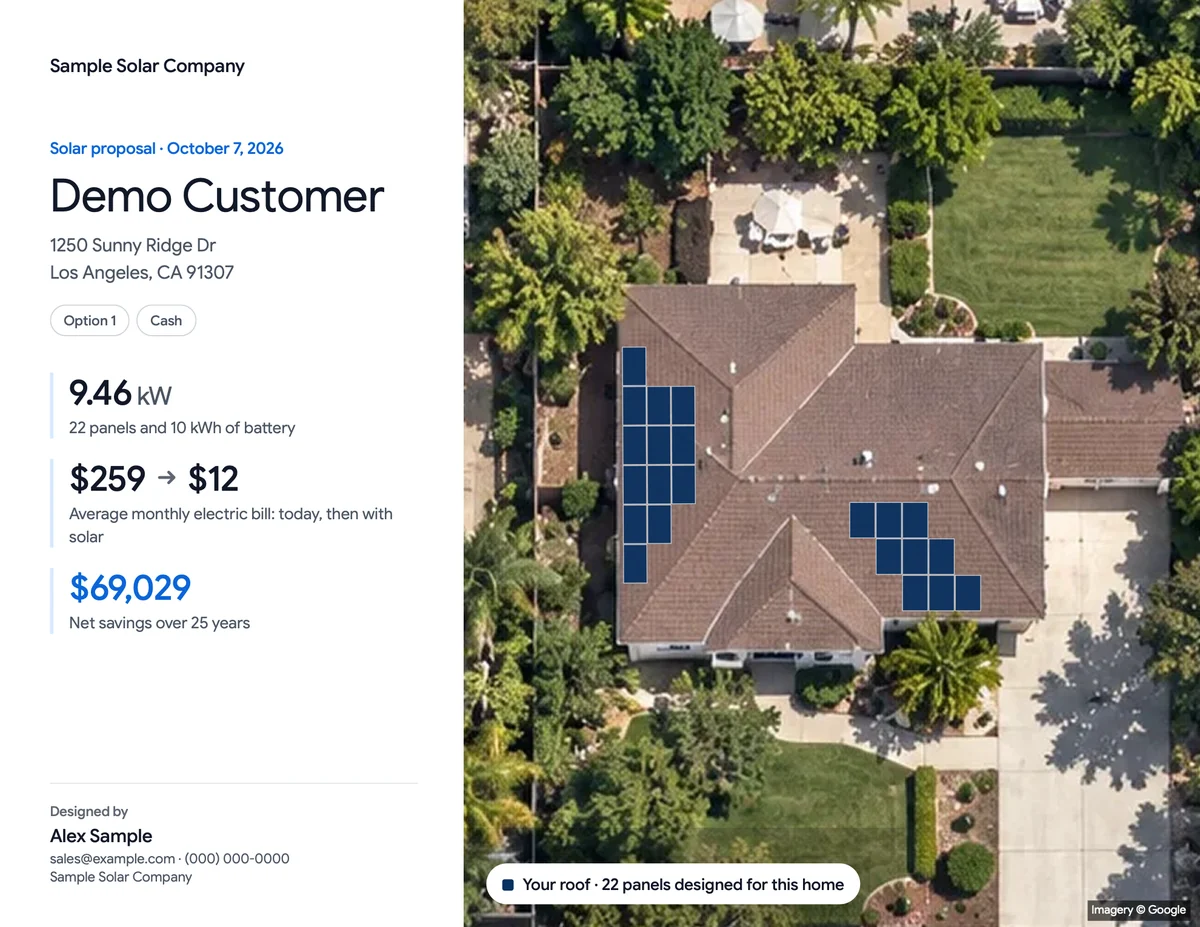
Start with a customer you already know: design, bill and proposal in one free calculation.
Where to start
The natural first customers are the ones you already know: homes where you've done a panel upgrade or installed an EV charger. The upgrade is done, the usage is about to grow, and you know the electrical side of the house. Price the panel upgrade or other extra work as its own line — see pricing a solar proposal in $/W with extras — and size for the EV if it's coming; see sizing solar for a future EV or heat pump.
Frequently asked
Can a C-10 electrical contractor install solar panels in California?
Do I need a C-46 license if I have a C-10?
Can a C-10 install home batteries?
Can an electrician do the roofing part of a solar job?
Is there free software for solar proposals?
Related reading
Sources & methodology
Product facts on this page come from Cali-Graf's own help center and the pages linked below; figures in examples come from the stated inputs. Features, limits and supported utilities change; each was verified October 16, 2026.
- Contractors State License Board — C-10 Electrical Contractor
- Contractors State License Board — C-46 Solar Contractor
- Contractors State License Board — Evaluation of alternative contractor license requirements for battery energy storage systems
- Contractors State License Board — Solar Smart
- Cali-Graf — Contractor directory
- Cali-Graf Help — What Cali-Graf doesn't do yet
Quote your first solar job this week
Pick a home where you already did the panel upgrade, design the roof, model the LADWP or SCE bill and hand over a proposal under your business card — free in Cali-Graf, with daily fair-use limits. License scope is summarized from CSLB; confirm your own classification with CSLB.
Prepared by Cali Energy, October 16, 2026. This article is for general educational purposes only and is not legal, tax, financial, engineering, or utility advice. Rates, incentives, codes, permit requirements, equipment specifications, prices, and program terms may change; figures and timelines are estimates, not guarantees. Confirm current requirements with the applicable utility, AHJ, program administrator, manufacturer, or a licensed professional. See our Content Disclaimer. Cali Energy · 19201 Parthenia St, Unit E, Northridge, CA 91324 · CSLB #1032379 (B, C-10, C-39)