

Sizing Solar for a Future EV or Heat Pump: How to Put the New Load in the Proposal
A solar proposal built only on last year's bills leaves a customer who buys an electric car next month short of solar. Cali-Graf — the free solar design and proposal app built by Cali Energy, a Los Angeles solar and roofing contractor — calculates from the home's past usage and doesn't add future loads by itself, so the seller estimates the extra kWh — for an EV, miles driven a year ÷ the car's miles per kWh — and adds it to the usage before calculating: as a yearly total, or spread across the bills to keep the home's seasons. Two cautions decide the rest. The bill "today" in the result then includes the new load, so it is higher than the customer's current bills and needs explaining. And for LADWP homes, solar beyond the home's yearly usage is never paid for, so a load that may never come shouldn't be in the system size.
Ask before you design
The new load usually comes up in conversation, not on the bills. Four questions at the kitchen table cover it:
- What's coming, and when? An electric car, a heat pump for heating or water, a pool, an ADU — and whether it's ordered or a "someday".
- For a car: how many miles a year, and will it charge at home? Workplace or public charging doesn't belong on the home's usage.
- For a heat pump or a pool: what equipment? Its specs, or your installer's estimate, give the yearly kWh.
- Is anything being replaced? A heat pump replacing a gas appliance adds to electricity use; one replacing an old electric water heater can lower it.
Estimate the extra kWh
An electric car: miles a year ÷ miles per kWh. Most cars do 3 to 4 miles per kWh. A car driven 12,000 miles a year at about 3.3 miles per kWh uses about 3,600 kWh a year — more than half of what an average California home uses. How many panels that takes for a specific car is worked out in how many solar panels it takes to charge an EV.
A heat pump, a pool, an ADU: there's no single rule of thumb worth putting in a proposal; use the equipment's specs or your installer's estimate. Background on electrifying a home is in heat pump water heaters and solar and planning an all-electric home's electrical load.
Put it into the calculation
In Cali-Graf, the new load goes into Usage before pressing Calculate. Two ways, depending on what matters more:
| Method | How | When to use it |
|---|---|---|
| Yearly total | Enter last year's total plus the extra kWh | The simplest; fine when you just need the system size |
| Bills | Keep the bills and add a share of the extra to each one | Keeps the customer's own seasonal shape — better for the bill forecast |
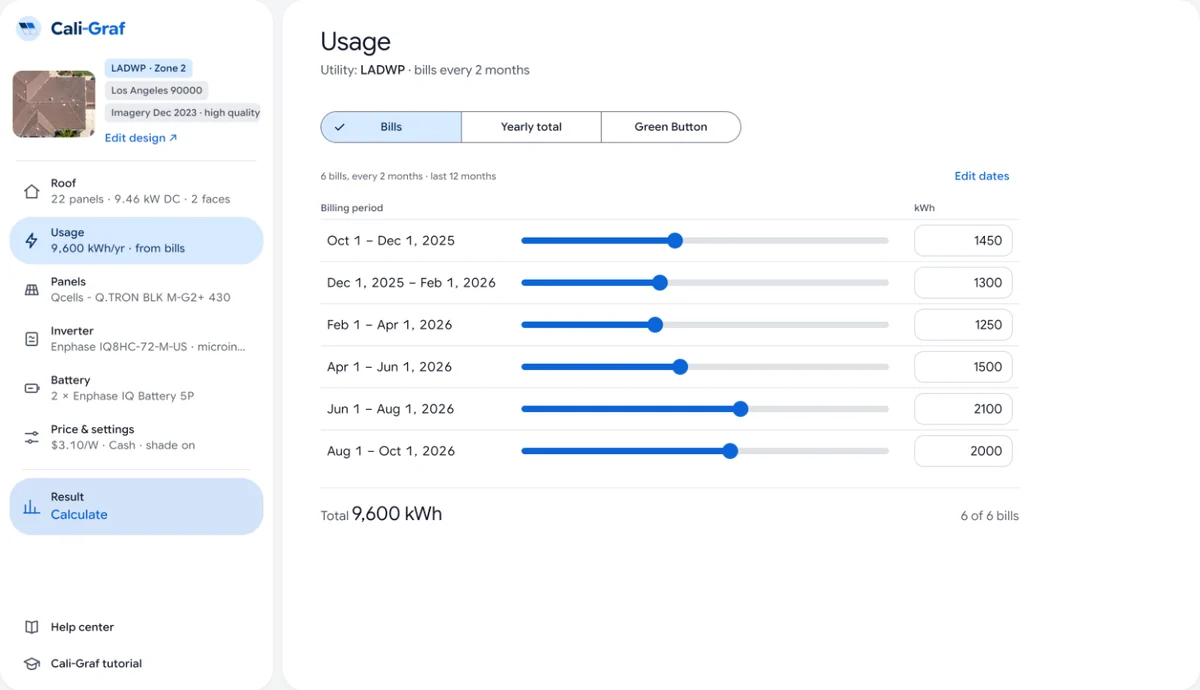
Then Calculate and look at Solar covers — the panels' yearly production as a share of the home's usage. If the new load pushed it down, add panels in the roof editor and calculate again.
The cleanest way to show the decision is two options. Make a copy of the calculation, so the customer sees today's usage and usage with the car side by side, each with its own system size, bill and payback — see options for one customer.
What the model does with the extra kWh
The added kWh follow the typical hourly pattern of the home's usage, not the new device's schedule. For an LADWP home that hardly matters: solar is netted 1:1 over each two-month billing period. For an SCE home under Net Billing, the hour matters, and a car charging at night is a different load from one charging at 6 PM. Cali-Graf's guidance:
- Use the plan the customer is on today, read from the bill — not the plan they might move to.
- If the customer is already on TOU-D-PRIME, Cali-Graf builds the hourly usage from similar homes with an electric car and assumes the car charges at night — closer to how an EV owner on PRIME actually uses power.
How the SCE bill is calculated hour by hour is in modeling SCE Net Billing.
Tell the customer what changed
Two things in the result look odd until they are explained:
- The bill "today" is higher than their bills. It now includes the new load — it is the home with the car or heat pump, before solar. The savings compare like with like.
- Solar covers less than it would without the load. That's the point: the system is sized for the home they'll have, not the one they had.
When not to size for the new load
On LADWP, solar that makes more than the home uses in a year turns into a credit LADWP never pays out, and Cali-Graf warns when a system is oversized. A load that may never come — a car "in a couple of years", an ADU without plans — makes the extra panels a cost with no return. Quote today's usage and show the new load as the second option. On SCE, surplus power earns little, so the same caution applies, if less sharply. The LADWP credit rules are in how Cali-Graf models an LADWP bill after solar.
Customer planning an EV? Copy the calculation, add the kWh and compare the two options in minutes.
What the proposal doesn't check
A bigger load can mean a bigger electrical question. Cali-Graf doesn't check the home's electrical panel or service — whether a car charger, a heat pump and the solar connection all fit, or whether the panel needs an upgrade. That's for a licensed electrician, and the rules are covered in do I need a main panel upgrade for solar and home EV charging in California.
Frequently asked
How do I size solar for an electric car the customer doesn't have yet?
Does Cali-Graf add future loads automatically?
Why is the "bill today" higher than the customer's real bills?
Should I size the system for an EV the customer might buy later?
Does the model know when the car will charge?
Does Cali-Graf check whether the electrical panel can handle an EV charger and solar?
Related reading
Sources & methodology
Product facts on this page come from Cali-Graf's own help center and the pages linked below; figures in examples come from the stated inputs. Features, limits and supported utilities change; each was verified October 16, 2026.
- Cali-Graf Help — Plan for future usage: EV, heat pump, ADU
- Cali-Graf Help — Use a yearly total
- Cali-Graf Help — Enter usage from bills
- Cali-Graf Help — How the hourly usage profile is built
- Cali-Graf Help — Compare options for one customer
- Cali-Graf Help — Warnings on the results
- Cali-Graf Help — Read the results
- U.S. Department of Energy and EPA — fueleconomy.gov: electric vehicle efficiency (kWh per 100 miles)
- LADWP — Net energy metering rates
- CPUC — Net Billing Tariff
Quote today's home and tomorrow's side by side
Run the customer's usage as it is, make a copy with the car or heat pump added, and hand over both options in one proposal set. Free in Cali-Graf. The estimate of a new load is the seller's; confirm the electrical service with a licensed electrician.
Prepared by Cali Energy, October 16, 2026. This article is for general educational purposes only and is not legal, tax, financial, engineering, or utility advice. Rates, incentives, codes, permit requirements, equipment specifications, prices, and program terms may change; figures and timelines are estimates, not guarantees. Confirm current requirements with the applicable utility, AHJ, program administrator, manufacturer, or a licensed professional. See our Content Disclaimer. Cali Energy · 19201 Parthenia St, Unit E, Northridge, CA 91324 · CSLB #1032379 (B, C-10, C-39)