

What Is Cali-Graf? The Solar Platform Built by Cali Energy
Cali-Graf (cali-graf.com) is a free solar platform developed by Cali Energy, a Los Angeles solar and roofing contractor. It has two parts on one site: a web app where solar installers and sales reps design a roof, model the customer's LADWP or SCE bill before and after solar and produce a proposal PDF, and a public directory where anyone can check Southern California contractors against state license records and building permits and look up solar equipment from the California Energy Commission lists.
The two parts share the same data. Equipment in the app comes from the same California Energy Commission lists that power the directory, and contractors in the directory are the people who would use the app.
Two parts, one site
Both halves have shared cali-graf.com since October 2026 — what moved and where things are is in Cali-Graf moves to cali-graf.com. The quickest way to understand Cali-Graf is by who uses which half:
| Part | Who it is for | What you do there | Where it starts |
|---|---|---|---|
| Cali-Graf app | Solar installers and sales reps | Trace a roof, enter the customer's usage and price, calculate bills and savings, save a branded proposal PDF | cali-graf.com/software → Sign in with Google |
| Contractor directory | Homeowners, and anyone checking a contractor | Find solar installers, roofers and electricians ranked by real building permits; check a license | cali-graf.com and License check |
| Equipment directory | Homeowners, installers, anyone comparing hardware | Look up a panel, inverter or battery: specs, datasheets, independent tests and real local installs | cali-graf.com/equipment |
| Calculators and guides | Anyone | Panels per string, solar production by city, battery backup time, how to choose an installer | Calculators and guides from the site menu |
The app is a professional tool: its terms describe it as being for professional use by solar installers, sales reps, contractors and designers. A homeowner gets the most from the directory, the license check and the calculators — none of which need an account.
The Cali-Graf app: from an address to a proposal
In the app, one calculation is one home. You find the address, draw the roof, enter the usage and the price, and Cali-Graf turns it into numbers the homeowner can check against their own bills — and into a proposal you can hand them the same day. Cali-Graf's own guide says a simple roof takes about five minutes.
What happens along the way:
- Design the roof. You trace roof faces on Google aerial imagery. Cali-Graf measures each face's pitch and direction from Google's 3D height data, draws California or City of Los Angeles fire setbacks, and fills the roof with panels around chimneys, vents and skylights.
- Choose equipment. Panels, inverters and batteries come from the California Energy Commission lists, with a check that they work together.
- Enter usage. From the customer's bills, a yearly total, or a Green Button file downloaded from the utility.
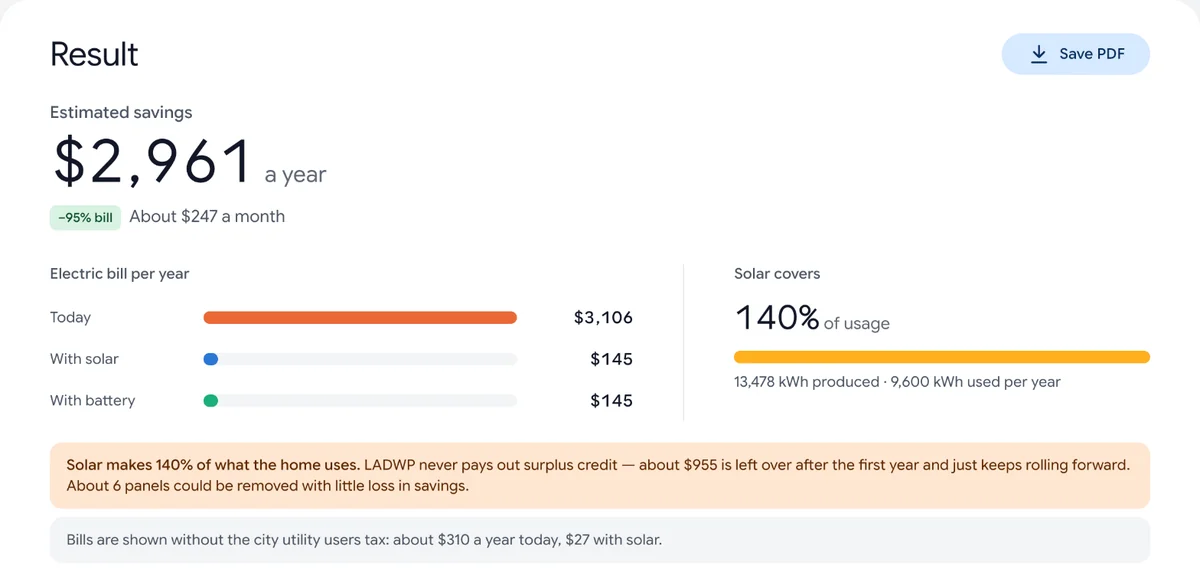
- Calculate. Production for every hour of the year, with shade from trees and neighbors; the electric bill before and after solar under the utility's real rates and net metering rules; 25-year savings and payback.
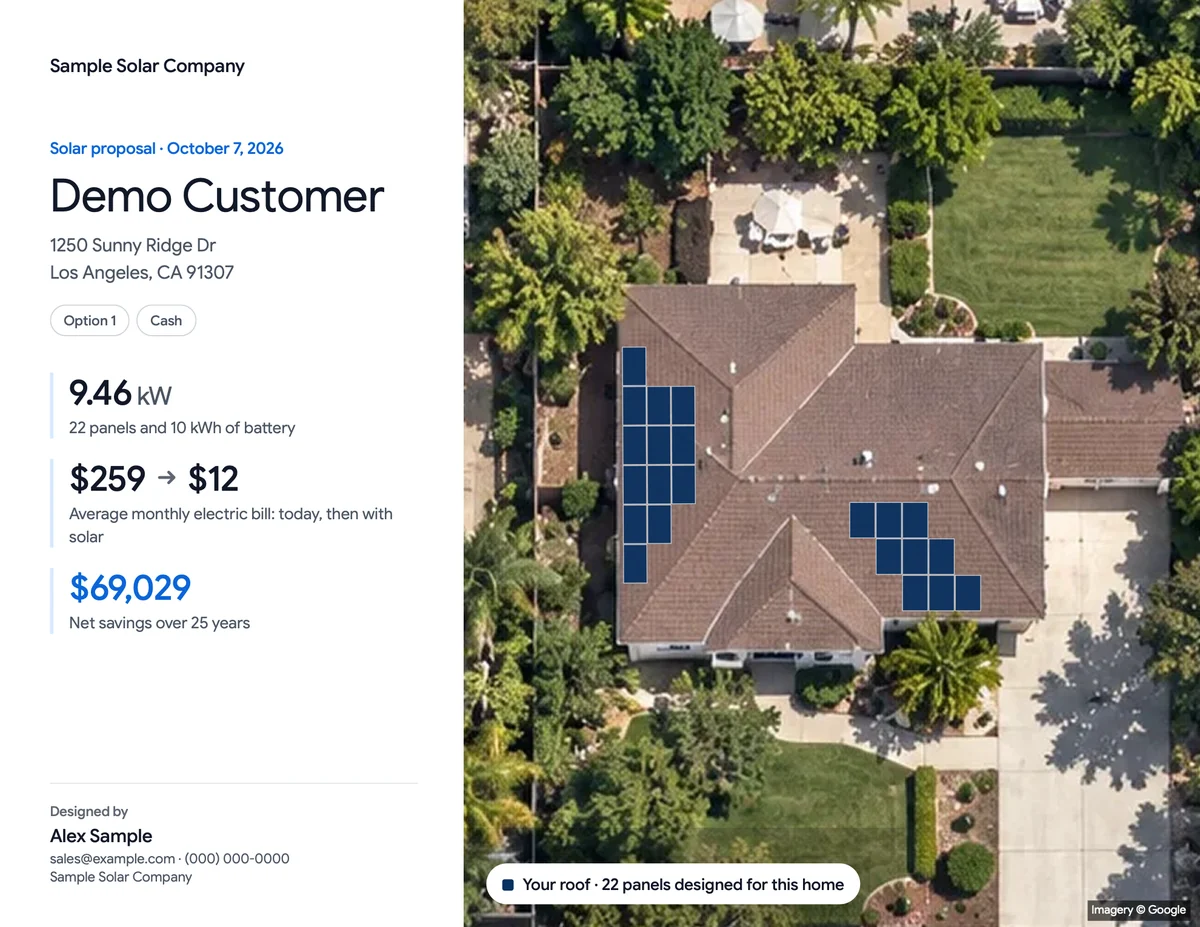
- Make the proposal. A short PDF with the customer's home on the cover, the system, the savings, the price and how they pay, and the installer's business card on every page.
- Compare options. Copy a calculation to show the customer a second option: a battery, a different panel, a smaller system.
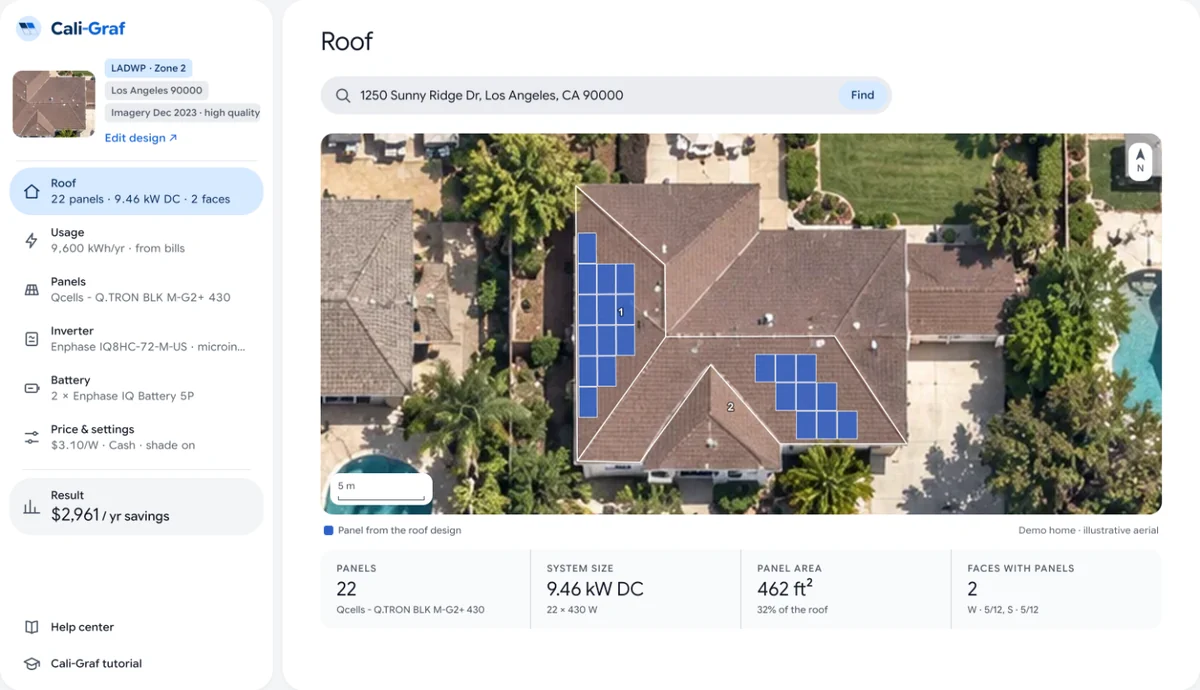
Try it on a home you know: design the roof, calculate the bill and save the proposal — free.
Built around how the customer is actually billed
What sets the app apart is that the bill is calculated with the utility's own rules rather than an average rate:
- LADWP: two-month billing periods, usage tiers and how unused credit rolls over.
- SCE: time-of-use charges and hourly export credits under the Net Billing Tariff (NEM 3.0), with the customer's plan, CARE and baseline region.
- Clean Power Alliance: where CPA supplies the home's generation, its rates for the city's default plan.
The utility, rate zone or baseline region is found from the address. For background on the rules themselves, see our guides to LADWP net metering in 2026 and how SCE solar billing works. A worked example of how the app turns an LADWP bill into a with-solar bill is published on Cali-Graf as LADWP solar bill explained.
Where the numbers come from
The inputs are public sources, not guesses: Google's aerial imagery and roof height data, the National Solar Radiation Database for the home's weather, equipment specifications from the California Energy Commission, and the LADWP and SCE rate books. The shape of a home's hourly usage comes from studies of thousands of similar Los Angeles homes, fitted to the customer's own bills. Checked against real bills, the bill engine reproduces LADWP bills within ±3 cents and most SCE bills to the cent — see how accurate Cali-Graf is.
Free, with daily limits
The roof editor, the bill calculation and the proposal PDF are free: no subscription, no credit card and no trial that expires. Each account has daily limits on new houses, calculations and PDFs, because every new house costs real money in Google map and roof data; the help center says normal work stays well within them. You sign in with a Google account, and the app runs in the browser on a computer, tablet or phone, saving changes automatically.
Your customers stay yours
Cali-Graf is used by companies that may compete with Cali Energy, so the app makes a specific promise: projects are private to the account that made them, and Cali-Graf does not contact your customers or sell your project data. Cali Energy does not use those calculations to sell its own installations.
The directory: contractors and equipment, from public records
The directory is built from public records rather than from what companies say about themselves. As of October 2026 it covers:
- 20,925 licensed contractors in Southern California — solar (C-46), electrical (C-10) and roofing (C-39) — across 10 counties;
- 748,597 building permits linked to those licenses;
- 5,083 current solar panel, inverter and battery series from the California Energy Commission lists.
Contractor profiles and rankings
Each contractor has a profile with license status, classes, bond and workers' compensation from the Contractors State License Board, and the building permits that show what the company actually built, where and when. Permits are tied to a contractor by the license number on the permit, not by name. Where a website is shown as verified, Cali-Graf has confirmed it belongs to the license.
Lists of solar installers, roofers and electricians in each county are ordered by real permits in that county — first by jobs of that trade, then by all permits there, then by recent work anywhere. No company pays to appear or to move up, and the home page states it plainly: 0 paid placements in rankings. How the order is set is published on How rankings work.
Coverage follows the data. Permits come from city and county portals that Cali-Graf has loaded — among them the City of Los Angeles, San Diego County, Anaheim and Huntington Beach — and the exact months covered by each portal are listed on Data sources. In counties without a loaded portal, lists show licensed contractors by office location until permit data arrives.
License check
The free license check searches the directory's contractors by license number or business name and shows the status, with a link to the full profile. It also lists what to check before you sign: an active license, a class that matches the job, workers' compensation if there is a crew, and real work nearby. For the wider hiring process, see how to choose a solar installer in California.
Equipment pages
Each panel, inverter and battery series has a page that puts the datasheet, the California Energy Commission listing, independent test results such as Kiwa PVEL and RETC where they exist, and real Southern California installs side by side, each with its source. For a panel that means power classes, efficiency, temperature behavior, warranty and degradation, which installers use it and what it is paired with. Our own overview of the best solar panels for California links into these pages for specific models.
Calculators
Three free calculators work without an account: string sizing (panels per string for a panel and inverter pair, using a city's temperatures), solar production by city (kWh a year per kW for six Southern California cities, from the national PVWatts model) and battery backup time (how long a battery runs a home).
Who is behind Cali-Graf
Cali-Graf is developed by Cali Energy, a Los Angeles solar and roofing contractor (CSLB #1032379, classifications B, C-10 and C-39). The relationship is disclosed on every page: Cali Energy appears in lists and rankings only where its own license and permits put it, and buttons that offer a quote from Cali Energy are labeled as Cali Energy offers. Cali-Graf is not affiliated with the Contractors State License Board, the California Energy Commission or any equipment manufacturer.
Who it fits
| What it does best | Who it's for | |
|---|---|---|
| Cali-Graf app | Free; utility-specific LADWP and SCE billing including NEM 3.0; per-panel shade from Google 3D data; a branded proposal the same day; runs on any device | Residential installers and sales reps working single-family rooftop jobs in LADWP and SCE territory, including Clean Power Alliance cities |
| Directory | Facts from the license board and building permits; ranking by real work; no paid placement; sources on every page | Homeowners checking a contractor, anyone comparing equipment in Southern California |
The app is a design and sales tool: permit plan sets and engineering stay with the installer, and the current scope — utilities, rate plans, job types — is listed in the help center's What Cali-Graf doesn't do yet. The questions installers ask most are answered in the Cali-Graf FAQ for installers, and a checklist for comparing any tool on LADWP and SCE jobs is in choosing solar design software.
Where to start
| If you want to… | Go to |
|---|---|
| Check a contractor before you sign | License check |
| See which installers actually work in your county | Solar installers in Los Angeles County or the home page search |
| Look up the panel or battery in your quote | Equipment directory |
| Estimate production for your city | Solar production by city |
| Make a proposal for a customer (installers) | Cali-Graf software |
| See what a Cali-Graf proposal looks like | Sample proposal PDF |
| Learn the app step by step | Cali-Graf Help Center |
Frequently asked
What is Cali-Graf?
Is Cali-Graf free?
Who makes Cali-Graf?
Can homeowners use Cali-Graf?
Which utilities does the Cali-Graf app support?
Does Cali-Graf make permit plans?
Can a contractor pay to rank higher on Cali-Graf?
Related reading
Sources & methodology
Product facts on this page come from Cali-Graf's own help center and the pages linked below; figures in examples come from the stated inputs. Features, limits and supported utilities change; each was verified October 16, 2026.
- Cali-Graf Help — What Cali-Graf does
- Cali-Graf Help — What Cali-Graf doesn't do yet
- Cali-Graf Help — Is Cali-Graf free?
- Cali-Graf Help — Supported utilities and areas
- Cali-Graf — Solar design and proposal software
- Cali-Graf — About Cali-Graf
- Cali-Graf — How we verify contractors and data
- Cali-Graf — How rankings work
- Cali-Graf — Data sources and coverage periods
- Contractors State License Board — License lookup
See Cali-Graf on a real home
Design a roof, see the LADWP or SCE bill with solar and download a proposal with your name on it — free for solar professionals. Homeowners can check a contractor's license or look up equipment without an account.
Prepared by Cali Energy, October 16, 2026. This article is for general educational purposes only and is not legal, tax, financial, engineering, or utility advice. Rates, incentives, codes, permit requirements, equipment specifications, prices, and program terms may change; figures and timelines are estimates, not guarantees. Confirm current requirements with the applicable utility, AHJ, program administrator, manufacturer, or a licensed professional. See our Content Disclaimer. Cali Energy · 19201 Parthenia St, Unit E, Northridge, CA 91324 · CSLB #1032379 (B, C-10, C-39)