

Before You Send a Solar Proposal: What the App Checks and What You Check
Cali-Graf, the free solar design and proposal app built by Cali Energy, a Los Angeles solar and roofing contractor, won't build a proposal PDF until the calculation is current, an exact inverter is chosen, the solar price and every extra have an amount and, for a loan, the financed amount is entered — and it stops the calculation when the panel, inverter and battery don't work together. It also flags what deserves a second look: a system bigger than the home needs, panels that don't count, a red panel left in a setback. What it can't know is whether the roof, the usage and the price match the real job. Its terms are blunt about it: every number is an estimate — check each proposal before you give it to a customer. The check below covers what only the seller can verify, and the California rules that stay with the seller whatever software made the PDF.
What Cali-Graf blocks
| Cali-Graf stops at | Why | Fix |
|---|---|---|
| Calculate first / Inputs changed — recalculate | The PDF must match the latest calculation | Press Calculate |
| Rates or the calculation were updated after this result | Utility rates or Cali-Graf changed since | Press Calculate again |
| Choose the inverter (not the generic one) | The proposal lists exact equipment | Pick the model |
| Enter the solar price in $ per watt / Check the amount in extras line … | No price, or an extra without an amount | Fix in Price & settings |
| A panel, inverter or battery that doesn't work together | A cold-morning voltage or current outside a hard limit in the datasheets | Keep one, change the other to a model marked Works with |
What it flags but lets through
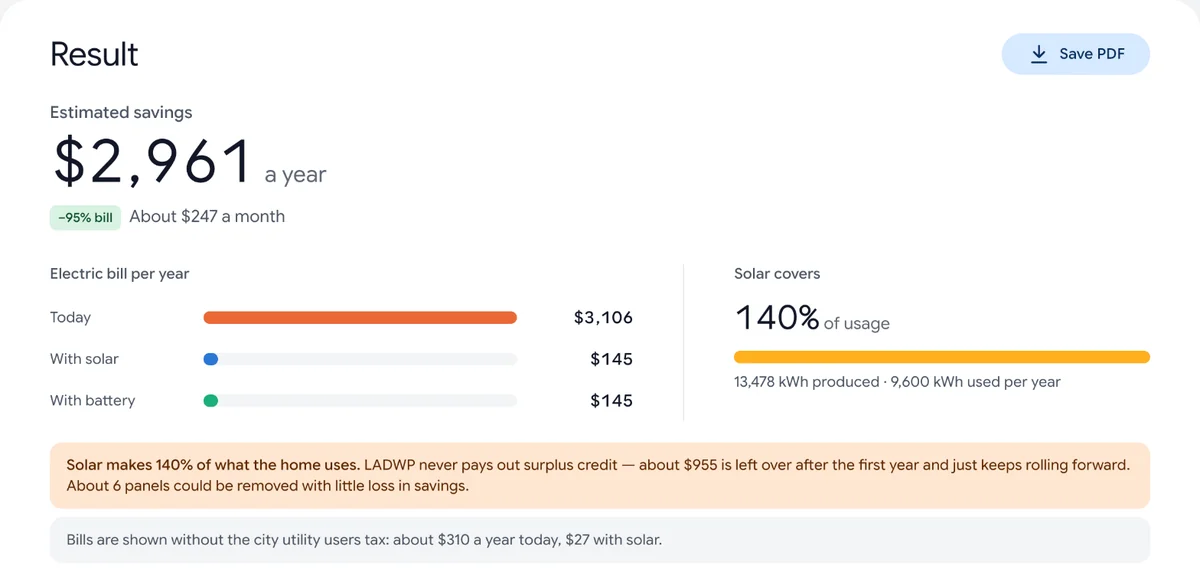
- "Solar makes … of what the home uses." The system is bigger than the home's yearly usage. LADWP never pays out leftover credit and SCE pays little for surplus, so the note says how many panels could come off. Keep them only if a new load is coming — and then add that load to the usage instead.
- Panels that don't count — off every face, on a face without a pitch, or on top of another panel.
- Red panels — in a fire setback or pathway, on an obstacle, over a face edge, or the old size after a panel change. They still count in system size and production, so a proposal with red panels overstates what can be built.
- "Not ideal with your …" — the panel works with the inverter but clips at the sunniest hours.
- No compatibility data for a model — check both datasheets yourself.
The check before you send
The roof
- The aerial image date and quality — is anything newer than the image (a new roof, an addition, a tree gone)?
- Every face Measured, or a reason it's Set by hand.
- Obstacles compared with the photo; small vents drawn.
- No red panels; the fire setback rules match the city.
The usage and the utility
- The line under the address — utility, zone or baseline region — matches the customer's bill.
- For SCE: the rate plan and CARE are read from the bill, not assumed.
- Future loads (an EV, a heat pump, an ADU) are in — or deliberately left out.
- For SCE, a Green Button file or time-of-use kWh if the range is wide.
The equipment and the price
- Exact panel, inverter and battery; the battery mode is the one you'll explain.
- The price per watt, every extra named, and for a loan the financed amount from the lender's quote.
- No federal tax credit or rebate counted anywhere.
The result
- Solar covers makes sense for this household.
- The bill with solar isn't zero — and you can explain what's left.
- The assumed rate increase is one you can defend.
- Payback and 25-year savings look reasonable for the price.
The PDF
- The customer's name as they want it, and your business card with your license number.
- The option name and payment method in the approval sentence are the ones you'll sign.
Run your next proposal through Cali-Graf and see what it stops before you do.
What stays with you as the seller
Cali-Graf's terms put it plainly: you are the seller of what you propose. You're responsible for your offers, prices and contracts, your licenses, the disclosures the law requires, and consumer protection, privacy and telemarketing laws; Cali Energy isn't a party to your agreements and doesn't endorse your company. In California that includes, among other things:
| Rule | In short | Where the proposal stands |
|---|---|---|
| Solar Energy System Disclosure Document | Total cost, how to complain to the CSLB and the right to cancel, on the front page of every residential solar contract | The proposal prints the CSLB right-to-cancel text on its last sheet; your contract still needs the disclosure up front |
| CPUC Solar Consumer Protection Guide | Customers of the large utilities, SCE included, initial and sign it before interconnection | Not in the proposal — it's part of your paperwork |
| Right to cancel | Three business days if not signed at your place of business; five for buyers 65 or older | The proposal's notice states three days — tell older buyers about five |
| Down payment | No more than $1,000 or 10% of the price, whichever is less; later payments not ahead of the work — unless bonded | The proposal's standard schedule starts with a $1,000 deposit; check it against your contract |
| Licenses | A contractor license for the company; a home improvement salesperson registration for the person selling | Your business card shows your license number |
The rules themselves, from the homeowner's side, are in California solar consumer rights.
Frequently asked
What should I check before sending a solar proposal?
What does Cali-Graf check automatically?
Who is responsible for the numbers in a Cali-Graf proposal?
Does the Cali-Graf proposal include all required California disclosures?
How long does a California homeowner have to cancel a solar contract?
Related reading
Sources & methodology
Product facts on this page come from Cali-Graf's own help center and the pages linked below; figures in examples come from the stated inputs. Features, limits and supported utilities change; each was verified October 16, 2026.
- Cali-Graf — Terms of Service (sections 5 and 6)
- Cali-Graf Help — Create the proposal PDF — and what it needs first
- Cali-Graf Help — Warnings on the results
- Cali-Graf Help — Equipment compatibility check
- Cali-Graf Help — Why panels turn red
- Cali-Graf Help — Customer approval and the 3-day right to cancel
- CPUC — California Solar Consumer Protection Guide
- California Business & Professions Code §7159.5 — down payment and progress payments
- California Business & Professions Code §7169 — Solar Energy System Disclosure Document
- California Civil Code §1689.6 — right to cancel
Let the app catch the mistakes it can
Cali-Graf blocks a PDF with a stale calculation, a generic inverter or a missing price, and flags oversized systems and red panels — so your own check is short. Free, with daily fair-use limits. This page isn't legal advice; check your contracts and disclosures with your own counsel.
Prepared by Cali Energy, October 16, 2026. This article is for general educational purposes only and is not legal, tax, financial, engineering, or utility advice. Rates, incentives, codes, permit requirements, equipment specifications, prices, and program terms may change; figures and timelines are estimates, not guarantees. Confirm current requirements with the applicable utility, AHJ, program administrator, manufacturer, or a licensed professional. See our Content Disclaimer. Cali Energy · 19201 Parthenia St, Unit E, Northridge, CA 91324 · CSLB #1032379 (B, C-10, C-39)