

EV charging at home in California: what it really costs per mile in 2026
Charging at home is usually far cheaper than gasoline in California — but how much cheaper depends on something most guides skip: on LADWP's standard rate your car's kilowatt-hours are billed at whatever tier your household has already reached, not at the advertised Tier 1 price. This page prices the same charging five ways from the utilities' own 2026 schedules, in cents per mile, against what the same miles cost in gasoline.
Get a free estimate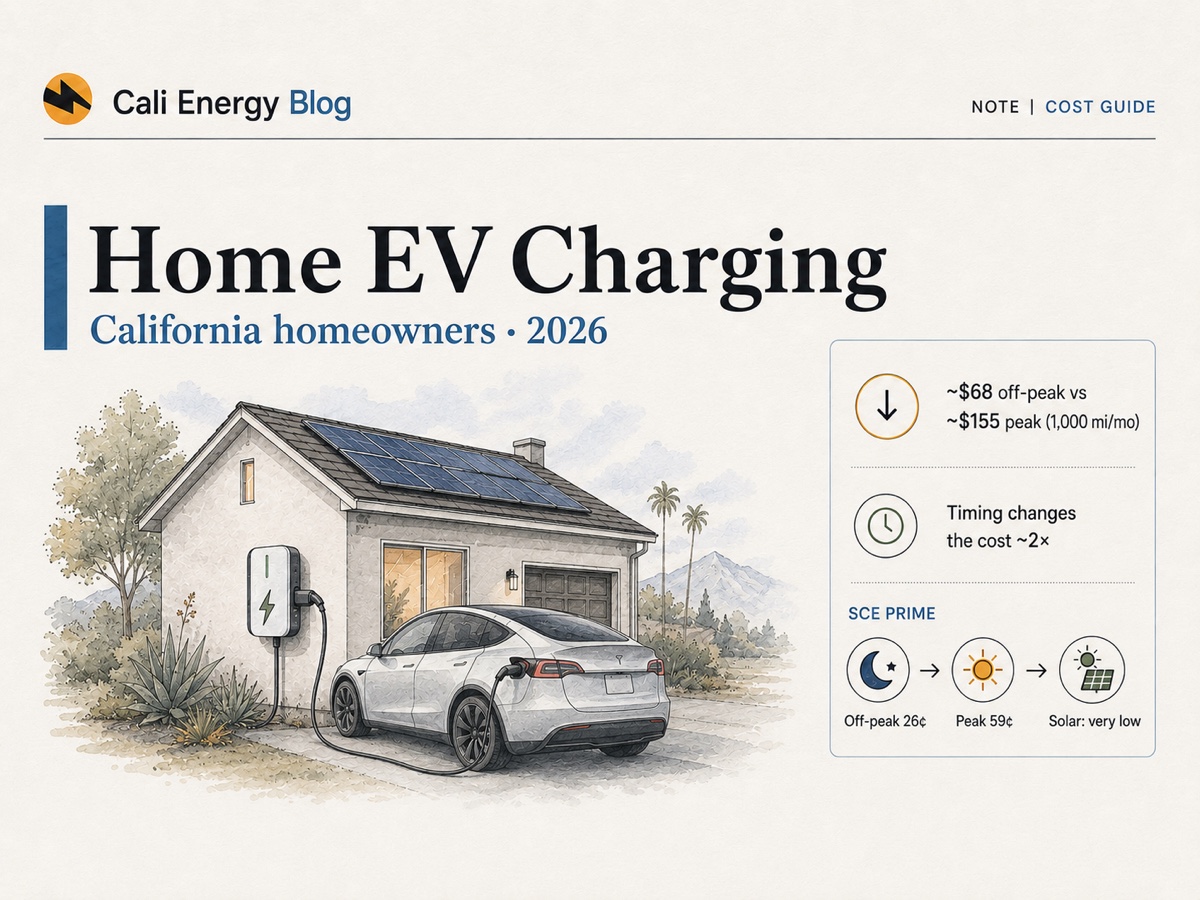
Quick answer
- Charging overnight costs about 6.5–9¢ per mile in the LA area for an efficient EV — against 18.4¢ per mile for a 30 mpg gas car at California's current $5.52/gallon.
- On LADWP the price of an EV kilowatt-hour depends on how much your house already uses. The tiered R-1A rate charges car charging at whatever tier it lands in on top of the household — 35.5¢/kWh for a typical home this summer, 45.1¢ for a heavy one, tax included.
- Switching to LADWP's time-of-use rate (R-1B) and charging after 8 p.m. prices that same energy at a flat 26.5¢/kWh in summer, tax included — the single biggest lever for a Los Angeles EV owner, and one most guides never mention.
- On SCE the lever is the clock, not the tier. TOU-D-PRIME is about 26¢/kWh off-peak and about 59¢ during the 4–9 p.m. summer peak — a 2.3× swing on identical energy.
- Electricity is not always cheaper. Charge a thirsty EV during SCE's summer peak and it can cost more per mile than gasoline. The model below shows exactly where that line falls.
What charging your car actually costs
Pick your car, your mileage and your rate. The model prices the same energy five ways and compares it with gasoline.
Summer rates (LADWP July–September; SCE summer). LADWP figures include the 10% City of Los Angeles Electricity Users Tax and are marginal — the difference between your bill with the car and without it, which is what tiered pricing actually charges you. R-1B adds a $12/month service charge and SCE PRIME a $0.79/day basic charge; both are shown separately below because you pay them whether or not you own a car. Planning estimate, not a quote.
Why an EV kilowatt-hour costs more than your average rate
This is the part almost every charging-cost guide gets wrong.
LADWP's standard residential rate, R-1A, is tiered: the first block of monthly kilowatt-hours is cheap, the next block costs more, and in summer a third block costs more still. Your car does not get the cheap block. It arrives on top of everything the house already used, so it is billed at the highest tier your household reaches.
That is why the same 250 kWh of charging can cost noticeably different amounts in two houses on the same street:
| Household use before the car | Tier the charging lands in | Cost of the charging | Effective rate |
|---|---|---|---|
| 200 kWh — small apartment | Tier 1 & 2 | $79.07 | 31.6¢/kWh |
| 500 kWh — typical house | Tier 2 | $88.73 | 35.5¢/kWh |
| 800 kWh — larger house | Tier 2 | $88.73 | 35.5¢/kWh |
| 1,050 kWh — house with AC and a pool | Tier 3 | $112.66 | 45.1¢/kWh |
Cali Energy calculation from the LADWP R-1A Total Consumption Charge for July–September 2026 (26.408¢ / 32.267¢ / 40.968¢ per kWh), Zone 1 tier thresholds of 350 and 1,050 kWh per month, plus the 10% City of Los Angeles Electricity Users Tax. Rates from LADWP Schedule R-1.
The 2026 rates this page uses
Straight from the two utilities' own schedules.
| Rate | Period | Jan–Mar | Apr–May | June | Jul–Sep |
|---|---|---|---|---|---|
| R-1A tiered | Tier 1 | 24.771¢ | 24.362¢ | 24.362¢ | 26.408¢ |
| R-1A tiered | Tier 2 | 30.630¢ | 30.221¢ | 30.221¢ | 32.267¢ |
| R-1A tiered | Tier 3 | 30.630¢ | 30.221¢ | 38.922¢ | 40.968¢ |
| R-1B time-of-use | Base — 8 p.m.–10 a.m. weekdays, all weekend | 25.293¢ | 24.884¢ | 24.494¢ | 26.540¢ |
| R-1B time-of-use | Low Peak — 10 a.m.–1 p.m., 5–8 p.m. weekdays | 27.647¢ | 27.238¢ | 27.238¢ | 29.284¢ |
| R-1B time-of-use | High Peak — 1–5 p.m. weekdays | 27.647¢ | 27.238¢ | 33.078¢ | 35.124¢ |
Source: LADWP Schedule R-1 — Residential Service, Total Consumption Charge tables (these already include LADWP's quarterly adjustment factors). R-1A adds a Power Access Charge of $2.30 / $7.90 / $22.70 per month by tier; R-1B adds a $12.00 monthly service charge. October–December 2026 was not yet published when this page was verified.
On the SCE side the plan that matters for an EV household is TOU-D-PRIME. SCE's own rate-plan page states its highest rates run 4–9 p.m., that it carries a $0.79 per day Base Services Charge, and that unlike the standard TOU plans it comes with no baseline credit. Summer energy runs roughly 26¢/kWh off-peak against about 59¢ on-peak; the plan comparison and how PRIME differs from TOU-D-4-9PM and 5-8PM is in SCE time-of-use plans compared.
Structural terms from SCE — Time-of-Use Residential Rate Plans. Per-kWh figures are approximate summer values; confirm yours in your SCE account, since they vary by baseline region and tariff update.
When electricity is not cheaper than gasoline
The honest edge case, because it is a real one.
“EVs are cheaper to fuel” is true for almost every overnight charger in California. It stops being true in one specific combination: a power-hungry EV charged during SCE's 4–9 p.m. summer peak.
A Hyundai Ioniq 5 N is rated by the EPA at 43 kWh per 100 miles. Drive 1,000 miles a month and it needs 430 kWh. At PRIME’s 4–9 p.m. peak — which on that plan applies all year, not only in summer — that is $253.70. The same 1,000 miles in a 30 mpg gas car costs $184.00 at $5.52 a gallon. Move that identical charging to the off-peak window and it falls to $111.80 — less than half the gas bill, and less than half the peak-hour cost of the very same electricity.
Both sides of that comparison use the same 1,000 miles and the same month. The EV figures exclude the $0.79/day basic charge and the gas figure excludes oil changes and other maintenance, so it is an energy-to-energy comparison, not a total cost of ownership.
What to actually do about it
Four steps, in the order that pays.
- Schedule the charge, don't plug and hope. Every EV and every Level 2 charger can start charging at a set time. On SCE set it after 9 p.m.; on LADWP R-1B set it after 8 p.m. This single setting is worth more than any hardware choice.
- Find the number your car actually uses. The EPA figure on fueleconomy.gov is in kWh per 100 miles and is measured at the wall, so it already includes charging losses — do not add another allowance on top.
- Check which tier your house lands in. Take the kWh from your LADWP bill, divide by the days in the period, and multiply by 30. If that number plus your charging crosses 1,050 kWh in Zone 1 or 1,500 in Zone 2 during summer, your car is being billed at 40.968¢ before tax — and R-1B is worth a serious look.
- Ask about the LADWP EV discount. LADWP's Schedule R-1 provides a discount “on the block of energy designated by the Department as necessary for basic vehicle charging,” with proof of vehicle registration and charging location required. The schedule does not publish the discount amount or the metering arrangement, so ask LADWP directly what applies to your address rather than relying on figures quoted in third-party guides.
What this page does not cover
It does not price the charger or its installation — that is in what a Level 2 charger costs to install in Los Angeles. It does not tell you whether your electrical panel can carry one; see planning an all-electric home. It does not size a solar array for your driving — that is how many solar panels it takes to charge an EV. And it does not model public DC fast charging, which is priced entirely differently and is usually two to three times the cost of charging at home.
The rates here are residential schedules published for 2026 and change on their own timetables — LADWP adjusts quarterly, SCE through the CPUC. Both utilities publish the current numbers; the links are in the sources below.
Daytime charging on your own panels is the cheapest energy on this page
Electricity you generate and use immediately has no per-kWh price at all — you already bought it with the system. The catch is timing: most cars are away during peak production, so capturing it usually means a battery or a car that sits at home during the day. And under NEM 3.0, exporting midday and pulling back at night no longer nets out one-for-one at SCE, PG&E and SDG&E — which is what makes charging directly from your own panels worth more than exporting. LADWP is a municipal utility and is not on NEM 3.0; it still credits exports at the retail rate.
The export mechanics are in NEM 3.0 explained. Note that the 30% federal Residential Clean Energy Credit is not available for homeowner-owned systems placed in service after December 31, 2025, so model any new system without it.
Frequently asked
How much does it cost to charge an EV at home in California in 2026?
Why does my EV charging cost more per kWh than my utility's advertised rate?
Is LADWP or SCE cheaper for charging an EV?
Should I switch to LADWP's time-of-use rate for an EV?
Can charging at home ever cost more than gasoline?
Do I need to add charging losses to the EPA number?
Related reading
Sources & methodology
Figures on this page come from the primary sources below and, where noted, from Cali Energy calculations using the stated assumptions. Rates, incentives, and program terms change; each was verified September 4, 2026.
- LADWP — Schedule R-1 Residential Service (R-1A and R-1B Total Consumption Charge tables, 2026)
- LADWP — Residential Electric Rates (tier thresholds, zones, R-1B time periods)
- SCE — Time-of-Use Residential Rate Plans (TOU-D-PRIME: 4–9 p.m. peak, $0.79/day, no baseline credit)
- U.S. EPA / DOE — fueleconomy.gov, EPA combined kWh per 100 miles by model
- U.S. EPA — Fuel Economy and EV Range Testing (EV energy measured at the wall outlet)
- U.S. EIA — Weekly Retail Gasoline Prices, California
- CPUC — Net Billing Tariff (NEM 3.0)
- IRS — Residential Clean Energy Credit
Want the charging to run on your own power instead?
Cali Energy sizes solar and battery systems around how you actually drive — so more of your charging comes off your roof and less off the tier you happen to land in. In-house crews across LADWP, SCE and the Burbank/Glendale municipals. Call +1 (323) 844-7777 for a straight assessment.
Get a free estimatePrepared by Cali Energy, September 4, 2026. This article is for general educational purposes only and is not legal, tax, financial, engineering, or utility advice. Rates, incentives, codes, permit requirements, equipment specifications, prices, and program terms may change; figures and timelines are estimates, not guarantees. Confirm current requirements with the applicable utility, AHJ, program administrator, manufacturer, or a licensed professional. See our Content Disclaimer. Cali Energy · 19201 Parthenia St, Unit E, Northridge, CA 91324 · CSLB #1032379 (B, C-10, C-39)