

Do You Need a Main Panel Upgrade for Solar?
Straight answer: many homes don’t. A 200-amp panel with a 200-amp main leaves room for about a 7.6 kW inverter without touching anything, which covers most single-family homes. Upgrades get likely with a 100A or 125A panel, when the panel is full, or when a battery or EV charger joins the project. One condition decides more cases than capacity does, and almost nobody explains it: under the 120% method the solar breaker has to land at the opposite end of the busbar from the main. Where it can’t, that method allows nothing at all, and the electrician moves to a different one.
Get a free estimate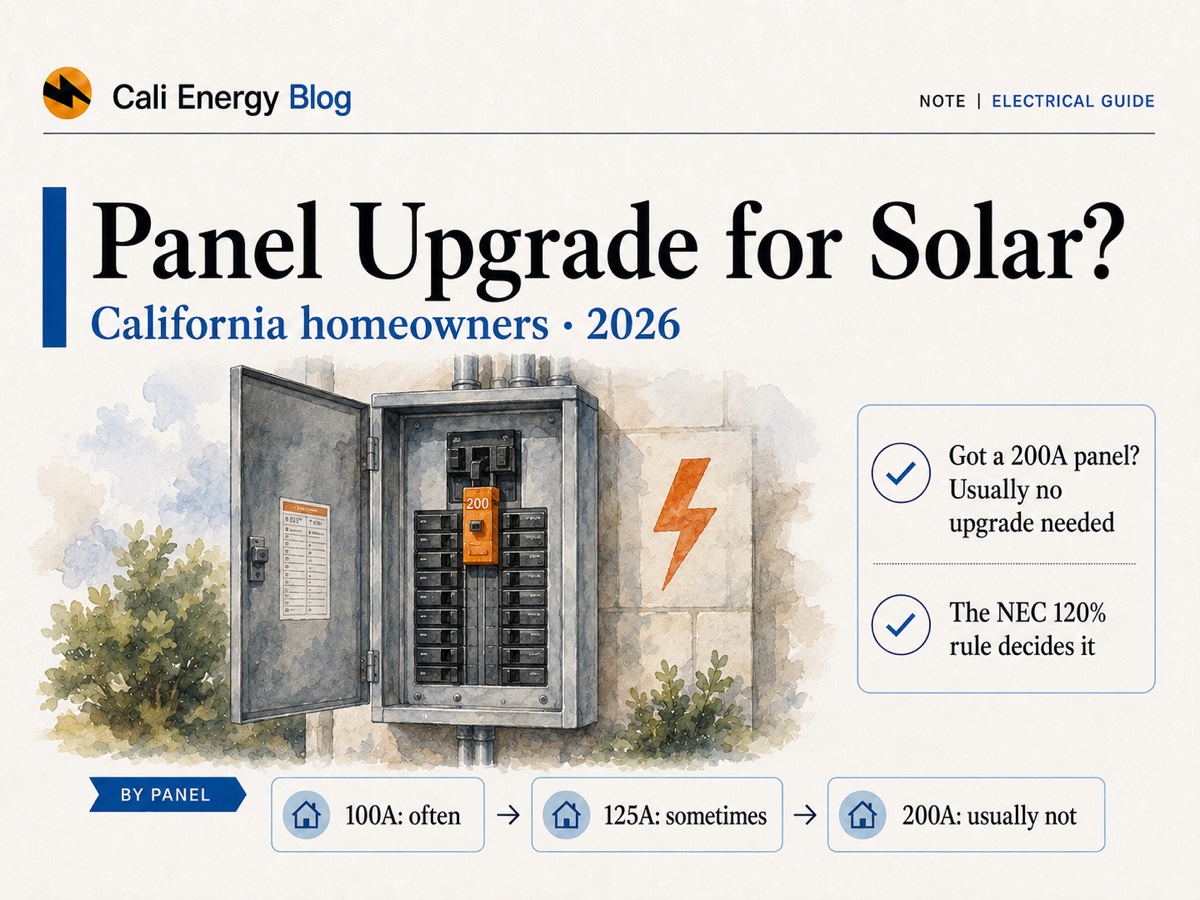
- The rule is 125% of the inverter’s output current plus the main breaker rating ≤ 120% of the busbar rating. The headroom in amps is not the size of the system — divide it by 1.25 first.
- A 200A panel with a 200A main has 40A of headroom, which is 32A of continuous inverter output, or about 7.6 kW — enough for most homes, no upgrade needed.
- The 120% method applies only where the solar breaker sits at the opposite end of the busbar from the main. Where it cannot, a panel whose main equals its busbar allows zero backfeed under that method — and the electrician moves to the sum-of-breakers method at 705.12(B)(3), a supply-side connection, or a panel change.
- California has been on the 2025 California Electrical Code (2023 NEC) since January 1, 2026, where the rule is 705.12(B)(2). Which edition governs your job is set by the date you applied for the permit.
- In Los Angeles a panel upgrade has consequences beyond the wire: it can push you off LADBS’s express solar permit and out of LADWP’s simpler interconnection track.
The honest short answer
We hold a C-10 electrical license, so we will say what a salesperson often won’t: a lot of homes need no panel upgrade at all. If yours has the common modern setup — a 200-amp busbar with a 200-amp main breaker — a typical residential system fits under the code with capacity to spare. The homes that genuinely need an upgrade fall into a few clear buckets, and you can spot most of them before you sign anything.
The whole question comes down to one rule about how much current a panel’s busbar can carry when the utility and your solar feed it from both ends. Understand that rule and the mystery goes away.
The 120% rule, and the one step most summaries skip
The rule itself is short. What gets lost is that the number it limits is the inverter’s current, not the breaker’s rating.
Inside every panel is a busbar, the metal spine every breaker clips onto. It has an ampere rating — 100, 125, 200, 225. The utility feeds one end through the main breaker; a load-side solar system feeds the other end through a backfeed breaker. Because current stacks from both ends, the code caps the total.
Here is the rule, quoted from the California Electrical Code: “Where two sources, one a primary power source and the other another power source, are located at opposite ends of a busbar that contains loads, the sum of 125 percent of the power-source(s) output circuit current and the rating of the overcurrent device protecting the busbar shall not exceed 120 percent of the ampacity of the busbar.” The same section adds that the busbar must still be sized for its connected loads under Article 220.
Notice what is being limited: 125 percent of the inverter’s output current. That matters when you turn the arithmetic into a system size. The amps of headroom you calculate are not the amps of inverter you can install — divide by 1.25 first. (California’s own standard plan states the same rule in terms of the combined solar breaker rating, which comes to the same place, because the breaker already carries the 125 percent factor.)
Work the common case. A 200A busbar × 120% is 240A. Subtract the 200A main and 40A of headroom remains. That 40A is 125% of the inverter, so the inverter itself is capped at 40 ÷ 1.25 = 32A continuous, which at 240 V is 7,680 W — a 7.6 kW inverter is the largest standard unit that fits, on a 40A backfeed breaker. That is why so many 200A homes need no upgrade.
If the solar breaker can’t go at the far end, this method allows nothing
The 120% allowance is not a property of the panel. It is one of several methods the code offers, and it applies only where the two sources sit at opposite ends of the busbar. California’s own Solar Permitting Guidebook tabulates both cases: for a 125A busbar with a 125A main, the maximum combined solar overcurrent device is 25A at the opposite end — and 0A if it is anywhere else. Same shape at 100A and 200A.
In an older load center the far-end slot is frequently already taken, which is why two homes with identical panels can get opposite answers. It also means the breaker cannot simply be moved later: the code requires a permanent label with this or equivalent wording — “WARNING: POWER SOURCE OUTPUT CONNECTION — DO NOT RELOCATE THIS OVERCURRENT DEVICE.” That label governs the power-source breaker, not the load breakers around it, so rearranging a load circuit to free the far-end space is often possible.
And zero under this method is not zero altogether. Where the far-end position cannot be had, the code offers another route at 705.12(B)(3): the sum of the ampere ratings of all overcurrent devices on the panelboard, load and supply, excluding the one protecting the busbar, may not exceed the busbar ampacity — with no position requirement. On a fully loaded 200A panel that usually leads nowhere, but it is the next test an electrician runs, ahead of a supply-side connection or a panel change.
Your panel → what actually fits
This assumes the typical case where the main breaker equals the busbar rating, the solar breaker lands at the opposite end, and a 240 V split-phase service. Both figures are shown — the headroom in amps, and the inverter that headroom really permits.
| Existing panel | 120% of busbar | Headroom | Inverter it permits | Backfeed breaker | Likely need an upgrade? |
|---|---|---|---|---|---|
| 100A | 120A | 20A | 16A · 3.84 kW | 20A | Often yes — tight even for solar alone, almost always with a battery or EV charger |
| 125A | 150A | 25A | 20A · 4.80 kW | 25A | Sometimes — fits a small system; upgrade likely for average-plus usage or add-ons |
| 200A | 240A | 40A | 32A · 7.68 kW | 40A | Usually no for solar alone — the common, comfortable case |
| 225A with a 225A main | 270A | 45A | 36A · 8.64 kW | 45A | Rarely for solar alone |
| 225A with a 200A main — the usual “solar-ready” pairing | 270A | 70A | 56A · 13.44 kW | 70A | Rarely — room for battery and EV too |
Headroom is 120% of the busbar minus the main breaker. The inverter column is that headroom divided by 1.25, because the code limits 125% of the inverter’s continuous output current, and the kilowatts are that current at 240 V — a 120/208 V service yields about 13% less. Note the two 225A rows: the widely-quoted “70A and 13 kW” belongs to a 225A busbar with a 200A main, not a 225A main. Every row assumes the opposite-end position and that the main breaker equals the busbar except where stated; a main materially below the busbar is the derate case, where the service rather than the busbar becomes the binding limit and a load calculation is required. Values calculated from the 2025 California Electrical Code (Title 24, Part 3) 705.12(B)(2). California’s Solar Permitting Guidebook tabulates the same arithmetic in its Table 4, but caps several pairings at 60 A because its standard plan is limited to 10 kW AC — an expedited-permit limit, not a code limit — and it is written to older section numbering.
Screen your own panel
Enter what is stamped on your main breaker and the panel label. This is a simplified screen against the 120% method — it flags the likely path, not a permit or plan-check determination. A licensed electrician confirms the real answer against your service, your AHJ, your utility and the code edition your permit falls under.
Simplified 120% busbar screening tool
A first-look screen for whether your panel has room for solar.
Simplified screen only, and only against the 120% method. Headroom is 120% of the busbar minus the main breaker; the inverter ceiling is that headroom divided by 1.25, per 705.12(B)(2) of the 2025 California Electrical Code. It assumes the busbar is also adequate for its connected loads under Article 220, and where the main breaker is below the busbar rating the service — not the busbar — is usually the binding limit. Backfeed breakers are sized at 125% of inverter output rounded up to the next standard rating (705.30(B)). Shared-inverter, PCS and export-limited setups are not screened here, and a derate needs a real load calculation. Not a permit or plan-check determination.
Which code edition applies to your job
Section numbers moved twice in six years, and the edition that governs your project is not necessarily the newest one.
| Code edition | Section | In force in California |
|---|---|---|
| 2017 NEC | 705.12(B)(2)(3)(b) | Superseded |
| 2020 NEC — the 2022 California Electrical Code | 705.12(B)(3)(2) | January 1, 2023 to December 31, 2025 |
| 2023 NEC — the 2025 California Electrical Code | 705.12(B)(2) | Since January 1, 2026 |
Two things follow. First, the naming is a trap: the 2025 California Electrical Code took effect on January 1, 2026, just as the 2022 edition took effect in 2023. The edition year always runs a year ahead of the effective year.
Second, and more practically: under California Health and Safety Code § 18938.5 the standards that apply are those in effect when the building permit application was filed. A job permitted in late 2025 is still under the 2022 code and the 2020 NEC numbering, even though it is being built now. If a plan check cites a section you cannot find, that is usually why.
The arithmetic did not change across any of these editions. What changed is where the rule sits and, in 2023, that the whole busbar menu now applies only to equipment with no specific listing for combining multiple sources — listed multi-source equipment follows its listing instead.
How to read your own panel in two minutes
You can usually answer “do I have room?” yourself, then have it confirmed. Open the outer door only. Never remove the interior cover that sits behind it — the terminals under that cover stay energized even with the main breaker off — and touch nothing inside.
1. Read the main breaker
Open the panel door. The single large breaker at the top or bottom has a number stamped on its handle — 100, 125, 150, 200. That is your main breaker rating.
2. Find the busbar rating
The label sticker inside the door usually lists the bus rating in amps — on older panels it often does not, and then it has to be read by an electrician rather than guessed. Usually it matches the main breaker, but not always — and when it differs, both numbers go into the math. A 200A main on a 225A bus is worth 30 A more of headroom than a 200A main on a 200A bus.
3. Look at the far end of the bus
The decisive one. Is there a free double-pole space at the opposite end from the main? If that end is full, the 120% method is off the table regardless of what the amps say.
4. Note the condition
Rust, scorch marks, loose or discolored terminations, or aluminum branch wiring can mean the panel gets replaced for safety reasons that have nothing to do with solar.
When you most likely do need an upgrade
Being honest about the exceptions: these are the situations where an upgrade, or a code-compliant workaround, is genuinely on the table.
A 100A or 60A panel
Older Los Angeles and Valley homes often have one. It permits about a 3.8 kW inverter at best, and modern homes with air conditioning usually want the service capacity anyway.
You are adding a battery
A battery inverter backfeeds the same busbar, competing with solar for the same headroom — the code sums 125 percent of both source currents against the same allowance. On its own breaker it also needs space at the same far end of the bus, and there is only one far end. It often tips a 100A or 125A panel over the line by itself.
You are adding an EV charger
A charger is a continuous load, not a source, so it is not a term in the 120% calculation — though it is one under the sum-of-breakers method, and it enters the service load calculation either way, and on a smaller panel that is often what forces the upgrade. See our EV charging guide.
The far-end space is taken
Not a capacity problem but a geometry one, and it produces the same answer. Sometimes rearranging circuits frees the position; sometimes it does not.
The panel is full or unsafe
No open spaces, damage, or terminations that have run hot mean the panel gets replaced. Solar is just the moment it surfaces.
California adds one of its own
The state does not permit reconditioned panelboards, so a replacement has to be new equipment. The reserved-breaker-space rules people sometimes cite here — spaces for a heat pump water heater, electric cooktop and the rest — come from the Energy Code and apply to newly constructed dwellings, not to replacing a panel in an existing home.
Neither was recalled — and the brand alone doesn’t force a replacement
You will read that these panels were “recalled.” They were not. The Consumer Product Safety Commission opened an investigation into Federal Pacific Stab-Lok breakers in 1980, and its own testing confirmed that some failed certain UL calibration tests. On December 8, 1982 the Commission voted to close the case without issuing a complaint, saying the data did not establish a serious risk of injury and that gathering more would cost several million dollars. It made no safety determination either way. For Zinsco there is no federal recall, no investigation and no agency finding at all — the concerns are documented by home inspectors, forensic engineers and insurers, not by a regulator.
Nor does California or Los Angeles require replacing a panel because of its brand. If anything the statute runs the other way: Health and Safety Code § 17920.3(d), which defines substandard housing for code-enforcement purposes, carves out wiring that conformed to the law when installed and is in good and safe condition. That is a definition for enforcement, not a shield — an inspector, a utility or an insurer can still require work on a specific panel. What actually forces a replacement is the condition of your particular panel — overheated or loose terminations, a breaker that will not seat — or the interconnection math above. Insurers are a separate matter and some decline to write policies on these panels, which is a market practice rather than a code requirement.
What a panel upgrade triggers in Los Angeles
The wiring is the easy part. In LA an upgrade changes which permit you get and which interconnection track you land in — and that is usually what moves the timeline.
| Threshold | What crossing it means |
|---|---|
| Service panel above 225A | LADBS’s express solar permit is limited to systems of 10 kW or less on a one- or two-family rooftop at 120/240 V, with a service panel not exceeding 225 amperes. Go past it and the job goes to plan check. |
| New total connected load above 400A | Plan check is required under the Los Angeles Electrical Code, as it is for equipment rated 600A or more. |
| Any service panel upgrade, LADWP territory | LADWP’s simpler Type 1 interconnection covers systems up to 30 kW that do not include a service panel upgrade. Including one moves the project to Type 2, which adds engineering review. |
| Overhead residential service, 400A or less | You need a meter spot sheet from an LADWP Electric Service Representative before LADBS inspects. For services up to 200A single phase, the LADBS inspector performs the final inspection on LADWP’s behalf, then releases it electronically so LADWP can set the meter. |
Los Angeles County is a separate authority with its own electrical code for unincorporated areas and contract cities, and SCE territory follows SCE’s own process rather than LADWP’s. Confirm your address before assuming any of the above.
What it costs
The figures below are typical ranges from Cali Energy’s 2026 work, city permit included — not a published statistic, a quote or a fixed price; a written quote after a site visit sets yours. The closest independent benchmark — a 2025 national survey by Berkeley Lab, with a $3,500 median for a single-family main panel replacement — is broken down in main panel upgrade cost in Los Angeles.
| Scope | Typical range | When it applies |
|---|---|---|
| Panel (breaker box) upgrade | $3,000 – $4,500 | Same service size, or 100A to 200A, panel swapped in place |
| Panel plus service drop, meter or mast | $3,000 – $4,500 | Utility conductors, meter or mast must be upgraded too |
| Full service upgrade with trenching or relocation | $6,000 – $15,000+ | Underground service, panel relocation or major rework |
One part of the bill is more predictable than the rest. LADWP states that where a service is being upgraded and the existing LADWP service is already adequate for the new demand, there are generally no installation charges; everything beyond that is quoted case by case by a Service Planning Engineer. So the utility side of an upgrade is often zero — it is the panel, the labor, the permit and any mast or meter work that carry the cost.
Alternatives to a full upgrade
An upgrade is not the only path. Often a cheaper, code-compliant route gets the system in without replacing the panel — and which one fits is an electrician’s call, not a salesperson’s.
Supply-side (line-side) connection
Land the solar ahead of the service disconnect, so the busbar calculation does not apply. The limit moves rather than disappears: under 705.11 of the code now in force, the sum of the power-source continuous current output ratings on the service — other than any controlled by a listed power control system — may not exceed the ampacity of the service conductors. In practice the constraints are a listed service-rated disconnect or tap and correctly sized conductors, and in Los Angeles the utility has its own say.
Main-breaker derate
Swap the main for a smaller one — 200A down to 175A frees 25 A of headroom, worth about 4.8 kW more inverter. It works only where a load calculation justifies the smaller main and the result stays at or above the 100 A minimum the code sets for a one-family dwelling service. That floor is why the derate is no help on the panels that need it most: a 100A service cannot be derated at all.
Power control system
A listed power control system or energy management system can limit what the sources put onto the busbar. The code then uses the controller setpoint in place of the inverter output current in the busbar math, which can make a panel work that would fail a raw calculation. A plain smart panel does not do this — only a device listed for power control. Our smart panel guide goes further.
Size the system to the panel
The least discussed option and often the sanest. If 7.6 kW covers your usage, a 200A panel needs nothing done to it. Check what you actually need before paying to enlarge what you have.
Have the panel read by an electrician, not a salesperson
We hold a C-10 electrical license (CSLB #1032379), so this assessment happens in-house and an upgrade gets recommended only where the code actually requires one. If your 200A panel has room, we will say so. Ask any company quoting an upgrade to show you three numbers: your busbar rating, your main breaker rating, and whether the far-end position is available.
Get a free panel & solar assessmentFrequently asked
Do I really need a main panel upgrade to go solar?
Often, no. A 200A busbar with a 200A main breaker — the common modern setup — leaves 40A of headroom, which permits an inverter of about 7.6 kW and covers most single-family homes. Upgrades become likely with an older 100A or 125A panel, when the panel is full or damaged, or when a battery or EV charger joins the project. One condition decides a surprising number of cases: under the 120% method the solar breaker must land at the opposite end of the busbar from the main, and if that position is not available the method allows nothing — at which point the electrician tests the sum-of-breakers method at 705.12(B)(3), a supply-side connection, or a panel change.
What exactly is the 120% rule?
It caps how much current can be pushed onto a panel's busbar from both ends. Quoted from the California Electrical Code: “Where two sources, one a primary power source and the other another power source, are located at opposite ends of a busbar that contains loads, the sum of 125 percent of the power-source(s) output circuit current and the rating of the overcurrent device protecting the busbar shall not exceed 120 percent of the ampacity of the busbar.” In the 2025 California Electrical Code, in force since January 1, 2026, that is section 705.12(B)(2). Note what is limited: 125% of the inverter's output current. It is also only one of several permitted busbar methods.
How big a solar system fits on my 200-amp panel?
About 7.6 kW of inverter, assuming a 200A main and a 240 V service. The arithmetic: 200A × 120% = 240A, minus the 200A main leaves 40A of headroom; that 40A is 125% of the inverter output, so the inverter is capped at 32A continuous, which at 240 V is 7,680 W. It lands on a 40A backfeed breaker at the opposite end of the bus. If your panel has a 225A busbar with a 200A main — worth checking the label — the headroom is 70A and the ceiling rises to about 13.4 kW.
Why do I keep seeing different numbers for the same panel?
Two reasons. First, many explanations treat the headroom in amps as the system size, which overstates it by 25% — the code limits 125% of the inverter current, so the headroom has to be divided by 1.25. Second, the widely-quoted “70 amps and 13 kW” for a 225A panel assumes a 200A main; with a 225A main the same busbar gives 45A and about 8.6 kW. Both the busbar rating and the main breaker rating have to be read off the panel, and they are not always the same number.
Which code edition applies to my project?
The one in effect when your building permit application was filed, under California Health and Safety Code § 18938.5. California has been on the 2025 California Electrical Code (which adopts the 2023 NEC) since January 1, 2026, where the busbar rule is 705.12(B)(2). A job permitted between 2023 and the end of 2025 falls under the 2022 code, where the same rule is 705.12(B)(3)(2). The math is identical in both; only the section number moved. And note the naming: the “2025” edition took effect in 2026.
Were Zinsco and Federal Pacific panels recalled?
No. The Consumer Product Safety Commission investigated Federal Pacific Stab-Lok breakers starting in 1980 and confirmed by its own testing that some failed certain UL calibration tests, but in December 1982 it voted to close the case without issuing a complaint, saying the data did not establish a serious risk and that gathering more would cost millions. It made no safety determination either way. For Zinsco there is no federal recall, investigation or finding at all. Neither California nor Los Angeles requires replacing a panel because of its brand — replacement is driven by the condition of your particular panel or by the interconnection math. Insurers may take their own view.
Does a battery or EV charger change the answer?
Differently. A battery inverter is a source: the code sums 125 percent of both source currents against the same allowance, so it competes with solar for the same headroom and, on its own breaker, for the same single space at the far end of the bus. It often tips a 100A or 125A panel over by itself. An EV charger is a continuous load, not a source — the code says explicitly that EV charging loads are considered continuous — so it is not a term in the 120% calculation, though it is one under the sum-of-breakers method. Either way it enters the service load calculation, and on a smaller panel that is frequently what forces the upgrade. Load management can change that result.
What does a panel upgrade cost?
In Cali Energy’s 2026 work, a panel replacement typically runs about $3,000–$4,500, city permit included, whether or not the service drop, meter or mast is upgraded with it; underground service or relocation, about $6,000–$15,000+. One part is more predictable: LADWP states that where the existing service is already adequate for the new demand there are generally no installation charges from the utility, with anything beyond quoted case by case by a Service Planning Engineer. Those are typical ranges from our work, not a published statistic or a quote; the closest independent benchmark, a 2025 national survey by Berkeley Lab, found a $3,500 median for a single-family main panel replacement. The full breakdown is in main panel upgrade cost in Los Angeles.
Can I avoid the upgrade altogether?
Sometimes. Where the far-end position is unavailable, the sum-of-breakers method at 705.12(B)(3) has no position requirement, though on a fully loaded panel it usually leads nowhere. A supply-side connection lands the solar ahead of the service disconnect so the busbar rule does not apply — the limit moves to the service, where the sum of the power-source continuous current output ratings may not exceed the ampacity of the service conductors. A main-breaker derate frees headroom where a load calculation justifies a smaller main and the result stays at or above the 100 A minimum for a one-family dwelling service — which is why it cannot rescue a 100A panel. A listed power control system lets the code use the controller setpoint instead of the inverter's output current. And the simplest option is often overlooked: size the system to the panel you have, if it already covers your usage.
Does upgrading the panel slow down my solar project in Los Angeles?
It can, and not because of the wiring. LADBS's express solar permit is limited to systems of 10 kW or less on a one- or two-family rooftop with a service panel not exceeding 225 amperes; beyond that the job goes to plan check, as it does when new total connected load exceeds 400A. On the utility side, LADWP's simpler Type 1 interconnection covers systems up to 30 kW that do not include a service panel upgrade — including one moves you to Type 2 and adds engineering review. You will also need a meter spot from an LADWP Electric Service Representative before LADBS inspects.
Related reading
Sources & methodology
Figures on this page come from the primary sources below and, where noted, from Cali Energy calculations using the stated assumptions. Rates, incentives, and program terms change; each was verified September 28, 2026.
- California Electrical Code (Title 24, Part 3) — California Building Standards Commission
- California Solar Permitting Guidebook — Table 4, maximum combined supply OCPDs by busbar rating
- NFPA 70 (National Electrical Code) — free read-only access
- LADBS — solar photovoltaic permits and requirements
- LADWP — interconnection program for NEM (PV), BESS and cogeneration projects
- LADWP — charges and fees for electric service requests
- CPSC — Federal Pacific Electric Stab-Lok investigation closed (Release 83-008, March 1983)
- CSLB — license lookup (verify C-10 electrical / C-39 roofing)
Not sure if your panel can handle solar?
We're a licensed C-10 electrical contractor (CSLB #1032379), not just a solar dealer — so we read your panel honestly and only recommend an upgrade when the code actually requires one. Send us a photo of your open panel and we'll tell you where you stand.
Get a free estimatePrepared by Cali Energy, September 28, 2026. This article is for general educational purposes only and is not legal, tax, financial, engineering, or utility advice. Rates, incentives, codes, permit requirements, equipment specifications, prices, and program terms may change; figures and timelines are estimates, not guarantees. Confirm current requirements with the applicable utility, AHJ, program administrator, manufacturer, or a licensed professional. See our Content Disclaimer. Cali Energy · 19201 Parthenia St, Unit E, Northridge, CA 91324 · CSLB #1032379 (B, C-10, C-39)