

Can Solar Panels Power a Whole House?
Yes — over a year. An average California home used about 6,040 kWh in 2024, and in Los Angeles roughly nine 400 W panels make that much. What panels alone cannot do is run the house when the sun is down: in an NREL model of an LA roof the array produces nothing for half the hours of the year, and a grid-tied system shuts off in a blackout. Nights, the evening AC peak and outages are a battery question.
Get a free estimate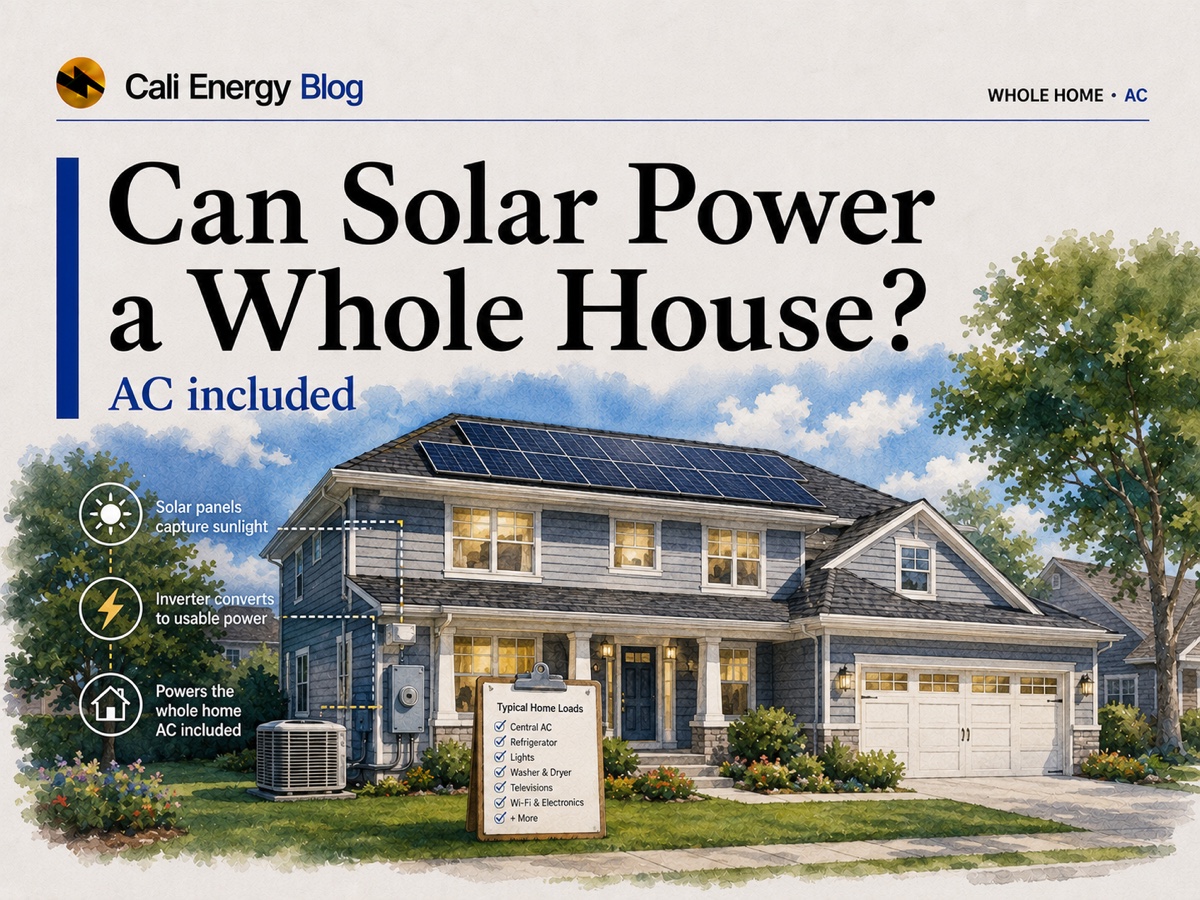
- Over a year, yes: about 3.6 kW (9 panels) covers an average California home; an average U.S. home takes about 16, a large all-electric home 20-plus.
- Not hour by hour: an LA array makes nothing for 51% of the year’s hours and only about a tenth of its output in the 4–9 p.m. peak window.
- Seasons trade off: a system sized to the year makes about 71% of an average month’s share in December and about 120% in summer; the bill nets them, differently on LADWP and SCE.
- Nights and outages need a battery — and whole-home backup is limited by power (kW) as much as by storage (kWh).
Four questions behind “power my whole house”
| Question | Short answer | What decides it |
|---|---|---|
| Make as much electricity in a year as the house uses? | Yes, in most LA homes | Your yearly kWh and usable roof area |
| Run the house in the evening and overnight? | Only with a battery | Battery kWh vs your evening and night use |
| Keep everything on in a blackout? | Only with a battery and backup equipment | Battery power (kW) and storage (kWh), which loads are backed up |
| Disconnect from the utility? | Possible, rarely worth it | December sun, days of storage, a generator |
Most people asking the question mean the first one, and that is also how installers size a system: to your annual consumption. The other three are about when the electricity is made, and that is where the sun sets the limits.
How many panels power a whole house in Los Angeles
The EIA’s 2024 figures put the average California home at 503 kWh a month — about 6,040 kWh a year, against 863 kWh a month nationally. In NREL’s PVWatts model of a south-facing 20° roof in Northridge, each kilowatt of panels makes about 1,700 kWh a year. Divide one by the other and you have the system size:
| Household | Yearly use | System size | 400 W panels | Module area |
|---|---|---|---|---|
| Average California home (EIA, 2024) | 6,036 kWh | 3.6 kW | 9 | ~175 sq ft |
| California average + one EV (12,000 mi/yr) | 9,636 kWh | 5.7 kW | 15 | ~295 sq ft |
| Average U.S. home (EIA, 2024) | 10,356 kWh | 6.1 kW | 16 | ~310 sq ft |
| Large all-electric home with AC, pool or two EVs | 15,000 kWh | 8.8 kW | 23 | ~450 sq ft |
Sources: EIA Table 5A, 2024 · NREL PVWatts v8, Northridge, 20° south, 14% losses · EV: 30 kWh per 100 miles, an EPA rating on fueleconomy.gov · module area at about 20.5 W per sq ft. Planning estimates, not a design.
A U.S.-sized home lands near the low end of the 15–25 panels often quoted nationally, and an average California home needs well under that. The real number comes from your own 12 months of bills, your roof’s direction and shade, and loads you plan to add. For the full method, see how many solar panels you need; for an EV on its own, panels to charge an EV.
December vs summer. In the same model, December makes 100 kWh per kW and August 175. A system sized to the year covers only about 71% of an average month’s share in December and makes about 120–125% of it in June through August. “Whole house” therefore means the year nets out, not every month.
What the bill does with that. On LADWP, exported energy is netted at retail prices under its NEM rider, so a system sized to the year can offset most of the energy charges. On SCE’s Solar Billing Plan, exports are credited at hourly export values that are low at midday, so the same system offsets the year in kilowatt-hours but not in dollars — and fixed charges stay on either bill. See average home electricity use in California.
Why panels alone can’t run the house around the clock
The same NREL hour-by-hour model shows the gap. Over the year the array produces nothing in 4,438 of 8,760 hours — 51%. Only about 11% of its yearly output arrives between 4 and 9 p.m., the window when electricity costs the most on time-of-use rates. On an average July day a 7 kW array looks like this:
| Clock time | Output | vs a 3,500 W central AC |
|---|---|---|
| 9 a.m. | ~2.8 kW | Covers most of it |
| 1 p.m. | ~5.0 kW | Covers it, with surplus |
| 5 p.m. | ~2.2 kW | Covers under two-thirds |
| 6 p.m. | ~0.9 kW | About a quarter |
| 7 p.m. onward | ~0 kW | None — grid or battery |
Source: NREL PVWatts v8 hourly output, Northridge, 20° south, July average, daylight time. Individual days vary with weather; see solar on cloudy and rainy days.
Then there are blackouts. A grid-tied inverter must disconnect within two seconds when the grid goes down (SCE Rule 21; certified grid-tied inverters are built to do this), so panels without a battery and backup equipment keep nothing running — even at noon. See do solar panels work at night?
Can solar run your air conditioning?
Over a summer, easily. A central AC drawing about 3,500 W and using about 10 kWh on a hot day (figures adapted from the EIA Residential Energy Consumption Survey; units vary widely) needs about 1.8 kW of panels to match on an average July day, when each kilowatt makes about 5.6 kWh. The catch is timing: after about 6 p.m., when the house is still hot, the AC runs on grid power or a battery. A battery can carry it if two numbers fit — its stored kWh for the evening, and its power and motor-start rating against the locked-rotor amps (LRA) on the outdoor unit’s nameplate. See heat and solar output in LA and SCE time-of-use plans.
Whole house at night or in an outage: the battery math
| What stays on | Energy per day | One battery, no sun | Power check |
|---|---|---|---|
| Critical loads: fridge, lights, Wi-Fi, furnace fan, medical device, pump | ~7.2 kWh | Close to two days | Fine |
| An average California home | ~16.5 kWh | Most of a day; the overnight part usually fits | Usually fine |
| Summer whole-home: plus central AC, electric water heater, EV charging | ~37 kWh | Under half a day | AC + water heater + EV = 14.5 kW, above 11.5 kW |
Sources: Tesla Powerwall 3 datasheet · load estimates adapted from EIA RECS · EIA Table 5A. Other batteries differ; the arithmetic is the same.
So a battery is not needed to offset your yearly use — it is needed to run the house after dark from your own solar and to keep it running in an outage. Two numbers decide whether a battery setup can back up the whole house: how many kWh it stores and how many kW it can deliver at once. Whole-home systems in LA usually stack two or more batteries, or back up only the circuits that matter and leave the EV charger and water heater off. With the sun recharging every day, the same battery lasts much longer in a multi-day outage; the outage and PSPS guide models that month by month, and whole-home vs critical-loads backup covers the panel and wiring side.
Whole house is not the same as off-grid
Off-grid means no utility at all, so the system has to cover the worst stretch, not the average. For an average California home in Los Angeles that means about 5 kW of panels just to match an average December day before battery losses, about 50 kWh of storage for three days — close to four 13.5 kWh batteries — and in practice a generator for long storms. In summer the surplus is wasted once the batteries are full. Almost every LA home that “runs on solar” stays connected; see grid-tied vs off-grid vs hybrid.
Sizing it for your house
Use 12 months of kWh
Add up a full year from your bills or the utility portal; one summer month overstates the year, one spring month understates it.
Count loads you will add
An EV, a heat pump or an induction range raises the yearly total; leaving roof space for them is cheaper than a second project.
Decide what “whole” means
Yearly offset, evenings, or blackouts — each adds equipment. Say which one you want before you compare quotes.
Check kW, not just kWh
For backup, compare the battery’s continuous and surge ratings with the loads you want on at the same time.
Where to go next
Cali Energy designs solar and battery systems for Los Angeles homes from the customer’s own usage data. Call +1-323-844-7777 or ask for a sizing review — production figures are estimates, not guarantees.
Frequently asked
Can solar panels power an entire house?
Over a year, yes — a system sized to your annual use makes as many kilowatt-hours as the house consumes. Hour by hour, no: panels make nothing at night, little after about 6 p.m., and a grid-tied system shuts off in a blackout. Running the house at those times takes a battery.
How many solar panels to power a whole house in California?
For an average California home (about 6,040 kWh a year), about nine 400 W panels in Los Angeles. An average U.S.-sized home (about 10,360 kWh) takes about 16, and a large all-electric home using 15,000 kWh about 23. Your own 12 months of usage and your roof decide the real number.
Can solar panels run air conditioning?
Yes over a summer: a central AC using about 10 kWh on a hot day needs roughly 1.8 kW of panels in July. But output falls to almost nothing by 7 p.m., so evening AC runs on the grid or a battery whose power and motor-start ratings fit the unit.
Do I need a battery to power my whole house with solar?
Not to offset your yearly use on a grid-tied system. You need one to run the house after dark from your own solar or during an outage. For whole-home backup, check both storage (kWh) and power (kW): AC, a water heater and EV charging together can exceed what one battery delivers.
Will solar panels power my house during a blackout?
Not on their own. A grid-tied inverter must shut off within two seconds when the grid goes down. With a battery and backup equipment, the backed-up circuits keep running and the panels recharge the battery during the day.
If solar powers my whole house, will my bill be zero?
Usually not. Fixed charges remain on every bill. On LADWP exports net at retail prices, so a right-sized system can offset most energy charges; on SCE’s Solar Billing Plan midday exports earn much less than evening imports cost, so the bill shrinks but rarely disappears.
Can solar make my house fully off-grid?
It can, but in Los Angeles that means sizing for December, about 50 kWh of storage for three days of average use and usually a generator. Where a utility line is available, staying connected is simpler and cheaper.
Related reading
Sources & methodology
Figures on this page come from the primary sources below and, where noted, from Cali Energy calculations using the stated assumptions. Rates, incentives, and program terms change; each was verified October 5, 2026.
- EIA — 2024 Average Monthly Bill, Residential (Table 5A): California 503 kWh/month, U.S. 863
- NREL — PVWatts v8 (hourly output, Northridge, 20° south, 14% losses)
- Tesla — Powerwall 3 datasheet (13.5 kWh usable, 11.5 kW continuous)
- SCE — Rule 21, Generating Facility Interconnections (anti-islanding, two seconds)
- LADWP — Service Rider NEM, Net Energy Metering
- SCE — How the Solar Billing Plan works
- EIA — Residential Energy Consumption Survey (appliance energy use)
- U.S. EPA / DOE — fueleconomy.gov (EV kWh per 100 miles)
- U.S. Department of Energy — Homeowner’s Guide to Going Solar
Cover your year — and your nights
Get a system sized to your actual usage, with battery and backup handled as their own step. Estimates, not guarantees.
Get a free estimatePrepared by Cali Energy, October 5, 2026. This article is for general educational purposes only and is not legal, tax, financial, engineering, or utility advice. Rates, incentives, codes, permit requirements, equipment specifications, prices, and program terms may change; figures and timelines are estimates, not guarantees. Confirm current requirements with the applicable utility, AHJ, program administrator, manufacturer, or a licensed professional. See our Content Disclaimer. Cali Energy · 19201 Parthenia St, Unit E, Northridge, CA 91324 · CSLB #1032379 (B, C-10, C-39)