

Do Solar Panels Work in Cloudy or Rainy Weather?
Straight answer: yes — at reduced output. Panels make power from all the light that reaches them, so clouds cut production rather than stop it. In a typical Los Angeles year, by NREL’s hour-by-hour model for a Northridge roof, 267 days produce at least 80% of a clear day, 80 days fall somewhere between a quarter and 80%, and 18 stormy days drop below a quarter — the darkest, a December storm, to about 4%. Nearly all the dark days fall between November and May, and together they make up less than 4% of the year’s output.
Get a free estimate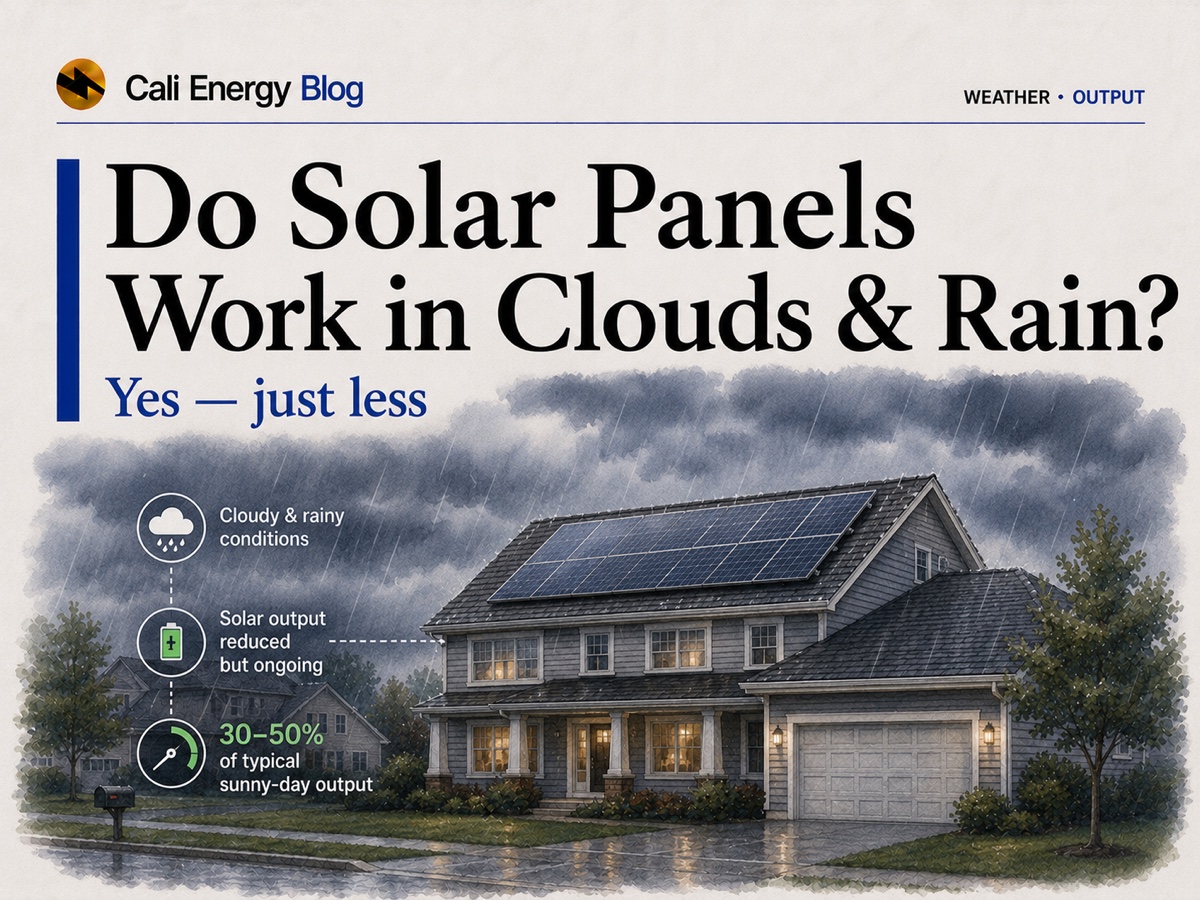
- Clouds reduce, they don’t switch off: panels respond to scattered sky light as well as direct sun.
- LA in numbers: 267 near-clear days, 56 partly cloudy days at 50–80%, 24 days at 25–50% and 18 days under 25% in a typical Northridge year.
- The dark days are few and seasonal: 38 of the 42 days below half output fall in November–May; together they make 3.6% of annual production.
- Weather is already in the estimate: the ~1,700 kWh per kW a year a south-facing LA roof makes includes clouds; a year of clear days would make about 2,050.
- Rain doesn’t hurt panels and usually rinses off dust; cold even helps efficiency slightly.
Do solar panels work on cloudy days?
Yes — output follows the light that gets through.
A solar panel turns the light that reaches it into electricity, whether that light comes straight from the sun or is scattered across the sky by clouds and haze. Thin high clouds or the morning marine layer trim output; thick storm clouds cut it hard; but as long as there is daylight, panels produce something. That is why the honest answer is a range, and why the useful question for a homeowner is how often each kind of day happens where you live.
How cloudy weather changes output in Los Angeles
A typical year, day by day.
| Output vs a clear day | Days a year | Typical weather |
|---|---|---|
| 80% or more of a clear day | 267 | Sunny or thin haze |
| 50–80% | 56 | Partly cloudy, marine layer |
| 25–50% | 24 | Mostly cloudy |
| Under 25% | 18 | Overcast or stormy |
Source: Cali Energy analysis of an hourly NREL PVWatts run (version 8, weather from the National Solar Radiation Database typical year, 14% system losses). A “clear day” is the 95th percentile day of its month. Weather labels are typical, not measured.
Overcast days in the general guides are said to produce roughly 10–25% of normal; LA’s numbers fit that, with its worst storm days lower still — the darkest day of the modeled year, December 24, made 0.17 kWh per installed kW, about 4% of a clear December day. But they are rare: if every day were as clear as the clearest days of its month, the roof would make about 2,050 kWh per kW a year instead of 1,700, so weather costs about 17% over the year, much of it on days that are only hazy.
Month by month
The rainy season, and May gray.
| Month | Clear day | Median day | Darkest day | Days below half |
|---|---|---|---|---|
| Jan | 4.63 | 4.03 | 0.49 | 7 |
| Feb | 5.39 | 4.78 | 0.28 | 6 |
| Mar | 6.14 | 5.43 | 0.77 | 6 |
| Apr | 6.35 | 5.81 | 1.07 | 3 |
| May | 6.42 | 5.89 | 1.55 | 6 |
| Jun | 6.27 | 5.90 | 3.58 | 0 |
| Jul | 6.11 | 5.80 | 2.26 | 1 |
| Aug | 5.95 | 5.72 | 4.13 | 0 |
| Sep | 5.77 | 5.36 | 2.97 | 0 |
| Oct | 5.38 | 5.11 | 1.40 | 3 |
| Nov | 4.78 | 4.17 | 0.45 | 2 |
| Dec | 4.38 | 3.96 | 0.17 | 8 |
Source: Cali Energy analysis of the NREL PVWatts hourly run above.
Low-output days cluster in the rainy season, November through March, with another handful in May, when the marine layer — locals call it May gray — reaches inland. June, August and September have none. On the coast the pattern shifts later: in Santa Monica June produces less than May (how much sun LA gets). Winter’s lower output is mostly shorter days and a lower sun, not clouds; see solar panels in winter.
Rain, fog, cold and snow
Rain
Panels are built for outdoor weather; rain does no harm and usually washes off the dust that builds up in a dry spell. A slow drift down that rain fixes is soiling; see solar not producing.
Fog and marine layer
Morning low cloud near the coast trims output until it burns off; it shows in the coastal months above as a smaller dip, not a shutdown.
Cold
Cool cells are slightly more efficient: modern modules lose only about 0.3% per °C above 25°C, so a cool bright day can beat a hot one; see heat and solar output.
Snow
In the LA basin and the San Fernando Valley winter means rain; snow on panels matters only at mountain elevations.
What a storm day means for your system
For a 6 kW system in Northridge, a median June day makes about 35 kWh and the worst June day about 21; a median December day makes about 24 kWh, and the darkest storm day about 1. Bills and net metering run over months or a year, so a storm day barely shows in the total. It matters for a battery in an outage: on a stormy winter day the roof will not refill it, so backup planning should assume a few days with little solar; see solar and battery for a multi-day outage.
Cloudy places run solar too. In the same EU model, panels in Berlin make about 1,010 kWh per kW a year and in Chicago NREL’s model gives about 1,310, against roughly 1,700 in the San Fernando Valley (PVGIS; PVWatts). In Los Angeles the sky is rarely what limits a system; roof direction, shade and your utility’s rules matter more.
Where to go next
Cali Energy is a licensed Los Angeles solar, battery and electrical contractor (CSLB #1032379). We model your own roof with local weather, so the estimate already includes cloudy days. Call +1-323-844-7777 or get a roof-specific estimate.
Frequently asked
Do solar panels work on cloudy days?
Yes, at reduced output. Panels use scattered sky light as well as direct sun. In a typical Los Angeles year modeled by NREL for a Northridge roof, 267 days make at least 80% of a clear day’s output and only 18 stormy days fall below a quarter.
How much do clouds affect solar panels?
It depends on the cloud. Hazy or partly cloudy days typically give 50–80% of a clear day; heavy overcast roughly 10–25%, and a winter storm can drop to a few percent — about 4% on the darkest modeled day in Northridge. Over a whole LA year, weather costs about 17% compared with all-clear days.
Do solar panels work in the rain?
Yes, at low output while it rains, and rain does no harm; it usually rinses off dust. In Los Angeles most rainy days fall between November and March.
Do solar panels charge batteries on cloudy days?
Yes, but less. A battery recharges from whatever the roof makes after the house takes what it needs, so on an overcast day it may refill only partly. For outage planning, assume a few days in winter with little solar.
Is solar worth it if it’s sometimes cloudy?
In Los Angeles, cloudy days are already in the yearly estimate: about 1,700 kWh per kW on a south-facing roof. Whether solar pays depends far more on your bill and your utility than on the weather.
Do I need more panels because of cloudy weather?
No. Systems are sized to a year of usage using local weather data, which already includes cloudy days. You would size up only for a specific goal, such as covering more winter use or recharging a battery in outages.
Related reading
Sources & methodology
Figures on this page come from the primary sources below and, where noted, from Cali Energy calculations using the stated assumptions. Rates, incentives, and program terms change; each was verified October 5, 2026.
Sunny LA, real numbers
Send us your address and a recent bill and we’ll model your roof with local weather — cloudy days included. Estimates, not guarantees.
Get a free estimatePrepared by Cali Energy, October 5, 2026. This article is for general educational purposes only and is not legal, tax, financial, engineering, or utility advice. Rates, incentives, codes, permit requirements, equipment specifications, prices, and program terms may change; figures and timelines are estimates, not guarantees. Confirm current requirements with the applicable utility, AHJ, program administrator, manufacturer, or a licensed professional. See our Content Disclaimer. Cali Energy · 19201 Parthenia St, Unit E, Northridge, CA 91324 · CSLB #1032379 (B, C-10, C-39)