

Grid-Tied vs Off-Grid vs Hybrid Solar in California
Straight answer: grid-tied solar has no battery, uses the grid as its bank and shuts off in a blackout. Hybrid adds a battery and stays connected, so it can back up the house and shift solar into the evening — and on SCE it is now the norm: about 4 in 5 new home systems on the Solar Billing Plan approved in 2025 included one. Off-grid drops the utility entirely, which in Los Angeles means sizing panels and batteries for December and for cloudy weeks.
Get a free estimate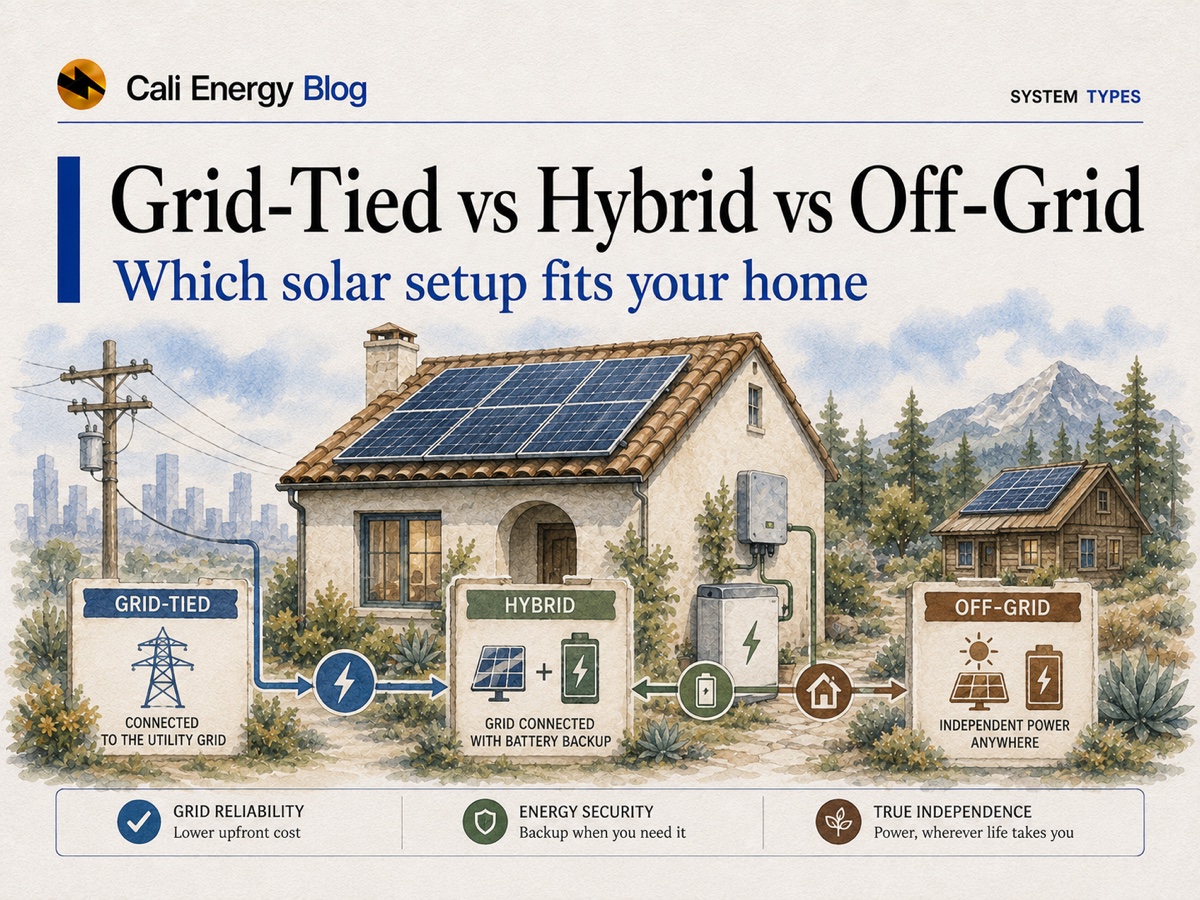
- Grid-tied: panels and inverter only. Simplest, but it must shut off within two seconds when the grid goes down.
- Hybrid: grid-tied plus a battery with backup equipment. It runs backed-up circuits in an outage and, on SCE, turns cheap midday exports into evening savings.
- The shift is measurable: the share of new SCE home systems with a battery rose from 11.5% under NEM 2.0 in 2022 to 81% on the Solar Billing Plan in 2025.
- LADWP is different: exports net at retail prices, so a battery there is mostly about backup.
- Off-grid is possible, but in Los Angeles it means panels sized for December with a margin, about 50 kWh of storage for three days of average use, and usually a generator.
| Grid-tied | Hybrid (grid + battery) | Off-grid | |
|---|---|---|---|
| Connected to the utility | Yes | Yes | No |
| Battery | No | Yes | Yes, large |
| Key equipment | Panels and a grid-tied inverter — string, with optimizers, or microinverters | The same, plus a battery on a shared hybrid inverter or its own inverter, and backup equipment that separates the house from the grid | Panels, a battery bank, a battery inverter-charger and charge control, usually a generator |
| Power in a blackout | No — shuts off by design | Backed-up circuits, day and night | Yes, as long as stored energy and fuel last |
| Surplus solar | Exported for credit | Stored first, then exported | Wasted once the battery is full |
| Utility bill | Yes | Yes | None |
| Who it suits | LADWP homes where outages are rare | SCE homes; anyone who needs backup | Sites without a utility line nearby |
Sources: SCE Rule 21 · SCE Solar Billing Plan · LADWP net metering. “Who it suits” is a starting point, not a rule.
Grid-tied: the simplest system
The grid is your battery — until it goes down.
A grid-tied system sends whatever the house doesn’t use to the grid and draws from it at night. Under Rule 21 it must stop energizing the grid within two seconds of an outage and stay off until the grid is back and stable (SCE Rule 21), so the house goes dark like the neighbors’ — see do solar panels work in a power outage.
How well solar-only pays depends on the utility. On SCE’s Solar Billing Plan a midday export from a 2026 system earns about 6¢ in summer, while on-peak power cost 58.7¢ in SCE’s July 2026 sample bill (SCE; sample bill), so solar the house can’t use at the moment is worth little. LADWP nets exported against imported kilowatt-hours at retail prices over each billing period (LADWP), so a solar-only system there keeps much more of its value.
Hybrid: what most new SCE systems now are
Grid-connected, with a battery.
A hybrid system stores midday solar in a battery and uses it in the evening, and with backup equipment it separates the house from the grid in an outage and keeps the backed-up circuits running. The battery can share an inverter with the panels or sit on its own inverter (“AC-coupled”); for the homeowner both work as hybrid systems. State interconnection records show how quickly SCE customers moved to it once the Solar Billing Plan made exports cheap:
| Year approved | Tariff | All SCE | Los Angeles County |
|---|---|---|---|
| 2022 | NEM 2.0 | 11.5% | 12.6% |
| 2023 | Solar Billing Plan | 50.2% | 38.4% |
| 2024 | Solar Billing Plan | 73.3% | 68.9% |
| 2025 | Solar Billing Plan | 80.7% | 82.0% |
| 2026 (Jan–Aug) | Solar Billing Plan | 79.6% | 83.1% |
Source: CPUC California DG Stats, Interconnected Project Sites, data through August 31, 2026; Cali Energy count of residential net-metered solar systems with storage capacity above zero. NEM 2.0 systems still being approved in 2024–2026 came from applications filed by April 14, 2023.
Whether a battery pays for itself is a separate question from whether it is popular; the bill math is in do I need a battery, and backup scope in whole-home vs critical-loads backup.
Off-grid: possible, but a different project
Sized for the worst month, not the average.
An off-grid home has no utility connection, so the panels must cover the whole year and the batteries must cover every night and every cloudy run. An average California home used about 503 kWh a month in 2024 (average home electricity use), about 16.5 kWh a day. A south-facing Los Angeles roof produces about 3.18 kWh per installed kW on an average December day (PVGIS), so just matching that use in December takes about 5.2 kW — before battery losses and below-average weeks, which is why off-grid arrays are typically sized well above that. Three days of storage at the same use is about 50 kWh, close to four batteries of 13.5 kWh. Off-grid designs usually add a generator for long storms, and summer surplus has nowhere to go once the batteries are full. Cali Energy estimate from those figures, not a design.
It makes sense where bringing in a utility line is impractical. In the city, the same equipment as a hybrid system gives most of the independence while the grid covers the bad weeks.
Grid-tied now, battery later
Most systems can take an AC-coupled battery later without replacing the panels; see adding a battery to existing solar. A grandfathered NEM 2.0 system keeps its status when a battery is added, except one funded by SGIP with a reservation accepted on or after June 4, 2024, outside the equity budgets (NEM 2.0 grandfathering). On SCE’s Solar Billing Plan the evening savings start only when the battery does, so the gap matters there.
Which setup fits whom
Grid-tied fits if…
You are on LADWP, outages rarely affect you, and you want the simplest system.
Hybrid fits if…
You are on SCE’s Solar Billing Plan, you use most power in the evening, your area sees safety shutoffs, or someone at home relies on medical equipment.
Off-grid fits if…
A utility line is far away or very costly to bring in, and you accept sizing for winter and running a generator.
Check your utility first
The same roof is worth different money on SCE and LADWP; see which utility serves your city.
Where to go next
Cali Energy is a licensed Los Angeles solar, battery and electrical contractor (CSLB #1032379). Tell us your utility, your usage and whether backup matters, and we will lay out grid-tied and hybrid options side by side. Call +1-323-844-7777 or compare options for your home.
Frequently asked
What is the difference between grid-tied, hybrid, and off-grid solar?
Grid-tied solar has no battery and uses the grid for night power and as a bank for surplus. Hybrid adds a battery while staying connected, so it can back up the house and shift solar into the evening. Off-grid has no utility connection at all and must cover every night and cloudy spell from its own batteries, usually with a generator.
Why does grid-tied solar shut off during a power outage?
Safety. Under Rule 21 a grid-tied system must stop energizing the grid within two seconds of an outage, so it cannot feed lines crews may be repairing. Without a battery and backup equipment it has nowhere safe to send power, so the house goes dark even in full sun.
Can I go fully off-grid with solar in California?
Yes, but it is a bigger project. For an average California home in Los Angeles, matching use on an average December day takes about 5.2 kW of panels before losses, three days of storage is about 50 kWh, and most designs add a generator. It makes most sense where bringing in a utility line is impractical.
Is a hybrid solar system worth the extra cost?
On SCE’s Solar Billing Plan it often is, because a summer-day export earns about 6¢ while on-peak power cost 58.7¢ in SCE’s July 2026 sample bill, and a battery closes that gap. On LADWP, where exports net at retail prices, a battery is mainly worth it for backup.
Which system type is most common for California homes?
Grid-connected systems. On SCE, hybrid has become the norm for new installs: 81% of residential systems on the Solar Billing Plan approved in 2025 included a battery, against 11.5% of NEM 2.0 systems approved in 2022, by Cali Energy’s count of CPUC DG Stats records.
Does LADWP or SCE change which system I should pick?
Yes. SCE’s Solar Billing Plan pays little for exports, which favors a battery. LADWP nets exports against imports at retail prices, so solar-only keeps more of its value there and a battery is mostly a backup decision.
Related reading
Sources & methodology
Figures on this page come from the primary sources below and, where noted, from Cali Energy calculations using the stated assumptions. Rates, incentives, and program terms change; each was verified October 5, 2026.
- CPUC — California DG Stats, Interconnected Project Sites (data through August 31, 2026; Cali Energy count of residential systems with storage)
- SCE — Rule 21, Generating Facility Interconnections (section H.1.a, two-second anti-islanding)
- SCE — How the Solar Billing Plan works (export values by start year)
- SCE — Solar Billing Plan sample bill (June 22–July 21, 2026)
- LADWP — Service Rider NEM, Net Energy Metering
- PVGIS (European Commission JRC) — PV output for a south-facing 20° Los Angeles roof
Not sure which setup fits your home?
Tell us your utility, your usage and whether outage backup matters, and we’ll lay out grid-tied and hybrid options side by side. Estimates, not guarantees.
Get a free estimatePrepared by Cali Energy, October 5, 2026. This article is for general educational purposes only and is not legal, tax, financial, engineering, or utility advice. Rates, incentives, codes, permit requirements, equipment specifications, prices, and program terms may change; figures and timelines are estimates, not guarantees. Confirm current requirements with the applicable utility, AHJ, program administrator, manufacturer, or a licensed professional. See our Content Disclaimer. Cali Energy · 19201 Parthenia St, Unit E, Northridge, CA 91324 · CSLB #1032379 (B, C-10, C-39)