

SCE Time-of-Use Plans Compared: TOU-D-4-9PM vs 5-8PM vs PRIME
If you are an SCE customer, the plan on the top of your bill decides how much a summer evening actually costs — and the three plans draw that expensive window differently. And if you install solar, add a battery, or buy an EV, SCE largely makes the choice for you. Here is what actually differs between the three 2026 residential plans, and which one you get a say in.
Get a free estimate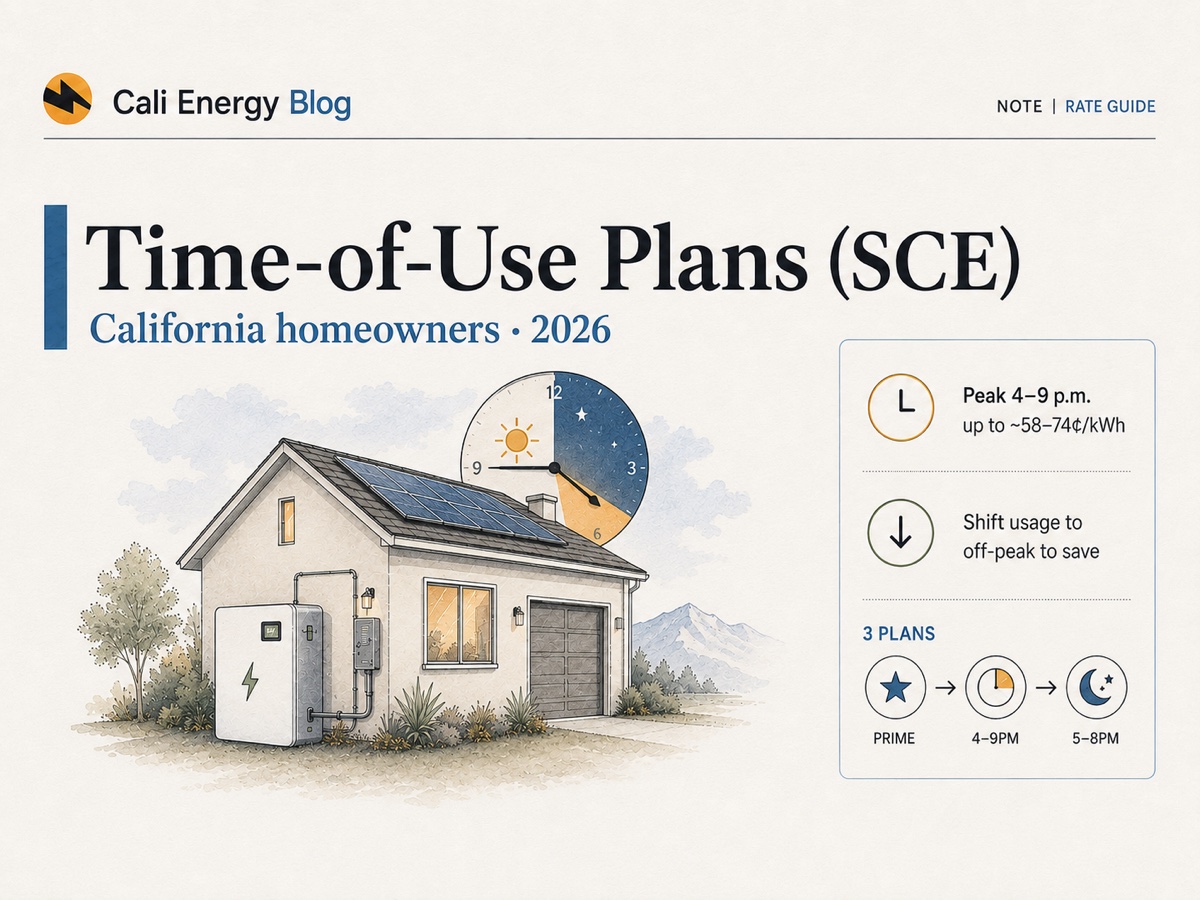
The three plans at a glance
Southern California Edison prices electricity by when you use it. All three residential time-of-use (TOU) plans share the same idea — cheap overnight power, expensive weekday-evening power — but they draw the expensive window differently.
The two "standard" TOU plans differ mainly in how wide and how tall the peak window is. TOU-D-4-9PM charges a summer peak of roughly 58¢/kWh across a long five-hour window (4–9 p.m. weekdays). TOU-D-5-8PM squeezes peak into three hours (5–8 p.m.) but charges much more — around 74¢/kWh — for it — published summaries of the 2026 schedules put the narrow window around 74¢/kWh against roughly 58¢ on the wider one. SCE sets those per-kWh prices by baseline region and revises them between rate updates, so treat them as the shape of the difference rather than as your price. Both plans price off-peak hours at about 34¢/kWh in summer and include a roughly 10¢/kWh baseline credit on your baseline allocation.
The third plan, TOU-D-PRIME, is built for electrified homes. Its daily Base Services Charge is the same $0.79 as the other two — what it gives up is the baseline credit, and what that buys is lower per-kWh rates — the plan that matters most if you own solar, a battery, or an EV. More on that below.
| Plan | Highest-rate window | When it applies | Base Services Charge | Baseline credit | Built for |
|---|---|---|---|---|---|
| TOU-D-4-9PM | 4–9 p.m. weekdays | Summer weekdays | $0.79/day | 10¢/kWh up to your allocation | The common default |
| TOU-D-5-8PM | 5–8 p.m. weekdays | Summer weekdays | $0.79/day | 10¢/kWh up to your allocation | Homes that can go dark for three hours |
| TOU-D-PRIME | 4–9 p.m. | All year | $0.79/day | None | EV, battery, heat pump — and Solar Billing Plan homes |
Windows, Base Services Charge and baseline credit as published on SCE’s Time-of-Use plan pages. Per-kWh prices move with your baseline region and with each SCE rate update — yours are on your bill and in your SCE account. The published plan prices for all three plans, across the summer and winter periods, are tabulated in our Los Angeles electricity rates guide.
How each plan actually works
TOU-D-4-9PM
The most common default. A long 4–9 p.m. peak, but a comparatively gentle ~58¢/kWh. Best if your evening load is unavoidable but spread out — you would rather pay a moderate rate over five hours than a punishing rate over three.
TOU-D-5-8PM
A narrower 5–8 p.m. peak at a steep ~74¢/kWh. This plan rewards households that can go nearly dark for three specific hours — pre-cool the house before 5 p.m., delay laundry and dishes until 8 p.m. If you truly avoid 5–8 p.m., the wider off-peak can win.
TOU-D-PRIME
The electrification plan. It carries the same $0.79/day Base Services Charge as the other two, but no baseline credit — and in exchange its off-peak and overnight rates are the lowest of any SCE residential plan. One structural difference matters more than any price: PRIME’s 4–9 p.m. window is its most expensive period all year, while on the two standard plans the punishing window is a summer one. Designed for — and largely required of — solar, battery, EV, and electric heat-pump customers.
TOU-D-PRIME: usually not optional for solar & EV homes
If you go solar in SCE territory, this is the plan you will most likely land on.
SCE places Solar Billing Plan customers — the customers on California's current Net Billing Tariff (NEM 3.0), which applies to interconnection applications submitted on or after April 15, 2023 at the investor-owned utilities (SCE, PG&E and SDG&E) — on TOU-D-PRIME. The plan is also built for households with an EV or plug-in hybrid, a home battery, or an electric heat-pump water or space heater, according to SCE's rate plan pages.
Here is the honest nuance most guides skip: PRIME’s 4–9 p.m. peak is not cheaper than TOU-D-4-9PM’s — the two are close, and PRIME’s applies all year rather than only in summer. What makes PRIME work is the combination of a lower off-peak rate (around 26¢/kWh, versus ~34¢ on the standard plans) and cheaper overnight super-off-peak hours in the cooler months. That structure only pays off if you shift load out of the 4–9 p.m. window — which is exactly what a solar-plus-battery system or a scheduled EV charger does automatically. The battery discharges through the expensive evening, and you recharge and run the house on cheaper off-peak power. Without that ability to shift, PRIME’s all-year evening peak and the loss of the baseline credit can work against you.
What actually changes when you move to PRIME
The comparison that actually decides this is narrow: hold your usage and your habits still, and ask what changes. Moving to PRIME does three things at once. You keep the same $0.79/day Base Services Charge. You lose the 10¢/kWh baseline credit, which costs you a fixed amount every month regardless of when you use power. And you gain the lowest off-peak and overnight rates SCE offers, which pays only on the kilowatt-hours you actually move out of 4–9 p.m.
So PRIME rewards a household that can shift load and penalises one that cannot. A battery or a scheduled EV charger does the shifting automatically; a household without either keeps the same evening consumption, loses the credit, and gains little. That is the whole decision.
Compare plans on your own usage rather than on an example: SCE’s own rate comparison in your account prices your last twelve months through each plan.
Compare the plans for your usage
Enter your monthly kilowatt-hours and roughly how much of that lands in the 4–9 p.m. peak. The tool estimates a monthly cost per plan and flags the cheapest.
Illustrative estimate of energy charges plus the $0.79/day Base Services Charge, using SCE’s bundled rates in effect from October 1, 2026 (whole-cent, ±0.5¢). The 9¢/kWh baseline credit is applied to the standard plans only — TOU-D-PRIME has none — up to your seasonal baseline allocation (by region and Basic / All-electric type). Usage outside 4–9 p.m. is spread across the day by hours. Excludes taxes, the California Climate Credit, CCA/Direct-Access generation, and solar export. Verified against sce.com on 2026-08-05 — confirm current rates with SCE.
How to choose — a quick framework
Can you avoid 5–8 p.m. almost entirely? TOU-D-5-8PM's narrow window can win, but the ~74¢ peak punishes any slip-ups. Is your evening load moderate but unavoidable? TOU-D-4-9PM's gentler ~58¢ over a wider window is the safer default. Do you have solar, a battery, or an EV? You are almost certainly on — or headed to — TOU-D-PRIME, and the goal becomes maximizing cheaper off-peak use and minimizing peak draw.
For context, none of these evening rates are cheap: California's average residential price was about 35.25¢/kWh in early 2026 versus a U.S. average near 18.83¢, per the U.S. Energy Information Administration. That gap is a big part of why solar-plus-storage pencils out in SCE territory — a battery lets you sidestep the most expensive hours entirely.
Cali Energy is a Northridge-based installer (CSLB #1032379) with in-house crews serving SCE, LADWP, and the Burbank/Glendale municipal utilities. If you want help modeling your actual SCE bill against a solar or solar-plus-battery system, call +1 (323) 844-7777 — no pressure, just the numbers for your home.
Frequently asked
Which SCE plan has the highest peak rate?
TOU-D-5-8PM has the highest summer peak at roughly 74¢/kWh, but only across a narrow 5–8 p.m. window. TOU-D-4-9PM charges about 58¢/kWh over a longer 4–9 p.m. window. TOU-D-PRIME's peak is similar to 4-9PM (~59¢), but its off-peak rate is lower.
Do I have to be on TOU-D-PRIME if I go solar with SCE?
In most cases, yes. SCE places Solar Billing Plan (NEM 3.0 / Net Billing Tariff) customers on TOU-D-PRIME, and the plan is also designed for EV, battery, and electric heat-pump households. Confirm your specific situation with SCE.
Why is TOU-D-PRIME good for batteries and EVs if its peak rate is high?
Because PRIME's off-peak rate is around 26¢/kWh — below the ~34¢ off-peak on the standard plans, with even cheaper overnight hours in the cooler months. A battery or scheduled EV charger lets you avoid the expensive 4–9 p.m. peak entirely and run on off-peak power, which is where PRIME wins.
Are these exact rates?
No — they are approximate 2026 summer weekday figures and vary by baseline zone, season, and CPUC-approved rate updates. Always verify your exact rates in your SCE online account. The calculator is illustrative, before baseline credits and taxes.
What is the basic charge on TOU-D-PRIME?
About $0.79 per day (roughly $24/month) with no baseline credit. The standard TOU-D plans have a smaller basic charge but earn a baseline credit of about 10¢/kWh on your baseline allocation.
Related reading
Sources & methodology
Figures on this page come from the primary sources below and, where noted, from Cali Energy calculations using the stated assumptions. Rates, incentives, and program terms change; each was verified September 8, 2026.
Not sure which SCE plan — or whether solar — fits your bill?
Cali Energy will model your actual SCE usage against solar and battery options, with the real numbers for your home and no pressure. Call +1 (323) 844-7777.
Get a free estimatePrepared by Cali Energy, September 8, 2026. This article is for general educational purposes only and is not legal, tax, financial, engineering, or utility advice. Rates, incentives, codes, permit requirements, equipment specifications, prices, and program terms may change; figures and timelines are estimates, not guarantees. Confirm current requirements with the applicable utility, AHJ, program administrator, manufacturer, or a licensed professional. See our Content Disclaimer. Cali Energy · 19201 Parthenia St, Unit E, Northridge, CA 91324 · CSLB #1032379 (B, C-10, C-39)