

Do Solar Panels Work at Night?
No. A solar panel needs sunlight, and in Los Angeles that leaves an array idle for about 10 hours a night in June and nearly 15 in December, according to an NREL hour-by-hour model. Full moonlight is about 400,000 times dimmer than the sun — a whole rooftop system would make a few hundredths of a watt. After dark your home runs on a battery or on the grid, and which one, and at what price, depends on your utility.
Get a free estimate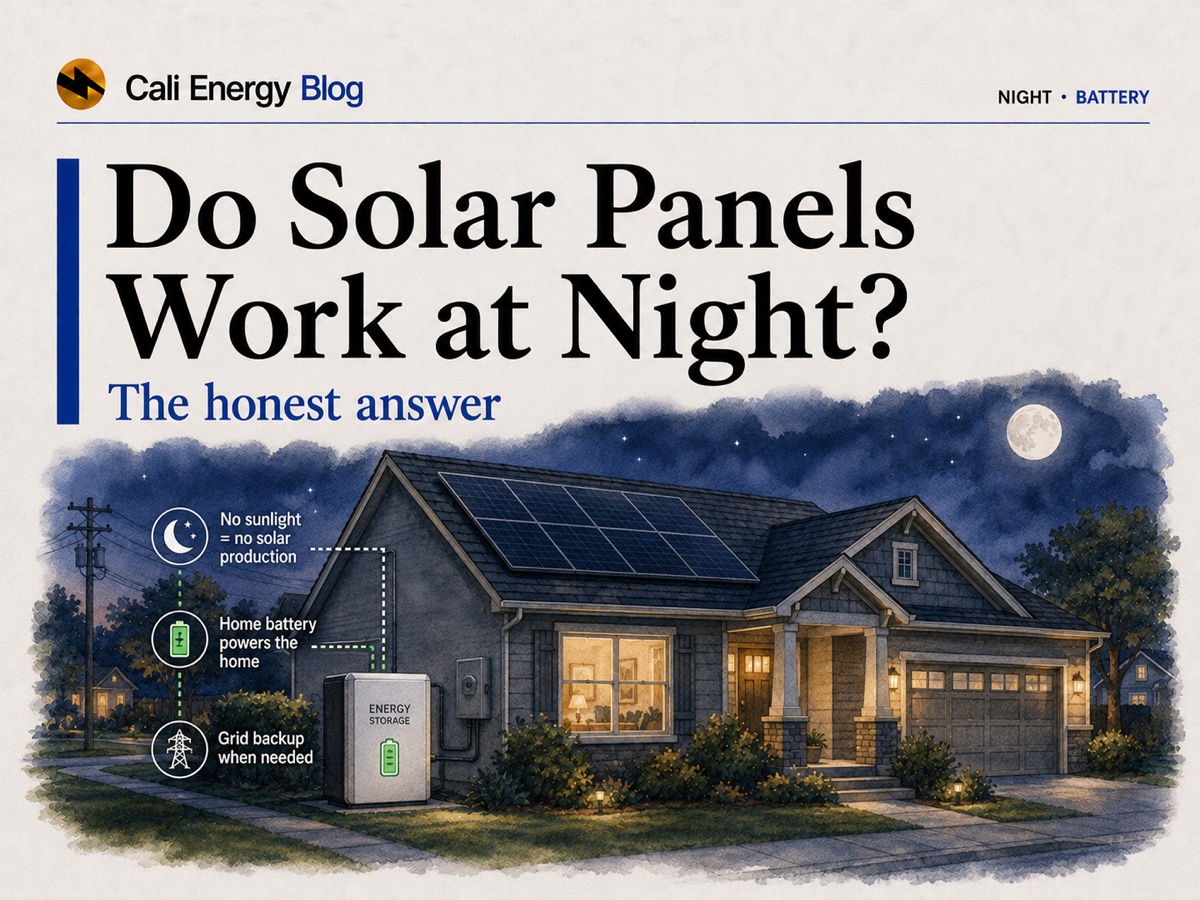
- No sun, no output: an LA array makes useful power from about 7 a.m. to 3:30 p.m. in December and 6 a.m. to 7 p.m. in June; after 7 p.m. it adds up to less than 0.1% of the year’s output.
- Moonlight doesn’t count: a 7 kW array under a full moon would make about 0.02 W, far below what an inverter needs to switch on.
- After dark you use a battery or the grid. Net metering is a billing rule, not a power source.
- What nights cost depends on your utility: LADWP nets exports at retail prices; on SCE, evening power is the most expensive and midday exports earn little, which is why most new SCE systems add a battery.
When solar panels start and stop in Los Angeles
Panels make electricity when sunlight frees electrons in the cells; output follows the light, rising after sunrise, peaking around midday and fading well before sunset on a typical south-facing roof. In NREL’s PVWatts hour-by-hour model of an LA roof, the array is idle in 4,438 of the year’s 8,760 hours — 51%:
| Month | Useful output starts | Ends | Hours with no output |
|---|---|---|---|
| December | ~7 a.m. | ~3:30 p.m. | ~15 |
| March | ~7 a.m. | ~5:30 p.m. | ~12.5 |
| June | ~6 a.m. | ~7 p.m. | ~10 |
| September | ~7 a.m. | ~5:30 p.m. | ~12.5 |
Source: NREL PVWatts v8, Northridge, 20° south, 14% losses, typical weather year; “useful” means at least 1% of the array’s peak; clock times include daylight saving. East- or west-facing panels shift the window earlier or later.
The late afternoon matters most: only about 11% of a year’s output arrives between 4 and 9 p.m., and practically none after 7 p.m. Cloudy days thin the daytime output but don’t stop it; see solar on cloudy and rainy days.
Moonlight, streetlights and “night-time solar”
Moonlight is sunlight reflected off the moon. NASA lists the sun at magnitude −26.74 and a full moon at −12.74; a 14-magnitude gap means the sun is about 400,000 times brighter. Scale a 7 kW array down by that and full moonlight gives it about 0.02 W — nothing an inverter will even start on.
Researchers are working on cells that produce power at night from heat radiating into the sky. A Stanford team reported 50 milliwatts per square meter in 2022 — roughly one four-thousandth of what a modern panel makes in full sun. It is a lab result, not a product you can buy.
How your home gets power after dark
| System | Normal night | Night-time blackout |
|---|---|---|
| Grid-tied, no battery | All power from the grid | Dark: the inverter shuts off with the grid |
| Grid-tied with a battery | Battery first, grid when it runs low | Backed-up circuits run on the battery |
| Off-grid | Battery only | Same as any night, until storage runs out |
Sources: SCE Rule 21 (grid-tied inverters disconnect within two seconds of an outage) · DOE Homeowner’s Guide to Going Solar (storage for evening use and outages).
Net metering often gets described as “the grid stores my solar.” It doesn’t: the power you use at night is the grid’s, and the tariff decides how your daytime exports are credited against it. See do solar panels work in a power outage?
What night-time power costs on SCE and LADWP
SCE
Time-of-use plans charge the most in the evening (4–9 p.m. on TOU-D-4-9PM and PRIME), when the array has almost stopped. The Solar Billing Plan credits midday exports at hourly values that are low, so storing noon power for the evening is usually worth more than exporting it.
LADWP
Exports are netted against imports at the full retail price under LADWP’s net metering rider, so a kilowatt-hour sent out at noon offsets one bought at night. A battery there is mostly for backup.
Either way you still get a bill: fixed charges stay, and on SCE evening imports cost more than daytime exports earn. See SCE solar billing explained, LADWP solar and battery incentives and do you need a battery under NEM 3.0?
How much battery your nights need
An average California home uses about 16.5 kWh a day (EIA, 2024). One battery such as the Tesla Powerwall 3 stores 13.5 kWh — about 80% of that whole day, so the evening and overnight share of an average home usually fits in it on a sunny day. A home with central AC running into the evening, an electric water heater or an EV charging overnight needs more, and in December the dark stretch is nearly 15 hours. Essentials alone — fridge, lights, Wi-Fi, a furnace fan — come to about 7 kWh a day. See can solar power a whole house? and best home battery backup.
Making solar work for your evenings
Shift what you can
Run the dishwasher, laundry and pool pump at midday when the array is producing, especially on SCE.
Time the EV
Charge at midday if the car is home; otherwise after 9 p.m. on SCE time-of-use plans or after 8 p.m. on LADWP’s R-1B. See EV charging costs.
Size the battery to evenings
Add up what runs from sunset to bedtime and overnight, not the whole day.
Know your plan
Your rate plan’s peak hours decide which evening hours are worth covering. See SCE time-of-use plans compared.
Where to go next
Cali Energy designs solar and battery systems for Los Angeles homes around when the household actually uses power. Call +1-323-844-7777 or ask about solar and storage — production and savings figures are estimates, not guarantees.
Frequently asked
Do solar panels work at night?
No. They need sunlight, and in Los Angeles an array makes no useful power for about 10 hours a night in June and nearly 15 in December. After dark a home runs on a battery or on grid power.
Can solar panels charge from moonlight?
Not usefully. A full moon is about 400,000 times dimmer than the sun, so a 7 kW array would make around 0.02 W — too little for the inverter to switch on.
What time do solar panels stop producing in Los Angeles?
For a south-facing roof, useful output ends around 3:30 p.m. in December, 5:30 p.m. in March and September, and 7 p.m. in June, in NREL’s model. West-facing panels run a little later.
How does my house have electricity at night with solar?
From a battery charged by the day’s solar, or from the grid. Net metering doesn’t deliver power at night; it only sets how daytime exports are credited against night-time imports.
Do I need a battery to use solar at night?
Only if you want your own solar power after dark or during outages. A grid-tied system without a battery works fine but buys night power from the utility and shuts off in a blackout.
Why do I still get an electric bill with solar?
Because you still buy power at night and pay fixed charges. On SCE, evening power costs more than midday exports earn; on LADWP, exports offset imports at retail prices, so a right-sized system can cover most energy charges.
Is it better to charge an EV during the day or at night with solar?
If the car is home at midday, charging then uses your own solar. Otherwise charge after the evening peak: after 9 p.m. on SCE time-of-use plans or after 8 p.m. on LADWP’s R-1B.
Related reading
Sources & methodology
Figures on this page come from the primary sources below and, where noted, from Cali Energy calculations using the stated assumptions. Rates, incentives, and program terms change; each was verified October 5, 2026.
- NREL — PVWatts v8 (hourly output, Northridge, 20° south, 14% losses)
- NASA — Sun Fact Sheet (visual magnitude −26.74)
- NASA — Moon Fact Sheet (full-moon apparent magnitude −12.74)
- Assawaworrarit, Omair, Fan — Nighttime electric power generation at a density of 50 mW/m² via radiative cooling of a photovoltaic cell, Applied Physics Letters 120, 143901 (2022)
- SCE — Rule 21, Generating Facility Interconnections (anti-islanding, two seconds)
- SCE — Time-of-Use residential rate plans
- SCE — How the Solar Billing Plan works
- LADWP — Service Rider NEM, Net Energy Metering
- Tesla — Powerwall 3 datasheet (13.5 kWh usable)
- EIA — 2024 Average Monthly Bill, Residential (Table 5A)
- U.S. Department of Energy — Homeowner’s Guide to Going Solar
Power your evenings, not just your middays
Find out whether solar plus a battery makes sense for your home and utility, with an itemized estimate. Estimates, not guarantees.
Get a free estimatePrepared by Cali Energy, October 5, 2026. This article is for general educational purposes only and is not legal, tax, financial, engineering, or utility advice. Rates, incentives, codes, permit requirements, equipment specifications, prices, and program terms may change; figures and timelines are estimates, not guarantees. Confirm current requirements with the applicable utility, AHJ, program administrator, manufacturer, or a licensed professional. See our Content Disclaimer. Cali Energy · 19201 Parthenia St, Unit E, Northridge, CA 91324 · CSLB #1032379 (B, C-10, C-39)