

The Solar Proposal, Sheet by Sheet: What Each Page Answers and What to Say
A homeowner decides on a few numbers — what they pay today, what they'd pay with solar, and what the system costs — and the proposal from Cali-Graf — the free design and proposal app built by Cali Energy, a Los Angeles solar and roofing contractor — is built to put those first. It runs to five or six short sheets: a cover with the monthly bill today and with solar, your solar system, your battery (only with one), your savings, price and approval, and your right to cancel. Each sheet answers one question, and each draws a predictable question back from the customer. Knowing both turns the presentation into a conversation rather than a page-turn. The seller's company — not the software's — is on every page.
What each sheet answers
| Sheet | The question it answers | What the customer usually asks |
|---|---|---|
| Cover | "What will I pay?" — the monthly bill today and with solar, or bill plus loan payment | "Why isn't it zero?" |
| Your solar system | "What goes on my roof, and is it enough?" — size, production against usage, equipment, roof layout | "Why this many panels?" |
| Your battery | "What does the battery do?" — the mode, outage backup, any extra savings | "Will it lower my bill?" |
| Your savings | "Is it worth it?" — month by month and over 25 years, payback, cost per kWh | "What did you assume about rates?" |
| Price and approval | "What does it cost, and when do I pay?" — the price line by line, cash stages or loan terms, signature | "Why pay before the work?" |
| Your right to cancel | "Can I change my mind?" — the notice the Contractors State License Board requires | — |
The battery sheet appears only when the design has a battery, and the savings sheet only when the home's usage was entered. A page-by-page guide written for homeowners is in how to read a solar proposal.
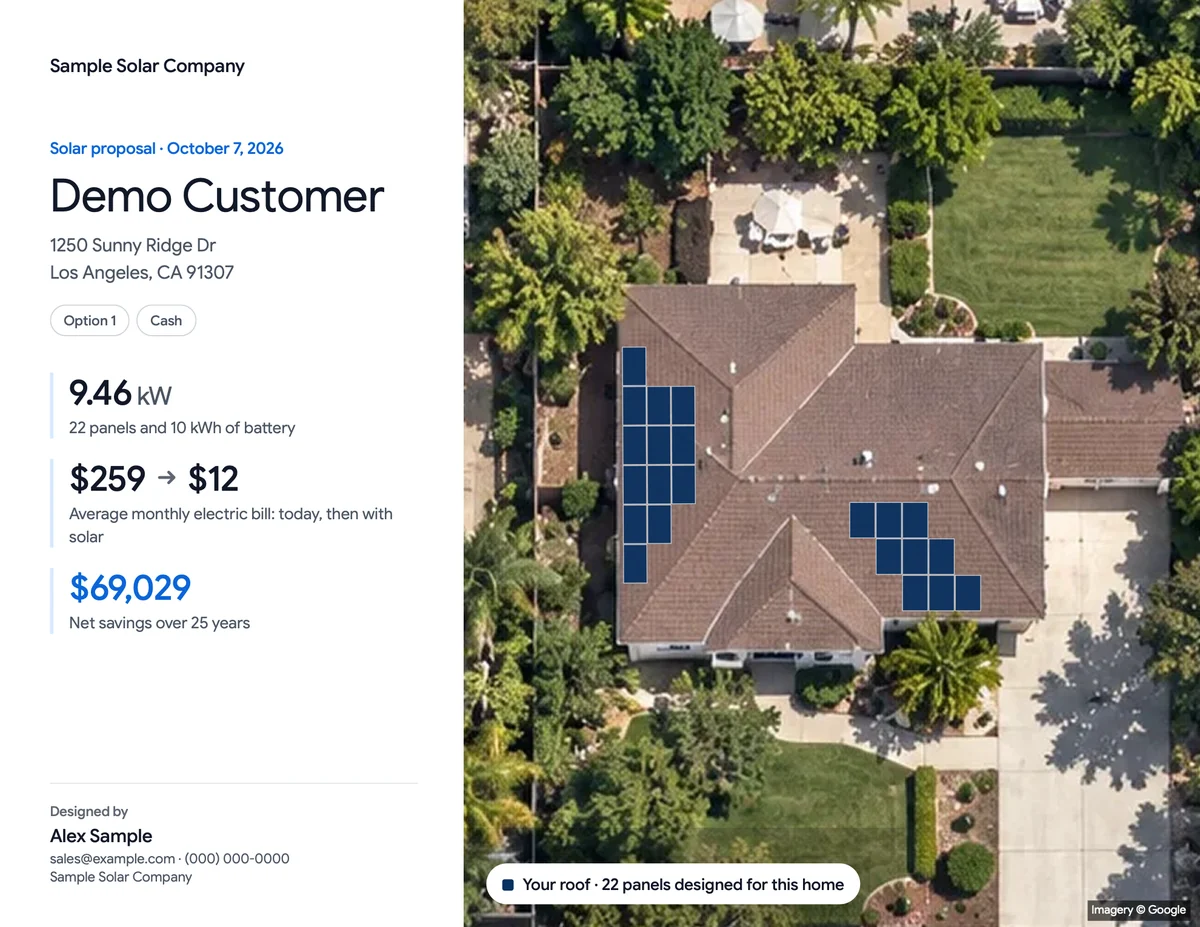
Open the sample proposal next to this page, then build one for a customer you're seeing this week.
Answers that hold up
"Why isn't my bill zero?" Utilities keep charges that solar can't pay: on LADWP the minimum charge and taxes, and adjustment factors the solar credit doesn't cover; on SCE the daily Base Services Charge and taxes. A proposal that showed zero would be leaving them out. The mechanics are in how Cali-Graf models an LADWP bill and SCE Net Billing, hour by hour.
"Why this many panels?" Point to Solar covers on the system sheet — production as a share of the home's usage — and to the roof layout. If coverage is well over 100% on LADWP, say plainly that surplus credit is never paid out — Cali-Graf's result warns about it, with how many panels could come off.
"Will the battery lower my bill?" On LADWP, usually not — solar is netted 1:1 over each billing period, so the proposal says the battery's value is backup. On SCE, a battery that moves solar into the 4–9 PM peak can add savings, and the battery sheet shows how much in the chosen mode.
"What did you assume about rates?" The rate increase used for the 25-year numbers is printed under the savings sheet. Know why you chose it — see picking a rate escalation you can defend.
"Why pay before the work?" The cash schedule follows the work: a deposit at signing, then stages at permits, installation and final connection.
What's under your control
| On the proposal | Where it comes from | Good practice |
|---|---|---|
| Your company, name, license, phone, email | The Business card, filled in once | Fill in the license — homeowners look it up |
| The customer's name | Customer name in Price & settings | Write it as they want it — "The Lopez family" |
| The option and payment method | The calculation; Make a copy for Option 2, 3 | Show two or three options rather than one |
| The price | Solar price per watt plus extras, each with an amount | Every extra named, none bundled silently |
| Equipment | The exact panel, inverter and battery | Never the generic inverter — the PDF won't build with it |
Your brand is on the cover, in the footer of every page, at the signature line and in the file name; Cali-Graf never puts its own or anyone else's company on the proposal. Uploading your own logo isn't available yet, so the cover shows your company name in text. To send one proposal with a colleague's name or another phone number, change the business-card fields in that calculation only.
The approval and the right to cancel
The price sheet ends with Your approval: one sentence naming the option and the payment — for example, "I approve Option 2 as described in this proposal, paying with cash" — and two dated signature lines, the customer's and yours. Every page has a box for the customer's initials, so pages of a signed proposal can't be swapped. The last sheet carries the Contractors State License Board's text: three business days to cancel.
Two things stay with you. The proposal can be signed on the spot, but your contract, your disclosures and how you collect signatures must meet California law — including the Solar Energy System Disclosure Document on the contract's front page, and the longer, five-business-day cancellation window for buyers who are 65 or older. And proposals use a standard cash schedule — a $1,000 deposit at signing, then 30%, 50% and 20% of the rest at permits, installation and final connection; your own schedule can't be set yet, so if your contract differs, tell the customer. What to check before any proposal leaves your hands is in before you send a solar proposal.
Frequently asked
What should a solar proposal include?
Can I put my company's brand on a Cali-Graf proposal?
Can a customer sign the Cali-Graf proposal?
Does the proposal include a right-to-cancel notice?
Can I change the payment schedule on the proposal?
Related reading
Sources & methodology
Product facts on this page come from Cali-Graf's own help center and the pages linked below; figures in examples come from the stated inputs. Features, limits and supported utilities change; each was verified October 16, 2026.
- Cali-Graf Help — Create the proposal PDF — and what it needs first
- Cali-Graf Help — Your brand on the proposal
- Cali-Graf Help — Customer details on the proposal
- Cali-Graf Help — Payment schedule and financing in the proposal
- Cali-Graf Help — Customer approval and the 3-day right to cancel
- Cali-Graf Help — Proposal numbers explained
- Cali-Graf — Sample proposal (made-up demo home)
- California Civil Code §1689.6 — right to cancel
- California Business & Professions Code §7169 — Solar Energy System Disclosure Document
Bring this proposal to your next kitchen table
Design the roof, model the LADWP or SCE bill and print the five or six sheets under your own business card — free in Cali-Graf, with daily fair-use limits. The help center's Proposal section has the current details of each sheet.
Prepared by Cali Energy, October 16, 2026. This article is for general educational purposes only and is not legal, tax, financial, engineering, or utility advice. Rates, incentives, codes, permit requirements, equipment specifications, prices, and program terms may change; figures and timelines are estimates, not guarantees. Confirm current requirements with the applicable utility, AHJ, program administrator, manufacturer, or a licensed professional. See our Content Disclaimer. Cali Energy · 19201 Parthenia St, Unit E, Northridge, CA 91324 · CSLB #1032379 (B, C-10, C-39)