

How to Compare Two Solar Quotes: The 20-Number Checklist
Straight answer: compare on price per DC watt and the total you will actually pay, never on the monthly payment. Two proposals for the same panels can differ by thousands once interest and a financing fee are folded in. Two things most homeowners don’t know: California already publishes a consumer-protection guide your installer is required to hand you and get you to sign before your system can interconnect, and the contract itself must carry a one-page disclosure stating the total cost including financing. Below is what to line up side by side, and what the market actually charges.
Get a free estimate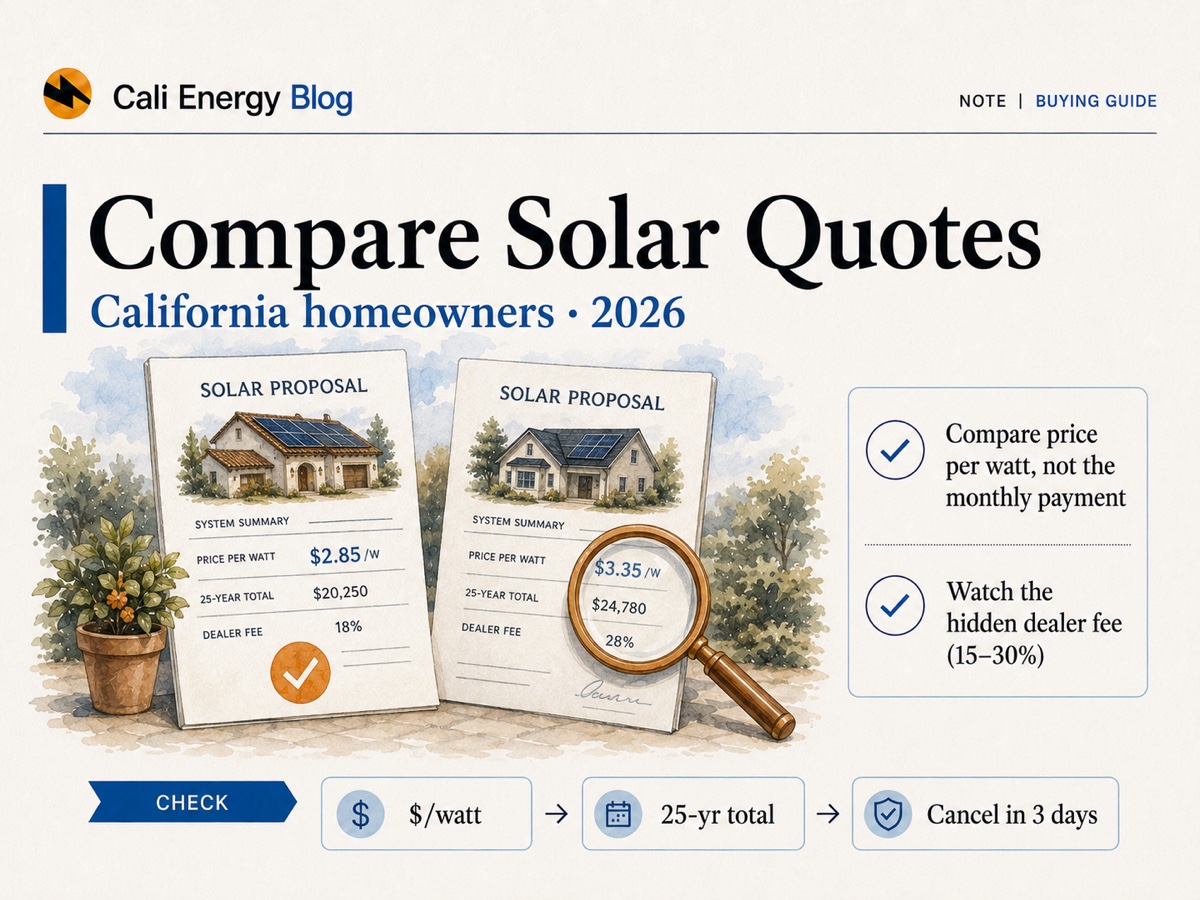
We install solar in Los Angeles, so we are one of the companies you may be comparing. Everything below is sourced to a regulator, a statute or a national laboratory so you can check it against our quote too — and you will notice this page sets no pass mark on price. Deciding what a fair number is, is not our job to do for you.
- Compare on price per DC watt and the total of all payments — never the monthly payment alone.
- Judge that price against the real distribution, not a slogan. Among 2024 US residential installs the 20th percentile was $3.00/W, the median $4.00/W and the 80th percentile $5.20/W. A cash offer belongs against the cash median of about $3.50/W.
- How you pay moves the price: across the US the median cash system cost $3.50/W against $4.70/W financed, and the CFPB reports hidden fees in solar lending “typically range from between 10 to 30 percent of the cash price but can exceed 50 percent.”
- The CPUC recommends your installer hand you the California Solar Consumer Protection Guide at first contact, and requires that you read, sign and initial it before a solar contract is signed in investor-owned utility territory. Read it while you can still walk away.
- You can cancel until midnight of the third business day — fifth for a senior citizen — on any contract made away from the seller’s own business premises, in writing.
The one number that actually compares two quotes
And what to judge it against.
Quotes lead with a monthly payment because it is the easiest number to make look small. Stretch the loan, roll in a fee, add an escalator, and “$0 down, $189 a month” can hide a system costing far more than it needs to. A payment is not a price — it is a price spread over time with interest added.
The honest comparison is price per DC watt: the all-in system price divided by the system size in DC watts. Same arithmetic on every quote. Then the total of every payment you will make, escalators included. A quote with the smaller monthly payment and the larger total is the more expensive quote.
What is a fair price per watt? Not a single number, and not one we are going to hand you. What exists is a published distribution. Berkeley Lab’s 2025 Data Update, from records of systems installed in 2024, put the US residential spread at a 20th percentile of $3.00, a median of $4.00 and an 80th percentile of $5.20 per DC watt before incentives, with California at the median. Its 2026 Data Update, covering 2025 installs, reports that residential prices fell year over year, with larger declines on cash purchases — so the whole distribution has shifted down since those figures. Pull the current numbers from Berkeley Lab before you use any of them as a yardstick.
One distinction survives every edition and matters more than the level. Those percentiles blend cash and financed systems, and the two are not close: in the 2024 data the median cash system cost $3.50 per watt against $4.70 financed. Compare a cash offer with cash figures and a financed offer with financed ones, whatever edition you are reading.
All of it applies to solar alone. A battery, a main-panel upgrade or roof work belong on their own lines and get compared separately — the distribution above covers stand-alone systems bought outright. Our cost guide works through where each figure comes from.
Two things California already hands you
Before any checklist of ours, use the two the state requires. Most homeowners never realise they exist, and their absence is itself a signal.
The California Solar Consumer Protection Guide
The CPUC publishes a consumer guide and recommends that providers hand it over at first contact. What is required is the signing: in the territory of the CPUC-regulated utilities — SCE, PG&E, SDG&E, Bear Valley, PacifiCorp and Liberty — the provider must collect your initials and signature, and the Commission requires the guide to be given to you to read, sign and initial before a solar contract is signed. The signed guide then forms part of the interconnection application, which is where the utility checks it. The guide itself puts the consequence plainly: customers of those companies “must sign this guide to connect a residential solar system to the electric grid.” The point of the sequencing is that you read it while you can still walk away, so do not let it be left until afterwards.
It also anticipates the pressure. In its own words: “Do not feel pressured to read this guide while the salesperson waits. Ask them to come back at a later date to allow you time to read it.”
The signed document carries your rights and a “before you sign” checklist; the CPUC’s extended web version carries the questions to put to a provider. Ask both installers these and write the answers down:
- “What is the total cost of the solar system or solar energy over the entire course of the contract?”
- “What is the total cost of the loan over the entire course of the contract?”
- “How much will I pay per month? When will these payments increase and by how much?”
- “Will my payments increase over time? How much will they increase and how frequently?”
- “Are there warranties for the panels and inverters? If yes, how long do they last and whom do I contact to replace these components?”
- “Will you explain to me why an electricity bill savings estimate is not a guarantee?”
- “What electricity provider bill escalation rate is assumed in your electricity bill savings estimate?”
- “What situations would allow me to be released from a contract?”
The guide also carries a block of questions about the company itself — how long it has operated, its licence and complaint history, who performs the installation and who answers a warranty claim years later. Ask those too: the equipment is commodity, the company is not.
One Los Angeles note: the requirement runs through the CPUC-regulated utilities. LADWP is municipal and outside it, so an LADWP customer may never be offered the guide at all — a reason to go and read it yourself rather than a reason it does not matter.
The disclosure that states the total, including financing
Under Business and Professions Code § 7169 every residential solar contract in California must carry a Solar Energy System Disclosure Document printed on the front page or cover page, in boldface 16-point type, stating the total cost and payments for the system, including financing costs, where to complain, and your cancellation rights. The familiar single-page layout is the CSLB’s form; the statute sets the placement and the type size.
That single page defeats the payment-only pitch, because it forces the financed total into the open. Two cautions on using it. It includes interest, so do not divide it by watts and compare it to a per-watt benchmark — ask separately for the cash price of the identical system and divide that. And read the cancellation wording against the section below rather than assuming it always applies.
How much they may legally ask for up front
On a home improvement contract in California — which a solar installation is — the down payment is capped by Business and Professions Code § 7159.5 at $1,000 or 10 percent of the contract price, whichever is less. Payments after that may not run ahead of the value of the work actually performed and materials delivered.
This is the provision that stops a homeowner handing over a large sum to a company that then stops answering the phone, and unlike the cancellation right it applies wherever the contract was signed. A schedule asking for a third up front is not aggressive salesmanship, it is outside the statute. For anything turning on it, check with the CSLB.
The line-by-line comparison
Fill both columns for each quote and ask for every line in writing. A clear itemised proposal makes this easy; a reluctance to itemise is the finding.
| Line item | What to check | What should make you ask more |
|---|---|---|
| Price per watt ($/W-DC) | All-in system price ÷ system size in DC watts, solar only. Compare this, not the monthly payment. | Place it against the current published distribution, matching cash offers to cash figures. Wherever it lands, high or low, ask for the same thing: the itemisation behind it. |
| Cash price, stated separately | The all-in price if you paid today. The cleanest number there is. | An installer who will only give a monthly payment. The gap between cash and financed is where the financing cost lives. |
| Total of all payments | Every payment over the loan or agreement, escalators included — the figure the § 7169 disclosure has to state. | A total thousands above the cash price for identical equipment. |
| System size (kW DC) | Both quotes sized in DC watts for the same share of your usage. | One quietly smaller, so “cheaper” only because it is less system. |
| Panel make, model and wattage | Exact make and model, watts per panel, and a panel count that multiplies out to the stated kW. | “Premium panels,” “or equivalent,” or a name with no findable datasheet. |
| Inverter type, brand and warranty | Microinverters or a string inverter, named brand, and its own warranty term. A string inverter normally carries 10 to 12 years against 25-year panels — that is the standard arrangement, not a defect. Microinverters typically match the panel term. | Type or brand unstated. Where the term is shorter, ask what an extension costs and who pays for the labour to swap it in year thirteen. |
| Panel product warranty | The product and workmanship warranty on the panel, which is separate from the performance warranty. Current mainstream modules carry 25-year product terms, and some run 30. | Only the performance warranty listed, or a product term well short of the market. |
| Workmanship warranty | The installer’s own labour warranty on the installation and the roof penetrations — manufacturer warranties do not cover labour. | Not stated at all. Ask who honours it if the company is gone. |
| Year-one production estimate | Estimated first-year kWh, and what it was modelled on. California’s supporting-information form requires a solar-only production estimate to be based on NREL’s PVWatts, so you can ask which inputs were used and check them. | A figure noticeably above the other quote for the same roof, or an unwillingness to say what it was modelled on. The state’s own guide tells you to ask why a savings estimate is not a guarantee. |
| Assumed utility rate escalation | The annual rate increase baked into any savings projection — a question the CPUC guide puts to you directly. | An aggressive assumed escalation doing the work that the system is supposed to do. |
| APR and financing fee | The loan APR in writing, and what the financing costs you as against the cash price. | A “0% APR” alongside a system price well above the cash price for the same equipment. |
| Escalator (lease or PPA) | The yearly rise in your payment, and the buyout terms. The CPUC says escalators “are typically in the range of a 1 percent to 3 percent increase above the rate you paid in the previous year” — so it compounds. | The same regulator adds: “Be cautious of entering into a contract with an escalator higher than that.” Also any escalator you were not told about. |
| Battery, panel upgrade, roof work | Whether each is in the price, and at what specification — battery brand and usable kWh, panel upgrade scope, roof condition. | “Battery-ready” sold as a battery; roof or panel work left out and billed later as a change order. |
| Permit and interconnection | Both in scope, with who files them. | “Permit not included.” |
| Licence and workers’ compensation | The CSLB licence number on the contract, checked on the CSLB site, with the right classification and active workers’ compensation. | A licence number that does not match the company name on the proposal. |
Price percentiles are Berkeley Lab’s installed-price distribution for US residential systems installed in 2024, gross of incentives, for stand-alone systems bought outright — the same figures behind our cost guide. The questions on savings estimates and rate escalation are taken from the CPUC’s own consumer guide. Every line is a question to ask, and the answer that matters is whether the installer will put it in writing.
Why the “0% APR” quote can cost more
A difference between two quotes for the same equipment that has nothing to do with the roof.
Solar lenders charge the installer a fee to offer a low or zero rate, and that fee is generally folded into your price rather than absorbed. The federal consumer regulator describes it this way: the Consumer Financial Protection Bureau reports that hidden fees in solar lending “typically range from between 10 to 30 percent of the cash price but can exceed 50 percent”, and that some lenders include markups that can increase the loan principal by 30 percent or more. Note the denominator — a share of the cash price, not of the loan balance. It is a characterisation rather than a measured statistic, and some lenders price the same costs into the APR instead.
The market data points the same way from a different direction. Across 2024 US residential installations the median cash system cost $3.50 per watt and the median loan-financed system $4.70 — $1.20 apart, or roughly $7,200 on a 6 kW system. That gap has grown from $0.60 per watt in 2017, and Berkeley Lab attributes it partly to loan fees rolled into the up-front price, while cautioning that not all of it is dealer fees and that cash and financed buyers are not identical populations.
None of this makes financing wrong. It makes the cash price the unit of comparison. Ask both installers, in writing, for the cash price of the identical system alongside the financed one. If a company will not state a cash price, you cannot compare it to anything.
Your right to cancel — and where it stops
California’s Home Solicitation Sales Act gives you the right to cancel until midnight of the third business day, and the fifth business day if you are a senior citizen, by giving written notice to the seller at the address or email specified in the agreement.
Two details decide whether you actually get the days you think you have. First, for a home-improvement contract — which is what a solar installation is — the clock starts when you receive a signed and dated copy of the contract, not when you sign. Second, and this is the one that catches people: the statute defines a business day as any calendar day except Sunday and nine listed holidays. Saturday counts. Sign on a Friday and Saturday is day one, Monday day two, Tuesday day three — your deadline is midnight Tuesday, not Wednesday. Anyone counting Monday to Friday files a day late. The five-day senior period applies to contracts entered into on or after January 1, 2021.
The scope is wider than people assume, and it has a hard edge. The Act covers a contract made at other than appropriate trade premises, which the statute defines as premises where the seller normally carries on business. So it is not only the classic doorstep pitch: a contract signed at your kitchen table, at a home show, or in a coffee shop is covered. But a contract negotiated and signed at the contractor’s own office is not a home solicitation, and this cancellation right does not attach to it.
Practically: never sign under “this price is only good today.” A real number survives a night’s sleep and a second quote. And if the pressure is the reason you are signing, that is the reason not to.
Six things that deserve a straight answer
Payment-only pitch
A monthly payment but no cash price, no total, no price per watt. All three exist; a company that will not put them in writing has made your decision easier.
No guide, no disclosure
You were never given the state consumer guide, or the contract has no disclosure page stating the total including financing. Both are requirements, not courtesies.
Cash and financed far apart
A financed price well above the cash price for identical equipment. Ask for the difference to be itemised rather than assuming what it is.
Vague equipment
“Premium panels” with no brand, model or wattage. Installers name the gear they stand behind, and you cannot check a warranty on a product with no name.
An estimate doing too much work
A first-year output well above the other quote for the same roof, or savings resting on an aggressive assumed utility escalation. Ask what rate increase was assumed.
Scope left out
Roof condition, a main-panel upgrade or the permit missing from the proposal, then billed later as change orders. Get the exclusions in writing too.
What settles most comparisons
One. Get the cash price of the identical system from both, in writing, with battery and any electrical or roof work on separate lines. Divide the solar half by DC watts and compare against about $3.50 per watt for cash, within the $3.00 to $5.20 spread of the market.
Two. Set the cash price beside the financed total from the disclosure page. The difference is what the financing costs you, and it belongs in the comparison as its own number.
Three. Add up every payment over the full term, escalators included. The quote that wins on price per watt and on total usually wins outright, whichever monthly payment looked smaller.
Get a straight, itemised quoteCash, loan or lease: where the cost hides in each
Cash is the cleanest: you pay the price and own the system, so price per watt tells you almost everything, and the market data says cash buyers pay less per watt. A loan is fine — just separate the system price from the interest and any fee rolled in, and compare the cash-equivalent price rather than the payment. A lease or PPA means a third party owns the panels: little up front, but watch the escalator, the buyout, and what happens when you sell. California’s supporting-information form has dedicated blocks for both — total cost, monthly payment and escalator for a lease; energy rate per kWh, escalator, upfront and monthly payments for a PPA — so those numbers should already be written down somewhere. Since the federal residential credit ended, the third-party owner may still claim a business credit that you no longer can, which is part of why these offers have become more common — whether that value reaches you depends on how the deal is priced.
If your bill went the wrong way after going solar, that is usually sizing or rate-plan math rather than the panels — we unpack it in why your bill went up. Whichever route you take, the checklist is the same: named equipment, a real price per watt, and a real total.
Frequently asked
What's the single best way to compare two solar quotes?
Price per DC watt, then the total of every payment. Divide each all-in system price by the system size in DC watts, with a battery and any electrical or roof work kept on separate lines. Judge the result against the real distribution: among US residential systems installed in 2024 the 20th percentile was $3.00/W, the median $4.00 and the 80th percentile $5.20, before incentives. If you are paying cash, the right yardstick is the cash median of about $3.50/W — the blended figures include financed systems, which ran a dollar twenty higher. Never compare on the monthly payment: it can be tuned to look small while the total goes up.
How do I tell whether a price per watt is fair?
By placing it in the published distribution rather than against a threshold. Berkeley Lab's 2025 Data Update, covering systems installed in 2024, put the US residential spread at a 20th percentile of $3.00 per DC watt, a median of $4.00 and an 80th percentile of $5.20, before incentives, with California at the median — and its 2026 update reports residential prices fell year over year, with larger declines on cash purchases, so the whole range has moved down since. Check the current figures at the source before using them. The distinction that holds across editions is cash against financed: in the 2024 data the cash median was $3.50 and the financed median $4.70, so compare like with like. Wherever your quote lands, ask for the itemisation behind it.
What is a hidden dealer fee on a solar loan?
A fee the lender charges the installer to offer a low or zero interest rate, generally folded into your system price rather than absorbed. The Consumer Financial Protection Bureau reports that hidden fees in solar lending “typically range from between 10 to 30 percent of the cash price but can exceed 50 percent” — a share of the cash price, not of the loan. The market shows the same effect: the median cash system cost $3.50 per watt against $4.70 financed in 2024. The way to see it in your own quote is to ask for the cash price and the financed price for the identical system.
Does my installer have to give me anything before I sign?
Yes, two things. The California Solar Consumer Protection Guide must be given to you to read, sign and initial before a solar contract is signed, in investor-owned utility territory — SCE, PG&E, SDG&E, Bear Valley, PacifiCorp and Liberty. The CPUC recommends it be handed over at first contact, and the signed guide then forms part of the interconnection application. Separately, Business and Professions Code § 7169 requires a one-page Solar Energy System Disclosure Document on the cover of the contract, in 16-point boldface, stating the total cost and payments including financing costs. If neither appeared, that is worth asking about. Note that LADWP is municipal and outside the CPUC signature requirement.
What lease or PPA escalator is normal?
The CPUC gives a rare published benchmark here: escalators “are typically in the range of a 1 percent to 3 percent increase above the rate you paid in the previous year,” and the same guide adds “Be cautious of entering into a contract with an escalator higher than that.” So an escalator near 4% is not simply the market rate — it is above what the regulator tells you to watch for. Whatever the figure, run it out over the full term and add up every payment before comparing it with a purchase.
How long do I have to cancel a solar contract in California?
Until midnight of the third business day after signing, or the fifth business day if you are a senior citizen, by giving written notice to the seller at the address or email in the agreement. Business days, not calendar days. The right comes from the Home Solicitation Sales Act and applies to a contract made away from the seller's normal place of business — your home, a home show, anywhere that is not their premises. A contract negotiated and signed at the contractor's own office is not a home solicitation and does not carry this right. For anything turning on it, confirm with the CSLB or an attorney.
Should I worry if a proposal shows 0.7% annual degradation?
No. That is a normal planning figure, not a warning sign — the national laboratory's own economic modeling of residential PV assumes about 0.7% a year over a 30-year life. Module-level measurements cluster near a median of 0.5% a year, with a mean nearer 0.8–0.9%, and whole-system energy yield declines faster still once soiling, shade and inverter losses are counted. What matters more than the number in the proposal is the written performance warranty behind it.
What if only one installer will give me a cash price?
Then you have your answer on comparability. Without a cash price you cannot compute a price per watt, cannot separate the system cost from the financing cost, and cannot set the two proposals side by side on any common basis. Ask in writing. If it still does not come, compare the one you can measure against the published distribution instead, and treat the other as unpriced.
Related reading
Sources & methodology
Figures on this page come from the primary sources below and, where noted, from Cali Energy calculations using the stated assumptions. Rates, incentives, and program terms change; each was verified September 10, 2026.
- CPUC — California Solar Consumer Protection Guide
- California Business and Professions Code § 7169 — Solar Energy System Disclosure Document
- CPUC — CSLB disclosure documents and Solar Energy System Supporting Information
- California Business and Professions Code § 7159.5 — down payment and progress payment limits
- California Civil Code § 1689.5 — home solicitation contract, definitions
- California Civil Code § 1689.6 — right to cancel
- Consumer Financial Protection Bureau — Issue Spotlight: Solar Financing (Aug 2024)
- Berkeley Lab — U.S. Distributed Solar and Storage, 2025 Data Update (installed-price distribution)
- CSLB — check a contractor's licence
Get one honest, itemized solar quote
Send us your recent bill and your roof and we'll give you a real number — cash price, price per watt, and total cost, with no dealer fee and no door-to-door pressure. CSLB #1032379.
Get a free estimatePrepared by Cali Energy, September 10, 2026. This article is for general educational purposes only and is not legal, tax, financial, engineering, or utility advice. Rates, incentives, codes, permit requirements, equipment specifications, prices, and program terms may change; figures and timelines are estimates, not guarantees. Confirm current requirements with the applicable utility, AHJ, program administrator, manufacturer, or a licensed professional. See our Content Disclaimer. Cali Energy · 19201 Parthenia St, Unit E, Northridge, CA 91324 · CSLB #1032379 (B, C-10, C-39)