

Solar Quote Red Flags: 15 Warning Signs Before You Sign
Before you sign a solar proposal, run it past a short checklist. Most red flags aren’t sneaky claims — they’re details that are simply missing: no written production estimate, no equipment model numbers, no cash price, no license number. A price above the other bids can be perfectly fair; the fix is to ask for an itemized explanation, not to walk away. This is a quick sanity-check of a single proposal — to line up two or three offers side by side, use our quote comparison checklist.
Get a free estimate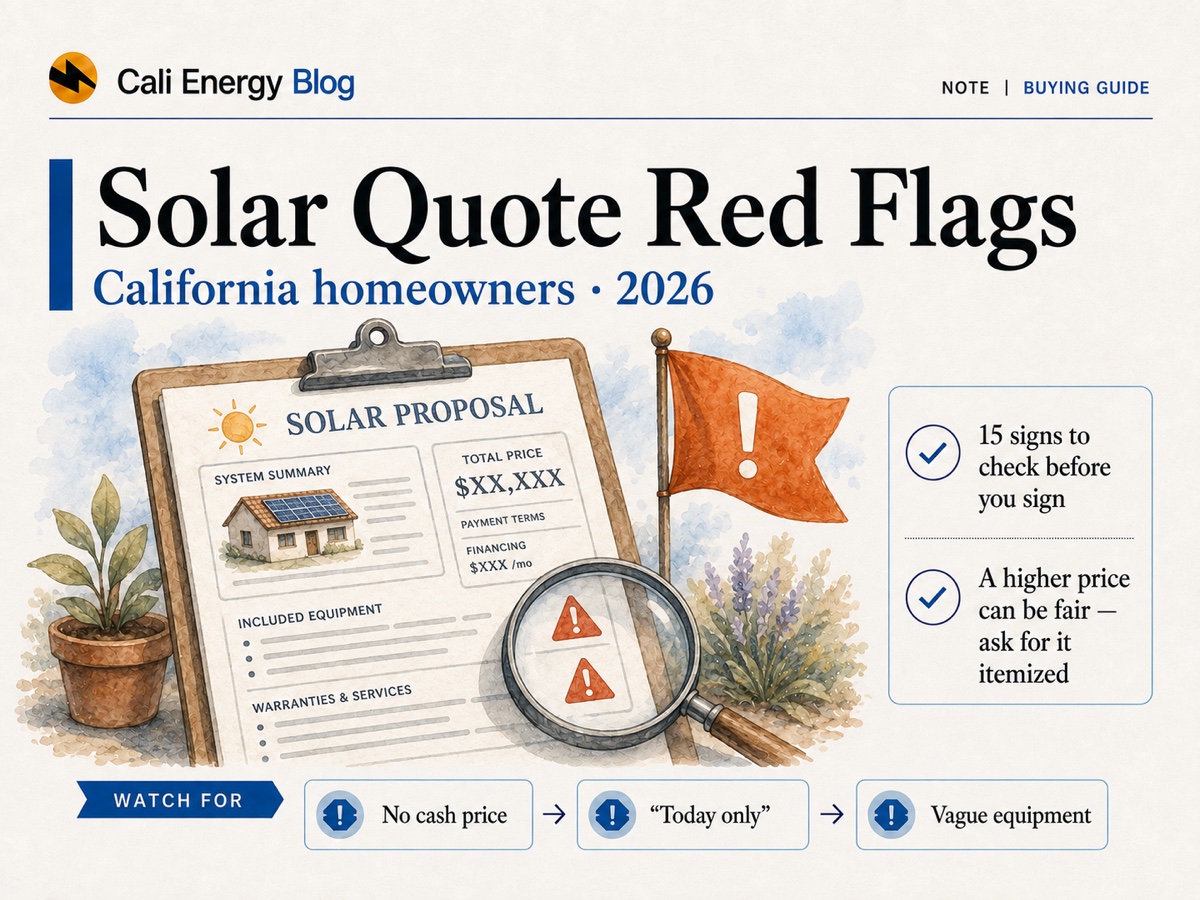
- A solar proposal is easy to sanity-check once you know what to look for — most red flags are things that are missing, not things that are said.
- A price above the other bids can be perfectly legitimate (roof work, electrical upgrades, premium gear). The fix isn’t to reject it — it’s to ask for an itemized explanation.
- Compare proposals on price per watt, written production, and warranties — not the monthly payment.
How to read any solar proposal in a few minutes
You don’t need to be an engineer to spot a weak solar quote. The strongest proposals are specific and written down; the ones worth a second look tend to be vague, verbal, or rushed. Below are 15 warning signs to scan for, why each one matters, and the exact thing to ask for so you can compare offers fairly. None of these on its own means a company is acting in bad faith — think of them as prompts for a good question.
| Warning sign | Why it matters | What to ask for |
|---|---|---|
| A price per watt far below your other quotes | Judge price against the other proposals you hold for the same system, not against a round number from the internet — published “average” figures mix cash and financed deals, different system sizes and different scopes, which is exactly how a fair quote gets flagged and a bad one gets a pass. A bid well under the others can mean bargain equipment, a thin design, or a number that changes after the site visit. | The cash price divided by DC watts for each quote — after subtracting anything that adds cost but no watts, such as a battery, a main-panel upgrade or roof work, or the arithmetic punishes whichever quote scoped the job honestly. Plus the panel and inverter make and model, so you can see what the low number actually buys. |
| A price far above the others, unexplained | A higher price is often justified — roof work, a panel upgrade, a battery or premium gear all add real cost. It is only a flag when nobody can tell you what the extra pays for. One trap when you do the division yourself: the total on the California solar disclosure document includes finance charges, so dividing that by watts compares a financed number against cash ones and makes every financed quote look expensive. | An itemized breakdown showing where the added cost goes (equipment, electrical, roof, financing), and the cash price stated separately. |
| Vague equipment (“premium panels”) | “Tier-1” or “premium” with no make and model tells you nothing about efficiency, warranty, or who honors it. | The exact panel, inverter, and battery brand and model number, in writing. |
| No written production estimate or guarantee | Without an annual kWh figure you can’t judge whether the system fits your bill — or hold anyone to it later. | A written first-year kWh/year estimate and any production guarantee terms. |
| “Today-only” or expiring-price pressure | A real, fair price rarely evaporates overnight, and a genuine deadline should be specific and verifiable. Same-day pressure mainly discourages you from comparing offers. | The proposal in writing with a reasonable validity window, so you can compare it calmly. |
| Only a monthly payment — no cash price | Quoting just the payment hides the true system cost and any financing charges rolled into it. | The full cash price and the total financed price side by side. |
| Large gap between cash and financed price | That gap is usually a dealer fee. The federal consumer bureau found these fees “typically range from between 10 to 30 percent of the cash price but can exceed 50 percent”, and that lenders generally do not include them in the cost of credit they disclose — so the fee is invisible in the APR conversation. Its example: a $30,000 cash price financed as a $39,000 principal, with the lender remitting $30,000 to the installer and keeping $9,000. | Both prices in writing, and a plain explanation of the difference between them. |
| Roof condition left out of scope | Panels last 25+ years; an aging roof underneath may not. Re-roofing after install means removing and reinstalling the array. | A note on roof age/condition and whether repair or replacement should happen first. |
| A needed panel (service) upgrade left out | Adding solar — and especially a battery or EV charger — can require a main-panel or service change. Leaving it out understates the real cost. Whether it’s required depends on the applicable NEC edition, your AHJ/utility, and equipment configuration. | Whether a main-panel upgrade is included or excluded, and its estimated cost if needed. |
| A production estimate that looks inflated | Overstated output makes payback look better than it is. A well-oriented, relatively unshaded Southern California rooftop may produce on the order of ~1,500–1,700 kWh per kW-year; actual output varies materially by location, tilt, azimuth, shading and system losses. | The assumptions behind the estimate (roof direction, tilt, shading) — ideally an NREL PVWatts–style basis. |
| Missing written warranties | Panels, inverter, battery, and workmanship each carry their own warranty. Verbal promises are hard to enforce. | The written equipment and workmanship warranty terms and who services them. |
| No CSLB license number on the proposal | Contracting for more than $500 without a licence is a misdemeanour in California, not merely bad practice. A missing license number makes the company hard to verify. | The CSLB license number — then confirm status yourself at the CSLB “Check a License” tool. |
| A large upfront deposit | For home-improvement contracts California caps the down payment at the lesser of 10% or $1,000, on the contract amount excluding finance charges, and a contractor may not take payment ahead of the value of work performed. But there is a real exception: a contractor who furnishes a performance and payment bond, or an approved joint control, is exempt from those limits and may lawfully ask for more up front. So a big deposit request is a question, not proof of anything. | A payment schedule tied to work completed — and, if the deposit exceeds the cap, the bond or joint control that permits it. |
| An undisclosed lease/PPA escalator | Many leases and power-purchase agreements raise the rate every year (an escalator). A low first-year payment can climb over the term. | The escalator rate and the payment in year 1, 10, and 20 — in writing. |
| Contract terms that don’t match the verbal pitch | What’s signed is what governs — not what was said at the kitchen table. Price, size, equipment, or guarantees can differ. | Time to read the full contract, and written confirmation that it matches every verbal promise. |
Deposit limit and the bond exemption from Business and Professions Code §7159.5; licence checks at CSLB Check a License; dealer fees from the CFPB issue spotlight on solar financing (August 2024); production benchmark from PVWatts. What counts as a fair price is a comparison against your own quotes, not a published average.
A higher price isn’t automatically a red flag
It’s worth repeating, because it’s the most common misread: a quote above the others you have collected can be completely fair. A steep or multi-story roof, a needed main-panel upgrade, structural reinforcement, premium panels, or an added battery all raise the price for real reasons. The goal of this checklist isn’t to push you toward the cheapest bid — it’s to make sure any price, high or low, comes with a clear, written explanation you can compare. When something looks off, the productive move is to ask for an itemized breakdown, not to assume the worst.
For a side-by-side method, see our compare solar quotes checklist, and see what solar actually costs in California in 2026 if you want a published distribution rather than a single average — it separates the cash median from the financed one, which is the distinction that makes a benchmark usable at all.
The three numbers that make quotes comparable
If you only standardize three things across every proposal, make it these. They turn very different-looking offers into an apples-to-apples comparison.
Price per watt
Cash price ÷ system size in DC watts, with battery, panel-upgrade and roof work taken out of the top first — and the same unit on every quote, since a proposal may also state a lower CEC-AC rating. This normalizes cost across different system sizes and is the single best number for comparing offers.
First-year production
Estimated kWh/year, with the roof orientation and shading assumptions behind it. This tells you whether the system actually fits your usage.
Total cost of ownership
Cash price, or the full financed total including any dealer fee — plus warranty terms. The monthly payment alone hides both.
Two rules worth knowing before you sign
Deposit cap: for home-improvement contracts California limits the down payment to the lesser of 10% of the contract amount or $1,000, excluding finance charges, and bars a contractor from taking payment ahead of the work done — unless they furnish a performance and payment bond or approved joint control, which exempts them (Business & Professions Code §7159.5). Right to cancel: where the contract was signed away from the contractor’s own business premises, you have until midnight of the third business day after you receive a signed and dated copy of the contract — usually the day you sign; the fifth for a senior citizen — and California counts Saturday as a business day. How that works in practice is below; the CPUC California Solar Consumer Protection Guide is the state’s own summary.
How to verify a contractor’s license in two minutes
Every legitimate California solar proposal should carry a CSLB license number. You can confirm it yourself: open the CSLB Check a License tool, enter the number or business name, and you’ll see the license classification, current status, bond, workers’-compensation coverage, and any publicly listed disciplinary actions. It’s free, and it’s the quickest way to confirm the company you’re talking to is who they say they are. For reference, Cali Energy is CSLB #1032379.
Audit your own quote: the red-flag checklist
Tick anything you see in a proposal you’re holding. The tool weights each flag and gives you a quick risk read — no upload, nothing leaves your browser. These ten focus on the flags that most often hide money — the dealer fee, a tax credit pitched as a guaranteed refund, “free solar” — which are about how a deal is financed rather than how it is specified. Remember a higher price can be justified; these flags are about transparency, not cost.
Solar quote audit
Check every item that applies to your proposal.
Educational self-check based on CPUC and CFPB consumer-protection guidance, not a substitute for legal or financial advice. Weights reflect how often a flag hides real cost, not a formal standard.
If you already signed: how the cancellation right actually works
“You get three days” is the version everyone knows. Several details decide whether you still have them, and they catch people out.
It depends where you signed. The three-day right comes from California’s home-solicitation rules, and those apply to a contract made somewhere other than appropriate trade premises — defined as premises where the seller “normally carries on a business.” Signed at your kitchen table or on your doorstep: it applies. The statute defines those premises as where the seller “normally carries on a business, or where goods are normally offered or exposed for sale,” so a booth at a fair or a home show is less clear-cut than it looks. Signed in the contractor’s own office: this particular right does not attach, and you are down to whatever the contract itself grants. That is worth knowing before you agree to where the meeting happens.
Seven days, not three, after a disaster. A separate rule gives until midnight of the seventh business day to cancel a contract for the repair or restoration of residential premises damaged by a disaster — which in Los Angeles means anyone rebuilding after a fire is working to a different clock from the one below.
Saturday is a business day. This is the one that costs people their window. The statute defines a business day as any calendar day except Sunday and nine named holidays — New Year’s Day, Washington’s Birthday, Memorial Day, Independence Day, Labor Day, Columbus Day, Veterans’ Day, Thanksgiving and Christmas. Saturday is not on that list, so it counts. For a home improvement contract — which a solar installation is — the clock runs to midnight of the third business day after you receive a signed and dated copy of the contract, usually the day you sign — the fifth if the buyer is a senior citizen.
| You sign on | The three business days are | Deadline, midnight of |
|---|---|---|
| Monday | Tue, Wed, Thu | Thursday |
| Thursday | Fri, Sat, Mon (Sunday skipped) | Monday |
| Friday | Sat, Mon, Tue | Tuesday |
| Saturday | Mon, Tue, Wed | Wednesday |
Counted from California Civil Code §1689.6, which runs the period from the day after signing, and §1689.5(e), which excludes only Sunday and the nine listed holidays. A listed holiday falling inside the window pushes the deadline out by a day — unless it lands on a Sunday, which is excluded anyway, in which case nothing moves. Christmas Day 2033 is a Sunday: sign on the Friday and the deadline is still the Tuesday. This is general information, not legal advice for your contract.
How to actually cancel. The notice has to be in writing — a phone call to your salesperson is not cancellation. Send it to the address or email address specified in the agreement, not to whoever you have been texting. It does not need to follow any particular form or wording, as long as it makes clear you do not intend to be bound; the contract should also come with a cancellation form you can use — and if it did not, the clock may never have started. The three days run from the day you sign an agreement “which complies with Section 1689.7,” and that section adds: “Until the seller has complied with this section the buyer may cancel the home solicitation contract or offer.” What it requires is specific — a completed Notice of Cancellation in duplicate, attached to the agreement and easily detachable, in at least 10-point type and in the same language as the contract. So if you signed at home and no such form was attached, do not assume the window shut; that is worth a lawyer’s five minutes before you give up on it. And if you post it, the law treats it as given when you deposit it in the mail with postage paid — so a letter mailed on the last day counts even though it arrives later. Keep proof of what you sent and when.
A calm way to handle pressure
If a proposal is sound, waiting a day won’t change the price. A reasonable response to “this offer is only good today” is simply: “Please put it in writing and I’ll compare it this week.” Any provider working in good faith will be glad to. Take the time to read the full contract, confirm it matches everything you were told verbally, and keep your deposit within the legal limit. If you’re still weighing whether to move at all, is solar still worth it in California? walks through the 2026 math.
Get a clear, itemized solar proposalFrequently asked
What is the biggest red flag in a solar quote?
Usually it’s something missing rather than something said: no written production estimate, no equipment make/model, no cash price, or no CSLB license number. A proposal that’s specific and in writing is far easier to trust and compare than a verbal pitch. If a key detail is absent, ask for it before you sign.
Is a high solar price always a bad sign?
No — and judging it against a published “average price per watt” is the wrong test anyway, because those averages mix cash and financed deals, different system sizes and different scopes. A difficult roof, a main-panel upgrade, structural work, premium equipment or an added battery all raise cost for real reasons. Compare the cash price per DC watt across the proposals you actually hold — first taking out anything that adds cost but no watts, such as a battery, a main-panel upgrade or roof work, because those inflate the price per watt of whichever quote scoped the job properly. When one is still higher, ask for an itemized explanation rather than rejecting it. One arithmetic trap: the total on California's solar disclosure document includes finance charges, so dividing that figure by watts makes any financed quote look expensive next to a cash one.
How much deposit can a solar contractor ask for in California?
For a home-improvement contract, California limits the down payment to the lesser of 10% of the contract amount or $1,000, on the amount excluding finance charges, and the contractor may not request or accept payment beyond the value of work performed or material delivered (Business & Professions Code §7159.5). There is a genuine exception, though, and it is why a large deposit is a question rather than proof of wrongdoing: a contractor who furnishes a performance and payment bond, or an approved joint control, is exempt from those limits and may lawfully take more up front. So ask which applies — if the deposit exceeds the cap, ask to see the bond.
How do I check if a solar company is licensed?
Use the CSLB Check a License tool. Enter the license number or business name and you’ll see the classification, current status, bond, workers’-comp coverage, and any publicly listed disciplinary actions. It’s free and takes about two minutes.
Can I cancel a solar contract after signing?
Usually yes, but the details decide it. The three-day right comes from California's home-solicitation rules and applies to a contract made somewhere other than premises where the seller normally carries on business — so signing at your kitchen table is covered, signing at the contractor's office generally is not. Where it applies you have until midnight of the third business day after you receive a signed and dated copy of the contract — usually the day you sign — or the fifth if the buyer is a senior citizen. Careful with the counting: California defines a business day as any day except Sunday and nine named holidays, so Saturday counts — sign on Friday and your deadline is midnight Tuesday, not Wednesday. Cancel in writing, sent to the address or email address specified in the agreement; no particular form is required, and a mailed notice takes effect when you deposit it with postage paid, not when it arrives. One more thing worth knowing before you conclude you are too late: the three days run from signing an agreement that complies with Civil Code §1689.7, and that section says that until the seller has complied, the buyer may cancel. It requires a completed Notice of Cancellation in duplicate, attached to the contract and easily detachable, in at least 10-point type. If you signed at home and got no such form, the window may still be open. A separate rule gives seven business days for contracts to repair residential premises damaged by a disaster. This is general information, not legal advice — read your own contract.
What is a lease or PPA escalator, and why does it matter?
An escalator is an annual increase built into many solar leases and power-purchase agreements — often a few percent a year. A low first-year payment can climb meaningfully over a 20–25 year term. If you’re offered a lease or PPA, ask for the escalator rate and the payment in year 1, 10, and 20 in writing before you decide.
Related reading
Sources & methodology
Figures on this page come from the primary sources below and, where noted, from Cali Energy calculations using the stated assumptions. Rates, incentives, and program terms change; each was verified September 29, 2026.
- California Business and Professions Code §7159.5 — home improvement down payment limit and the bond exemption
- California Civil Code §1689.5 — home solicitation contract, appropriate trade premises and the definition of a business day
- California Civil Code §1689.6 — the right to cancel and how notice is given
- California Civil Code §1689.7 — the required Notice of Cancellation, and the buyer's right to cancel until the seller complies
- California Business and Professions Code §7159 — home improvement contract requirements and the three-day / five-day right-to-cancel notice
- CFPB — Issue Spotlight: solar financing dealer fees (August 2024)
- CSLB — Check a License
- CSLB — home improvement contract requirements
- CPUC — California Solar Consumer Protection Guide
- NREL PVWatts — production estimator
Want a proposal you can actually check?
Send us your roof and a recent bill and we'll give you a written, itemized proposal — equipment model numbers, kWh production estimate, and a clear cash price. No pressure, no today-only deals.
Get a free estimatePrepared by Cali Energy, September 29, 2026. This article is for general educational purposes only and is not legal, tax, financial, engineering, or utility advice. Rates, incentives, codes, permit requirements, equipment specifications, prices, and program terms may change; figures and timelines are estimates, not guarantees. Confirm current requirements with the applicable utility, AHJ, program administrator, manufacturer, or a licensed professional. See our Content Disclaimer. Cali Energy · 19201 Parthenia St, Unit E, Northridge, CA 91324 · CSLB #1032379 (B, C-10, C-39)