

How to Read a Solar Proposal, Page by Page
A good solar proposal answers five questions in order: what you pay the utility today and with solar, what system goes on your roof, what it saves over time, what it costs and how you pay, and how you can cancel. Read it page by page and check one thing on each: that the bill "with solar" isn't zero, that the equipment has exact model names, that the payback uses the full price, that the payment schedule doesn't ask for too much up front, and that the right-to-cancel notice is there. The example below is the public sample proposal made in Cali-Graf, the design and proposal software Cali Energy built for installers, for a made-up Los Angeles home on LADWP — a 22-panel system with a 10 kWh battery.
The cover: today vs. with solar
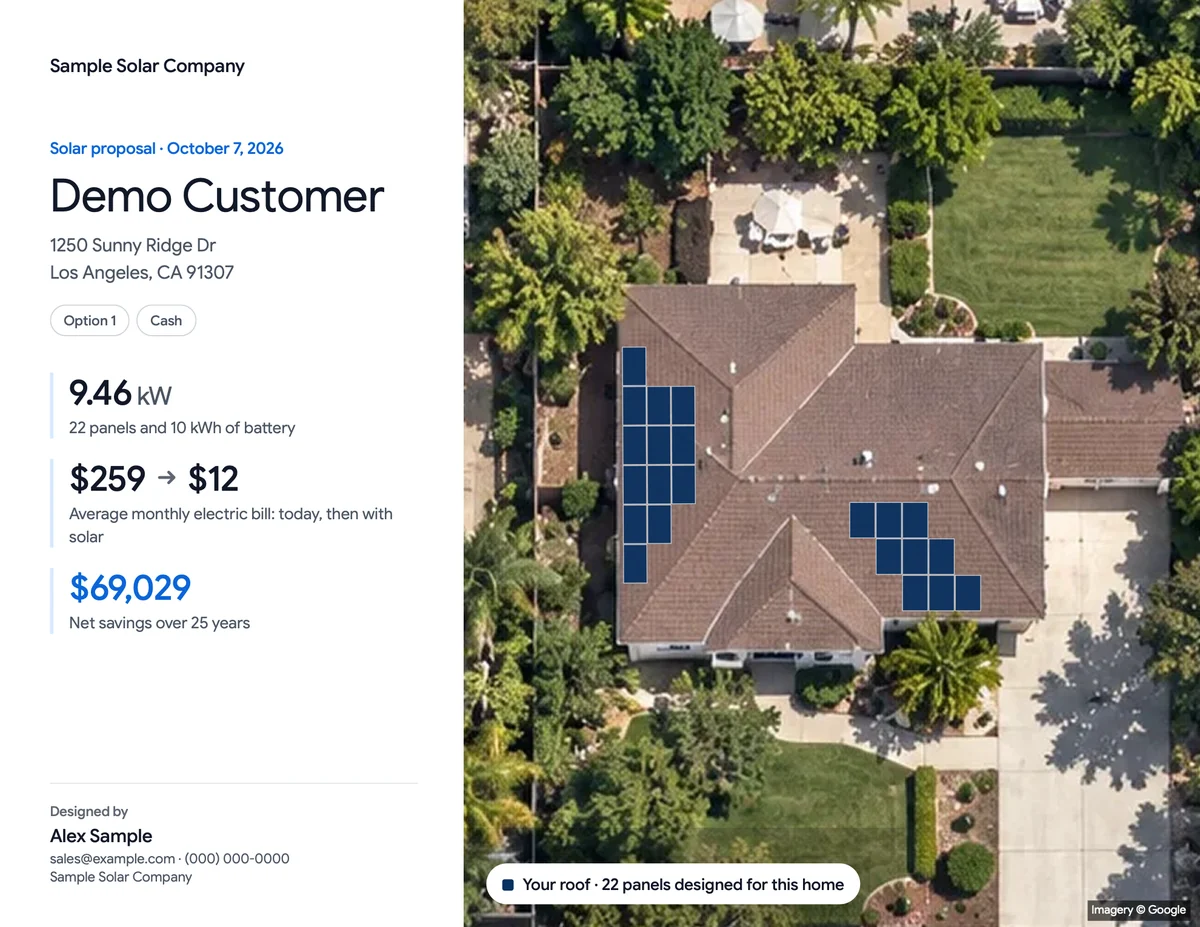
The cover should show the two numbers you'll remember: your average monthly electric bill today and with solar — in the sample, $259 and $12. In Cali-Graf's proposals these are the first year's bills divided by 12; with a loan the cover reads "your bill today, then bill + loan payment". Below them, net savings over 25 years: 25 years of bills without solar, minus bills with solar, minus what you pay for the system.
Check: who prepared it. The cover should name the seller and the company, with a contractor's license number you can look up with the Contractors State License Board before you sign.
Your solar system: size, production and equipment
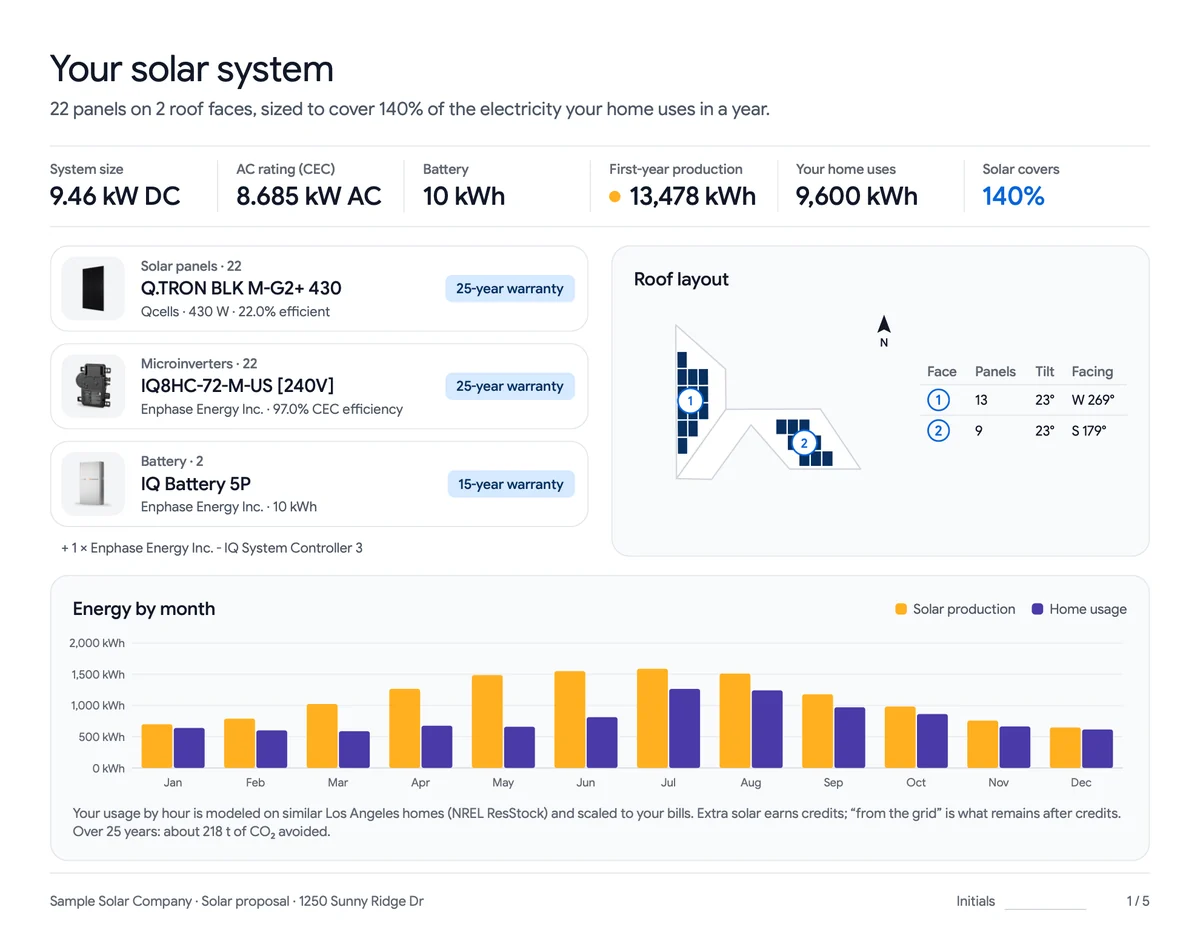
This page says what's going on the roof and how much it makes:
- System size in kW DC, and an AC rating. The sample: 9.46 kW DC from 22 panels.
- First-year production next to what your home uses, and the share solar covers. The sample makes 13,478 kWh for a home using 9,600 kWh — 140%.
- Exact equipment: the panel, inverter and battery models, makers and warranties, plus a roof layout with each face's panel count, tilt and direction.
Check: coverage well above 100%. On LADWP, solar beyond your yearly usage turns into a credit the utility never pays out; on SCE, surplus earns little. A system sized past your usage should come with a reason — an electric car you're buying, say. Check: model names. "Premium panels" isn't a model; an exact name lets you look the product up.
Your battery (if there is one)
A battery page should say what the battery does day to day, not just its size. The sample's battery is set to backup only: it stays charged from solar and takes over when the grid goes down, and day to day it doesn't change your electric bill — the savings come from the panels. That's the right answer for an LADWP home, where solar is netted 1:1 over each billing period. It also estimates how long essentials run in an outage.
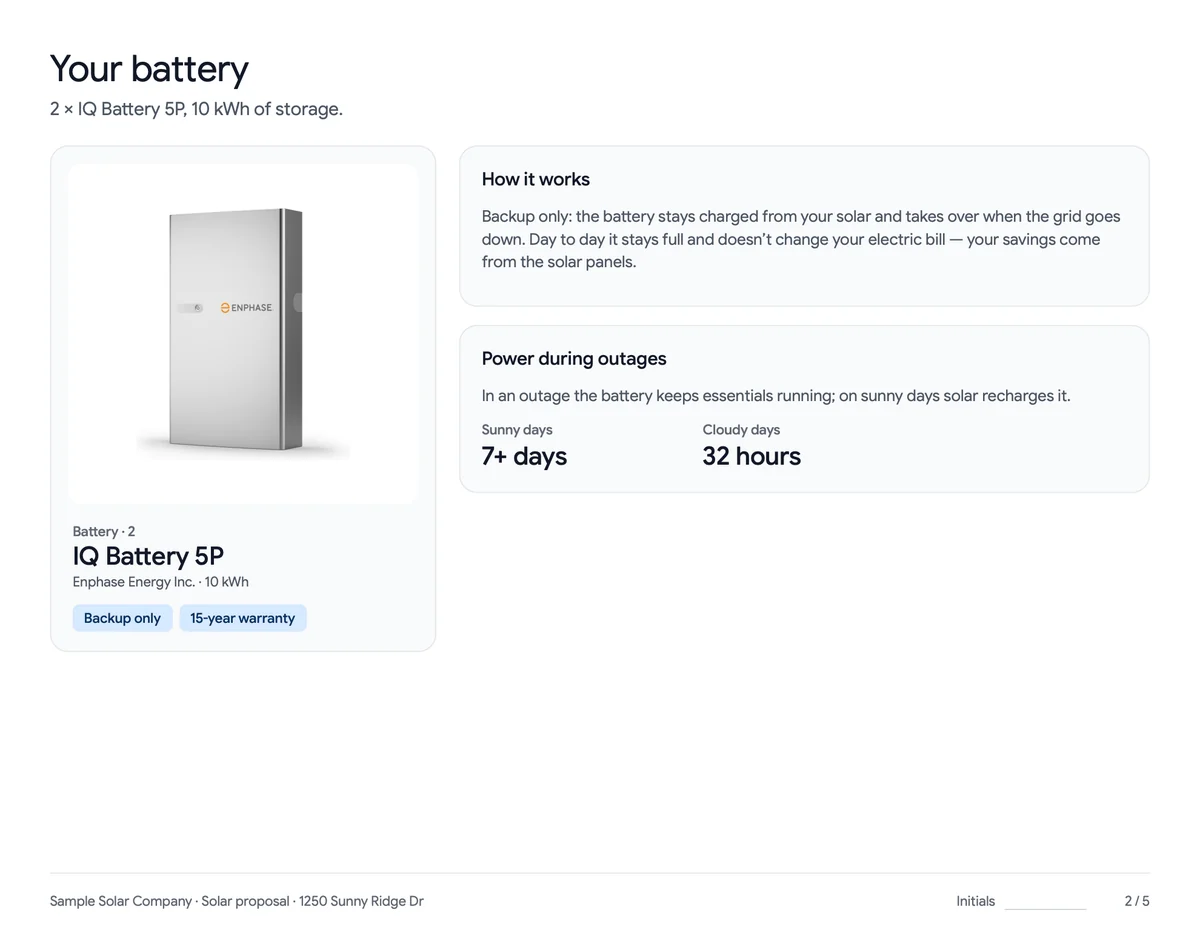
Check: which circuits stay on during an outage, and whether any bill savings are claimed for the battery — and why. Backup choices are covered in whole-home vs critical-loads backup.
Your savings: month by month and over 25 years
This is the page to read slowly:
| Number | What it means | What to check |
|---|---|---|
| Average monthly bill | Today vs. with solar, first year | With solar shouldn't be $0 — fixed charges stay |
| Electric bill offset | Share of the first year's bill solar removes | — |
| Pays for itself | Years until bill savings equal what you paid upfront | Is it on the full price? |
| Month by month | Bill without and with solar for each month | The months with the highest bills should show the biggest drop |
| Total you pay, 25 years | All bills without solar vs. with solar (cash: price included) | — |
| Cost per kWh | Utility today vs. the system's price ÷ its 25-year production | — |
| Assumed rate increase | How fast utility rates are assumed to rise | Is it stated, and does it seem reasonable? |
In the sample, the bill with solar is about $10 in most months, not zero — LADWP's minimum charge — and the utility's city tax is listed separately rather than hidden. The savings page also states plainly that the numbers are estimates, not a guarantee.
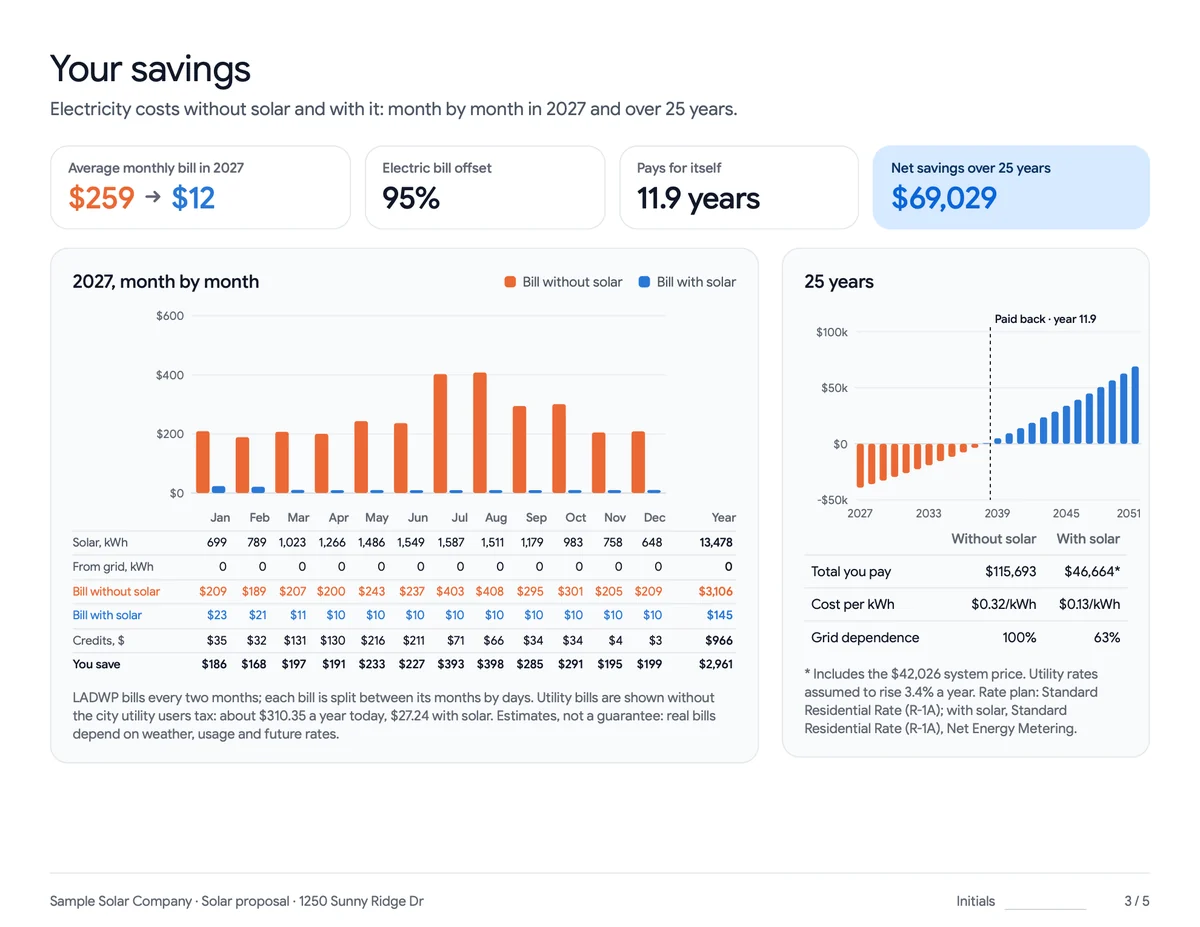
Check: the federal tax credit. The 30% credit ended for systems installed after 2025; a 2026 proposal shouldn't subtract it anywhere — see does your solar quote still subtract the 30% tax credit?. Check: the rate increase. The 25-year savings grow quickly with it; the sample assumes 3.4% a year and says so.
Price and approval
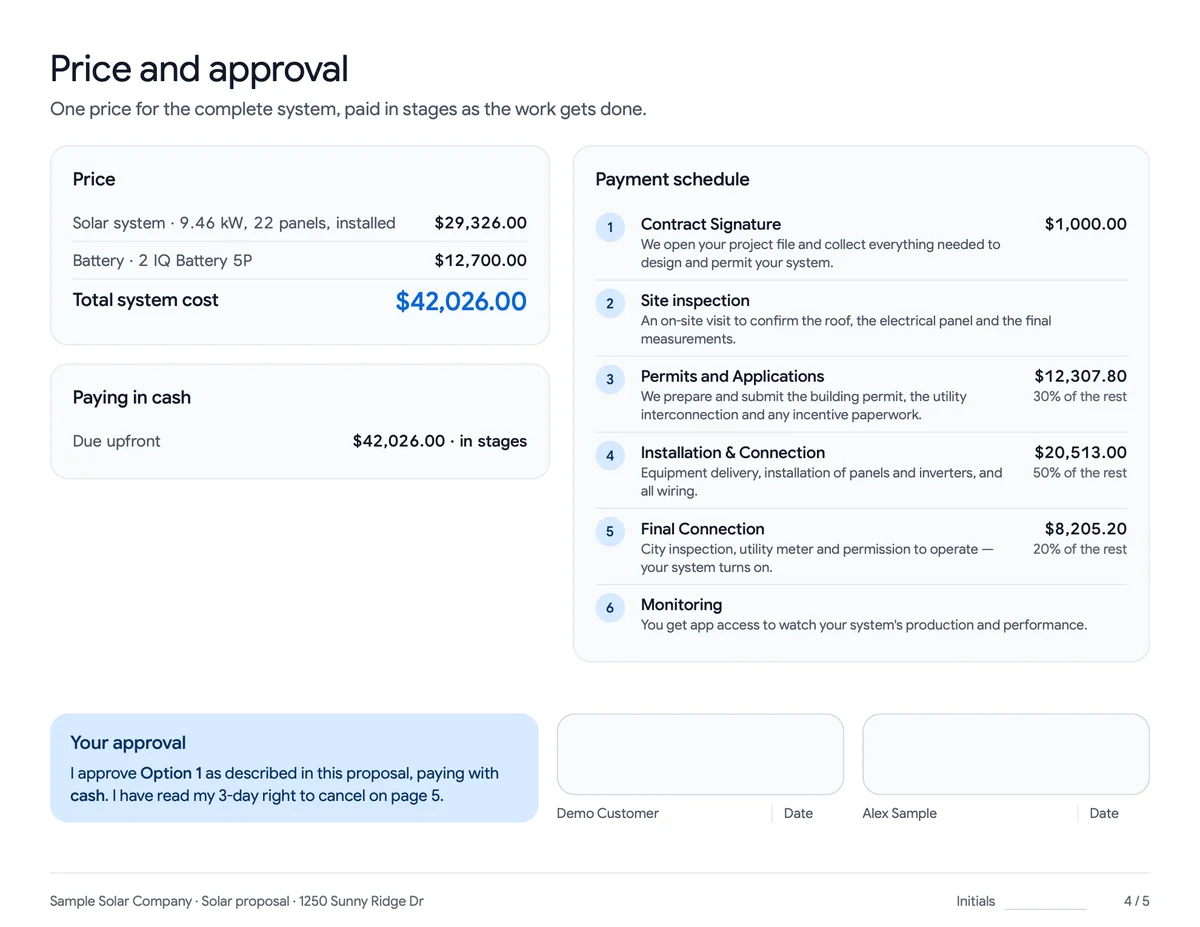
This page should give one price for the complete system, line by line — solar, battery, any extras — and how you pay: cash in stages, or a loan with its payment. In the sample, the cash price is split into a payment schedule that follows the work: a payment at signing, then at permits, installation and final connection.
Check: the payment at signing. California caps a home improvement down payment at $1,000 or 10% of the price, whichever is less, and later payments shouldn't run ahead of the work done — unless the contractor has a performance and payment bond. Check: the approval sentence names the option and the payment method you actually chose, and every page has a box for your initials, so pages can't be swapped later.
Want to see these pages for your own home? Ask Cali Energy for a free estimate built on your roof and bills.
Your right to cancel
The last page should carry the notice the Contractors State License Board requires, with the total cost, how to complain to the CSLB and your cancellation right. A contract signed anywhere other than the contractor's place of business can be cancelled in writing within three business days — five if you're 65 or older. The details, and the rest of your rights as a solar buyer, are in California solar consumer rights.
Questions to ask before you sign
1. Is any federal tax credit or rebate included in these numbers?
- Why this system size — and what happens to solar my home doesn't use?
- What's the bill with solar made of, if it isn't zero?
- What rate increase did you assume, and what do the savings look like with a lower one?
- For a battery: what does it do on a normal day, and what stays on in an outage?
- What do I pay at signing, and when is each later payment due?
To compare two proposals side by side, use the same footing for both — full price, system size, your usage and the same rate increase — as in the solar quote comparison checklist.
Frequently asked
What should a solar proposal include?
Why isn't my bill with solar zero?
What is a reasonable payback period for solar?
What does "solar covers 140%" mean?
How much can a solar contractor ask for at signing in California?
How long do I have to cancel a solar contract?
Related reading
Sources & methodology
Product facts on this page come from Cali-Graf's own help center and the pages linked below; figures in examples come from the stated inputs. Features, limits and supported utilities change; each was verified October 16, 2026.
- Cali-Graf — Sample proposal (made-up demo home)
- Cali-Graf Help — Proposal numbers explained
- Cali-Graf Help — Customer approval and the 3-day right to cancel
- Cali-Graf Help — Payment schedule and financing in the proposal
- California Business & Professions Code §7159.5 — down payment and progress payments
- California Business & Professions Code §7169 — Solar Energy System Disclosure Document
- California Civil Code §1689.6 — right to cancel
- Contractors State License Board
Want a proposal you can read this way?
Cali Energy (CSLB #1032379), a Los Angeles solar installer, designs on your own roof and prepares a proposal with your bill today and with solar, exact equipment, the full price and the right-to-cancel notice. Whoever you choose, check their license before you sign. The sample's numbers are illustrations for a made-up home; this is general information, not legal or tax advice.
Prepared by Cali Energy, October 16, 2026. This article is for general educational purposes only and is not legal, tax, financial, engineering, or utility advice. Rates, incentives, codes, permit requirements, equipment specifications, prices, and program terms may change; figures and timelines are estimates, not guarantees. Confirm current requirements with the applicable utility, AHJ, program administrator, manufacturer, or a licensed professional. See our Content Disclaimer. Cali Energy · 19201 Parthenia St, Unit E, Northridge, CA 91324 · CSLB #1032379 (B, C-10, C-39)