

Your Solar Consumer Rights in California
Straight answer: California law gives you a written contract with a solar disclosure on its cover page showing the total cost, the CPUC’s Solar Consumer Protection Guide, a deposit cap of $1,000 or 10%, and — if you signed anywhere but the contractor’s office — three business days to cancel, five if you’re 65 or older. The cancellation clock starts when you receive a signed, dated copy of the contract. Here’s how to use each right, and where to turn if something goes wrong.
Get a free estimate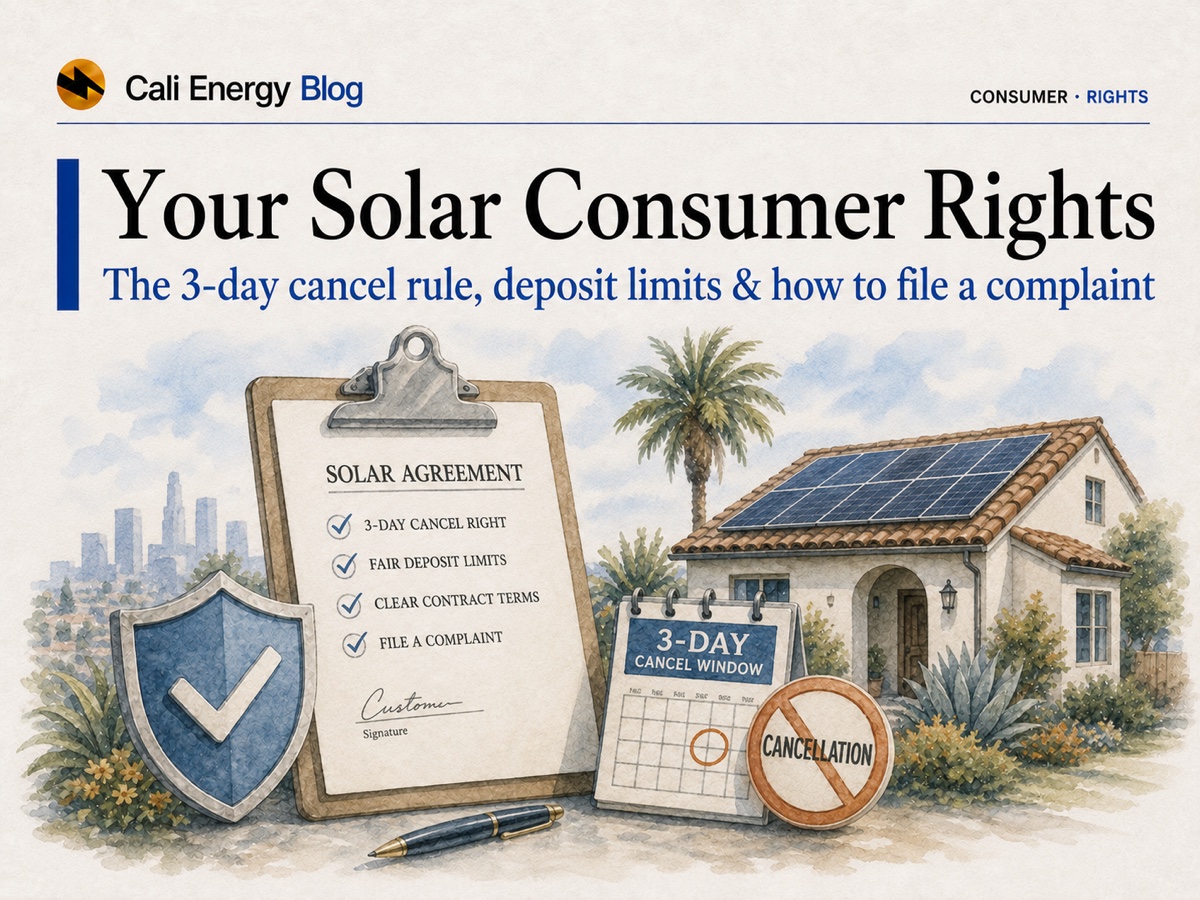
- Every residential solar contract must carry the Solar Energy System Disclosure Document on its cover page in 16-point bold: the total cost including financing, where to complain, and your cancellation right — in the language you were sold in.
- If you signed anywhere but the contractor’s place of business, you have three business days to cancel in writing (five if you’re 65 or older), counted from when you receive a signed, dated copy of the contract.
- The deposit is capped at $1,000 or 10% of the price, whichever is less, and later payments may not run ahead of the work — unless the contractor furnishes a performance and payment bond or joint control.
- The contractor needs an active CSLB license in C-46 Solar or C-10 Electrical, a $25,000 bond, and the salesperson a home improvement salesperson registration. Check all three before you sign.
- Complaints go to the CSLB (PACE financing: the DFPI). In fiscal 2022–23, 39% of investigated solar complaints were settled; 10% involved a license that was already revoked. General information, not legal advice.
Your core rights at a glance
What the law requires, and how to use each right before and after you sign.
| Your right | What the law requires | How to use it |
|---|---|---|
| A written contract | Home improvement jobs over $500 need a written contract with a detailed description, a payment schedule and the contractor’s name, address and license number | Get every verbal promise into the contract before you sign |
| A solar disclosure on the cover page | Total cost including financing, how to complain, and your cancellation right, in boldface 16-point type, in the language of the sales pitch (B&P §7169) | Read the cover page first; the total cost is there |
| The CPUC consumer guide | Customers of PG&E, SCE, SDG&E and three smaller utilities initial and sign it before interconnection, with time to read it | Ask for it at first contact, in your language |
| A right to cancel | 3 business days if not signed at the contractor’s place of business; 5 if you’re 65 or older | Cancel in writing by midnight of the last day; keep proof |
| A capped deposit | $1,000 or 10% of the price, whichever is less, excluding finance charges; payments may not exceed the work done | A bigger deposit needs a bond or joint control — ask which |
| A licensed, bonded contractor | Active license in C-46 Solar or C-10 Electrical; $25,000 contractor bond | Check the license, bond and salesperson at CSLB |
| A place to complain | CSLB handles contractor complaints, with a dedicated solar form; DFPI oversees PACE financing | File in writing with copies of everything |
Sources: CSLB — home improvement contracts · CSLB solar disclosure document · B&P §7169 · CPUC guide · CSLB — right to cancel · CSLB — bond. General information, not legal advice.
The written contract: what it must contain
In California, a home improvement project over $500 needs a written contract. CSLB says it should describe the products and the work in detail — sizes, who does what, manufacturer model numbers — include a written payment schedule, say who pulls the permits, give a completion date, and identify the contractor by name, business address and license number; warranties for labor and materials belong in writing too. Changes to price or scope need a written, signed change order (CSLB).
Two money rules matter most. The down payment can’t exceed $1,000 or 10% of the contract price, whichever is less, excluding finance charges, with no exception for special-order materials — on a $25,000 system that is $1,000. And payments may not exceed the value of the work performed. The one exception: a contractor who furnishes a performance and payment bond, or an approved joint control, may lawfully take more (B&P §7159.5), so a large deposit request is a question to ask, not proof of wrongdoing. Your contract must also carry a “Notice to Owner” about liens: anyone who helps improve the property and isn’t paid — subcontractors, suppliers, workers — can record a mechanics lien on it. CSLB further warns that some solar contracts let a company place a lien on your home or make all payments due at once if you miss one; read for both (CSLB, CSLB Solar Smart).
The two documents unique to solar
Beyond a normal contract, California adds two solar-specific safeguards.
The Solar Energy System Disclosure Document
Developed by CSLB with the CPUC under B&P §7169, it goes on the front page of every residential solar contract in boldface 16-point type: the total cost including financing and energy or power costs, how to complain to CSLB, and your cancellation right. The contract and the disclosure must be in the language mainly used in the sales presentation or marketing. Supporting pages can add how the panel count and production were calculated and what the contract means if you sell the home — ask for them (B&P §7169, CSLB form).
The CPUC Solar Consumer Protection Guide
The state’s guide covers rates, financing and your rights. Providers interconnecting homes with PG&E, SCE, SDG&E, Bear Valley Electric Service, PacifiCorp or Liberty must collect your initials and signature on it, and you must be given time to read it; it should come in the language you were first contacted in (CPUC). LADWP isn’t on that list, but the guide is still worth reading.
Three business days — five if you’re 65 or older
Unless the contract was negotiated at the contractor’s place of business, you can cancel within three business days; since 2021, buyers 65 or older get five. Cancel by emailing, mailing, faxing or delivering written notice to the contractor’s place of business by midnight of the last business day after you received a signed, dated copy of the contract with the notice, and include your name, address and the date you received it (CSLB 3-day form, 5-day form). Saturdays count as business days — only Sundays and listed holidays are skipped — a mailed notice takes effect when you mail it, and until the seller provides the required Notice of Cancellation the right to cancel stays open (Civil Code §§1689.5–1689.7). If you cancel, the seller can be required to return the entire contract amount and restore your property (CSLB). Keep proof of when you sent the notice. General information, not legal advice.
Verify the license, the bond and the salesperson — it takes two minutes
On CSLB’s free Check a License tool, confirm the license is active, matches the company name, and carries a classification that covers the work: C-46 Solar or C-10 Electrical, with C-39 if roofing is part of the job. A general contractor with only a B license can’t take a solar-only job unless it subcontracts it to one of those (CSLB). The same record shows the contractor’s $25,000 bond — required since January 1, 2023 and filed for consumers damaged by defective construction or other license-law violations, and for unpaid employees (CSLB) — and whether the salesperson holds a home improvement salesperson registration. For a fuller walkthrough, see how to choose a solar installer in California.
What an active license looks like
Cali Energy holds CSLB #1032379 (classifications B, C-10 and C-39), the license behind our solar, battery, roofing and electrical work across Los Angeles and the San Fernando Valley. Whoever you hire, look up their number the same way before you sign.
Leases, PPAs and PACE: extra fine print
The disclosure and cancellation rules apply whether you buy, finance or lease. A lease or power-purchase agreement adds terms worth reading closely: a third party owns the panels, payments often rise each year — the CPUC says escalators are typically 1–3% — and selling the home means a transfer or buyout (CPUC; see selling a house with solar). Because the third party owns the system, it, not you, claims any business tax credit; the homeowner credit ended for owner-bought systems after 2025. PACE financing is repaid through your property-tax bill as a first-priority lien; PACE administrators are licensed by the Department of Financial Protection and Innovation, which takes PACE complaints (DFPI). Compare the ways to pay in cash vs loan vs lease vs PPA.
How solar complaints actually end
CSLB publishes a yearly report on solar complaints. The numbers show what goes wrong and why paperwork matters.
| Nature of complaint | Cases |
|---|---|
| Workmanship or abandonment | 1,232 |
| Misrepresentation or fraud | 323 |
| Unlicensed contractor | 33 |
| Home improvement contract violation | 32 |
| Permit violations | 19 |
| Unregistered salesperson | 11 |
| Other | 97 |
| Disposition | Cases |
|---|---|
| Insufficient evidence | 724 |
| Settled | 630 |
| License already revoked | 170 |
| Criminal referral | 34 |
| Advisory notice | 25 |
| Citation | 20 |
| Letter of admonishment | 17 |
| Accusation | 3 |
| Arbitration | 2 |
Source: CSLB Solar Smart — Solar Complaints Report FY 2022/2023. As published, the categories total 1,747, more than the 1,625 cases investigated; the outcomes total 1,625. The complaints came from 837 California ZIP codes.
Three things stand out. Workmanship or abandoned jobs account for 1,232 of the 1,625 investigated cases — about three in four — far more than sales misrepresentation. Most outcomes were either a settlement (39%) or insufficient evidence (45%) — which is why documents decide cases. And in 170 cases, about one in ten, the contractor’s license had already been revoked; checking the license before you sign is the cheapest protection there is.
If something goes wrong: how to file
1. Gather your paperwork
The contract with its cover-page disclosure, change orders, invoices, canceled checks, ads and messages. Documentation is what moves a complaint.
2. File with CSLB
Use CSLB’s complaint page, including its dedicated solar complaint form, call 800-321-CSLB (2752), or write to P.O. Box 26000, Sacramento, CA 95826, as the disclosure document lists.
3. Use the right agency
PACE financing goes to the DFPI. CSLB points consumers to the Federal Trade Commission for unwanted telemarketing calls or misleading advertising.
- The Solar Energy System Disclosure Document is on the cover page, with the total cost including financing.
- The contract lists the contractor’s name, address and license number, the equipment by model, the payment schedule, who pulls permits, and a completion date.
- I received the CPUC Solar Consumer Protection Guide and had time to read it.
- The deposit is $1,000 or 10% or less, or the contractor has shown the bond or joint control that allows more.
- I checked the license (C-46 or C-10), bond and salesperson registration at CSLB.
- I know my cancellation deadline — three business days, or five if 65 or older — and when it started.
This guide covers your legal rights and recourse. To pressure-test one proposal, use our solar quote red flags checklist; to line up two, see how to compare two solar quotes. For your own situation, consult a qualified attorney or contact CSLB and the CPUC directly.
Frequently asked
How long do I have to cancel a solar contract in California?
If you signed anywhere other than the contractor’s place of business, three business days — five if you’re 65 or older. The deadline is midnight of the last business day after you received a signed, dated copy of the contract with the cancellation notice. Cancel in writing by email, mail, fax or delivery to the contractor’s place of business, and keep proof. General information, not legal advice.
How much of a down payment can a solar contractor ask for?
No more than $1,000 or 10% of the contract price, whichever is less, excluding finance charges, and later payments may not run ahead of the work done (B&P §7159.5). A contractor who furnishes a performance and payment bond or an approved joint control is exempt and may take more — so ask which applies before paying a larger deposit.
Do I have to sign the California Solar Consumer Protection Guide?
If your utility is PG&E, SCE, SDG&E, Bear Valley Electric Service, PacifiCorp or Liberty, yes: the provider must collect your initials and signature on the CPUC guide before interconnecting, and give you time to read it. LADWP is not on that list, but the guide is still worth reading.
How do I check if a solar contractor is licensed in California?
Use CSLB’s free Check a License tool. Confirm the license is active, matches the company name and covers solar — C-46 Solar or C-10 Electrical (a B-only contractor must subcontract a solar-only job) — and look at the $25,000 bond, workers’ compensation and the salesperson’s registration on the same record.
How do I file a complaint against a solar company?
With the Contractors State License Board: online (there is a dedicated solar complaint form), by phone at 800-321-CSLB (2752), or by mail to P.O. Box 26000, Sacramento, CA 95826. Send copies of the contract, invoices and messages. PACE financing complaints go to the DFPI. In fiscal 2022–23, 39% of investigated solar complaints were settled and 45% closed for insufficient evidence.
What paperwork should I get before signing a solar contract?
A written contract with the contractor’s name, address and license number, the equipment, a payment schedule and a completion date; the Solar Energy System Disclosure Document on its cover page with the total cost; and the CPUC Solar Consumer Protection Guide. If any is missing, ask for it before you sign.
Related reading
Sources & methodology
Figures on this page come from the primary sources below and, where noted, from Cali Energy calculations using the stated assumptions. Rates, incentives, and program terms change; each was verified October 1, 2026.
- CSLB — Solar Energy System Disclosure Document (3-day right to cancel), form 13L-6
- CSLB — Solar Energy System Disclosure Document (5-day right to cancel)
- California Business & Professions Code §7169 — solar energy system disclosure document
- California Business & Professions Code §7159.5 — down payment and progress payments
- CSLB — Learn About Home Improvement Contracts
- CSLB — Home Improvement Contracts: Warnings and Exceptions (right to cancel, AB 2471)
- California Civil Code §1689.5 — home solicitation contracts and the definition of a business day
- California Civil Code §1689.6 — the right to cancel and how notice is given
- California Civil Code §1689.7 — the required Notice of Cancellation
- CPUC — California Solar Consumer Protection Guide
- CSLB — Solar Smart (Solar Complaints Report FY 2022/2023)
- CSLB — Bond Requirements ($25,000 since January 1, 2023)
- CSLB — C-46 Solar classification
- CSLB — Check a License
- CSLB — Filing a Complaint
- DFPI — PACE financing information and complaints
Know your rights, then get a clear proposal
We put the license number, the cover-page disclosure and an itemized price in writing up front — so you can check every right on this page before you decide.
Get a free estimatePrepared by Cali Energy, October 1, 2026. This article is for general educational purposes only and is not legal, tax, financial, engineering, or utility advice. Rates, incentives, codes, permit requirements, equipment specifications, prices, and program terms may change; figures and timelines are estimates, not guarantees. Confirm current requirements with the applicable utility, AHJ, program administrator, manufacturer, or a licensed professional. See our Content Disclaimer. Cali Energy · 19201 Parthenia St, Unit E, Northridge, CA 91324 · CSLB #1032379 (B, C-10, C-39)