

Planning an all-electric home: load, panel capacity and code
In smart-meter data from more than 22,000 California homes, 86% never drew more than 50 amps and nearly half stayed under 30. Yet adding an EV charger, a heat pump or an induction range still gets many homeowners told they need a 200-amp upgrade before anything is measured. The 2025 California Electrical Code has three routes for adding load to an existing home; here are the numbers behind each, with a worked 100-amp example.
The question behind the question
“Do I need a 200-amp panel?” is usually the wrong first question.
Adding an EV charger, a heat pump, a heat-pump water heater or an induction range raises how much electricity you buy and how much your service must be able to deliver. Those are two different problems, and conflating them is why so many homeowners are told they need a service upgrade before anyone has measured anything.
How much do homes actually draw? In a study of smart-meter data from more than 22,000 California homes, 86% had a peak load under 50 amps and nearly half peaked under 30 amps (Home Energy Analytics, as cited in Silicon Valley Clean Energy’s guide for building officials). On a 100-amp service that is a lot of unused room — and California’s electrical code contains more than one legitimate route to using it.
A panel upgrade is sometimes genuinely necessary. But at least one of those routes starts by measuring what your home actually draws rather than adding up nameplate ratings.
Five quantities that are not interchangeable
| Quantity | Unit | The question it answers |
|---|---|---|
| Annual energy | kWh/year | how much more electricity you will buy — and how much solar offsets it |
| Connected load | kW or amps | what the equipment can draw at nameplate |
| Calculated service load | amps, per NEC method | whether your service is legally adequate |
| Managed demand | kW or amps | actual peak after load controls |
| Solar capacity | kW DC | how much PV covers the added energy |
You cannot add up nameplate amps and call the result a demand forecast. Nameplate is what a device can draw; the code contains calculation methods precisely because real households never run everything at once. Any tool or salesperson that sums nameplate ratings and concludes you need an upgrade has skipped the actual question.
The code that applies in 2026
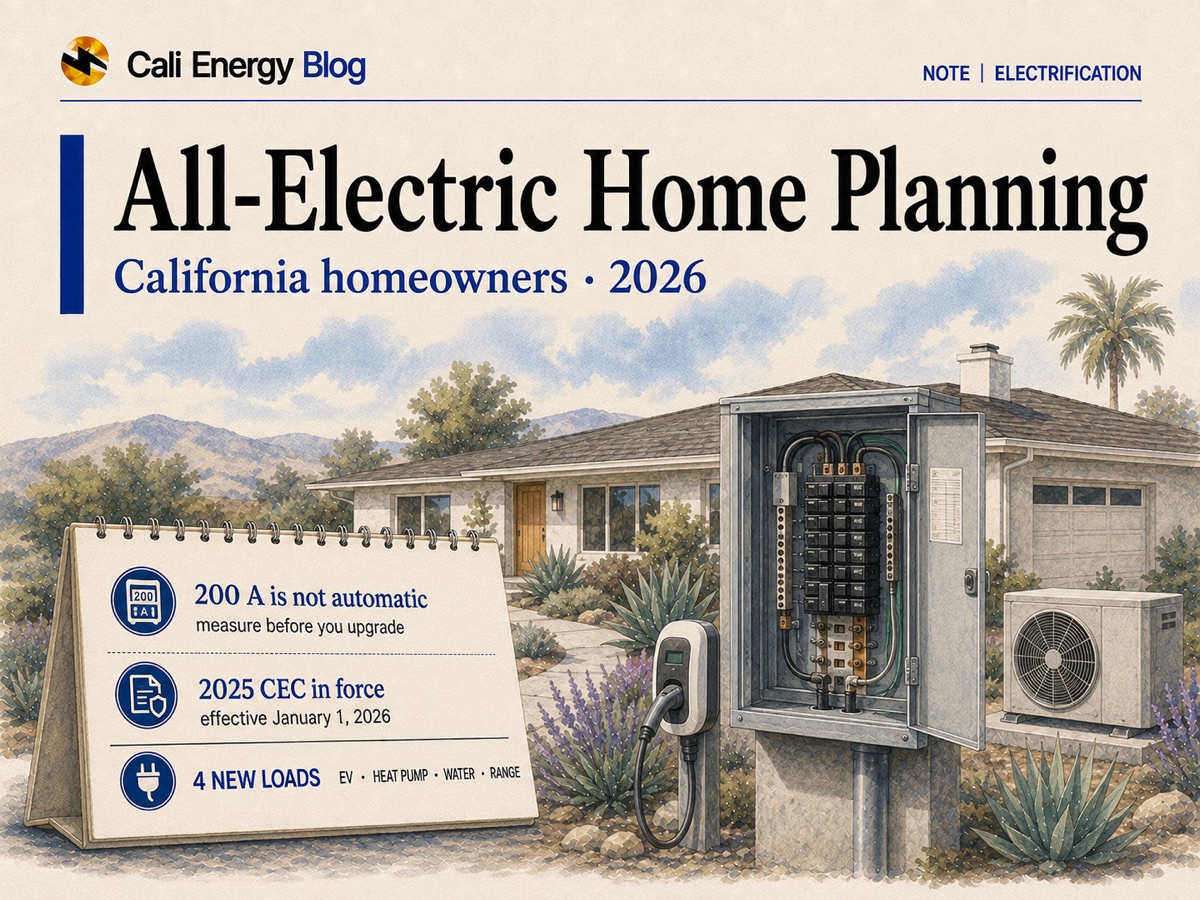
The 2025 California Electrical Code (Title 24, Part 3), based on the 2023 National Electrical Code, took effect January 1, 2026, replacing the 2022 edition. The California Building Standards Commission publishes the current codes at dgs.ca.gov/bsc/codes, and local jurisdictions such as LADBS may add amendments.
Watch the edition when you read guidance. The national 2026 NEC has moved load calculations from Article 220 to Article 120 and cut the dwelling lighting load from 3 to 2 volt-amperes per square foot (EC&M, May 2026). California has not adopted that edition, so in 2026 permits are checked against the 2023-based numbers below.
| Route | How it counts | Key numbers | Works best when |
|---|---|---|---|
| 220.83 — calculation for an existing dwelling | Adds up the home on paper: lighting and outlets by floor area, kitchen and laundry circuits, nameplates of fixed appliances | 3 VA per sq ft; 1,500 VA per small-appliance and laundry circuit; first 8 kVA at 100%, the rest at 40%; added air-conditioning or heat pump at 100% | There is no usable meter history, or the home already has solar |
| 220.87 — measured maximum demand | Starts from what the home actually drew, then adds the new load | A year of maximum-demand data, or a 30-day recording at 15-minute intervals; 125% of the peak plus the new load must not exceed the service rating | A year of utility interval data exists and the home has no solar |
| Load management — 625.42 and 750.30 | A listed device caps the current the new load can take, so loads share capacity | Settings restricted to qualified people; the calculation uses the managed limit rather than the full nameplate | One big new load — usually an EV charger — on a service that is nearly full |
Sources: City of Dublin residential load worksheet (2025 California Electrical Code) · Silicon Valley Clean Energy — Service Optimization for Building Officials · NFPA 70. Summaries, not code text: your electrician and building department apply the actual sections.
Two more rules shape every EV calculation. Section 220.57 counts a charger at 7,200 VA or its nameplate, whichever is larger — a 32-amp unit counts as 7,680 VA, and a smaller one still counts as 7,200 (Kopperfield summary of the 2023 NEC). And the 2023 NEC added Section 220.70, which lets a calculation use the current setpoint of an energy management system instead of the loads behind it (Mike Holt, 2023 NEC changes); ask your building department how it applies it.
Which route your jurisdiction accepts is the authority having jurisdiction’s call. That is a question for a licensed electrician who works in your city, not for an article.
A worked example: 1,500 square feet on 100 amps
An illustrative gas-heated house going all-electric, run through 220.83(B).
Floor-area, kitchen and appliance values come from the City of Dublin’s 2025-code worksheet. The heat pump and water-heater ratings are our assumptions — the labels on your equipment will differ, and so will the result.
| Line | VA | How it counts |
|---|---|---|
| Lighting and outlets, 1,500 sq ft × 3 VA | 4,500 | pool (first 8 kVA at 100%, rest at 40%) |
| Two kitchen small-appliance circuits and one laundry circuit | 4,500 | pool |
| Dishwasher, disposal, microwave (worksheet values) | 3,000 | pool |
| New: Level 2 charger, 32 A (220.57) | 7,680 | pool* |
| New: induction range (worksheet range value) | 12,000 | pool |
| New: heat-pump water heater, 240 V (assumed) | 4,500 | pool |
| New: electric dryer (worksheet value) | 5,000 | pool |
| Pool total | 41,180 | 8,000 + 40% of 33,180 = 21,272 |
| New: heat pump for heating and cooling (assumed 20 A at 240 V) | 4,800 | 100% |
| Calculated load | 26,072 | ÷ 240 V = 108.6 A — over a 100 A service |
Method: 2025 California Electrical Code 220.83(B), as laid out on the City of Dublin worksheet · Cali Energy arithmetic. *Some building departments count the charger at 100% outside the 40% pool; this house would then calculate at 127.8 A.
| Change | Calculated load | Fits 100 A? |
|---|---|---|
| As above | 108.6 A | No |
| Keep the gas dryer | 100.3 A | Just over |
| 120-volt plug-in heat-pump water heater (15 A circuit, at most 1,800 VA) | 104.1 A | No |
| Both of the above | 95.8 A | Yes, on paper |
| Charger counted at 100% (some departments) | 127.8 A | No |
| Same house on a 125 A or 150 A service | 108.6 A | Yes |
Cali Energy arithmetic, same method and assumptions as the table above.
Two lessons. Past the first 8 kVA, most additions count at only 40% of nameplate — a 12 kVA induction range adds 20 A, a 32-amp charger about 12.8 A — but a heat pump counts at 100%. And interpretation matters: the same house swings almost 20 amps depending on how the charger is counted, which is why the calculation belongs to an electrician who knows your building department.
The measured route, in numbers
Section 220.87 starts from the highest demand the home actually reached. Multiply it by 125%, add the new load, and compare the total with the service rating. A house whose highest demand over the past year was 40 A counts as 50 A, leaving 50 A on a 100-amp service — room for a 32-amp charger (7,680 VA, or 32 A) with 18 A to spare, even though the same house fails 220.83 once everything else is added.
| Highest measured demand | Counted at 125% | Left for new load |
|---|---|---|
| 30 A | 37.5 A | 62.5 A |
| 40 A | 50 A | 50 A |
| 50 A | 62.5 A | 37.5 A |
Cali Energy arithmetic from the 125% rule in 220.87. In the 22,000-home California study, 86% of homes peaked under 50 A and nearly half under 30 A.
The data has to exist first. SCE customers can download hourly and daily usage through Green Button in their SCE account (SCE). LADWP only began installing advanced meters in fall 2025, replacing older electromechanical and radio meters (LADWP), so many LADWP homes do not yet have a year of interval history. Without it, the code allows a 30-day recording at 15-minute intervals, taken while the home is occupied and accounting for the larger of the heating or cooling load.
One condition matters a lot in Los Angeles. Silicon Valley Clean Energy’s checklist for building officials lists no renewable energy system on the service as a 220.87 check: the meter on a solar home sees net flow, not what the house draws. Homes with solar are typically calculated under 220.83 instead.
Sharing the capacity you have
When the numbers come up short, equipment can let a new load share existing capacity instead of requiring more. Silicon Valley Clean Energy’s guide groups the options:
- Circuit-sharing devices let two appliances use one circuit but never at the same time — the common example is an EV charger sharing the dryer circuit.
- Energy management systems watch the service and slow or pause EV charging when the house nears its limit; under 625.42 the calculation can then use the managed limit.
- Smart panels manage circuits digitally against a setpoint.
- Lower-power equipment: properly sized inverter heat pumps, 120-volt heat-pump water heaters and lower-power Level 2 chargers.
Ask about these before accepting an upgrade. For what an upgrade costs when it is the right answer, and the rebates still open in 2026 — mostly tied to EV chargers — see panel upgrade cost in Los Angeles.
What to gather before you call an electrician
Every item below changes the calculation. Having them ready is the difference between a quote and a guess.
- Service size — the rating of the main service, usually 100 A, 125 A or 200 A.
- Main breaker rating, which is not always the same number as the service.
- Panel busbar rating, printed on the label inside the panel door.
- Recent maximum demand — for SCE, a Green Button download of a year of hourly data; for LADWP, ask what history your meter has, or plan a 30-day recording.
- Floor area of the home, which drives the lighting and outlet line.
- Existing electric heating, if any, and what it serves.
- What you are adding, with nameplate ratings: EV charger, heat pump, heat-pump water heater, induction range, dryer.
- Existing large loads — pool or spa equipment, well pump, workshop.
- Any solar or battery already installed, and its interconnection method.
- Planned work — an ADU or addition changes the answer, so mention it even if it is a year away.
Terms people mix up
Panel upgrade or service upgrade?
They are different jobs with different costs. A panel upgrade replaces the load center — the busbar and breakers. A service upgrade changes the supply itself: the meter, the service entrance conductors, and sometimes utility-side equipment. You can need one without the other, and the utility is only involved in the second.
100 amp or 200 amp?
200 A is the modern default for new construction, and it comfortably accommodates several new loads. But 100 A service is not automatically disqualifying — whether it works depends on your calculated load, your measured demand, and whether load management is used. The worked example above shows how close the call can be.
Load calculation or load study?
A load calculation applies the code’s method to your specific loads on paper. A load study measures what the home actually draws over time. The measured-demand route in the code exists precisely so that real data can replace conservative assumptions.
Why is a 32-amp charger on a 40-amp breaker?
EV charging is a continuous load, so its circuit is sized at 125% of the charger’s maximum: a 32-amp charger on a 40-amp circuit, a 48-amp one on 60. The load calculation counts the charger’s own rating, not the breaker. More in Level 2 charger cost in Los Angeles.
What is load management?
Equipment that prevents two large loads from drawing at once — typically pausing EV charging while another heavy appliance runs. It lets loads share existing capacity instead of requiring more of it, and the code recognizes it. For solar-specific busbar questions, that is a different rule; see do you need a main panel upgrade for solar.
Does solar or a battery add service capacity?
No. This is a common and expensive misunderstanding. Solar reduces the energy you buy; a battery shifts when you buy it. Neither increases what your service can deliver at a moment in time, both have their own interconnection rules that can consume busbar headroom, and solar typically closes off the measured-demand route.
The order to do things in
- Establish what you have — service size, main breaker, busbar rating.
- Pull your interval data from the utility, or plan a 30-day recording, so the measured-demand route is available.
- List what you are adding, with nameplate ratings and realistic timing.
- Have a licensed electrician run the calculation under the applicable code method.
- Ask about load management and lower-power equipment before accepting an upgrade.
- Ask the utility about upstream capacity, which is theirs to answer, not your electrician’s.
- Upgrade only if the accepted routes do not produce the capacity you need.
Talk to the utility earlier than you think
LADWP asks Level 2 customers to notify it and schedule a preliminary home inspection before installing, and advises contacting an Electric Service Representative at least two weeks before installing a home charger. The ESR assesses capacity up to the meter — whether LADWP must change a transformer or the lines to the house — while your electrician handles the wiring past it. If the job turns into a new panel, request a meter spot first: LADWP says an ESR schedules that site visit within five to ten business days. Charger projects that need LADWP conduit, service-cable or transformer work follow its longer commercial timeline. Source: LADWP Guide to Electric Service, March 2024.
In SCE territory, a service upgrade means SCE reworks its own service facilities under tariff Rule 16; who pays what is covered in panel upgrade cost in Los Angeles.
How long does the utility side take? In Berkeley Lab’s 2025 national survey, 64% of building-industry respondents and 80% of utility staff said single-family service upgrades finish within 30 days (Berkeley Lab, August 2026). Asking early is the difference between a scheduling detail and a project stalled waiting on utility-side work.
How much energy each addition adds
The other half of the question: what electrification does to the bill, and to your solar offset.
| Addition | SCE area, kWh/yr | LADWP area, kWh/yr | Basis |
|---|---|---|---|
| EV charging, 10,787 miles a year | 2,600–3,700 | 2,600–3,700 | EPA 24–34 kWh per 100 miles for common models × FHWA 2024 average miles |
| Heat pump, space heating | 565 | 542 | RASS 2019, homes heated by a heat pump |
| Heat-pump water heater | 480–720 | 510–770 | RASS 2019 electric water heating ÷ 2–3 (DOE: two to three times as efficient) |
| Electric range and oven | 359 | 328 | RASS 2019 |
| Electric dryer | 491 | 438 | RASS 2019 |
| All five | about 4,500–5,800 | about 4,400–5,700 | sum |
| For scale: average home, 2019 | 6,424 | 5,112 | RASS 2019 |
Sources: CEC 2019 Residential Appliance Saturation Study, Vol. 2, Table 14 · EPA fueleconomy.gov · FHWA Highway Statistics 2024, VM-1 · DOE Energy Saver · Cali Energy arithmetic. Heating figures come from 2019 homes in mild Los Angeles-area climates; a larger or draftier house uses more.
The car is well over half of the total. To keep the same solar offset, divide the added kilowatt-hours by about 1,700 kWh a year per kW of panels in Los Angeles (NREL PVWatts): roughly 2.6–3.4 kW, or seven to nine 400-watt panels, for all five. For the car alone, see how many solar panels it takes to charge an EV.
How this interacts with solar
Every added kilowatt-hour is a kilowatt-hour your solar array has to cover if you want to keep the same offset. Electrifying without resizing simply moves you from a well-covered bill to a partly-covered one.
The rate structure matters too. In SCE territory under the Net Billing Tariff, exported energy is worth less than energy you use yourself, so added evening load — EV charging, heat pumps — strengthens the case for a battery. LADWP’s retail-basis netting treats daytime export more generously. The right answer differs by utility, which is why a national rule of thumb is not much help in Los Angeles.
What this page does not do
The worked example is illustrative: real nameplates, your floor area and your building department’s reading of the code all change the result, and the energy figures are averages, not your household.
Nothing here is a service load calculation. A licensed C-10 electrician must perform the calculation for your specific panel, service and jurisdiction before any work is designed or permitted.
Frequently asked
Do I have to change my electric panel to install an EV charger at home in California?
Not automatically. California’s code has more than one route for adding load, including one based on what your home actually draws. In smart-meter data from 22,000 California homes, 86% peaked under 50 amps; a home that peaked at 40 A counts as 50 A under 220.87, which leaves room for a 32-amp charger on a 100-amp service. If the numbers fall short, a load-management device can let the charger share capacity. A licensed electrician should run the calculation before anyone concludes an upgrade is required.
Which electrical code applies in California in 2026?
The 2025 California Electrical Code (Title 24, Part 3), based on the 2023 National Electrical Code, took effect January 1, 2026, replacing the 2022 edition. The national 2026 NEC moved load calculations to Article 120, but California has not adopted it. Local jurisdictions may add amendments.
How does an EV charger count in a load calculation?
Under Section 220.57 a charger counts at 7,200 VA or its nameplate, whichever is larger — 7,680 VA for a 32-amp unit. In the existing-home calculation it usually joins the pool counted at 40% past the first 8 kVA, though some building departments count it at 100%. Its circuit is sized separately, at 125% of the charger’s maximum.
Can I use my smart-meter data instead of a paper calculation?
Often, under Section 220.87: a year of maximum-demand data, or a 30-day recording at 15-minute intervals, then 125% of the peak plus the new load must fit the service. SCE customers can download hourly data through Green Button. LADWP began installing advanced meters only in fall 2025, so many LADWP homes need a 30-day recording. Homes with solar are typically calculated under 220.83 instead, because the meter sees net flow.
When should I contact LADWP about a home EV charger?
Before installing. LADWP asks Level 2 customers to notify it and schedule a preliminary home inspection, and advises contacting an Electric Service Representative at least two weeks ahead. The ESR assesses capacity up to the meter and will say whether a transformer or line change is needed; your electrician handles the wiring past the meter.
Can I keep 100-amp service and still add an EV charger and a heat pump?
Sometimes, yes. In our illustrative 1,500 sq ft example, adding a charger, heat pump, induction range, heat-pump water heater and dryer calculated at 108.6 A — but keeping the gas dryer and choosing a 120-volt water heater brought it to 95.8 A. Measured demand and load management can change the answer again. It is a calculation for a licensed electrician, not a rule of thumb.
How much more electricity will an all-electric home use?
For an EV, heat pump, heat-pump water heater, electric range and dryer, roughly 4,400–5,800 kWh a year in the SCE and LADWP areas, mostly the car. At about 1,700 kWh per kW of panels in Los Angeles, keeping the same solar offset takes roughly 2.6–3.4 kW more. Under SCE’s Net Billing Tariff, evening loads also strengthen the case for a battery.
What is the difference between a panel upgrade and a service upgrade?
A panel upgrade replaces the load center — busbar and breakers. A service upgrade changes the supply itself: meter, service entrance conductors and sometimes utility-side equipment. They are different jobs at different costs, you can need one without the other, and only the second involves the utility.
Does adding solar or a battery increase my electrical capacity?
No. Solar reduces the energy you buy and a battery shifts when you buy it, but neither increases what the service can deliver at a given moment. Both have interconnection rules that can consume busbar headroom, and a solar home is typically calculated on paper under 220.83 rather than from meter data.
What information should I gather before calling an electrician?
Service size, main breaker rating, panel busbar rating, a year of interval or maximum-demand data from your utility, the home’s floor area, any existing electric heating, the nameplate ratings of everything you plan to add, existing large loads such as a pool pump, any solar or battery already installed, and any planned ADU or addition.
Related reading
Sources & methodology
Figures on this page come from the primary sources below and, where noted, from Cali Energy calculations using the stated assumptions. Rates, incentives, and program terms change; each was verified October 6, 2026.
- California Building Standards Commission — current codes (2025 edition effective January 1, 2026)
- NFPA 70 (National Electrical Code) — free read-only access
- City of Dublin — Residential Electrical Load Calculation worksheet (2025 California Electrical Code)
- Silicon Valley Clean Energy — Service Optimization for Building Officials
- Home Energy Analytics — home electrification: panel capacity across 22,000 customers
- Kopperfield — EV chargers and load calculations (2023 NEC 220.57)
- Mike Holt — Changes to the 2023 NEC: 220.70 Energy Management Systems
- EC&M — Changes to Dwelling Unit Calculations in the 2026 NEC (May 19, 2026)
- SCE — Energy Management Center (Green Button usage download)
- LADWP — Advanced Metering Infrastructure
- LADWP — Guide to Electric Service (March 2024)
- Lawrence Berkeley National Laboratory — Costs and Barriers of Residential Electrical Panel and Service Upgrades (August 2026)
- CEC — 2019 RASS, Volume 2: Results (electric UECs by utility)
- U.S. EPA / DOE — fueleconomy.gov vehicle data (combined kWh per 100 miles)
- FHWA — Highway Statistics 2024, Table VM-1 (miles per light-duty vehicle)
- U.S. Department of Energy — Energy Saver: Heat Pump Water Heaters
- NREL — PVWatts Calculator
About this reference
Cali Energy is a licensed California contractor (CSLB #1032379) based in Northridge. We publish this page as a reference and date it to the day each figure was checked against its source.
Prepared by Cali Energy, October 6, 2026. This article is for general educational purposes only and is not legal, tax, financial, engineering, or utility advice. Rates, incentives, codes, permit requirements, equipment specifications, prices, and program terms may change; figures and timelines are estimates, not guarantees. Confirm current requirements with the applicable utility, AHJ, program administrator, manufacturer, or a licensed professional. See our Content Disclaimer. Cali Energy · 19201 Parthenia St, Unit E, Northridge, CA 91324 · CSLB #1032379 (B, C-10, C-39)