

How Your SCE Solar Bill Works Under NEM 3.0
Short version: on SCE’s Solar Billing Plan (NEM 3.0), power you draw from the grid is billed at TOU-D-PRIME prices, and power you send back earns Energy Export Credits that depend on the hour — for a system starting in 2026, SCE’s averages are about 6¢/kWh on a summer day and 21¢ on a summer evening. The credits pay down your energy charges, not the $24.15 Base Services Charge, non-bypassable charges or taxes, and once a year a settlement bill squares the account. Here is how the statement reads, line by line.
Get a free estimate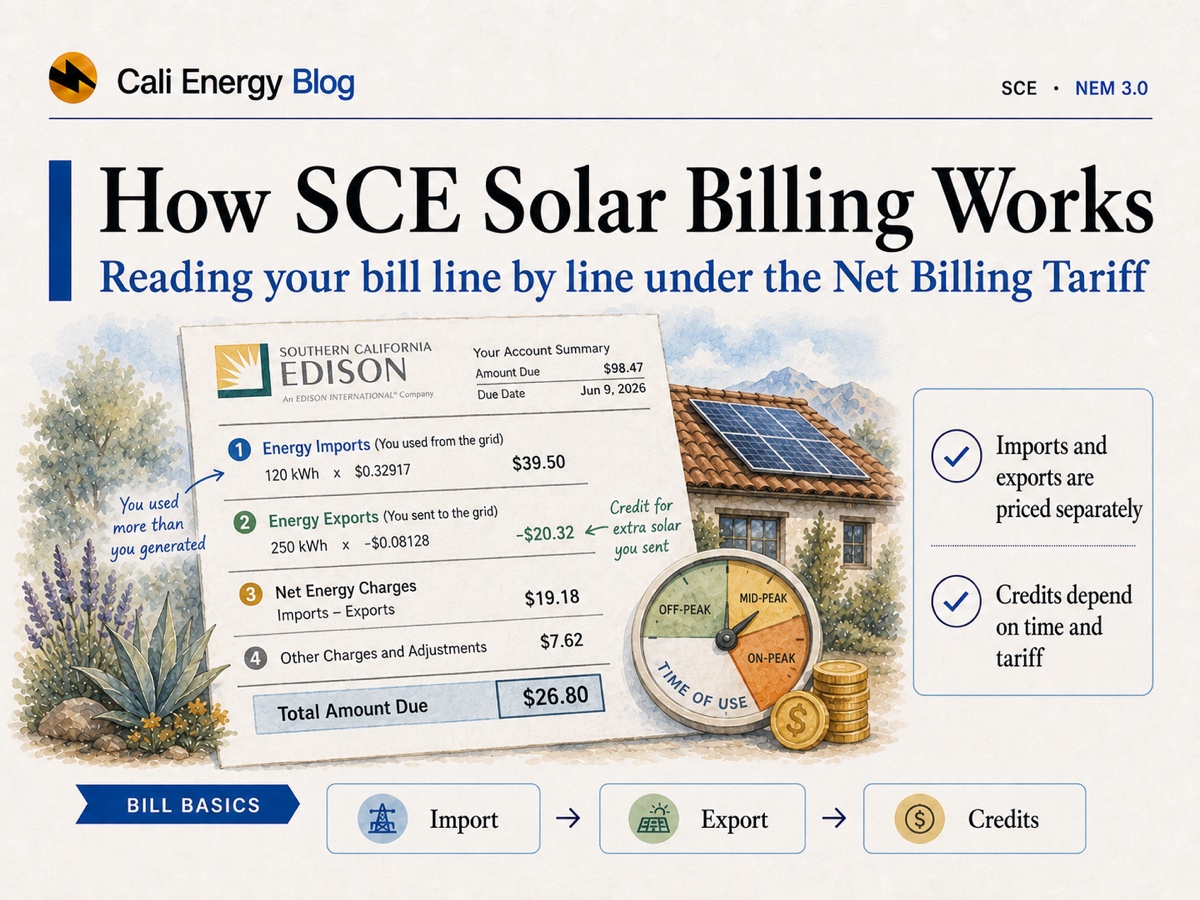
- SCE solar customers who applied from April 15, 2023 are on the Solar Billing Plan and the TOU-D-PRIME rate, where power costs most on summer weekdays from 4 to 9 p.m.
- Exports earn Energy Export Credits by hour and season. For a 2026 start: about 6¢ on a summer day, 21¢ on a summer evening, 3¢ on a winter day — locked for nine years — plus a bonus credit set by start year (1.6¢ for 2026).
- Credits pay down delivery and generation charges. They don’t pay the $24.15 Base Services Charge, non-bypassable charges or taxes. SCE’s old minimum charge no longer applies.
- Unused credits roll to the next month. At the yearly settlement, credits for exports above your own use are reduced, and net surplus earns about 2¢/kWh.
- NEM 2.0 customers are billed differently: set fees every month, and on the default Annual Billing Option, a year of energy charges at once.
How the Solar Billing Plan bills you
This is the statement itself. For why the rules changed, see NEM 3.0 explained.
Your home uses solar first. Only what the house doesn’t use at that moment is exported, and only what the panels can’t cover is imported (SCE).
Imports are billed at TOU-D-PRIME prices. Solar Billing Plan customers are on this time-of-use rate, where prices are highest on summer weekdays from 4 to 9 p.m. In SCE’s July 2026 sample bill, a kilowatt-hour costs 58.7¢ on-peak, 39.6¢ mid-peak and 26.1¢ off-peak, delivery and generation combined.
Exports earn Energy Export Credits, split into a delivery and a generation credit on the bill. The credits are applied to the delivery and generation sections; they do not offset the non-bypassable charges, and they cannot cover set fees such as the Base Services Charge or taxes (SCE sample bill; SCE glossary). Credits left over after a bill roll into the next month as “Credit from Previous Month.”
Once a year comes a settlement bill, in the month your system started service, which reviews the whole year (more below).
What an exported kilowatt-hour earns
SCE publishes average export values by season, time of day and the year you began using solar. New customers keep their start year’s prices for nine years.
| Start year | Summer day 6am–4pm | Summer evening 4–9pm | Summer overnight 9pm–6am | Winter day | Winter evening | Winter overnight |
|---|---|---|---|---|---|---|
| 2023 | 0.05 | 0.23 | 0.07 | 0.03 | 0.05 | 0.04 |
| 2024 | 0.05 | 0.23 | 0.07 | 0.03 | 0.05 | 0.04 |
| 2025 | 0.06 | 0.21 | 0.12 | 0.03 | 0.09 | 0.10 |
| 2026 | 0.06 | 0.21 | 0.12 | 0.03 | 0.10 | 0.10 |
Source: SCE — How the Solar Billing Plan works. Values are averages; actual credits vary hour by hour. If you move into a house that already has solar, the current year’s prices apply.
The Energy Export Bonus Credit comes on top. SCE’s tariff sets it by the year your system received permission to operate: 4.0¢/kWh for 2023, 3.2¢ for 2024, 2.4¢ for 2025, 1.6¢ for 2026 and 0.8¢ for 2027 — 9.3¢ down to 1.9¢ for income-qualified “equity” customers — fixed for nine years. Systems starting in 2028 or later get none, and neither does someone who moves into a home with an existing system. Unlike the ordinary credit, the bonus can also pay non-bypassable and fixed charges (SCE Schedule NBT). SCE’s program page quotes the 2023 rates.
Most solar production lands in the cheapest column: a summer-day kilowatt-hour sent out earns about 6¢, while the same kilowatt-hour bought back after 4 p.m. costs 58.7¢ in SCE’s sample. That gap — not the panels — is what shapes a Solar Billing Plan bill, and why using or storing your own solar pays better than exporting it.
SCE’s sample solar bill, line by line
SCE’s published sample: a Solar Billing Plan customer on TOU-D-PRIME, billing period June 22 to July 21, 2026 — 360 kWh drawn from the grid, 442 kWh exported.
| Section and line | Calculation | Amount |
|---|---|---|
| Delivery: Base Services Charge | 30 days × $0.76900 | $23.07 |
| Delivery: energy, on-peak | 160 kWh × $0.29033 | $46.45 |
| Delivery: energy, mid-peak | 56 kWh × $0.29033 | $16.26 |
| Delivery: energy, off-peak | 144 kWh × $0.19058 | $27.44 |
| Delivery: wildfire fund charge | 360 kWh × $0.00591 | $2.13 |
| Generation: on-peak | 160 kWh × $0.29667 | $47.47 |
| Generation: mid-peak | 56 kWh × $0.10558 | $5.91 |
| Generation: off-peak | 144 kWh × $0.07049 | $10.15 |
| Energy Export Credit — delivery | 442 kWh × −$0.03156 | −$13.95 |
| Energy Export Credit — generation | 442 kWh × −$0.03572 | −$15.79 |
| Energy Export Bonus Credit | 442 kWh × −$0.01600 | −$7.07 |
| Other: fixed recovery charge | 360 kWh × $0.00619 | $2.23 |
| Subtotal | $144.30 | |
| City utility users tax (6% in the sample) and state tax | $8.66 + $0.11 | $8.77 |
| Amount due | $153.07 |
Source: SCE Solar Billing Plan sample bill. The sample’s bonus credit is 1.6¢ per kWh, the 2026 rate; your own statement shows your actual rates.
Where to look on your own bill:
- Page one shows the Solar Billing Plan month (this sample is month 6) and the kWh you exported this period.
- “Your rate” should read TOU-D-PRIME; the usage table splits your grid kWh by on-, mid- and off-peak.
- “Solar billing plan details” lists export generation, credit earned, credit applied, your Net Surplus Compensation option (the sample: Rollover) and year-to-date surplus kWh (the sample: 1,704).
- If another company supplies your generation, such as a community choice provider, it handles your generation charges and credits, and they may not appear in detail on the SCE bill.
SCE changed the layout of solar bills from June 2026; the information is the same, with more call-outs. For what this bill leaves you paying every month, see why you still have a bill after solar.
The yearly settlement (true-up)
Once a year, in the month your system started service, SCE sends a settlement bill — the true-up. It compares the year’s grid use with the energy you exported and the credits you received. SCE’s own example: a home used 900 kWh from the grid and sent back 1,000. Its credits covered the 900 kWh; the credits earned on the extra 100 kWh are then reduced, and because they were already applied to monthly bills, the reduction shows up as a balance — an “EEC Adjustment” (SCE).
SCE’s reasoning is that export credits are meant to offset your own charges, not to erase the bill or earn income. Net surplus earns Net Surplus Compensation at about 2¢/kWh, as a check or a rollover credit (rollover is the default), and SCE notes it may not cover the full adjustment. The practical lesson: size the system to your own use — production beyond it is worth very little at settlement.
If you are on NEM 1.0 or NEM 2.0
Systems that applied before April 15, 2023 are billed under legacy net metering. You still receive a monthly bill tracking net energy charges, and set “Delivery” or “Nonbypassable” fees are due every month regardless of use. On the default Annual Billing Option, you pay the net energy charges once a year, at the end of your 12-month cycle; the Monthly Billing Option, which you can opt into, spreads them across the year and avoids a large settlement statement (SCE NEM bill guide). A credit balance at settlement can be paid out at the Net Surplus Compensation rate. Since November 2025 legacy customers pay the Base Services Charge too, and because SCE lowered its per-kWh rates at the same time, the monthly credit for surplus fell with them (SCE). How long legacy terms last is in NEM 2.0 grandfathering.
How to lower an SCE solar bill
With exports worth a few cents and evening power priced near 59¢, the lever is when you use electricity.
Use power when you make it
Run the pool pump, laundry, dishwasher, EV charging and pre-cooling in sunny hours, turning a 6¢ export into a kilowatt-hour you don’t buy.
Store the surplus
A battery charged at midday can carry the house from 4 to 9 p.m.; in SCE’s sample, those hours were $93.92 of $153.68 in energy charges. See do you need a battery?
Right-size, don’t oversize
Surplus above your yearly use is trimmed at settlement and earns about 2¢/kWh.
Watch your year-to-date numbers
The “Solar billing plan details” box shows credits earned and year-to-date surplus, so a settlement adjustment shouldn’t be a surprise.
Batteries add resilience
Storage also keeps essentials on in an outage or PSPS, and may qualify for SGIP incentives.
Know the rate
TOU-D-PRIME prices and peak hours are compared with SCE’s other plans in SCE time-of-use plans.
Not sure how your SCE bill will look after solar?
Cali Energy (CSLB #1032379) will go through your SCE statement and usage, model how much of your solar you would use yourself with and without a battery, and show the monthly and settlement picture. Call +1-323-844-7777 or get a free estimate.
Frequently asked
How does SCE bill solar customers under NEM 3.0?
On the Solar Billing Plan, grid power is billed at TOU-D-PRIME prices and exported power earns hourly Energy Export Credits, split into delivery and generation credits. The credits pay down delivery and generation charges; they don’t pay the $24.15 Base Services Charge, non-bypassable charges or taxes. Unused credits roll to the next month, and a settlement bill reviews the year in the month your system started service.
How much does SCE pay for exported solar under NEM 3.0?
It depends on the hour, the season and your start year. For a system starting in 2026, SCE’s averages are about $0.06/kWh on a summer day, $0.21 on a summer evening, $0.12 on a summer night, $0.03 on a winter day and $0.10 on winter evenings and nights, locked for nine years. A bonus credit is added by start year: 1.6¢/kWh for 2026 (3.7¢ for income-qualified customers), 4.0¢ for 2023, none from 2028.
Is there still a minimum charge on SCE solar bills?
No. Since the Base Services Charge began in November 2025, SCE says the minimum charge no longer applies: with zero usage you receive the Base Services Charge — $24.15 a month for most customers, $12.08 on FERA and $6 on CARE. Export credits can’t pay it, though remaining Net Surplus Compensation or bonus credits can.
What is a solar true-up on SCE?
The yearly settlement bill, sent in the month your system started service. On the Solar Billing Plan it compares the year’s grid use with your exports; if you exported more than you used, credits for the extra are reduced and appear as an “EEC Adjustment,” and net surplus earns about 2¢/kWh. On NEM 2.0’s default Annual Billing Option, the year’s net energy charges come due at settlement.
How do I read the solar section of my SCE bill?
Check “Your rate” (TOU-D-PRIME on the Solar Billing Plan), the on-, mid- and off-peak kWh you drew from the grid, and the Energy Export Credit lines for delivery, generation and any bonus. The “Solar billing plan details” box lists export generation, credit earned and applied, your Net Surplus Compensation option and year-to-date surplus kWh.
Does a battery help on SCE's NEM 3.0 bill?
Often, yes. A summer-day export earns about 6¢, while power bought on weekdays from 4 to 9 p.m. cost 58.7¢ per kWh in SCE’s July 2026 sample bill. A battery that stores midday solar for those hours cuts the most expensive imports, and adds backup in outages. Whether it pays depends on your evening usage and the battery’s cost.
Related reading
Sources & methodology
Figures on this page come from the primary sources below and, where noted, from Cali Energy calculations using the stated assumptions. Rates, incentives, and program terms change; each was verified September 28, 2026.
- SCE — How the Solar Billing Plan works (export values by start year, TOU-D-PRIME, settlement, EEC Adjustment, NSC)
- SCE — Solar Billing Plan sample bill (June 22–July 21, 2026)
- SCE — Solar glossary (credits not applied to fixed fees, NBCs and taxes; credit from previous month; NSC options)
- SCE — Guide to your Net Energy Metering bill (Annual and Monthly Billing Options)
- SCE — Base Services Charge (amounts; minimum charge no longer applicable)
- SCE — Net Surplus Compensation Rate
- SCE — Schedule NBT, Net Billing Tariff (ACC Plus Adder / bonus credit rates by vintage, Sheet 7)
- CPUC — Net Billing Tariff
See your real SCE solar numbers
Send us your SCE bill and usage and we'll show the monthly and settlement picture — with and without a battery. No dealer fees, no pressure.
Get a free estimatePrepared by Cali Energy, September 28, 2026. This article is for general educational purposes only and is not legal, tax, financial, engineering, or utility advice. Rates, incentives, codes, permit requirements, equipment specifications, prices, and program terms may change; figures and timelines are estimates, not guarantees. Confirm current requirements with the applicable utility, AHJ, program administrator, manufacturer, or a licensed professional. See our Content Disclaimer. Cali Energy · 19201 Parthenia St, Unit E, Northridge, CA 91324 · CSLB #1032379 (B, C-10, C-39)