

Rebuilding a Roof After the Eaton or Palisades Fire
A house rebuilt after the January 2025 Eaton or Palisades fire can mostly follow the 2022 building codes instead of the 2025 ones, under the Governor's Executive Order N-29-25, but not where fire safety is concerned: the State Fire Marshal's fire and life-safety rules adopted for 2025 still apply, so in a fire hazard severity zone the new roof has to meet the wildland-urban interface code, starting with a Class A roof assembly. The same order drops the requirement to install rooftop solar and a battery, but the roof still has to be solar ready, with at least 250 square feet set aside on a single-family home. The City of Los Angeles and Los Angeles County both require a cool roof on a new home, which limits how dark the roofing can be. And to stay on the faster like-for-like path, the new roof has to stay within a height limit.
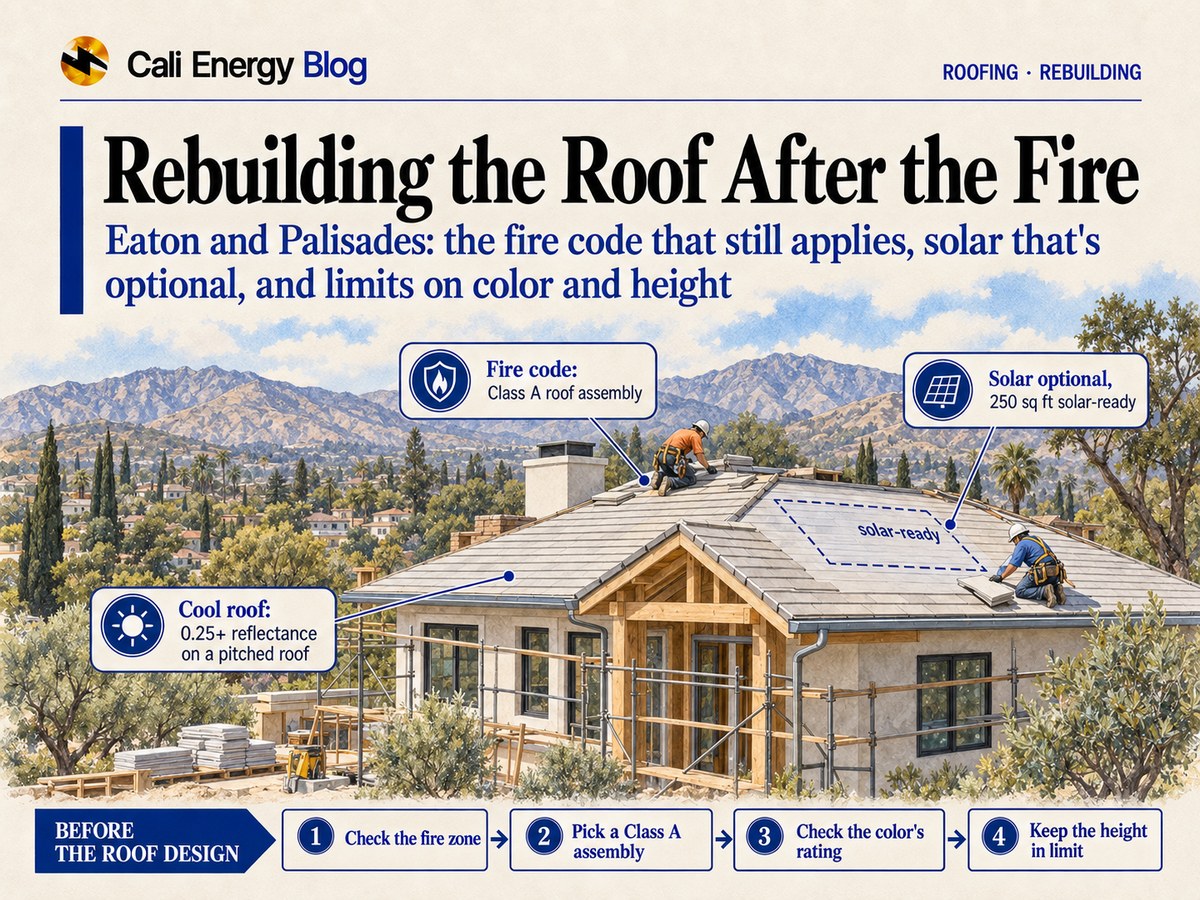
This page covers the roof of a house being rebuilt in Pacific Palisades, which is in the City of Los Angeles, or in Altadena, which is unincorporated Los Angeles County. Other burned areas, such as Pasadena, Sierra Madre and Malibu, have their own building departments and rules. The wildfire code's roof sections are explained one by one in California's WUI roofing requirements; none of this replaces a review of your lot by the building department. Hiring for the rebuild, and the disaster rules on licenses, prices and contracts, are covered in roofing scams after a fire or storm.
What applies to the roof, city and county
The two burn areas sit in different jurisdictions, but most of the rules for the roof come out the same.
| Rule | City of Los Angeles (Pacific Palisades) | Los Angeles County (Altadena) |
|---|---|---|
| Who issues the permit | Los Angeles Department of Building and Safety (LADBS) | Los Angeles County Public Works |
| Which code | The 2022 codes may be used, except the State Fire Marshal's fire and life-safety requirements adopted for 2025 | The same, under the same executive order |
| Fire rules for the roof | Wildland-urban interface code where the lot is in a fire hazard severity zone: a Class A roof assembly and its details | The same; the County lists Class A roofing, enclosed eaves and protected attic vents among current fire-area requirements |
| Rooftop solar and battery | Not required for a rebuild; solar ready still required | Not required; solar ready still required, including at least 250 sq ft of reserved roof on a single-family home |
| Cool roof (low-rise home) | Pitched roof: aged solar reflectance at least 0.25 and thermal emittance at least 0.85, or SRI 20; low-slope: 0.65 and 0.85, or SRI 78 | The same values |
| Height on the like-for-like path | Up to 110% of the old footprint and height | No higher than the old house, or the zone's limit without adding a story |
The fire rules still apply in full
Executive Order N-29-25, signed July 7, 2025, suspends the 2025 California Building Standards Code for homes substantially damaged or destroyed in this emergency, "with the exception of the fire and public safety requirements presented by the State Fire Marshal," as long as the project meets the 2022 code instead. The City's implementation guidelines for the Mayor's Emergency Executive Order No. 1 (version 4.0, June 2026) say the same. The wildfire rules for roofs are State Fire Marshal rules, and since January 1, 2026 they've had their own code, the California Wildland-Urban Interface Code (Title 24, Part 7).
Where a lot is in a fire hazard severity zone (how to check an address), the rebuilt roof has to have:
- A Class A roof assembly, tested as a system or on the code's short list; on a wood deck, tile and most metal count only as a tested, listed assembly (how to check a listing).
- Protection under profiled coverings. Where tile or metal leaves an air space over the deck: a 72-lb cap sheet or a tested Class A underlayment, bird stops at the eaves, and hips and ridges set in mortar.
- Metal valleys over a cap sheet, noncombustible gutters with a way to keep debris out, and eaves of noncombustible, ignition-resistant or otherwise protected construction.
- Listed ember- and flame-resistant vents for the attic and roof.
In the City of Los Angeles new wood shake isn't allowed anywhere (LABC 91.1505.1), and IBHS doesn't accept wood roofs for its Wildfire Prepared Home designation. What the 2025 fires showed about roofs that burned and roofs that held is in fire-resistant roofs in Los Angeles.
Solar is optional, the solar-ready area isn't
The same executive order suspends the Energy Code's requirements to install solar panels and a battery on a rebuilt home, and says the suspension doesn't apply to the "Solar Ready" requirements. Los Angeles County's handout on the order spells out what solar ready means for a single-family home:
- at least 250 square feet of roof reserved for a future solar system;
- wall space, inside or out, reserved for the future equipment;
- a pathway reserved for conduit between the electrical service and that roof area;
- an electrical service of at least 200 amps, with space for a two-pole breaker for the future system.
An ADU built as part of rebuilding the main house gets the same exemption and the same solar-ready requirements. The City's guidelines for Executive Order No. 8 state the same: the solar requirements are suspended and solar ready applies.
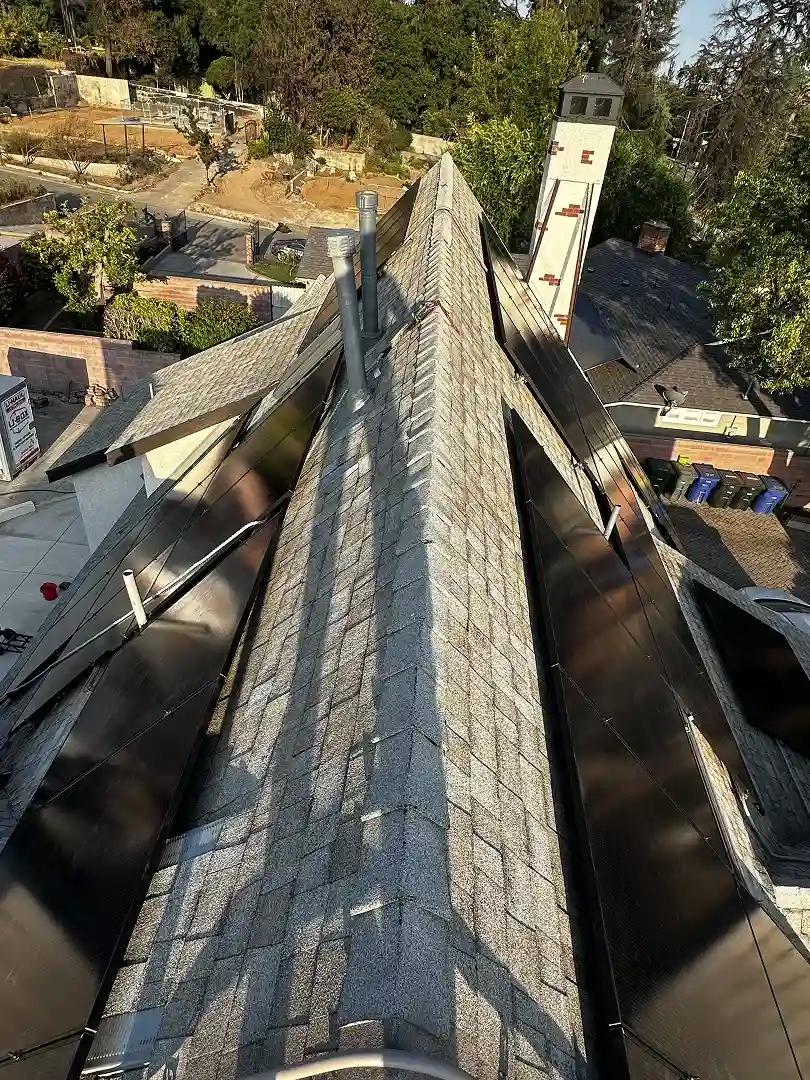
For the roof, that means deciding at the design stage where the 250 square feet go, keeping that area clear, and choosing a covering that panels can be attached to later. Panels can still go on during the rebuild; the order only removes the obligation.
The cool-roof rule limits the color
Both the City (Los Angeles Municipal Code 99.04.106.5) and the County (Title 31, the County's green building code) require roofing on a new low-rise home to meet minimum reflectance values, measured after three years of weathering:
- Pitched roof (steeper than 2:12): aged solar reflectance of at least 0.25 and thermal emittance of at least 0.85, or a Solar Reflectance Index (SRI) of at least 20.
- Low-slope roof: aged solar reflectance of at least 0.65 and thermal emittance of at least 0.85, or an SRI of at least 78.
The exceptions are mostly for re-roofing part of an existing house, so a rebuilt house's new roof is generally covered. Los Angeles County lists "not including cool roofing requirements" among the common errors on fire-rebuild applications. The rated values differ from one color to the next, so check the exact product and color in the Cool Roof Rating Council's listing before you choose. How the state's own cool-roof rule works on a re-roof is in the cool-roof requirement.
How high the new roof can go on the like-for-like path
The like-for-like path is for rebuilds that stay close to what was there, and the roof's height is one of its limits:
- City of Los Angeles. Under Emergency Executive Order No. 1, an eligible rebuild sits in substantially the same location and doesn't exceed 110% of the old footprint and height; any part of it may be rebuilt to the old height plus no more than 10%. A stairway housing of up to 72 square feet, an elevator housing and a chimney (by 5 feet) may project above that limit. A rebuild that goes beyond that can use the City's second streamlined path, Executive Order No. 8, which applies the zone's own height limits, or the normal process.
- Altadena. Under the County's Eaton Fire interim ordinance, adopted September 2, 2025, a like-for-like rebuild can be as tall as the old house, or as tall as the zone allows if it doesn't add a story, and may expand by 10% or 200 square feet, whichever is greater. Interim ordinances are extended and amended, so check the current version.
A steeper pitch, a higher ridge or a new roof deck for a view can push the house over these limits, so the roof's height belongs in the first design conversation, not the last.
Insurance and the roof you rebuild
The fires were a federally declared disaster, which matters for the tax side of a lost roof; see is a new roof tax deductible?. A rebuilt roof that meets the code is already Class A, which earns a discount from insurers that price wildfire risk (how much it's worth and how to claim it). The Department of Insurance said in March 2026 that some of California's largest insurers now commit to writing policies for homes that meet the IBHS Wildfire Prepared Home standard, which adds a noncombustible zone in the first 5 feet around the house and rules for decks, fences and nearby structures to what the code already requires of the roof.
Frequently asked
Do I have to put solar panels on my rebuilt home?
Do I have to build to the 2025 codes?
Can I rebuild with a wood shake roof?
Can I change the roof's shape in a like-for-like rebuild?
Does the cool-roof rule apply to tile?
Who issues the permit for my rebuild?
Related reading
Sources & methodology
Code sections, rules and figures on this page come from the primary sources below. Codes, local requirements and product terms change; each was verified October 9, 2026.
- Executive Order N-29-25, July 7, 2025
- Office of the Governor, Six months after the LA fires (July 7, 2025)
- Executive Order N-4-25, January 2025
- City of Los Angeles, Implementation Guidelines for Emergency Executive Order No. 1, version 4.0 (June 11, 2026)
- City of Los Angeles, Implementation Guidelines for Emergency Executive Order No. 8
- Los Angeles County, Executive Order N-29-25 implementation handout
- Los Angeles County, Fire Rebuilds: Common Errors
- Los Angeles County, Major Developments in the Building Codes for Single-Family Dwellings and Duplexes
- Los Angeles County, Eaton Fire Disaster Interim Ordinance summary
- Los Angeles County Recovers, Rebuild Policies, Interpretations and Exemptions
- City of Los Angeles, Ordinance No. 187208 (cool roof, LAMC 99.04.106.5)
- Los Angeles County, Cool Roof Ordinance (Title 31), 2019
- California Department of Insurance, Rebuilding With Wildfire Safety & Insurability, March 2026
- Los Angeles Building Code 2026, Chapter 15, 91.1505.1 (UpCodes)
We'll build the roof to the fire code and leave room for solar
Call (323) 844-7777. We build roofs for rebuilt houses to the wildfire code, in colors that meet the cool-roof rule, with the solar-ready area kept clear, and we can put the panels on now or leave them for later. Have ready your plans or your designer's roof plan, and tell us whether the lot is in the City of Los Angeles or in unincorporated Altadena.
Prepared by Cali Energy, October 9, 2026. This article is for general educational purposes only and is not legal, tax, financial, engineering, or utility advice. Rates, incentives, codes, permit requirements, equipment specifications, prices, and program terms may change; figures and timelines are estimates, not guarantees. Confirm current requirements with the applicable utility, AHJ, program administrator, manufacturer, or a licensed professional. See our Content Disclaimer. Cali Energy · 19201 Parthenia St, Unit E, Northridge, CA 91324 · CSLB #1032379 (B, C-10, C-39)