

How to Spot a Roofing Scam After a Fire or Storm
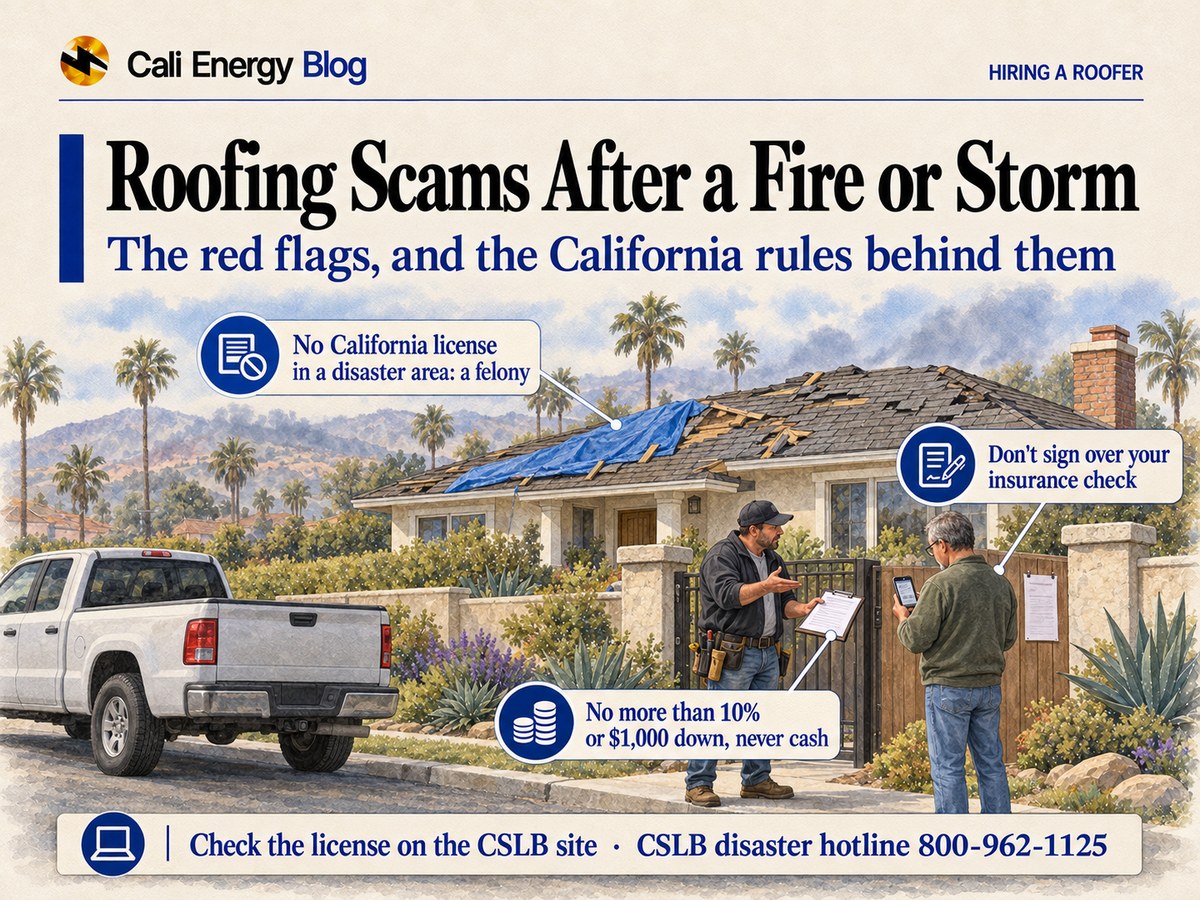
After a fire or a storm, roofing scams show the same few signs: someone who turns up uninvited, can't show a California contractor license, wants cash or more than $1,000 or 10% down, pushes you to sign today, asks you to sign over an insurance check, or wants a completion certificate before the work is done. California law is on your side. Contracting without a license to repair damage from a declared disaster is punishable as a felony (Business and Professions Code 7028.16); for 180 days after an emergency is declared, a contractor can't charge more than 10% above its pre-disaster price for repair work unless it can prove its own costs went up (Penal Code 396); using a false completion certificate to get paid is a crime (B&P 7158); and the state contractors board says rebuilding after a declared disaster takes a fixed-price contract, not time-and-materials or cost-plus. Check any roofer's license on the CSLB site before you sign. This is as of October 2026.
It covers houses in California after a declared disaster, such as the 2025 Los Angeles wildfires, and storm damage generally. It isn't legal advice. Choosing a roofer in ordinary times is covered in how to choose a roofing contractor in California, and the insurance side in filing a roof insurance claim in California.
Red flags and the rules behind them
Most of these come from the contractors board's own warnings to disaster victims; the rest are the laws that apply.
| What you see | What the rules say |
|---|---|
| Someone at the door, or a flier on the gate, offering repairs right away | The CSLB tells disaster victims to be cautious about door-to-door offers and fliers, not to rush, and not to hire the first contractor who comes along |
| No license number on the card, the ad or the contract, or a number that doesn't check out | The license number has to be on all ads, contracts and business cards; check it on the CSLB site and check that the person in front of you is listed on the license. Work of $1,000 or more, labor and materials, needs a license |
| An out-of-state crew or a "handyman" offering to rebuild | Contracting without a California license in a declared disaster area is punishable as a felony (B&P 7028.16) |
| A big deposit, or cash | No more than 10% down or $1,000, whichever is less; don't pay cash; don't let payments get ahead of the work |
| A price that jumped after the disaster | For 180 days after an emergency declaration, a contractor can't charge more than 10% above its pre-disaster price for repair or reconstruction work, unless it can show its own costs rose (Penal Code 396) |
| A time-and-materials or cost-plus contract to rebuild | The CSLB says disaster-related home improvement work needs a fixed-price contract listing the full price |
| A request to sign over your insurance check | The CSLB's advice: don't sign over any payment checks from your insurance company |
| A completion certificate to sign before the work is done | Knowingly using a false completion certificate to get paid or to get credit is a crime, with restitution ordered in disaster-repair schemes (B&P 7158) |
The rules, in more detail
- Licensing. The CSLB warns that "unscrupulous, unlicensed contractors often prey on victims of natural disasters," and that it is a felony to contract without a license in a declared disaster area. B&P 7028.16 sets the penalty: a fine of up to $10,000, a prison term of 16 months, two or three years, or both, or a lesser jail term and fine. A licensed contractor has passed the license exams, shown at least four years of journey-level experience, carries a license bond and has passed a criminal background check.
- Prices. Penal Code 396 covers repair and reconstruction services and emergency cleanup for 180 days after the governor, the president or a local body declares an emergency, and a violation is a misdemeanor punishable by up to a year in county jail, a $10,000 fine, or both. A higher price is allowed only if the contractor can prove it came from its own higher costs for labor, materials or supplies.
- Contracts. After the 2025 Los Angeles wildfires, the CSLB reminded homeowners that rebuilding after a declared disaster is a home improvement project, so the home improvement contract and payment rules apply, with a fixed-price contract, the down-payment limit and payments that don't run ahead of the work.
- Completion certificates. B&P 7158 makes it a crime to accept, use or offer a completion certificate knowing it's false and the work isn't substantially done, to collect payment or obtain credit; a scheme to defraud an owner over disaster repairs brings court-ordered restitution.
Before you sign
1. Check the license. On the CSLB site, by number or name: its status, its classifications (C-39 Roofing for a roof), its bond and workers' compensation, and its complaint history. Ask to see the pocket license.
- Get three bids and check references. A bid far below the others deserves questions, not a signature.
- Read the contract. A fixed price, the scope, the materials, the payment schedule, and who gets the permit.
- Pay by check or card, never cash, and only for work that's done; keep a file of every paper and payment.
- Talk to your building department about the rebuild, and to your insurer before signing anything tied to the claim.
- Make the roof safe first if it's leaking; temporary protection is in an emergency roof leak in a storm.
If you think you've been scammed
- The contractors board. File a complaint with the CSLB, or call its disaster hotline, 800-962-1125, which is for disaster victims, or its main line, 800-321-2752.
- Local law enforcement. The CSLB's disaster guide points to the consumer division of the local district attorney's office, and to the police or sheriff if a crime is in progress.
What can and can't be built when rebuilding after the Eaton and Palisades fires is in rebuilding a roof after the Eaton or Palisades fire.
Frequently asked
Is it illegal for an unlicensed contractor to repair fire or storm damage?
How much can a roofer raise prices after a disaster in California?
How much should I pay a roofer upfront?
Should I sign my insurance check over to the roofer?
What is a storm chaser?
Related reading
Sources & methodology
Code sections, rules and figures on this page come from the primary sources below. Codes, local requirements and product terms change; each was verified October 9, 2026.
- Contractors State License Board, Disaster Help Center (Rebuilding After the 2025 LA Wildfires: Important Contract and Payment Rules)
- Contractors State License Board, Contractors Board Warns Consumers About Unlicensed Contractors After Disasters
- Contractors State License Board, CSLB Urges Homeowners to Hire Licensed Contractors Following Southern California Wildfires, press release #25-01,…
- Contractors State License Board, After a Disaster (consumer guide)
- California Penal Code §396
- California Business and Professions Code §7028.16
- California Business and Professions Code §7158
Check us first, then talk to us
Call (323) 844-7777. Our license, #1032379 with the C-39 Roofing classification, is on the CSLB site, and the price, the scope and the payment schedule go in a written contract before any work starts. Have ready the address, photos of the damage, and your insurance claim number if you've opened one.
Prepared by Cali Energy, October 9, 2026. This article is for general educational purposes only and is not legal, tax, financial, engineering, or utility advice. Rates, incentives, codes, permit requirements, equipment specifications, prices, and program terms may change; figures and timelines are estimates, not guarantees. Confirm current requirements with the applicable utility, AHJ, program administrator, manufacturer, or a licensed professional. See our Content Disclaimer. Cali Energy · 19201 Parthenia St, Unit E, Northridge, CA 91324 · CSLB #1032379 (B, C-10, C-39)