

Fire-Safe Roof Insurance Discounts in California
Yes. Since October 14, 2022, the Department of Insurance's Safer from Wildfires regulation (10 CCR §2644.9) has required every California insurer whose rates change with a home's wildfire risk to discount a Class A fire-rated roof, along with enclosed eaves, fire-resistant vents and a short list of other upgrades. The rule doesn't set the size. In the insurers' own filings, a Class A roof is worth from a fraction of a percent to 5%, often of the wildfire part of the premium only; the larger savings come from doing several measures together. Your insurer has to tell you in writing how much each measure would take off your premium.
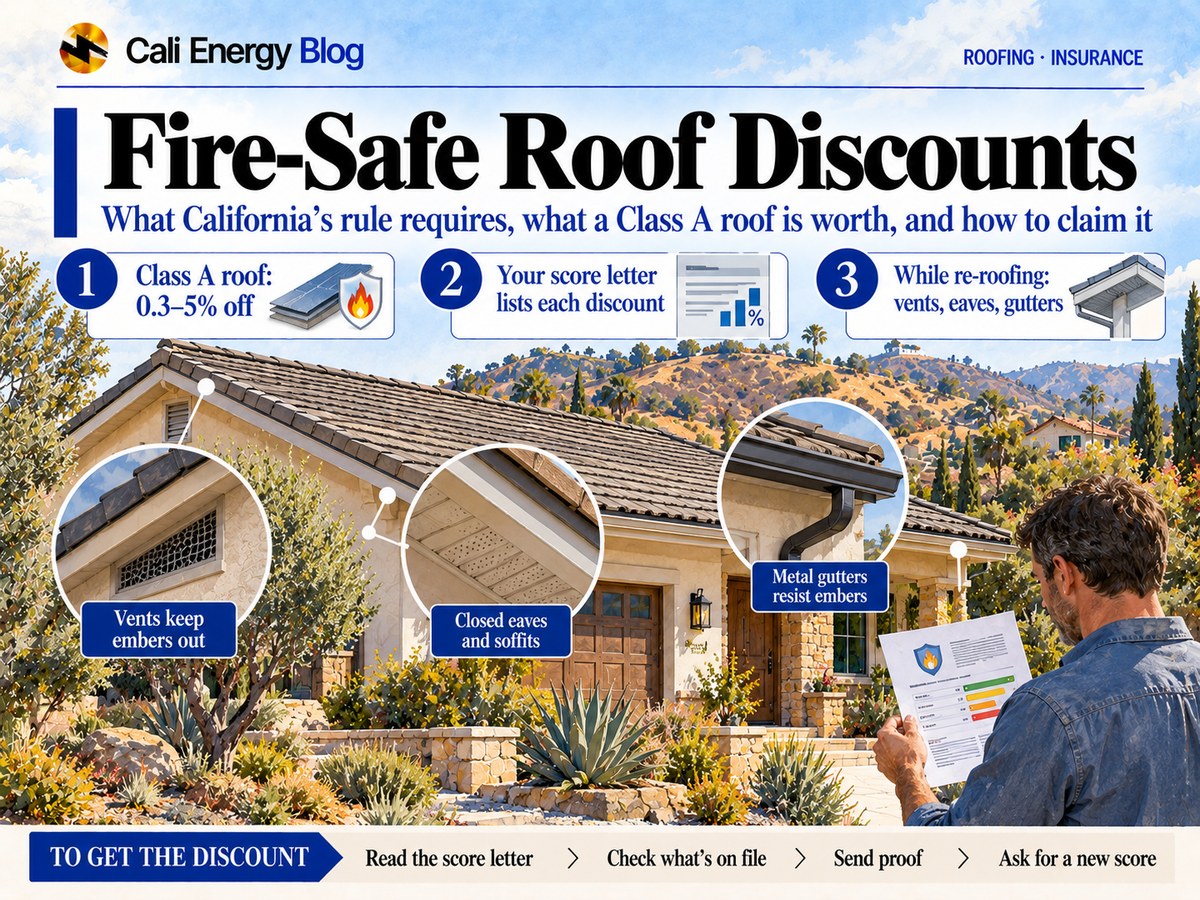
This page covers the discount. What a Class A rating certifies and how to check a roof's listing is in Class A roof ratings; which roof to choose for fire is in fire-resistant roofs in Los Angeles; how a roof's age affects keeping a policy is in roof age and home insurance. None of it is a reading of your particular policy.
What the regulation requires
The regulation applies to an insurer whose rating plan segments, adjusts or surcharges premiums by wildfire risk. Its rating plan has to reflect each of these:
- The house: a Class A fire-rated roof, enclosed eaves, fire-resistant vents, multi-pane windows or full shutters, and at least 6 inches of noncombustible material at the bottom of the exterior walls.
- The immediate surroundings: vegetation and debris cleared from under decks; vegetation, mulch and other combustibles cleared within 5 feet of the house; only noncombustible fences, gates and other improvements within those 5 feet; no combustible sheds or outbuildings within 30 feet; and defensible space as state and local law require.
- The community: a Firewise USA site in good standing, or a Fire Risk Reduction Community listed by the Board of Forestry.
Class A and fire-resistant vents are defined by the building code's wildfire chapter (California Building Code Chapter 7A, Sections 705A.1, 706A.1 and 706A.2); enclosed eaves, by the regulation itself, as boxed-in soffits with a horizontal underside or a covering applied to the underside of the rafter tails.
The same rule gives you information. An insurer that scores wildfire risk has to give you your score in writing within 15 days of an application, at least 45 days before each renewal, at least 75 days before a nonrenewal, and within 30 days after you ask for a new score because you've completed a measure. With the score it has to explain where you fall in its range and why, which measures would lower the score, and the premium reduction each measure would bring under its current rating plan. You can appeal the score, orally or in writing; the insurer must acknowledge within 10 days and answer in writing within 30, and tell you that the Department of Insurance can help if you still disagree.
What the rule doesn't do is set a number: insurers must offer discounts and justify them in their rate filings, but the size is theirs to choose. A 2025 law, AB 1 (Connolly; Chapter 472, Statutes of 2025), requires the Department to consider adding more home-hardening measures to the list by January 1, 2030, and every five years after that.
What a Class A roof is actually worth
Two reviews of insurers' rate filings put numbers on it. Researchers at Insurance for Good read the filings in force in January 2026 for the 15 largest California home insurers, 83% of the market.
| Measure | Discount range across the 15 insurers |
|---|---|
| Class A fire-rated roof | 0.3% to 5% |
| Enclosed eaves | 0.1% to 1% |
| Fire-resistant vents | 0.1% to 2% |
| Multi-pane windows | 0.1% to 5% |
| 6 inches of noncombustible siding at the base | 0.1% to 2% |
| Extra discount for completing the set | 1% to 7% |
| IBHS Wildfire Prepared Home | 2% to 37.5% |
| IBHS Wildfire Prepared Home Plus | 3.8% to 50% |
| Firewise USA community | 0.3% to 20% |
The percentage alone doesn't tell you the savings. Most of these insurers apply it to the wildfire or fire portion of the premium; State Farm and CSAA apply it to the whole base premium. All 12 required measures together came to between 3% and 28% depending on the company. And the dollars follow the risk: in Insurance for Good's hypothetical example of two Los Angeles homes with the same insurer, the same 21% off the wildfire portion was worth $947 a year on a high-risk home and $6 on a low-risk one.
Resources for the Future, an economics research institute, reviewed every rule and rate filing from January 2022 through June 2025 for 25 of the largest insurers and found that of all the single measures at the house, a Class A roof brings a far larger discount than any other. It averaged 1.88% where the discount applies to the whole premium and 1.05% where it applies to the wildfire portion, about $31 and $8 a year on an average policy statewide (more in high-risk areas). Among insurers that discount the whole premium, the other house measures averaged about 0.3% each.
Some insurers multiply discounts instead of adding them, so two 5% discounts make 9.75%, not 10%. The FAIR Plan has its own list: a Class A roof is one of 12 discounts it has offered since November 15, 2025, and a dwelling that earns all 12 may see up to 16.4% off the wildfire portion of its premium.
What counts as a Class A roof
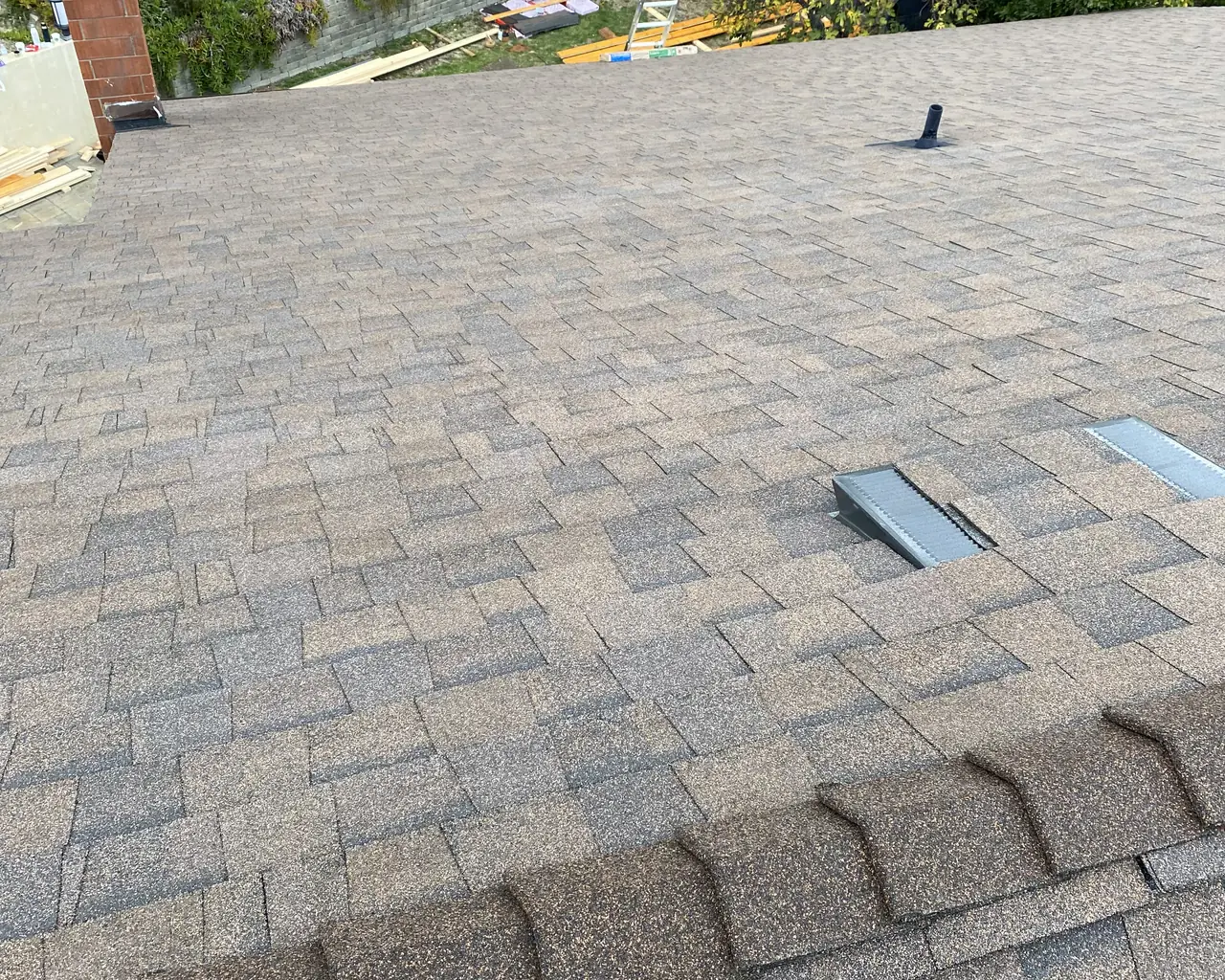
For the discount, "Class A fire-rated roof" carries its meaning from the building code's wildfire chapter (Section 705A.1), and a Class A rating belongs to the roof assembly as tested and installed, not to the material alone (how to check a roof's listing). The Department of Insurance says most roofs qualify, naming asphalt shingles, concrete, brick or masonry tile, and metal shingles or sheets, and says wood shake is not Class A; the FAIR Plan's list is fiberglass composition shingle, stone, concrete or clay tile, and metal. In the City of Los Angeles new wood shake isn't allowed at all (LABC 91.1505.1).
A wood shake roof is the case where re-roofing changes the answer. On a Woodland Hills house we re-roofed in October 2025, 28 squares of wood shake at the end of its life came off and composition shingle went on, a covering the Department of Insurance lists as usually qualifying.
How to get the discount and check it's applied
1. Read the wildfire score letter. It must list the measures that would lower your score and the premium reduction for each. If you haven't seen one, ask your insurer or agent for your score and that list.
- Check what's on file. If your roof is already Class A, make sure the insurer has it recorded that way; some insurers take roof details from property data rather than from you.
- Send proof after a re-roof. Photos of the finished roof, the contract or invoice naming the product, and the finaled permit (how to check a re-roof permit). Insurers verify differently: some take your word or photos, others require an inspection by an approved inspector.
- Ask for a new score. After a completed measure, the insurer has 30 days from your request to give you a revised score. The Department of Insurance says the savings take effect at the start of the next policy period.
- Appeal if it's wrong. Orally or in writing to the insurer, or through your agent or broker; then the Department of Insurance, (800) 927-4357.
- Compare insurers. The same roof earns from 0.3% to 5% depending on the company, applied to different parts of the premium, and the FAIR Plan has its own discounts.
Do the roof edges while the roof is open
When the roof is being replaced, the eaves, vents and gutters are already within reach, and the discounts reward doing several measures together:
- Vents. The Department of Insurance's guide describes ember- and fire-resistant vents as 1/16- to 1/8-inch noncombustible, corrosion-resistant metal mesh over exterior vents.
- Eaves. Open rafter tails can be enclosed with soffits; the Department recommends noncombustible or ignition-resistant materials.
- Gutters and tile edges. These aren't on the state's list, but the Insurance Institute for Business & Home Safety (IBHS) requires them for its Wildfire Prepared Home designation: noncombustible gutters and downspouts, a roof kept clear of debris, and noncombustible bird stops at the edges of barrel tile and corrugated metal roofs with open gaps. Wood roofs don't qualify.
The IBHS designation is the largest single discount in the filings, up to 37.5% at the Base level and 50% at Plus with some insurers, and seven of the 15 largest insurers offered one as of January 2026. The Department of Insurance said in March 2026 that some of the largest insurers now commit to writing policies for homes that meet the standard; a designation is verified by a third party and lasts three years, with an annual review. In a fire hazard severity zone, the wildland-urban interface code sets its own rules for the roof and its edges, covered in California's WUI roofing requirements.
Frequently asked
Does a Class A roof lower home insurance in California?
How much is the discount for a Class A roof?
My roof is already Class A. Do I get the discount automatically?
Does the FAIR Plan give a discount for a Class A roof?
Can a wood shake roof get the discount?
When does the discount start?
Related reading
Sources & methodology
Code sections, rules and figures on this page come from the primary sources below. Codes, local requirements and product terms change; each was verified October 6, 2026.
- California Code of Regulations, title 10, §2644.9, Consideration of Mitigation Factors; Wildfire Risk Models (operative October 14, 2022)
- California Department of Insurance, Safer from Wildfires
- California Department of Insurance, FAQ: Safer from Wildfires Regulation, September 2026
- California Department of Insurance, Rebuilding With Wildfire Safety & Insurability, March 2026
- AB 1 (Connolly), Residential property insurance: wildfire risk, Chapter 472, Statutes of 2025
- Insurance for Good, Do California Insurers Reward Wildfire Resilience?, November 2025, updated April 2026
- Insurance for Good, tables with updates
- Resources for the Future, From Risk to Reward: Insurance Discounts for Wildfire Mitigation, Working Paper 25-30, December 2025
- California FAIR Plan, Wildfire Hardening Discounts, November 2025
- IBHS, Wildfire Prepared Home How-To Prepare Checklist
- Los Angeles Building Code 2026, Chapter 15, 91.1505.1 (UpCodes)
We'll put on a Class A roof and give you the papers for your insurer
Call (323) 844-7777. We re-roof with Class A coverings and give you the product names, photos of the finished roof and the finaled permit to send your insurer. Have ready the wildfire score letter or renewal notice from your insurer, if you have one, so we can see which upgrades it lists.
Prepared by Cali Energy, October 6, 2026. This article is for general educational purposes only and is not legal, tax, financial, engineering, or utility advice. Rates, incentives, codes, permit requirements, equipment specifications, prices, and program terms may change; figures and timelines are estimates, not guarantees. Confirm current requirements with the applicable utility, AHJ, program administrator, manufacturer, or a licensed professional. See our Content Disclaimer. Cali Energy · 19201 Parthenia St, Unit E, Northridge, CA 91324 · CSLB #1032379 (B, C-10, C-39)