

How Much Life Is Left in Your Roof?
No test reads the years left in a roof; it's an estimate, and the people who make them for lenders follow a simple frame. Start with the expected life for the material, subtract the roof's age, then adjust for what an inspection finds: a roof in worse shape than its age suggests is treated as older, one in better shape as younger. HUD and Fannie Mae build their remaining-life estimates this way. The two hard parts are the age, which records answer better than looks, and the condition, which on tile and flat roofs sits under the surface. What different inspections cover, and what their reports should say, is in what a roof inspection checks.

This page is about the roof you have. Expected life by material is in roof lifespan by material; the warning signs to look for are in signs you need a new roof; and once a roof has been inspected, roof repair or replace works through the options.
The estimate, step by step
HUD's standard calculation of a component's remaining useful life is its expected useful life less its age, and HUD's assessors can enter a different remaining life when what they observe justifies it. Fannie Mae's assessors estimate an "effective age" for each building component, taking in maintenance, the local climate, use and other factors beyond normal wear, and a remaining useful life from it. For a house roof, that comes to four steps.
- Find the real age. Records beat looks; see the next section.
- Look up the expected life for the material. The published tables differ, so use the range, not one number: about 20 years for asphalt shingle, 40 to 60 or more for clay or concrete tile, 40 to 50 for metal, 10 to 20 for flat-roof membranes (roof lifespan by material).
- Adjust for condition. An inspection decides whether the roof is aging faster or slower than its years. What to look at differs by type of roof; see the table below.
- Subtract, and keep it a range. Expected life minus effective age gives the years left. An estimate that rests on an unknown age or on a part nobody could see is a guess, and should say so.
Finding the roof's real age
- The re-roof permit. In the City of Los Angeles, the Department of Building and Safety's online Permit & Inspection Report shows each permit for an address, with the date a re-roof was finaled; checking a re-roof permit walks through it. Fannie Mae tells its assessors to start the same way, determining age from building permits and certificates of occupancy.
- The papers from your purchase. If you bought the house, the seller's Real Estate Transfer Disclosure Statement, the form set out in Civil Code 1102.6, has a line for the roof's type and approximate age. Your buyer's inspection report may give an estimate too.
- The job's own papers. The contractor's invoice and any warranty registration date the work.
- What the records can't tell you. No permit on file doesn't prove the roof is original: it may have been replaced without one. A seller's "approximate" age is the seller's estimate.
What sets the years left on each type of roof
Which part of the roof sets the schedule depends on what the roof is made of, and on some roofs that part can't be seen from the surface.
| Roof | What usually decides the years left | Can it be judged from the surface? | More detail |
|---|---|---|---|
| Asphalt shingle | The shingles themselves, which sun and heat age, plus the flashings and, on an older roof, the deck | Mostly; the deck can't | Signs you need a new roof |
| Clay or concrete tile | The underlayment, fasteners and flashings under and around the tile, not the tile | No: a roofer has to lift some tiles | When to replace tile roof underlayment |
| Metal | The coating and any corrosion, and on exposed-fastener panels the screws | Mostly | Standing seam vs exposed-fastener metal roofs |
| Flat or low-slope | The membrane, and what's under it: wet insulation, the deck, the drainage | Partly; what's under the membrane can't | Flat roof repair, coating or replacement |
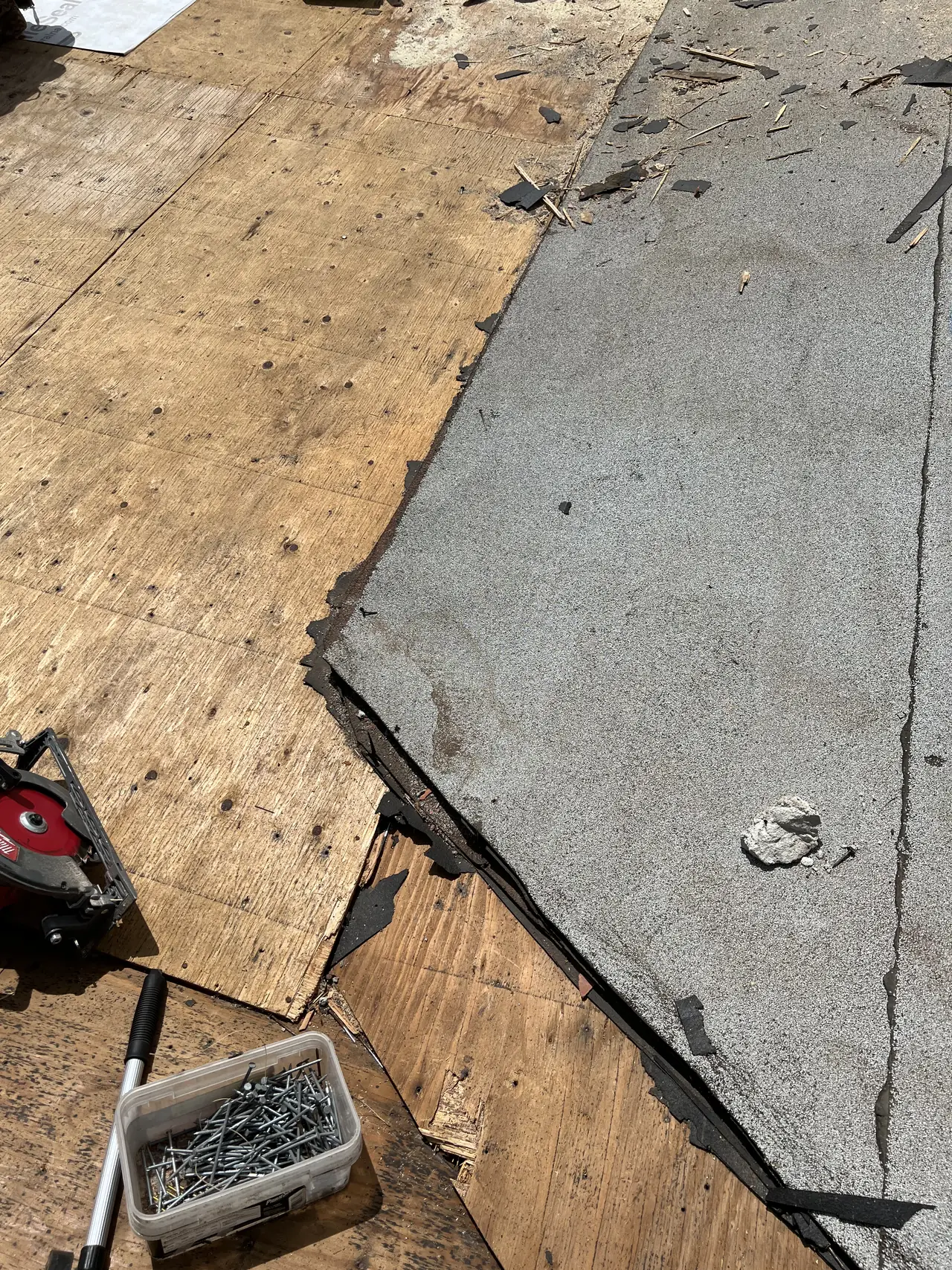
The tile row is the one that surprises people. Writing about historic clay tile roofs, the National Park Service puts the tile itself at generally about 100 years, but notes that a clay tile roof most often fails because its fastening system breaks down. On a Burbank tile roof we repaired in 2023, the call was a leak and the tile was sound: about 300 square feet of it was lifted, the underlayment and flashings were replaced, soft sheathing was replaced where it was found, and the same tile went back on.
Why the number of years matters
- Selling to a buyer with an FHA loan. Under HUD's appraisal rules (Handbook 4000.1, as updated in August 2026), the appraiser must report a roof with less than two years of remaining life and make the appraisal subject to inspection by a professional roofer. HUD proposed on September 22, 2026 to drop that two-year test, with feedback open through November 6, 2026; until a change is published, the rule stands. How much of a new roof's cost comes back in the sale price is in does a new roof add home value?, and the buyer's side is in buying a house with an old roof.
- Insurance, from 2028. Under SB 1301, starting January 1, 2028, an insurer can't refuse to issue or renew a homeowners policy solely because of the roof's age if you get and pay for an independent roof inspection confirming at least five years of useful roof life remaining. It can still take age into account, and the law doesn't define who counts as independent. Until then, each insurer's own roof-age rules apply; see roof age and home insurance.
- Solar. If panels are planned, compare the years left with how long the panels will be up; replace your roof before installing solar? covers that decision.
What a written estimate should include
An estimate you can rely on, or show a buyer or an insurer, should state:
- the roof type, slope and covering, and the condition of the flashings at chimneys, walls and other openings;
- any evidence of damage, leaks or standing water;
- the roof's age and where that figure came from: a permit, an invoice or the inspector's own estimate;
- the remaining term of any roof warranty;
- what couldn't be seen, such as the underlayment under tile or the insulation under a membrane, and whether the attic and ceilings were checked;
- the years left as a range, and what the range rests on.
These are the points Fannie Mae asks its assessors to cover for a roof (type, slope, covering, flashing, signs of damage, leaks or ponding, age and remaining warranty term), plus what HUD asks an appraiser to report when the roof can't be seen: the underside of the roof, the attic and the ceilings.
An example of the arithmetic
A 16-year-old architectural shingle roof, dated by a finaled re-roof permit. The tables put asphalt shingle at about 20 years, so by age alone about 4 years are left. If the inspection finds worn granules and cracked tabs across the sunniest slopes, the roof is aging faster than its years, and the estimate drops toward zero; if the surface is sound and the flashings tight, the 4 years stand. Either way, it falls short of the five years SB 1301 will ask of an inspection from 2028. This is an illustration, not a forecast for any roof.
Frequently asked
Can a roofer tell exactly how many years my roof has left?
My roof is past its expected life but doesn't leak. Is it done?
How do I find out how old my roof is?
Why do tiles have to be lifted to judge a tile roof?
Who can do the inspection SB 1301 refers to?
Related reading
Sources & methodology
Code sections, rules and figures on this page come from the primary sources below. Codes, local requirements and product terms change; each was verified October 8, 2026.
- U.S. Department of Housing and Urban Development, Mortgagee Letter 2016-26, Attachment A: Standard Table of Estimated Useful Life
- Fannie Mae, Form 4099, Instructions for Performing a Multifamily Property Condition Assessment, July 2026
- U.S. Department of Housing and Urban Development, Single Family Housing Policy Handbook 4000.1, update of August 12, 2026 (redline)
- U.S. Department of Housing and Urban Development, Single Family Housing Policy Drafts: Modernizing and Strengthening Minimum Property…
- U.S. Department of Housing and Urban Development, Modernization of FHA Minimum Property Requirements: Summary of Proposed Changes
- SB 1301 (Allen), Residential property insurance: nonrenewals, Chapter 693, Statutes of 2026 (Insurance Code §676.14)
- California Civil Code §1102.6 (Real Estate Transfer Disclosure Statement)
- LADBS Online Services, Permit & Inspection Report
- National Park Service, Preservation Brief 30: The Preservation and Repair of Historic Clay Tile Roofs
We'll inspect the roof and tell you what it needs
Call (323) 844-7777. We inspect the roof, photograph what we find and tell you whether it needs repairs or replacement. Have ready the roof's age if you know it, any papers from its last replacement, and, if you have one, a notice from your insurer.
Prepared by Cali Energy, October 8, 2026. This article is for general educational purposes only and is not legal, tax, financial, engineering, or utility advice. Rates, incentives, codes, permit requirements, equipment specifications, prices, and program terms may change; figures and timelines are estimates, not guarantees. Confirm current requirements with the applicable utility, AHJ, program administrator, manufacturer, or a licensed professional. See our Content Disclaimer. Cali Energy · 19201 Parthenia St, Unit E, Northridge, CA 91324 · CSLB #1032379 (B, C-10, C-39)