

Planning a Commercial Roof Replacement in Los Angeles
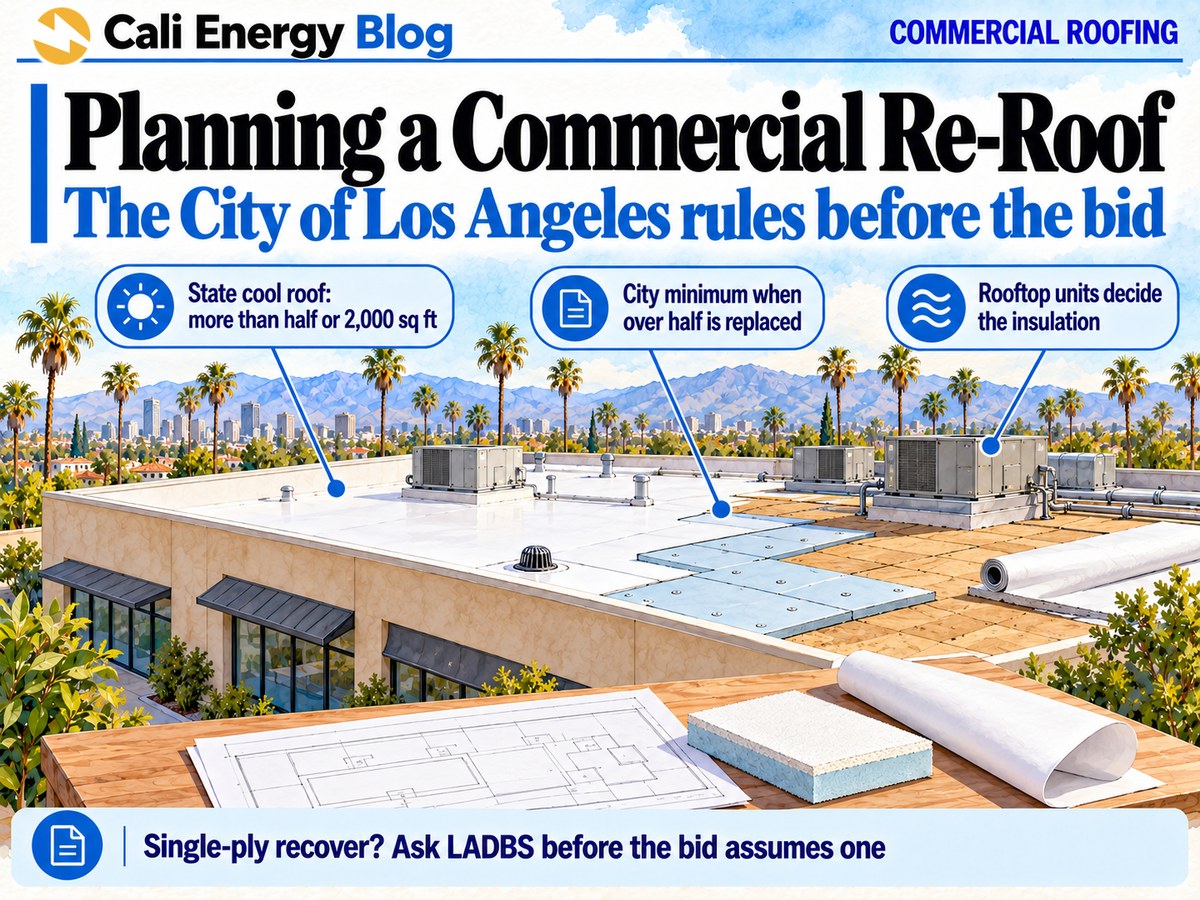
Plan a commercial re-roof in the City of Los Angeles around two energy rules, the building code's re-roofing rules and the permit. The state Energy Code's cool-roof and insulation requirements apply once more than half of the roof, or more than 2,000 square feet, whichever is less, is replaced, recovered or recoated over conditioned space: a low-slope roof then needs a cool surface (an aged solar reflectance of at least 0.63 with a thermal emittance of at least 0.75, or an SRI of at least 75) and, in most cases, continuous insulation of R-17 or R-23 depending on the climate zone. The City's Green Building Code adds a stricter cool-roof minimum (0.68 and 0.85, or SRI 82) when more than half of the roof is replaced. Rooftop units decide how much of that insulation fits under the flashing, the City's own table decides whether a new roof can go over the old one, and LADBS issues the permit. This page covers nonresidential buildings (offices, stores, restaurants, warehouses and industrial buildings) in the City of Los Angeles, as of October 2026. Apartment buildings follow the Energy Code's multifamily rules, covered in apartment building roof replacement; roofs over hotel and motel guest rooms have their own state values; houses follow the residential rules; and other cities have their own building departments.
How re-roof permits on houses differ city by city is in re-roof permits across Los Angeles County.
The rules that apply, in one table
Two energy rules, the re-roofing rules and the permit each have their own trigger.
| Rule | When it applies | What it asks for |
|---|---|---|
| State Energy Code, roof alterations (Title 24, Part 6, §141.0(b)2B) | Nonresidential building (not apartments or hotel and motel guest rooms): more than 50% of the roof or more than 2,000 sq ft, whichever is less, replaced, recovered or recoated, over conditioned space | Low slope (under 2:12): aged solar reflectance 0.63 and emittance 0.75, or SRI 75; steep slope (2:12 and up) in the city's climate zones: 0.25 and 0.80, or SRI 23. Low slope also gets insulation (next section). Products CRRC-rated and labeled |
| City cool roof (LAMC 99.05.106.13, Los Angeles Green Building Code) | A roof replacement of more than 50% of the roof | Low slope (2:12 or less, so a 2:12 roof is low slope here but steep for the state): aged reflectance 0.68 and emittance 0.85, or SRI 82; steeper: 0.28 and 0.85, or SRI 27 |
| City exceptions | Repairs; replacing 50% or less; replacement where solar is being installed; ballast or green roof of at least 25 lb/sq ft over the membrane | The city's minimum doesn't apply. The state's rule still can, except on repairs; a roof of at least 25 lb/sq ft is also exempt from the state's surface values, but not from its insulation (§141.0(b)2Bi, Exception 3) |
| Building code re-roofing (CBC §1512, as amended by LAMC 91.1512 from December 31, 2025) | Every re-roof | A replacement removes all layers to the deck; overlays only where the city's rule allows; flashings rebuilt to the maker's instructions; rusted or damaged flashings and drain outlets not reused; existing overflow drains kept |
| LADBS permit | Every re-roof | Express permit for a Class A or B covering under 6 lb/sq ft over solid sheathing (Class A in a Very High Fire Hazard Severity Zone) and for an approved coating on an existing roof; plan check for heavier coverings, other decks or structural work; inspections and a final unless LADBS waives them |
The state numbers didn't change with the 2025 Energy Code, which applies to permits applied for on or after January 1, 2026. On any roof over 4,000 sq ft, the state rule's 50%-or-2,000-sq-ft trigger is lower than the city's 50%: replacing 40% of a 50,000 sq ft roof over conditioned space, 20,000 sq ft, brings in the state rule. The city's code exempts a replacement of 50% or less, but LADBS reviews roof replacements of any value against its cool-roof section, and its plan-check checklist (GRN 10) words the cool-roof line as an alteration of 500 sq ft or more or 50% or more, so confirm with plan check on a partial job.
Cool surface and insulation on a low-slope roof
On a flat or low-slope commercial roof over conditioned space, the state rule asks for two things once it applies.
- The surface. A membrane or coating with an aged solar reflectance of at least 0.63 and a thermal emittance of at least 0.75, or an SRI of at least 75, rated and labeled by the Cool Roof Rating Council. Within the city, a replacement of more than half the roof also has to reach the city's 0.68 and 0.85, or SRI 82. A lower reflectance is allowed under the state rule if the roof is insulated to a lower U-factor (Table 141.0-B), and a roof of at least 25 lb/sq ft, such as pavers or a green roof, is exempt from the state's surface values but not from its insulation.
- The insulation. The replaced or recovered area gets continuous insulation of R-17 in climate zones 6 to 8 or R-23 in zones 1 to 5 and 9 to 16, or the matching U-factor (0.047 or 0.037) with at least R-10 above the deck (Table 141.0-C). In the City of Los Angeles, coastal areas such as Venice, Westchester and San Pedro and much of South Los Angeles fall in zones 6 and 8; the Valley, downtown and Hollywood are in zone 9, and Sunland-Tujunga in zone 16. A ZIP code can straddle zones, so look the address up in the California Energy Commission's EZ Building Climate Zone Search Tool.
- Exceptions to the insulation. A recover with new R-10 above the deck; a recoat; tapered insulation that averages the required value; and rooftop equipment that stays connected and in place (next section).
- Unconditioned space. The state rule doesn't apply over unconditioned space. On a warehouse with a conditioned office, it applies to the roof over the office only where the office walls run up to the roof deck; where the office has its own ceiling under an open warehouse roof, the Energy Commission's compliance manual says the roof rules don't apply. Whether the city's rule follows the same line isn't spelled out in its text; ask LADBS.
How flat-roof systems compare on homes is in flat roof options in Los Angeles.
Rooftop units and curbs
Adding R-17 or R-23 raises the roof surface, and the flashing at every curb, parapet and wall has to stay high enough above it.
- If the unit stays put. When rooftop mechanical equipment won't be disconnected and lifted, the insulation can be the greater of R-10 or the thickest layer that keeps the base flashing height the membrane maker requires (Energy Code §141.0(b)2B, exception 2). The California Energy Commission notes that many manufacturers and the National Roofing Contractors Association recommend at least 8 inches of base flashing.
- If the unit is lifted. Then the full table value applies; the commission's reasoning is that raising the curb costs less once the unit is up anyway.
- Below the deck. Where there's access, insulating under the deck doesn't change the flashing height and can be the cheaper route, according to the commission's compliance manual.
Plan the units with the mechanical contractor before the roofing bid: which come off, which stay, and who reconnects them.
Tear off or go over
Under the 2025 California Building Code, a roof replacement removes every layer down to the deck. An existing low-slope roof that drains and meets the code's ponding checks (CBC 1608.3 and 1611.2) doesn't have to be rebuilt to the 1/4-inch-per-foot slope a new roof needs, and existing overflow drains or scuppers can't be removed unless they're replaced; rusted flashings and old built-up roof gravel can't go back on.
From December 31, 2025, the City of Los Angeles uses its own roof-recover rule (LAMC 91.1512.3):
- No overlay when the existing roof is water-soaked or too deteriorated to carry another layer, when it's slate, clay, cement or asbestos-cement tile, or when it already has two or more layers.
- What can go over what follows the city's Table 91.1512.3.1: an existing built-up or modified bitumen roof can take most new coverings, an existing metal roof only a new metal one, and an existing tile roof nothing.
- Single-ply membranes. TPO, PVC and EPDM aren't in the city's table, either as the existing roof or as the new one, and the rule also allows a recover installed to the new covering maker's approved instructions; on a single-ply job, ask LADBS whether an overlay is allowed before a bid assumes one.
- Coatings. The city's rule names a new coating over an existing spray polyurethane foam roof, and LADBS's express permit list includes an approved coating on an existing roof; ask LADBS how it treats a coating on your roof before you plan on it.
Before any tear-off, South Coast AQMD Rule 1403 requires an asbestos survey; how that works is in asbestos testing before a roof tear-off. Drains and crickets on a house roof are in flat roof drains, scuppers and crickets.
The permit
LADBS's express permit list, which needs no plan check, includes a re-roof with a Class A or B covering weighing less than 6 lb/sq ft over existing or new solid sheathing, with a Class A covering required in a Very High Fire Hazard Severity Zone, and an approved coating on an existing roof; the bulletin notes that a cool roof may be required for non-residential buildings under §141.0(b)2B. Heavier coverings, structural work or other changes take plan check, where the plans carry LADBS's green building checklist (Form GRN 10) with the cool-roof item. LADBS inspects the work and finals the permit, though the city's code lets it waive inspections on a re-roof permit when the licensed contractor certifies the materials. How the LADBS permit works is in roof permits in Los Angeles.
Solar on the new roof
The city exempts a roof replacement where solar is being installed from its own cool-roof minimum. Whether an array planned for after the re-roof counts is LADBS's call. The state rule exempts only roof area under building-integrated solar from its surface values, not a rack-mounted array, and its insulation rule covers the whole replaced or recovered area; confirm with LADBS how it reads the two together on your job.
A commercial array sits on the roof for decades, and ballasted systems add weight. On the 567 kW ballasted array we installed on a flat TPO roof in Chatsworth, LADBS asked for a 110 mph wind rating, met with point anchors added to the ballast. That's the kind of structural and wind review to plan alongside the re-roof, before the array goes on. Anchors through the membrane are penetrations, so on a roof under a manufacturer's guarantee, get the roof maker's written approval for the array and its attachments; how guarantees treat added equipment is in a commercial roof maintenance plan. The order of the work on a house is in a new roof and solar together.
Crew safety and access
- During the work. On a steel- or concrete-framed building, the roofing crew works under Cal/OSHA's roofing rule (8 CCR 1730): on a low-slope roof over 20 feet high, warning lines at least 5 feet from the edge, guardrails, parapets at least 24 inches high or personal fall protection. Re-roofing a wood-framed commercial building falls under the residential-type rule (8 CCR 1731), with fall protection from 6 feet. Roof and skylight openings are guarded during the work (8 CCR 1632).
- After the work. Where your own staff or vendors go within 6 feet of a roof edge more than four times a year, Cal/OSHA's general industry rule calls for guardrails, and skylights need protection (8 CCR 3212). A re-roof is a natural time to add them; the upkeep side is in a commercial roof maintenance plan.
Before you sign
1. Jurisdiction. Confirm the parcel is in the City of Los Angeles in ZIMAS; a "Los Angeles" mailing address can sit in unincorporated county land. If ZIMAS can't find it, Los Angeles County Public Works' service locator shows which agency issues the permit. The city rules on this page don't apply outside the city; the state Energy Code still does.
- Climate zone and conditioned area. Know which zone the building is in and which parts of the roof are over conditioned space.
- Insulation and units. Ask each bidder for the insulation they'll install, its R-value, and how they'll handle every rooftop unit and curb.
- Product ratings. The membrane or coating's CRRC label should show the aged reflectance and emittance; compare it with 0.63 and 0.75, and with 0.68 and 0.85 inside the city when more than half the roof is replaced.
- Tear-off or overlay. Ask which the bid assumes, how many layers are on the roof now, and how the bidder checked that the old roof isn't wet, since a water-soaked roof can't take an overlay.
- Roof warranty. Ask which manufacturer's guarantee the new roof will carry and whether the installer is authorized by that manufacturer; its terms will govern later repairs and any solar.
- Schedule. Agree on when the work runs, which areas close, and who shuts down and restarts the rooftop units.
- License. Commercial roofing is the same C-39 Roofing license as residential; check it on the CSLB site. How to compare bids on a home re-roof is in comparing roofing quotes.
Frequently asked
Does a commercial re-roof in Los Angeles need a cool roof?
How much insulation does a commercial flat roof need when it's replaced?
Can a new commercial roof go over the old one in Los Angeles?
Do I need a permit to replace a commercial roof in Los Angeles?
Does adding solar change the cool-roof rule?
Related reading
Sources & methodology
Code sections, rules and figures on this page come from the primary sources below. Codes, local requirements and product terms change; each was verified October 15, 2026.
- California Energy Commission, 2025 Building Energy Efficiency Standards (Title 24, Part 6), CEC-400-2025-010, sections 100.1, 110.8(i), 140.3(a)1A…
- California Energy Commission, 2025 Building Energy Efficiency Standards (effective date)
- California Energy Commission, 2025 Nonresidential Cool Roofs (Energy Code Support Center)
- California Energy Commission, 2025 Nonresidential and Multifamily Compliance Manual, CEC-400-2025-008, Chapter 3
- California Energy Commission, Climate Zone tool, maps, and information (EZ Building Climate Zone Search Tool)
- Los Angeles Municipal Code, Section 99.05.106.13 (Cool Roof, nonresidential)
- Los Angeles Municipal Code, Sections 91.1505.1 and 91.1512 (Reroofing), Ordinance 188,797
- Los Angeles Municipal Code, Section 91.108.1 (Inspections; re-roof inspection waiver)
- 2025 California Building Code, Title 24, Part 2, Chapter 15
- LADBS, Green Building & Sustainability
- LADBS, Form GRN 10 (2026 LAGBC), Mandatory Requirements Checklist for Additions and Alterations to Non-Residential Buildings
- LADBS, Express Permits (No Plan Check Required), Information Bulletin P/GI 2026-003, revised June 10, 2026
- South Coast AQMD, Rule 1403, Asbestos Emissions from Demolition/Renovation Activities
- Cal/OSHA, Title 8, §1730 Roof Hazards
- Cal/OSHA, Title 8, §1731 Residential-type Roofing Activities, and §1716.2 (scope of residential-type construction)
- Cal/OSHA, Title 8, §1632 Floor, Roof, and Wall Openings to Be Guarded
- Cal/OSHA, Title 8, §3212
- Contractors State License Board, Description of Classifications (C-39 Roofing)
Adding solar after a commercial re-roof? We design and install the array
Call (323) 844-7777. We design and install commercial solar: before an array goes on, we look at the roof's age, its warranty terms and its layout, size the system to the area left after setbacks and equipment, and schedule the install after the roofing contractor finishes. Have ready the roof warranty, a roof plan if you have one, and 12 months of electric bills.
Prepared by Cali Energy, October 15, 2026. This article is for general educational purposes only and is not legal, tax, financial, engineering, or utility advice. Rates, incentives, codes, permit requirements, equipment specifications, prices, and program terms may change; figures and timelines are estimates, not guarantees. Confirm current requirements with the applicable utility, AHJ, program administrator, manufacturer, or a licensed professional. See our Content Disclaimer. Cali Energy · 19201 Parthenia St, Unit E, Northridge, CA 91324 · CSLB #1032379 (B, C-10, C-39)