

Apartment Building Roof Replacement in Los Angeles
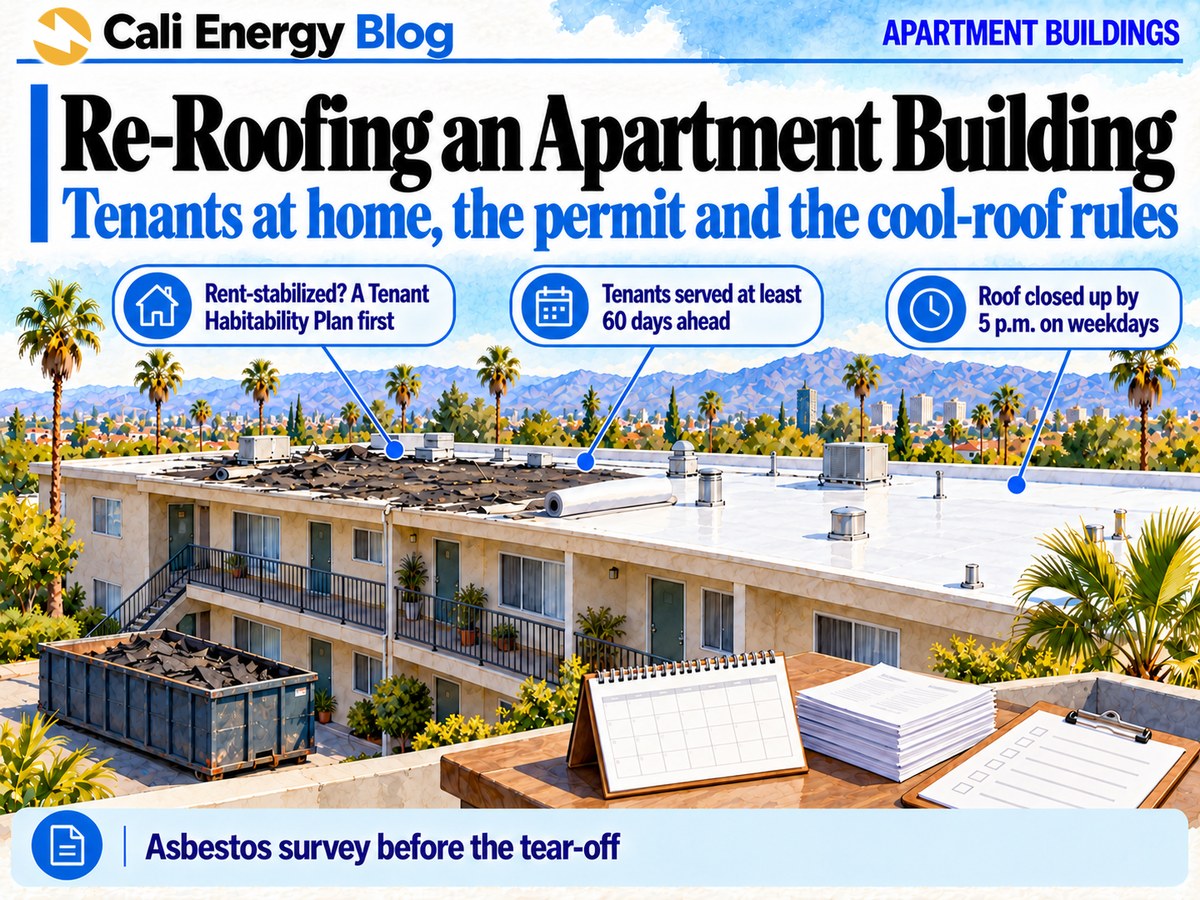
Replacing the roof on an apartment building in the City of Los Angeles works like a house re-roof on the roof itself, but several things change around it. On a rent-stabilized building, which generally means one first built on or before October 1, 1978, a tear-off over occupied units usually needs a Tenant Habitability Plan accepted by the Los Angeles Housing Department before LADBS issues the permit, served on tenants at least 60 days before work starts. Tenants can usually stay home, but any untenantable condition, an open roof included, is limited to 8 a.m. to 5 p.m. on weekdays under that plan. The state Energy Code's cool-roof and flat-roof insulation rules apply once more than half the roof, or more than 2,000 square feet, whichever is less, is replaced, which on a roof over 4,000 sq ft is earlier than on a house. And the asbestos survey before tear-off has no exemption for apartment buildings. This page covers apartment buildings in the City of Los Angeles as of October 2026; it isn't legal advice. Outside the city, the state Energy Code, Civil Code 1954 and 1941 still apply, and South Coast AQMD's asbestos rule within its district; the Tenant Habitability Plan, the city's noise hours and its cool-roof table don't, and the other city's own rules apply instead.
How the roof work itself goes is in the roof replacement process, and condo and HOA roofs in HOA roof rules in California.
What changes from a house
Most of the differences come from the tenants and from the building's size.
| Topic | Single-family house | Apartment building |
|---|---|---|
| Tenant plan | None | On a rent-stabilized building, a Tenant Habitability Plan accepted by LAHD before the permit is issued, when the work affects occupied units |
| Notice | To your own household | On a rent-stabilized building that needs a plan, the plan and a Notice of Primary Renovation Work served on tenants at least 60 days before work starts; on any rental, written notice before entering a unit |
| Work hours | City noise limits | City noise limits, and untenantable conditions only 8 a.m. to 5 p.m., Monday to Friday, under the plan |
| Permit route | LADBS permit, or a certified contractor's re-roof without one in some cases | LADBS permit; the certified-contractor route doesn't cover apartment roofs |
| State cool-roof and flat-roof insulation trigger | More than 50% of the roof replaced | More than 50% or more than 2,000 sq ft, whichever is less |
| City cool-roof values | Low-rise table | Low-rise table up to three stories; high-rise table, with a lower emittance, at four stories or more (CALGreen's definition) |
| Asbestos survey | Exemptions for an owner-occupant doing the work and for a job under 100 sq ft | Required before tear-off; those house exemptions don't apply |
Here an apartment building means three or more units. A duplex follows the house rules for the Energy Code and for LADBS's express framing repair, but the rent-stabilization, Tenant Habitability Plan and asbestos rules on this page apply to it too. On a mixed-use building, ask LADBS which rules apply to each roof area; office and retail buildings are in planning a commercial roof replacement.
Rent-stabilized buildings and the Tenant Habitability Plan
In the City of Los Angeles, the Rent Stabilization Ordinance generally covers rental units in buildings first given a certificate of occupancy on or before October 1, 1978. On those buildings, the permit is screened for the Tenant Habitability Program.
- Does the re-roof count? The Housing Department's checklist asks whether any unit is occupied, whether the work replaces or substantially modifies structural elements, roofs included, and whether it will affect weatherproofing; if a unit is occupied and the work replaces the roof or affects weatherproofing, it says to file a Tenant Habitability Plan before the permit is issued. The Rent Adjustment Commission's criteria include work on the structure, the roof included, that exposes the building frame or compromises its weather protection. A tear-off over occupied units usually answers yes; the Housing Department, or LADBS on its behalf, makes the call, and the department's own deadline is one working day after it has the scope. If no unit is occupied, the checklist says to sign it and get the permit; the commission's rules also count units that will be occupied while the work is done.
- What the plan says. The impacts on each unit (noise, utility interruptions, hazardous materials, fire safety systems, access, other services), how tenants won't have to live in an untenantable unit outside 8 a.m. to 5 p.m. on weekdays and won't be exposed to hazardous materials at any time, and how their belongings will be protected (LAMC 152.03).
- Timing. The Housing Department rules on the plan within five working days. The accepted plan, a Notice of Primary Renovation Work and a summary of the rules are then served on every affected tenant at least 60 days before the work starts (LAMC 152.04), with the notice in the language the lease was negotiated in, and tenants have 15 days to appeal. By the code's own clocks, five working days of review plus at least 60 days of service, allow at least two to three months between filing the plan and the tear-off; outstanding rent registration and code enforcement fees have to be paid before the plan is filed. Confirm the requirement and the timing with the Housing Department's Tenant Habitability Program before scheduling.
- Longer disruption. If the work will affect a unit for 30 days or more, or runs 30 or more days past the completion date in the accepted plan, the tenant can choose to end the tenancy in exchange for permanent relocation assistance (LAMC 152.05; Rent Adjustment Commission regulations). The completion date in the plan should allow for rain delays.
- Temporary housing. If a section can't be closed up by 5 p.m., or the work would leave a unit untenantable at night or on a weekend, the tenant has to be temporarily relocated, and the owner pays all temporary housing costs (Rent Adjustment Commission regulations).
- Asbestos abatement is its own trigger for the plan, whatever the roof work.
- A leak can't wait for the plan. Keeping the roof weathertight is the owner's duty (Civil Code 1941, 1941.1), and the Housing Department's checklist says it isn't meant to delay permits for maintenance of the building. Repair the leak now and schedule the replacement on the plan's timeline; ask the Housing Department how it treats the repair.
The Housing Department's Tenant Habitability Program page lists the forms and the steps.
Working with tenants at home
- The open roof. Under the plan, untenantable conditions are limited to 8 a.m. to 5 p.m., Monday to Friday, with services restored by 5 p.m. (Rent Adjustment Commission regulation 717.01). In practice, plan the work so each day's tear-off is dried in before 5 p.m. and nothing is left open over a weekend.
- Noise. City law bars loud construction near homes between 9 p.m. and 7 a.m., and on a residential lot before 8 a.m. or after 6 p.m. on Saturdays and national holidays and at any time on Sundays (LAMC 41.40).
- Entering units. Going into a unit to check a ceiling or repair water damage takes written notice with the date, approximate time and purpose; 24 hours is presumed reasonable, or six days if mailed, and entry is during normal business hours, except in an emergency, when the tenant has agreed orally to a repair visit within a week, or when the tenant is home and consents at the time (Civil Code 1954).
- Dust, debris and notices. Los Angeles's anti-harassment law lists, among examples of tenant harassment, entry notices that don't state the specific reason or a reasonable time window or aren't coordinated with the tenant's schedule, and failing to follow industry standards to limit tenants' exposure to noise, dust, lead paint and asbestos (LAMC 45.33).
On a building outside the Rent Stabilization Ordinance, the plan rules don't apply, but the roof is still the owner's to keep weathertight (Civil Code 1941, 1941.1), and the entry and noise rules still do.
The permit
The re-roof itself can be an LADBS express permit, issued without plan check, when it's a Class A or B covering under 6 lb/sq ft on solid sheathing; those items aren't limited to houses, and in a Very High Fire Hazard Severity Zone the covering has to be Class A. Replacing damaged framing members is on the express list only for houses and duplexes (item 14), but water, termite or dry-rot repair under 10% of a residential building's replacement cost is express on any residential building (item 16); larger structural work goes through plan check, so confirm the route with LADBS before the bid is final. The certified-contractor route that lets some house re-roofs go without a permit covers only plumbing-fixture and seismic gas shut-off valve replacements on multifamily buildings, not roofing (LAMC 91.108.12.1.1). On a rent-stabilized building, the Tenant Habitability Program screening comes with the permit. How the LADBS permit works is in roof permits in Los Angeles.
Cool-roof and insulation rules
Two sets of numbers apply, with different triggers.
- State Energy Code (§180.2(b)1A, multifamily). Once more than 50% of the roof, or more than 2,000 sq ft, whichever is less, is replaced, recovered or recoated, a low-slope roof (under 2:12) needs an aged solar reflectance of 0.63 and emittance 0.75, or SRI 75, in climate zones 6 to 15 (or added deck insulation in its place); a steep roof in zones 8 to 15 needs 0.20 and 0.75, or SRI 16, or one of the listed equivalents (attic insulation, a radiant barrier, no ducts in the attic in zone 9, or R-2 deck insulation). On a low-slope roof, the replaced or recovered area, not a recoat, also needs R-14 continuous insulation or a U-factor of 0.039 in zones 8 to 16; a recover with new R-10 above the deck complies, and where rooftop units stay connected in place the added insulation can be limited to the greater of R-10 or the thickest layer the flashing height allows. Replacing 2,400 sq ft of a 6,000 sq ft roof is 40%, and it still triggers the rule. Look the address up in the California Energy Commission's EZ Building Climate Zone Search Tool; zone 6 and zones 8, 9 and 16 all fall within the city.
- City cool roof (LAMC 99.04.106.5). When more than 50% of the roof is replaced: on a roof of 2:12 or less, 0.65 reflectance and 0.85 emittance, or SRI 78; steeper, 0.25 and 0.85, or SRI 20. At exactly 2:12 the city counts the roof as low slope and the state as steep. On a high-rise building the emittance is 0.75 instead of 0.85; the city's green building code adopts CALGreen's definitions (LAMC 99.02.202), under which a residential building four stories or more in height is high-rise and one of three stories or less is low-rise; ask LADBS how it counts a parking or basement level. The city's rule accepts none of the state's insulation or attic trade-offs, and doesn't apply to a roof replacement where solar is being installed; that lifts only the city's rule. Whether an array added after the roof counts isn't stated, so don't drop the cool-roof product on that basis unless LADBS confirms it for your permit. Both rules exempt pavers, ballast or a green roof of at least 25 lb/sq ft over the membrane from the reflectance values; the state's R-14 still applies.
How flat-roof systems compare is in flat roof options in Los Angeles, and how to read a cool-roof label in cool roof shingles and CRRC ratings.
Asbestos before the tear-off
South Coast AQMD Rule 1403 requires an asbestos survey by a Cal/OSHA-certified consultant before renovation, and it says apartment buildings aren't residential single-unit dwellings, so the house exemptions, for an owner-occupant doing the work and from the survey on a job under 100 sq ft, don't apply. Removing 100 sq ft or more of asbestos-containing material takes notice to the district 10 working days ahead. How the survey and notice work is in asbestos testing before a roof tear-off.
The cost and rent-stabilized buildings
Part of the cost of a new roof on a rent-stabilized building can be passed through to tenants only after the Housing Department approves an application under its Capital Improvement Program, filed within 12 months of completion; the improvement can't be normal or routine maintenance or repair. The program page has the terms.
Before you schedule
Six steps come before the tear-off date.
- Check the building's status. Confirm the parcel is in the City of Los Angeles in ZIMAS; whether the building is under the Rent Stabilization Ordinance, ask the Housing Department (1-866-557-7368). Note which units are occupied.
- Survey first. Order the asbestos survey before the roofing bid is final.
- Build the plan into the bid. Ask the roofer for a daily dry-in schedule, how the crew will keep debris off balconies and walkways, and how many working days the roof will take.
- Count the time. Allow for the plan's review, the 60-day service period, the permit and rain delays before the tear-off date.
- Tell tenants who to call. Name one contact for the job, and say where the dumpster and crew parking go and which part of the building is worked on when.
- Keep the records. Keep copies of every notice and entry, and the dates they were served.
Frequently asked
Do tenants have to move out when an apartment roof is replaced?
Do I need a Tenant Habitability Plan to re-roof my apartment building?
How much notice do tenants get for a roof replacement?
Can roofers work on Saturdays at an apartment building in Los Angeles?
Does an apartment re-roof need a cool roof?
Related reading
Sources & methodology
Code sections, rules and figures on this page come from the primary sources below. Codes, local requirements and product terms change; each was verified October 15, 2026.
- Los Angeles Municipal Code, Article 2 of Chapter XV, Tenant Habitability Program, Sections 152.00–152.06
- Los Angeles Municipal Code, Section 151.02 (definitions, Rental Units, Primary Renovation Work, Capital Improvement)
- Los Angeles Housing Department, Tenant Habitability Program
- Los Angeles Housing Department, Primary Renovation Work Identification Checklist (posted 2025)
- Rent Adjustment Commission Regulations, Section 710.00, Tenant Habitability Program (amended March 7, 2024)
- Los Angeles Housing Department, RSO Overview
- Los Angeles Housing Department, Capital Improvement Program
- Los Angeles Municipal Code, Section 41.40 (construction noise hours)
- Los Angeles Municipal Code, Section 45.33 (tenant anti-harassment)
- California Civil Code §1954
- California Civil Code §1941 and §1941.1
- LADBS, Express Permits (No Plan Check Required), Information Bulletin P/GI 2026-003, revised June 10, 2026
- Los Angeles Building Code 2026, Section 91.108.12.1.1 (UpCodes)
- California Energy Commission, 2025 Building Energy Efficiency Standards (Title 24, Part 6), CEC-400-2025-010, sections 100.1 and 180.2(b)1A
- California Energy Commission, Climate Zone tool, maps, and information (EZ Building Climate Zone Search Tool)
- Los Angeles Municipal Code, Section 99.04.106.5 and Tables 99.04.106.5.1–5.2 (Cool Roof)
- Los Angeles Municipal Code, Section 99.02.202 (adopts CALGreen definitions)
- 2025 California Green Building Standards Code (CALGreen), Chapter 2, Section 202 (high-rise and low-rise residential building)
- South Coast AQMD, Rule 1403, Asbestos Emissions from Demolition/Renovation Activities
Planning solar after the new roof? We design and install the array
Call (323) 844-7777. We design and install solar: before an array goes on, we look at the roof's age, its warranty terms and its layout, and we schedule the install after your roofer finishes. Have ready the roof's age, the number of units and 12 months of electric bills for the common areas.
Prepared by Cali Energy, October 15, 2026. This article is for general educational purposes only and is not legal, tax, financial, engineering, or utility advice. Rates, incentives, codes, permit requirements, equipment specifications, prices, and program terms may change; figures and timelines are estimates, not guarantees. Confirm current requirements with the applicable utility, AHJ, program administrator, manufacturer, or a licensed professional. See our Content Disclaimer. Cali Energy · 19201 Parthenia St, Unit E, Northridge, CA 91324 · CSLB #1032379 (B, C-10, C-39)