

What a Commercial Roof Maintenance Plan Should Include
A commercial roof maintenance plan should cover six things: inspections at least twice a year, in spring and fall and after severe weather; a task list that starts with the drains, flashings and roof edges; records of every visit, with photos and invoices; control over who goes on the roof, who repairs it and what gets added to it; a written procedure for reporting leaks under the roof guarantee; and fall protection for the people who do the work. On a roof under a manufacturer's guarantee this isn't optional: GAF, Carlisle, Elevate and Johns Manville make maintenance and records the owner's responsibility and can exclude damage, or void the guarantee, when the roof isn't maintained. The drains, records and safety parts of the plan apply either way. This page covers low-slope commercial roofs in California, with the codes in force since January 1, 2026; it isn't a substitute for the maintenance terms of your own guarantee.
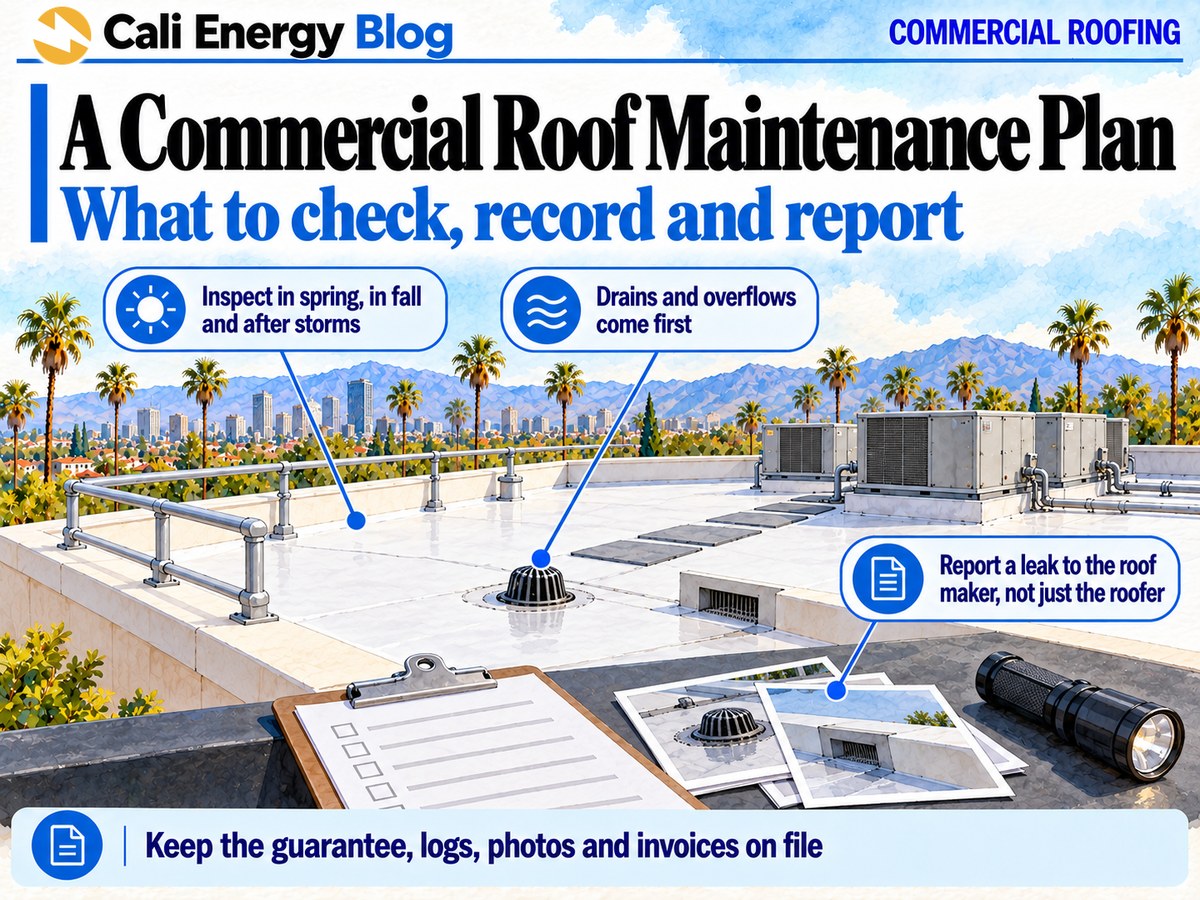
The plan at a glance
Most of the plan is a calendar and a file.
| Item | When | Why |
|---|---|---|
| Full inspection of the roof and everything on it | Twice a year, spring and fall | NRCA and the major membrane makers recommend it; GAF sets once a year as the minimum and twice as optimal |
| Extra inspections | After high winds, heavy rain or hail, and after rooftop equipment is serviced | Carlisle asks for a visit after any rooftop-unit service; GAF notes that the sooner damage is repaired, the smaller the repair |
| Drains, strainers, scuppers and overflows | Every visit, and before the rainy season | Debris stops drainage, and on a roof designed to the current code, the structure assumes the overflows work |
| Flashings, edges, penetrations and sealant | Every visit | GAF's checklist looks for loose flashings and deteriorated sealant; Elevate says sealant that cracks or shrinks is replaced |
| Surface cleaning | As the manufacturer specifies | Soiling lowers a white membrane's reflectance; grease from kitchen exhaust has to be removed from TPO and PVC |
| Records: guarantee, inspection logs with photos, invoices, rooftop access log | Every visit, kept on file | The guarantees list them; they show the roof was maintained if a claim is disputed |
| Repairs, new penetrations, curbs and attachments | Only after the manufacturer's written approval, by its certified or authorized roofer | GAF, Carlisle, Elevate and Johns Manville tie repairs to their own contractors, and the last three alterations too |
| Leak report to the manufacturer | As soon as it's found, the way the guarantee says; 30 days at the latest, and some guarantees count from the leak itself | Under a manufacturer's guarantee, notice to the roofing contractor isn't notice to the manufacturer |
A plan written for a specific roof should follow that roof's guarantee and the manufacturer's maintenance guide; where they differ from the table, they control.
What each visit checks
The manufacturers' owner checklists cover the same ground, from the ceilings up.
- Inside the building: ceilings, walls and the underside of the deck for leak stains, discoloration or rust.
- The membrane field: soft spots, damage from wind-blown debris or foot traffic, loose fasteners, and debris or plants in low spots.
- Flashings, edges and walls: base and curb flashings, edge metal, coping and gravel stops for loose attachment, rust or failed sealant; Johns Manville notes that bad mortar joints or loose coping on a wall next to the roof can look like a membrane leak.
- Penetrations and rooftop units: pipe and vent flashings, pitch pans that need filling, draw bands, unit curbs, ductwork and access doors, and condensate lines.
- Drains and standing water: below, in their own section.
Some items depend on the roof:
- Single-ply (TPO, PVC, EPDM): open seams, splits, shrinkage and punctures, and oil or kitchen grease on the surface; on a ballasted roof, the stone is spread back over bare spots (GAF).
- Built-up and modified bitumen: blisters and splits in the surface, pitch pockets whose filler has cracked or shrunk, and on a gravel-surfaced roof, bare spots where the gravel is gone; Elevate has it re-embedded in hot asphalt.
- Coated roofs: cracked, flaked, blistered or worn coating is recoated with a compatible coating (GAF); Elevate says a smooth APP roof installed without a coating should get one within five years.
Findings go on a copy of the roof plan, so a repair crew can find them.
What the roof guarantee asks of you
The four big commercial membrane makers put the owner's part in writing.
- GAF (EverGuard Diamond Pledge, form COMTS700-1224) requires regular inspections and maintenance with records, requires repairs by a GAF-certified roofing contractor, and excludes inadequate maintenance, roof traffic off GAF walkways, and changes or additions to the roof made without GAF's written approval.
- Carlisle (Golden Seal, form F0020, 2024) makes the warranty void if the owner fails to use reasonable care in maintaining the roof, or if alterations, repairs or objects such as solar arrays are made on or attached to the roof without Carlisle's written authorization; its care guide has alterations done by a Carlisle Authorized Applicator. If an array has to come off for a roof repair, the owner pays to remove and reinstall it and bears the lost generation.
- Elevate, formerly Firestone Building Products (Red Shield, 2026 forms), excludes failure to maintain the roof under its maintenance guide, and voids the warranty if leaks it doesn't cover aren't repaired by a licensed Elevate applicator within 60 days.
- Johns Manville (Peak Advantage) states that the guarantee isn't a maintenance agreement or an insurance policy and that routine inspections and maintenance are the owner's sole responsibility; changes such as pipe penetrations, curbs and added equipment go through a JM-approved contractor.
Leak notice runs on a short clock. All four set 30 days as the outer limit for reporting a leak to the manufacturer itself: Johns Manville asks for notice immediately on discovery, and Carlisle and Elevate count the 30 days from the leak, not from when someone finds it. GAF, Carlisle and Johns Manville say plainly that the roofing contractor isn't their agent, so telling the contractor doesn't count; if the installer's workmanship warranty is still running, tell the installer too. A guarantee also doesn't follow a sale on its own: Johns Manville's, for example, transfers only at JM's discretion, after an application and a fee paid within 30 days of the sale, and may require an inspection or repairs first.
A roof with no manufacturer's guarantee, or one that has run out, still needs the same plan; leaks then go to whoever gave the warranty still in force, such as the installer under its workmanship warranty.
Drains come first on a flat roof
On a low-slope roof the drains are the plan's core, and the codes explain why.
- Strainers. Roof drains are required to have domed strainers, except flat strainers on sun decks, parking decks and similar maintained areas (California Plumbing Code 1102.2); a missing or crushed strainer lets debris into the leader.
- Overflows. Where parapets would trap water, the roof needs secondary overflow drains or scuppers (California Building Code 1502.2). On a roof designed to the current code, the structure is sized for the water that builds up to those overflows, plus the depth flowing over them, when the primary drains are blocked (CBC 1611); a clogged or capped overflow lets water rise past that. A re-roof can't remove existing overflows unless it replaces them (CBC 1512.1).
- Where overflow water comes out. If the overflow drains run in their own piping, the current plumbing code has it discharge where occupants or maintenance staff can see it (CPC 1101.12.2.2.1); water coming out there means the primary drains are blocked or overwhelmed. Some buildings tie the overflows into the main leaders or use scuppers through the parapet instead, so the plan should note which this roof has.
- Standing water. Water still standing 48 hours after rain means the roof isn't draining the way the building code defines it (CBC chapter 2); Elevate asks for drainage within 24 to 48 hours, and Carlisle for ponded water to evaporate within 48 to 72. Ponding past 48 hours goes on the roof plan and gets a fix. How ponding is diagnosed and fixed is in ponding water on a flat roof, and drain details are in flat roof drains, scuppers and crickets.
Cities can amend these sections; the City of Los Angeles adopts the state's reroofing section and changes only its overlay rules (LAMC 91.1512). In Los Angeles, schedule the fall visit before the rains start; the timing is in preparing a roof for the rainy season.
Who goes on the roof
GAF's owner guide calls improperly added equipment, sometimes added by tenants, a very common source of roofing problems and lists damage by other trades, so the plan controls access.
- An access log. Who went up, when and why; GAF, Elevate and Johns Manville recommend one, and Carlisle lists rooftop traffic logs among the records the owner must keep.
- Walkways. Carlisle requires walkway pads where equipment is serviced every 30 days or less, and GAF excludes traffic off its walkways. Where service traffic crosses bare membrane, mark the path on the roof plan; GAF's checklist asks whether walkway pads are needed, and Elevate recommends them.
- A check after every service call. HVAC condensate lines should rest on blocks or supports, not on the membrane (Johns Manville).
- Nothing new through or on the roof without approval. New penetrations, curbs, equipment, signs and solar arrays need the manufacturer's written approval under each of the four guarantees, and the guarantee says who may cut and flash the roof for them. A tenant's solar installer isn't automatically that contractor. When equipment that needs service goes within 10 feet of a roof edge, the building code calls for guards or anchors with it (CBC 1015.6).
- Emergency patches. Use only what the manufacturer allows; Carlisle, for example, allows its lap sealant or a good rubber caulk on its membranes and rules out asphalt roof cement.
- Who inspects and who repairs. NRCA says building staff who know the roof and follow safety procedures can do inspections, and suggests that the contractor who installed a roof under warranty do the repairs. Elevate accepts any qualified person but recommends the installer at least once a year, and Carlisle suggests its authorized applicator or someone trained in single-ply roofing.
Restaurants and other tenants with kitchens
Kitchen exhaust puts grease on the roof. Carlisle says fats must be regularly removed from TPO and PVC membranes and must not be exhausted onto EPDM, and the California Mechanical Code requires a grease collection device at rooftop kitchen exhaust terminations (CMC 510.9.1). Emptying it and cleaning the membrane around the fan go on the plan.
Safety for the people who do the work
Roof inspections and repairs put people near edges and skylights.
- Routine visits. Under Cal/OSHA's general industry rules, guardrails are required where an employee needs to come within 6 feet of the roof edge more than four times a year; for less frequent work, personal fall protection can stand in (8 CCR 3212(d)). Employees who come within 6 feet of a skylight must be protected from falling through it; for a short inspection the rule allows a temporary suspension only with adequate risk control (3212(e)).
- Roofing work. On a steel- or concrete-framed building, Cal/OSHA's roofing rule (8 CCR 1730) governs the roofing crew; on low-slope roofs more than 20 feet high it calls for warning lines, guardrails or personal fall protection. Roofing on a wood-framed commercial building falls under the residential-type rule (8 CCR 1731), with fall protection from 6 feet.
- Anchors. If staff use roof anchors, include their inspection in the plan; GSA's national operations and maintenance specification for its buildings, for example, calls for a yearly third-party inspection and a 10-year recertification of roof anchorage points.
Who installs permanent guardrails on a leased building is a question for the lease and, if needed, a lawyer.
When maintenance stops paying
The Defense Department's 2020 roofing criteria (UFC 3-110-03, Change 5) put the cutoff plainly: a roof that keeps leaking despite repeated repairs should be scheduled for replacement, because maintaining it only takes effort away from the roofs that still work. The same edition says infrared moisture surveys can supplement but never replace a visual inspection; the 2026 edition no longer has a maintenance chapter. Planning the replacement is in planning a commercial roof replacement in Los Angeles.
Frequently asked
How often should a commercial roof be inspected?
Does a commercial roof warranty require maintenance?
Who do I report a commercial roof leak to?
Can I add solar or equipment to a roof under warranty?
What records should a roof maintenance file have?
Related reading
Sources & methodology
Code sections, rules and figures on this page come from the primary sources below. Codes, local requirements and product terms change; each was verified October 15, 2026.
- GAF, EverGuard Diamond Pledge NDL Roof Guarantee (specimen, COMTS700-1224)
- GAF, Scheduled Maintenance Checklist (COMGN119, 2024)
- Carlisle SynTec, Golden Seal Total Roofing System Warranty (sample, F0020 Rev 12/24) with Care and Maintenance Guide
- Carlisle SynTec, Owner's Manual (2025)
- Elevate (Amrize), Red Shield Roofing System Limited Warranty (sample, 2026)
- Elevate, Roofing System Maintenance Guide, Version 5 (2025)
- Johns Manville, Peak Advantage Guarantee (sample)
- Johns Manville, Owner's Manual (2026)
- NRCA, Tech Today, Professional Roofing, April 2012
- U.S. Department of Defense, UFC 3-110-03 Roofing, Change 5 (2020; superseded by the 2026 edition)
- U.S. General Services Administration, National Operations & Maintenance Specification (March 2025)
- 2025 California Building Code, Chapters 10, 15 and 16 (UpCodes)
- 2025 California Plumbing Code, Chapter 11 (IAPMO)
- 2025 California Mechanical Code, Section 510.9.1 (IAPMO)
- Cal/OSHA, Title 8, §3212
- Cal/OSHA, Title 8, §1730 Roof Hazards
- Cal/OSHA, Title 8, §1731 Residential-type Roofing Activities, and §1716.2 (scope of residential-type construction)
- Lawrence Berkeley National Laboratory, Effects of soiling and cleaning on the reflectance of a light-colored roofing membrane (2005)
Adding solar to a commercial roof under a guarantee?
Call (323) 844-7777. We design and install commercial solar. On a roof under a manufacturer's guarantee, the roof maker's written approval comes before the array, and its terms may require its own authorized roofer to flash the attachments. Whether the roof should be replaced first shows only on a roof visit. Have ready the guarantee and its serial number, the roof's age, a roof plan if you have one, and 12 months of electric bills.
Prepared by Cali Energy, October 15, 2026. This article is for general educational purposes only and is not legal, tax, financial, engineering, or utility advice. Rates, incentives, codes, permit requirements, equipment specifications, prices, and program terms may change; figures and timelines are estimates, not guarantees. Confirm current requirements with the applicable utility, AHJ, program administrator, manufacturer, or a licensed professional. See our Content Disclaimer. Cali Energy · 19201 Parthenia St, Unit E, Northridge, CA 91324 · CSLB #1032379 (B, C-10, C-39)