

How to Read Home Battery Specs: Energy, Power, Efficiency, Warranty and Safety
A home battery is described by a handful of numbers, and two of them do most of the work: usable energy in kWh — how much it stores, so how long it can run things — and continuous power in kW — how much it can run at once. Then come round-trip efficiency (how much energy survives the trip in and out), the warranty (years, and sometimes a cap on energy throughput), and the safety listings, above all UL 9540. On the battery pages of Cali-Graf, the free equipment directory built by Cali Energy, a Los Angeles solar and roofing contractor, each number names its source, and two practical extras sit alongside: how big a solar array refills the battery in a day in Southern California, and how often the battery shows up in local building permits. Whether a battery lowers your bill is a separate question — it depends on your utility. How the whole equipment directory works is in checking the equipment in a solar quote.
The five numbers
| Spec | What it means | Powerwall 3, as an example |
|---|---|---|
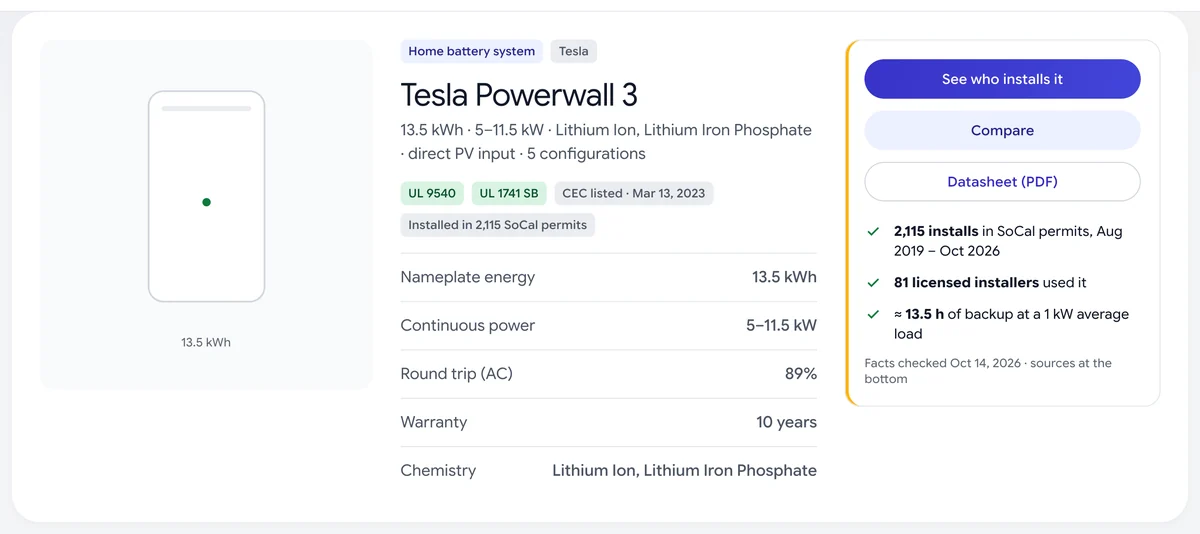
| Usable energy (kWh) | How much it can deliver from full | 13.5 kWh |
| Continuous power (kW) | How much it can run at the same time | 5–11.5 kW, by configuration |
| Round-trip efficiency | Share of energy you get back out of what goes in | 89% |
| Warranty | Years covered, sometimes with a throughput limit | 10 years |
| Safety listing | Certification of the whole storage system | UL 9540, with UL 9540A fire testing |
Energy versus power. Energy decides how long; power decides how much at once. A 13.5 kWh battery running flat out at 11.5 kW empties in about 1.2 hours; at a 1 kW average load, it lasts about 13.5 hours. A battery with plenty of energy but low power can keep the fridge and lights on for a long time but may not start a central air conditioner.
Round-trip efficiency. Every cycle loses some energy as heat. At 89%, storing 10 kWh of solar gives back about 8.9 kWh — which is one reason a battery can't save money where the utility already credits exported solar at full value.
Backup: how long will it last?
It depends on what you run. Spec pages give a reference — Cali-Graf's page for Powerwall 3 shows about 13.5 hours at a 1 kW average load — while Cali-Graf's proposals estimate essentials at about 300 watts — on its sample proposal, a 10 kWh battery covers about 32 hours without sun. Which circuits stay on is decided by how the battery is wired; see whole-home vs critical-loads backup.
Recharging from solar — the winter catch
A battery is only as useful in a long outage as the solar that refills it. Battery pages show the solar array size that refills the battery from empty in one average day, by Southern California city and month, from NLR's PVWatts model with a south-facing roof. For a 13.5 kWh battery in Los Angeles that's about 4.2 kW of panels in December but only about 2.5 kW in June. In winter, short days mean a system sized for summer may not refill the battery between outages — see can solar recharge a battery in winter?.
How it connects
- DC-coupled (hybrid). Panels connect straight to the battery's built-in solar inverter — direct PV input. Powerwall 3 works this way.
- AC-coupled. The battery charges through the home's wiring, next to existing inverters or microinverters.
- Expansion. Some batteries take add-on units; the page shows the maximum and how often local installs include one.
Which pairings work is covered in will this panel work with this inverter? and designing solar around Powerwall 3.
Safety and California code
| Listing | What it means |
|---|---|
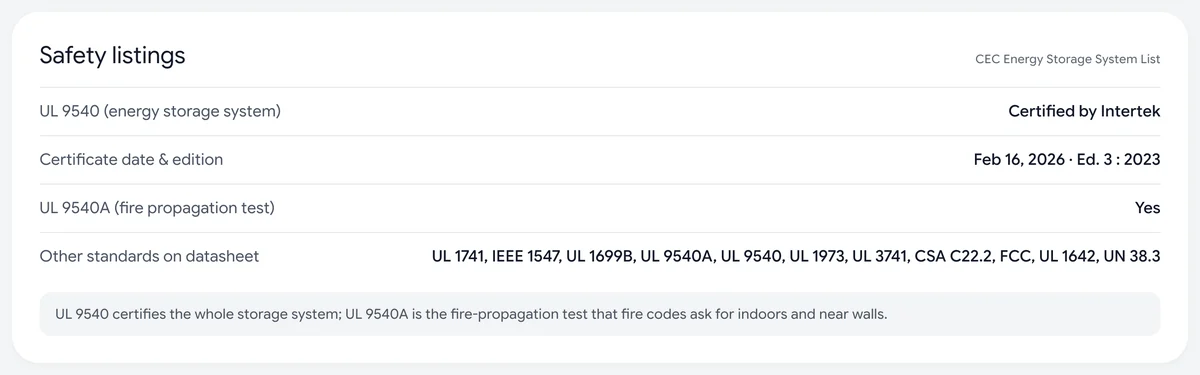
| UL 9540 | Certifies the whole energy storage system, not just the cells |
| UL 9540A | The fire-propagation test that fire codes look for when a battery goes indoors or near walls |
| UL 1741 SB | Grid-support certification for California's interconnection rules |
| CSIP (IEEE 2030.5) | The communication standard California utilities use for smart inverters |
| JA12 declaration | Lets the battery count toward California's energy code for new homes |
The page also shows where the battery may be installed — indoor or outdoor, its enclosure rating — and notes from the CEC list. Placement rules are in home battery fire safety.
Will it save money?
Not from the spec page. On an SCE home under Net Billing, a battery that shifts midday solar into the 4–9 PM peak lowers the bill; on an LADWP home, solar is already netted 1:1, so its value is backup. See selling home batteries: LADWP backup vs SCE savings.
Want to know what a battery would do for your home and utility? Ask Cali Energy for an estimate.
Frequently asked
What is the difference between kWh and kW on a battery?
What is round-trip efficiency?
What does UL 9540 mean for a home battery?
How much solar does it take to recharge a home battery?
How long will a home battery last in an outage?
Related reading
Sources & methodology
Product facts on this page come from Cali-Graf's own help center and the pages linked below; figures in examples come from the stated inputs. Features, limits and supported utilities change; each was verified October 16, 2026.
Thinking about a home battery in Los Angeles?
Look up the battery in your quote, then ask Cali Energy (CSLB #1032379), which develops Cali-Graf, for a design that shows what the battery does on your utility — savings on SCE, backup on LADWP. Example figures here are from Cali-Graf's Powerwall 3 page, built from the CEC list and Tesla's datasheet.
Prepared by Cali Energy, October 16, 2026. This article is for general educational purposes only and is not legal, tax, financial, engineering, or utility advice. Rates, incentives, codes, permit requirements, equipment specifications, prices, and program terms may change; figures and timelines are estimates, not guarantees. Confirm current requirements with the applicable utility, AHJ, program administrator, manufacturer, or a licensed professional. See our Content Disclaimer. Cali Energy · 19201 Parthenia St, Unit E, Northridge, CA 91324 · CSLB #1032379 (B, C-10, C-39)