

Checking the Equipment in a Solar Quote: A Guide to Cali-Graf's Equipment Directory
A solar quote names equipment by model — a panel, an inverter, maybe a battery — and each name is worth one lookup. The equipment directory in Cali-Graf — the free platform built by Cali Energy, a Los Angeles solar and roofing contractor — covers 5,083 current panel, inverter and battery series from the California Energy Commission's lists, as of October 2026, and puts on one page what you'd otherwise collect from five places: whether the model is CEC-listed, its specs with the source of every number, its warranty and degradation, independent test results where they exist, and how often it shows up in Southern California building permits — with the licensed installers who put it in. The page won't tell you whether a model is right for your roof; it will tell you whether the quote's model is what it says it is.
What's in the directory
| Category | Series | In SoCal permits |
|---|---|---|
| Solar panels | 2,003 | 2,000 |
| Inverters | 370 | 1,280 |
| Microinverters | 84 | 1,654 |
| Home batteries and storage | 2,626 | 5,456 |
Each page covers a series — one product line with its power classes or configurations — and lists the individual models inside it, so the exact model number from your quote should appear on its series page.
Five checks on any equipment page
1. Is it on the CEC list? The top of the page says CEC listed with the listing date. Incentive programs, and some utilities and permit offices, rely on these lists; an unlisted model is a question for the seller — see verifying equipment model numbers on the CEC list.
- Do the specs match the quote? Power, efficiency, size; for batteries, usable energy and continuous power. Every section names its source — the CEC list, the manufacturer's datasheet or a value Cali-Graf calculated, marked as calculated.
- What's guaranteed? Product and performance warranty, the output guaranteed in year 10 and year 25, and any extended warranty that depends on a certified installer.
- What do independent tests say? Kiwa PVEL and RETC results where published — with a clear note when the result is for the manufacturer rather than this exact series. See PVEL and RETC results explained.
- Who installs it here? Installs in Southern California permits, permits per year, the panels and batteries it was installed with, top ZIP codes and the licensed installers whose permits name it — see what equipment does my installer actually install?; the brands named most often across the region are in solar brands in Southern California permits.
Panel pages
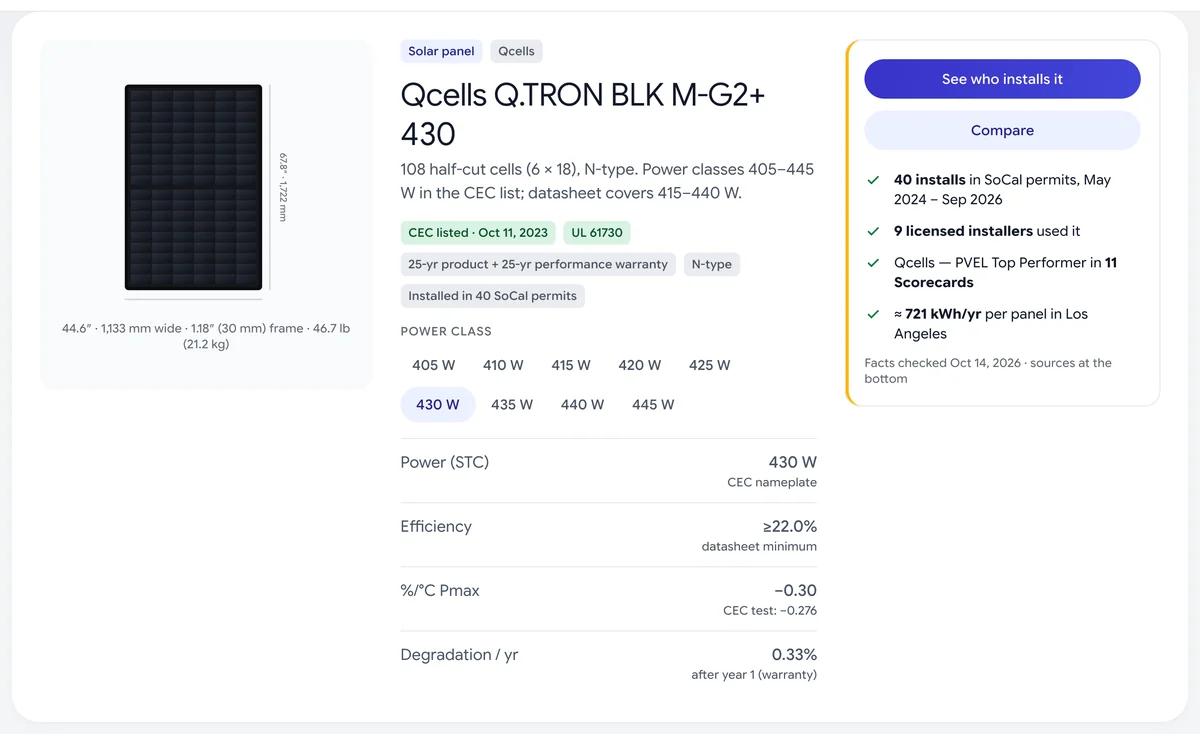
A panel page leads with the cell count and type, the power classes and the headline numbers — power at standard test conditions, efficiency, the temperature coefficient and the yearly degradation after year one. Further down: the models, the module size, electrical data, behavior away from lab conditions (at normal operating temperature and in low light), mechanical load and fire ratings, certifications, the warranty curve and independent tests. What each number means for a homeowner is in how to read a solar panel spec sheet.
Inverter and microinverter pages
An inverter page lists the models and their AC ratings and leads with the numbers that matter:
- CEC weighted efficiency — measured by an accredited lab at six power levels and three DC voltages; the number to compare between inverters.
- UL 1741 SB — the grid-support certification that meets California's Rule 21 for new interconnections.
- Maximum DC input voltage and the MPPT range — which panels it can safely take; the page's Panel compatibility & string sizing section works it out. Why cold mornings matter is in will this panel work with this inverter?.
- Who installs it — permits and licensed installers in Southern California.
Battery pages
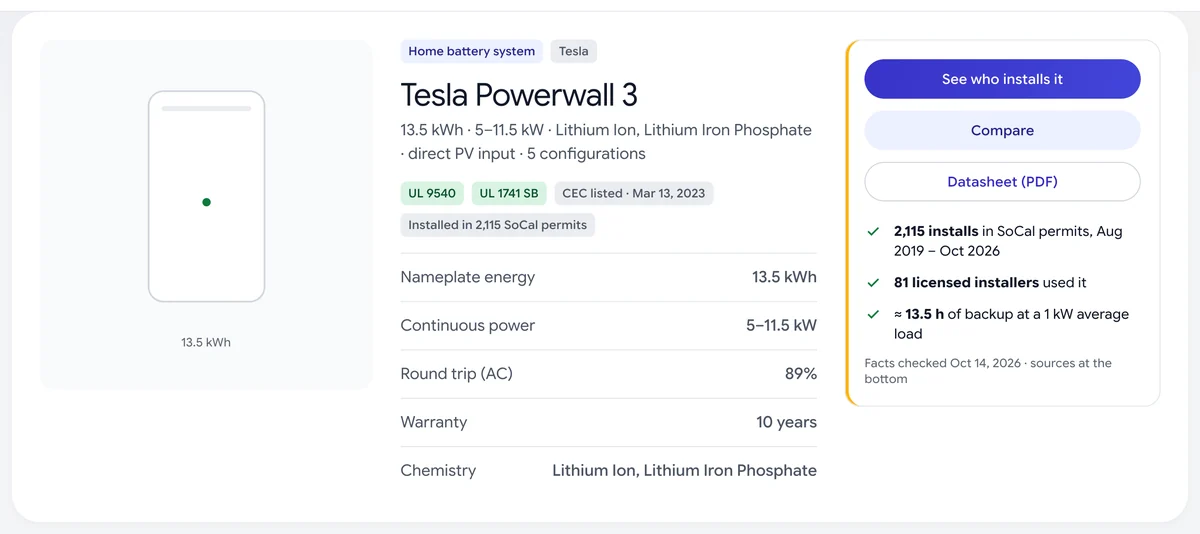
A battery page leads with usable energy, continuous power, round-trip efficiency, warranty and chemistry, then the configurations on the CEC list, backup estimates and installs. What those numbers mean for your home is in how to read a home battery page.
Have a quote? Look up each model number in the equipment directory before you sign.
What the pages won't tell you
- Whether it fits your roof or your bill. That depends on the design and your utility — a job for a proposal, not a spec page.
- Price. There are none.
- Every install. Install counts include only permits that name the product, from the portals loaded so far.
Frequently asked
How do I check if a solar panel or battery is CEC-listed?
What is CEC weighted efficiency?
Can I see which installers use a specific panel or battery?
Where does the equipment data come from?
Does the directory show prices?
Related reading
Sources & methodology
Product facts on this page come from Cali-Graf's own help center and the pages linked below; figures in examples come from the stated inputs. Features, limits and supported utilities change; each was verified October 16, 2026.
Look up the equipment in your quote
Type the panel, inverter or battery model from your quote into Cali-Graf's equipment directory: CEC listing, datasheet, independent tests and local installs on one page. Planning solar in Los Angeles? Cali Energy (CSLB #1032379), which develops Cali-Graf, designs with equipment checked to work together.
Prepared by Cali Energy, October 16, 2026. This article is for general educational purposes only and is not legal, tax, financial, engineering, or utility advice. Rates, incentives, codes, permit requirements, equipment specifications, prices, and program terms may change; figures and timelines are estimates, not guarantees. Confirm current requirements with the applicable utility, AHJ, program administrator, manufacturer, or a licensed professional. See our Content Disclaimer. Cali Energy · 19201 Parthenia St, Unit E, Northridge, CA 91324 · CSLB #1032379 (B, C-10, C-39)