

Designing Solar Around Powerwall 3: Hybrid Inverter, AC Coupling and Clipping
Powerwall 3 is a 13.5 kWh home battery with a solar inverter inside, so it can be designed two ways. As a hybrid, the panels connect straight to it and it is both the inverter and the battery; the number of Powerwall 3 units is also the number of inverters taking solar, and their combined AC limit decides how much of a large array is clipped at the sunniest hours. AC-coupled, it sits next to microinverters and takes solar through the home's AC wiring. Cali-Graf, the free design and proposal app built by Cali Energy, a Los Angeles solar and roofing contractor, handles both: pick Powerwall 3 in Inverter and in Battery for the hybrid, or a microinverter in Inverter and Powerwall 3 only in Battery for AC coupling — the compatibility check confirms the pair and the hourly model counts the clipping.
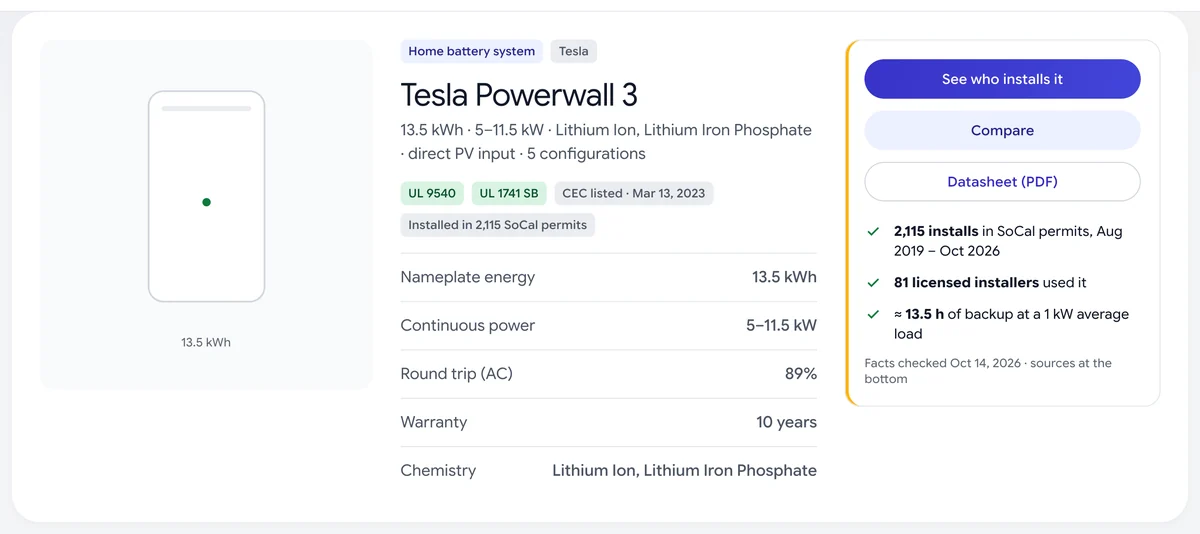
Powerwall 3 at a glance
| Powerwall 3 | |
|---|---|
| Energy | 13.5 kWh |
| Continuous power | 5–11.5 kW AC, depending on configuration (five listed on the CEC list) |
| Solar input (hybrid) | Up to 20 kW of panels at STC per unit; 6 MPPT inputs; 60–550 V input, 60–480 V MPPT range; up to 15 A working and 19 A short-circuit current per input |
| Round-trip efficiency | 89% |
| Listings | UL 9540, UL 1741 SB; on the California Energy Commission list |
| In Southern California | Named in 2,115 permits by 81 licensed installers, as of October 2026 |
Specifications and installation history are on its page in Cali-Graf's equipment directory: Tesla Powerwall 3.
Option 1: Powerwall 3 as the inverter (hybrid)
The panels are wired in strings into Powerwall 3's solar inputs, and the same unit stores energy and feeds the home.
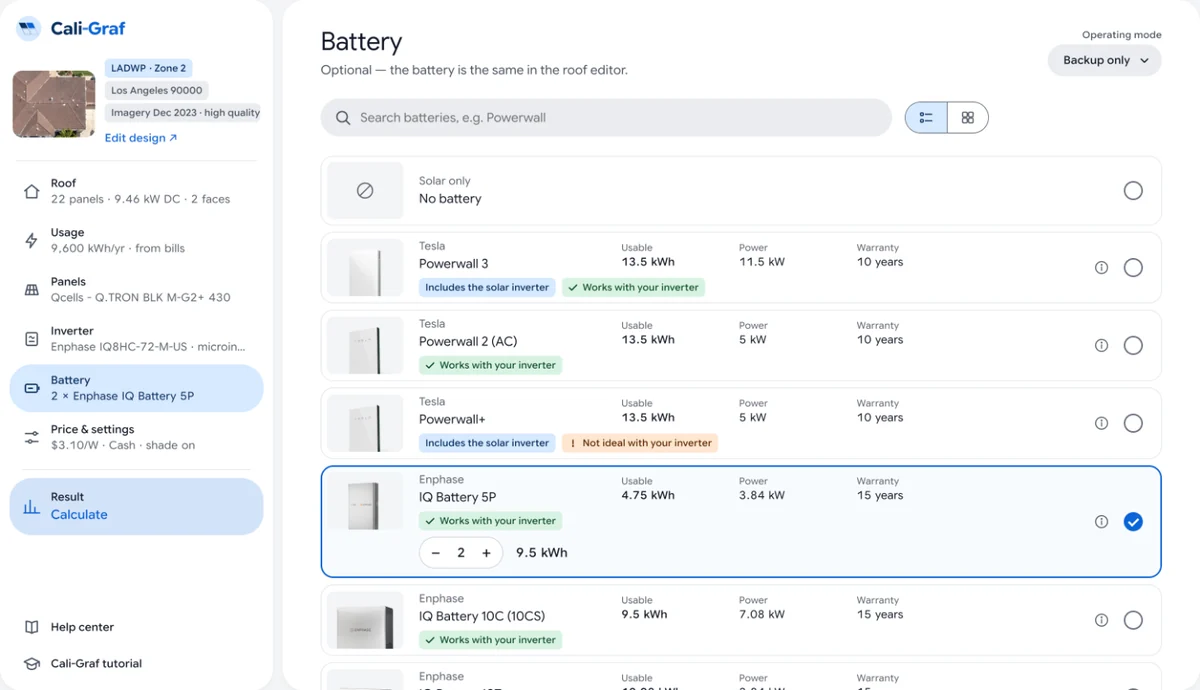
- In Cali-Graf: pick Powerwall 3 in Battery and set the units, then pick Powerwall 3 in Inverter. The line under Inverter shows how many units take the solar — the number set in Battery. Picking it as the inverter without the battery gives Powerwall 3 is the battery unit itself — choose Powerwall 3 in Battery.
- String sizing: the compatibility check works out the string range for the chosen panel from its cold-morning voltage and working voltage — shown as strings of n–m panels per input — and rejects panels whose current exceeds the per-input limits. The general math is in max panels per string.
- Shade: strings share current. Cali-Graf averages each face's shade over its panels, which matches panels that work on their own; on a string without optimizers, a shaded panel can pull down more of the string than that average shows — worth a second look on a shaded roof.
Clipping: how many units for how many panels
Each Powerwall 3 accepts far more panel power at its inputs than it can deliver as AC. When the panels make more than the units' combined AC limit — at midday on clear days — the extra is clipped. A little clipping is normal and often a fair trade; a lot means the system is short an inverter.
Cali-Graf models this hour by hour: the calculation runs as many inverters as there are Powerwall 3 units sharing the panels, and their combined power limit decides what is clipped. To see the effect, copy the calculation and change the number of units, then compare first-year production — see good, better, best options. A second unit adds storage and inverter capacity at once.
Copy the calculation, change one Powerwall 3 to two and see how much midday clipping goes away.
Option 2: Powerwall 3 next to microinverters (AC-coupled)
On a roof with microinverters — a new system or an existing one — Powerwall 3 can charge from the solar through the home's AC wiring.
- In Cali-Graf: pick the microinverter in Inverter and Powerwall 3 only in Battery. The compatibility check confirms the pair: Powerwall 3 works AC-coupled with Enphase IQ8 microinverters.
- What changes: each panel keeps its own microinverter, so a shaded panel doesn't hold back the others, and there's no string sizing; Powerwall 3's own solar inputs aren't used.
Adding a battery to a system that's already on the roof is a different job — Cali-Graf's calculation assumes no existing system; see adding a battery to existing solar.
What the battery is worth depends on the utility
Powerwall 3 behaves like any battery in the bill math: under SCE's Net Billing Tariff, holding midday solar for the 4–9 PM peak lowers the bill; under LADWP's net metering, its value is backup. Choose the operating mode accordingly — see selling home batteries on LADWP vs SCE.
Frequently asked
Can Powerwall 3 be used with microinverters?
How many panels can one Powerwall 3 take?
What is clipping with Powerwall 3?
How do I set up Powerwall 3 in Cali-Graf?
Does Powerwall 3 lower an LADWP bill?
Related reading
Sources & methodology
Product facts on this page come from Cali-Graf's own help center and the pages linked below; figures in examples come from the stated inputs. Features, limits and supported utilities change; each was verified October 16, 2026.
- Cali-Graf Help — Tesla Powerwall 3 and other hybrid inverters
- Cali-Graf Help — Equipment compatibility check
- Cali-Graf Help — Choose the inverter
- Cali-Graf Help — Battery operating modes
- Cali-Graf — Equipment directory: Tesla Powerwall 3
- Tesla — Powerwall 3 Datasheet
- California Energy Commission — Solar Equipment Lists
Size Powerwall 3 against the roof you designed
Lay out the panels, pick Powerwall 3 as the inverter or AC-coupled next to IQ8, and compare one unit with two on first-year production and the bill. Free in Cali-Graf, with daily fair-use limits. Powerwall 3 figures come from Tesla's datasheet and the CEC list; confirm current specifications with Tesla.
Prepared by Cali Energy, October 16, 2026. This article is for general educational purposes only and is not legal, tax, financial, engineering, or utility advice. Rates, incentives, codes, permit requirements, equipment specifications, prices, and program terms may change; figures and timelines are estimates, not guarantees. Confirm current requirements with the applicable utility, AHJ, program administrator, manufacturer, or a licensed professional. See our Content Disclaimer. Cali Energy · 19201 Parthenia St, Unit E, Northridge, CA 91324 · CSLB #1032379 (B, C-10, C-39)