

Will This Panel Work With This Inverter? Compatibility Checks for Southern California
Whether a panel works with a microinverter comes down to two hard limits in the inverter's datasheet: the panel's open-circuit voltage on the coldest morning must stay under the inverter's maximum input voltage, and the panel's short-circuit current must stay under its maximum module current. Enphase states it plainly in its IQ8 datasheets: modules must be within the maximum input DC voltage and maximum module Isc. Break either and the pairing doesn't work; stay inside both but outside the inverter's comfortable range, and it works with some output lost. Cali-Graf, the free design and proposal app built by Cali Energy, a Los Angeles solar and roofing contractor, checks these limits from the manufacturers' datasheets — panel voltage at −10 °C (14 °F), the coldest mornings in Los Angeles County — marks each model Works with, Not ideal or Doesn't work, and stops the calculation until a conflict is fixed. Where it has no data for a model, it says so, and the datasheets are yours to check.
The two hard limits
1. Voltage in the cold. A panel's voltage rises as it gets colder, and the highest voltage it will ever see is the open-circuit voltage (Voc) on a cold, clear morning. Corrected from the 25 °C test condition:
Voc at cold = Voc × (1 + β × (T_cold − 25 °C))
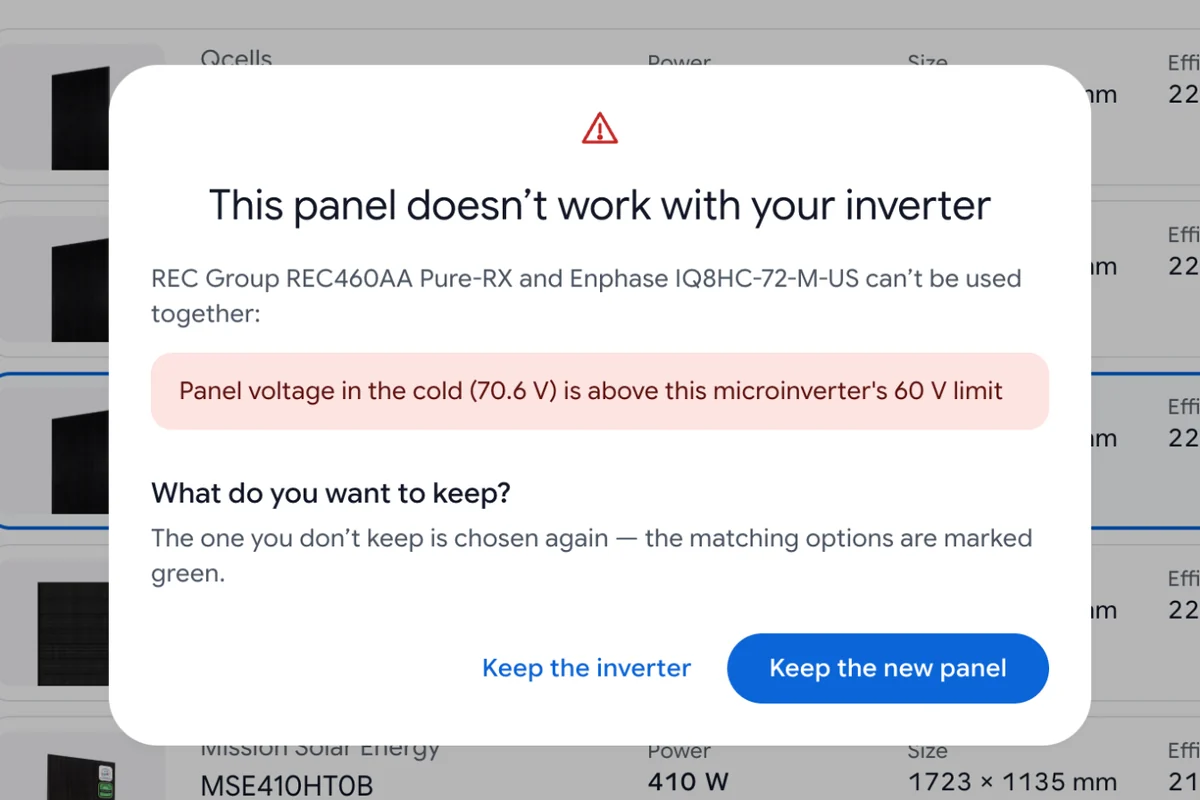
where β is the panel's temperature coefficient of Voc (negative, in %/°C) from its datasheet. For a panel with Voc of 49.0 V and β of −0.25%/°C at −10 °C: 49.0 × (1 + 0.0025 × 35) ≈ 53.3 V — under a 60 V limit. A panel whose Voc is already above 60 V at 25 °C fails before any temperature correction. When a panel's datasheet doesn't give β, Cali-Graf uses a typical −0.30%/°C.
2. Short-circuit current. The panel's Isc must not exceed the inverter's maximum module Isc. High-current panels — often the larger, higher-wattage formats — are the ones that hit it.
For reference, Enphase's IQ8HC datasheet (July 2026) lists a maximum input DC voltage of 60 V and a maximum module Isc of 20 A.
The soft limits that cost output
| Limit | What happens outside it | Cali-Graf's mark |
|---|---|---|
| MPPT voltage range (IQ8HC: 29.5–45 V) | A panel whose working voltage (Vmp) falls outside it loses some output | Not ideal |
| Commonly used module pairings (IQ8HC: 320–540 W) | A panel stronger than the usual pairing is clipped at the sunniest hours | Not ideal |
| Maximum continuous DC current (IQ8HC: 14 A) | A panel's working current (Imp) above it is clipped at peak | Not ideal |
"Not ideal" pairings are legal and common — a little midday clipping can be a fair trade for a cheaper inverter — but the customer's production estimate should include it, and Cali-Graf's hourly model does, using the exact inverter's power limit.
String inverters and Powerwall 3
With an inverter that takes strings of panels, the same two ideas set how many panels per string: the string's cold voltage must stay under the inverter's maximum input voltage, and its working voltage must stay above the minimum MPPT voltage, with the panel current under the per-input limits. For Tesla's Powerwall 3, which has a solar inverter inside, Cali-Graf reports the result as strings of n–m panels per input. The general math for string length in Southern California's cold is in max panels per string.
Batteries and inverters
A battery has to be listed by its manufacturer as working with the inverter, and Cali-Graf checks the pairing the same way. A few examples from the manufacturers' documents: Enphase IQ Batteries work only with Enphase microinverters; Powerwall 3 works AC-coupled with Enphase IQ8 microinverters, and is itself the solar inverter when used alone; SolarEdge's Home Battery works only with a SolarEdge Home Hub inverter. How the battery's mode changes the bill is a separate question — see selling home batteries on LADWP vs SCE.
How Cali-Graf checks it
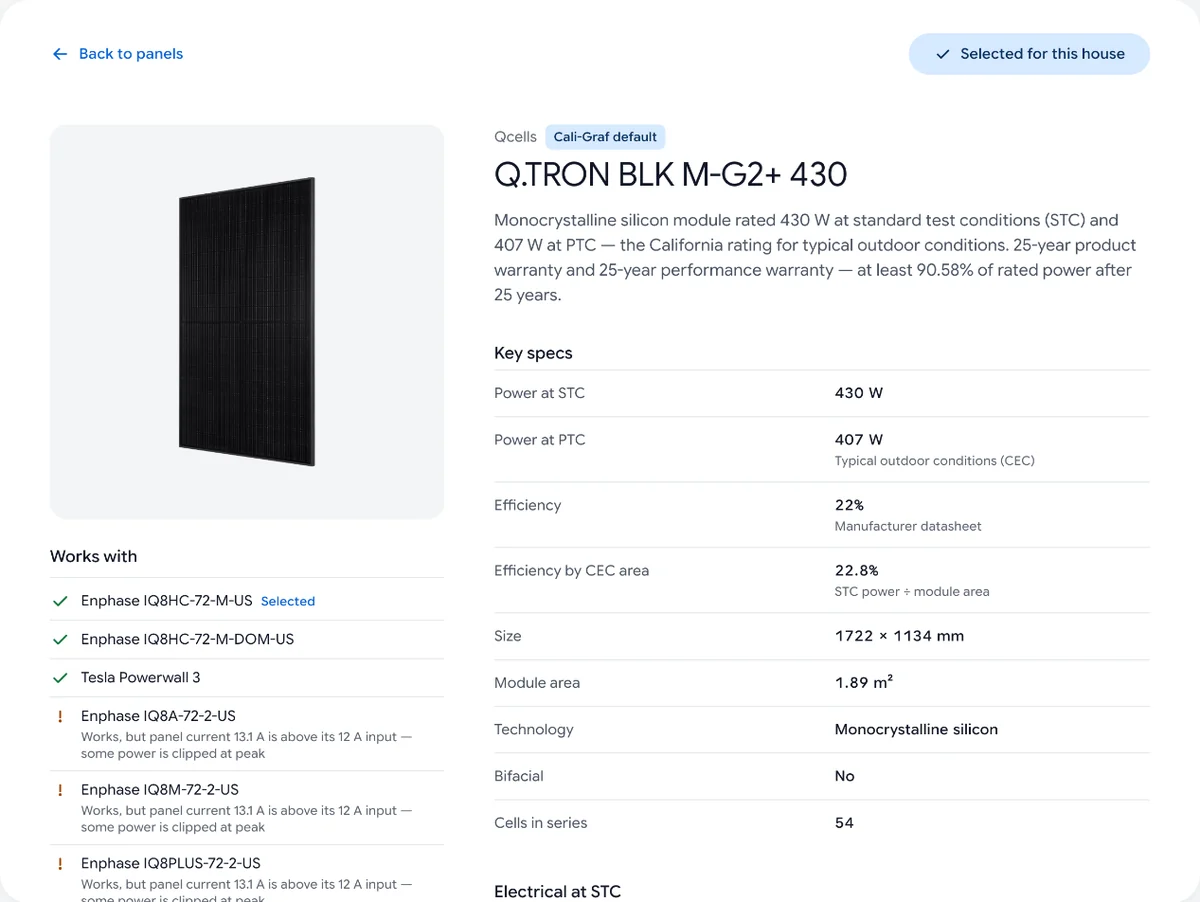
- Marks in the lists. As you pick equipment, models that fit are marked Works with; others say Not ideal with your … or Doesn't work, with the reason — for example, the panel's cold voltage against the limit.
- A conflict stops the calculation. Pick something that doesn't work and Cali-Graf asks What do you want to keep? — keep the inverter or keep the new panel — then shows the matching options in green. The proposal can't be made from an incompatible set.
- All details. Every panel, inverter and battery card opens its full specs — Voc, Isc, Vmp, Imp, temperature coefficients, the inverter's DC input limits — with the source of each number: the California Energy Commission's equipment list or the manufacturer's datasheet.
- What's covered. Compatibility data covers Enphase IQ8 microinverters and Tesla Powerwall 3, and batteries from Enphase, Tesla, SolarEdge and FranklinWH. For other models, Cali-Graf shows No compatibility data for this model yet — check the manufacturer's datasheet.
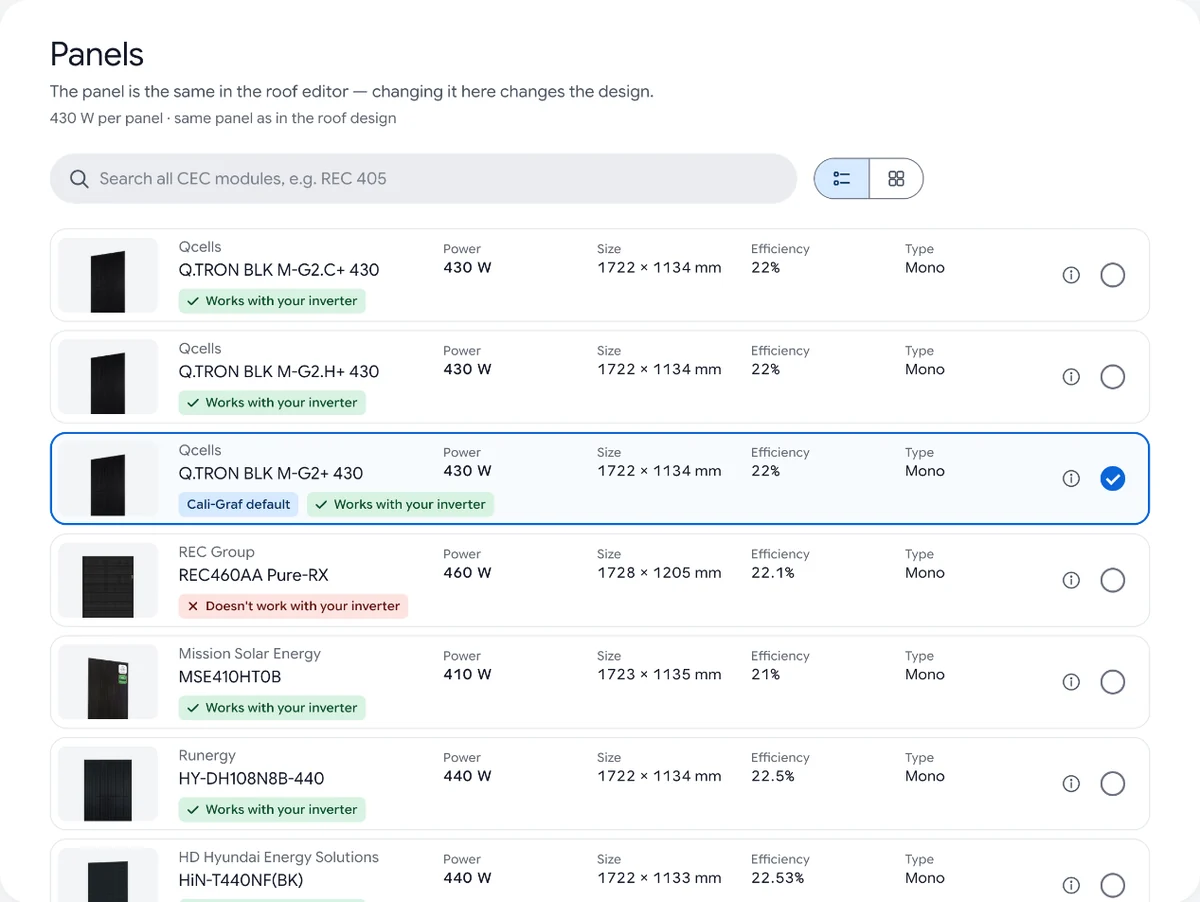
Try a panel you're considering against IQ8 or Powerwall 3 in Cali-Graf and see the cold-voltage check in the list.
Choosing the panel in the first place
The panel comes before the roof layout, because the layout is drawn in its size. Cali-Graf's panel search covers every panel on the California Energy Commission list — a brand and a wattage are enough, like REC 405 — and each card shows the power, size, area, efficiency and cell type. Two things worth knowing: STC power is a lab rating, and PTC in the details is closer to outdoor output (the production model works hour by hour on real conditions anyway); and when the CEC list lacks a panel's dimensions, the size is marked as estimated — check it against the datasheet before laying out a tight roof. The same CEC lists power Cali-Graf's public equipment directory.
Check it yourself from the datasheets
1. From the panel datasheet: Voc, Isc, Vmp, Imp and the Voc temperature coefficient.
- From the inverter datasheet: maximum input DC voltage, maximum module (or input) Isc, MPPT range, maximum continuous current and the usual module pairing.
- Correct Voc to your site's coldest morning — −10 °C covers Los Angeles County with margin.
- Hard limits first: cold Voc and Isc. Then the soft ones: Vmp in the MPPT range, power and Imp against the pairing and current limits.
- For a battery, confirm the pairing in the battery maker's compatibility documents.
Frequently asked
How do I know if a solar panel is compatible with a microinverter?
Why does panel voltage matter more in cold weather?
What temperature should I use for Los Angeles?
What does "Not ideal" mean in Cali-Graf?
Does Cali-Graf check every inverter?
Related reading
Sources & methodology
Product facts on this page come from Cali-Graf's own help center and the pages linked below; figures in examples come from the stated inputs. Features, limits and supported utilities change; each was verified October 16, 2026.
- Cali-Graf Help — Equipment compatibility check
- Cali-Graf Help — Choose panels
- Cali-Graf Help — Choose the inverter
- Cali-Graf Help — Equipment details: specs, temperature, warranty
- Cali-Graf Help — Add a battery
- Enphase — IQ8HC Microinverter data sheet (DSH-00047-10.0, July 2026)
- California Energy Commission — Solar Equipment Lists
- Cali-Graf — Equipment directory
Let the equipment lists flag the mismatch
Pick a panel, an inverter and a battery in Cali-Graf and each list marks what works, what clips and what won't — checked at −10 °C from the manufacturers' datasheets. Free, with daily fair-use limits. Confirm against the current datasheets before ordering.
Prepared by Cali Energy, October 16, 2026. This article is for general educational purposes only and is not legal, tax, financial, engineering, or utility advice. Rates, incentives, codes, permit requirements, equipment specifications, prices, and program terms may change; figures and timelines are estimates, not guarantees. Confirm current requirements with the applicable utility, AHJ, program administrator, manufacturer, or a licensed professional. See our Content Disclaimer. Cali Energy · 19201 Parthenia St, Unit E, Northridge, CA 91324 · CSLB #1032379 (B, C-10, C-39)