

Selling Home Batteries: LADWP Backup vs. SCE Savings
When a customer asks "should I add a battery?", the answer depends on the utility. On an SCE home under the Net Billing Tariff, solar sent to the grid at midday earns little and power bought from 4 to 9 PM costs the most, so a battery that stores midday solar for the evening lowers the bill — real money every month. On an LADWP home, solar sent to the grid is already credited 1:1 against usage over each billing period, so storing it saves nothing, and the battery's small round-trip losses can even show as a cost; its value is backup power during outages. Cali-Graf — the free design and proposal app built by Cali Energy, a Los Angeles solar and roofing contractor — simulates the battery hour by hour in the mode you pick — Time-of-use by default for SCE, Backup only for LADWP — and the proposal's battery sheet says plainly which kind of value it is.
The short answer by utility
| SCE (Net Billing) | LADWP (net metering) | |
|---|---|---|
| Does a battery lower the bill? | Yes — it moves cheap midday solar into the expensive evening peak | No — exports are already credited like evening power |
| Default mode in Cali-Graf | Time-of-use (hold for 4–9 PM peak) | Backup only |
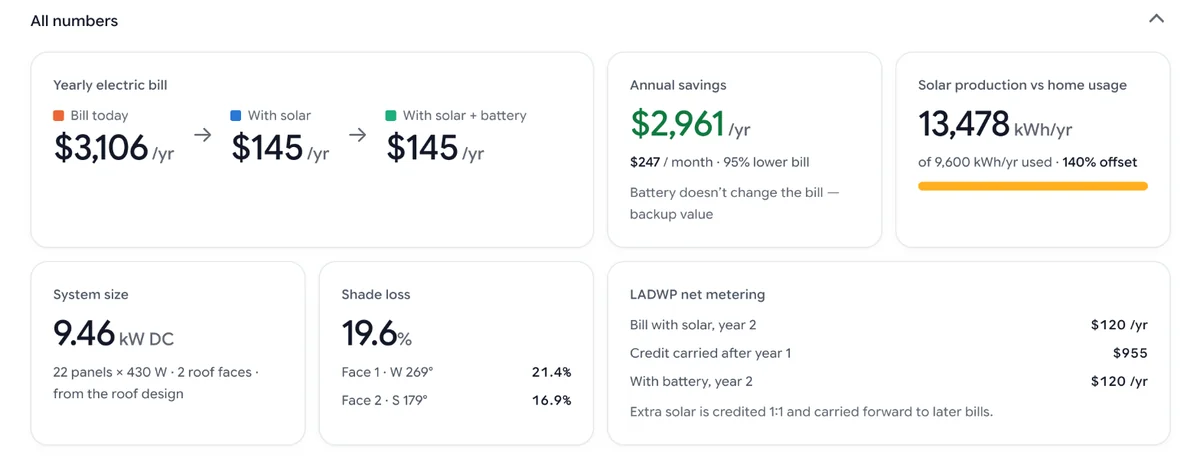
| What the result shows | A bill With battery and Estimated savings with solar and battery | Battery doesn't change the bill — backup value |
| How to sell it | Extra savings, plus backup | Backup, with the same savings as solar alone |
The tariff mechanics behind this are in SCE Net Billing, hour by hour and how Cali-Graf models an LADWP bill.
Three operating modes
The mode sets when the battery gives its energy back:
| Mode | What the battery does | When it fits |
|---|---|---|
| Time-of-use (hold for 4–9 PM peak) | Charges from solar during the day and saves the energy for the peak hours | SCE homes — the most savings under Net Billing |
| Self-powered (use solar any time) | Covers the home whenever solar falls short, at any hour | Customers who want to use as much of their own solar as possible |
| Backup only | Stays charged for outages and doesn't change the bill | LADWP homes, or anyone buying the battery for outages |
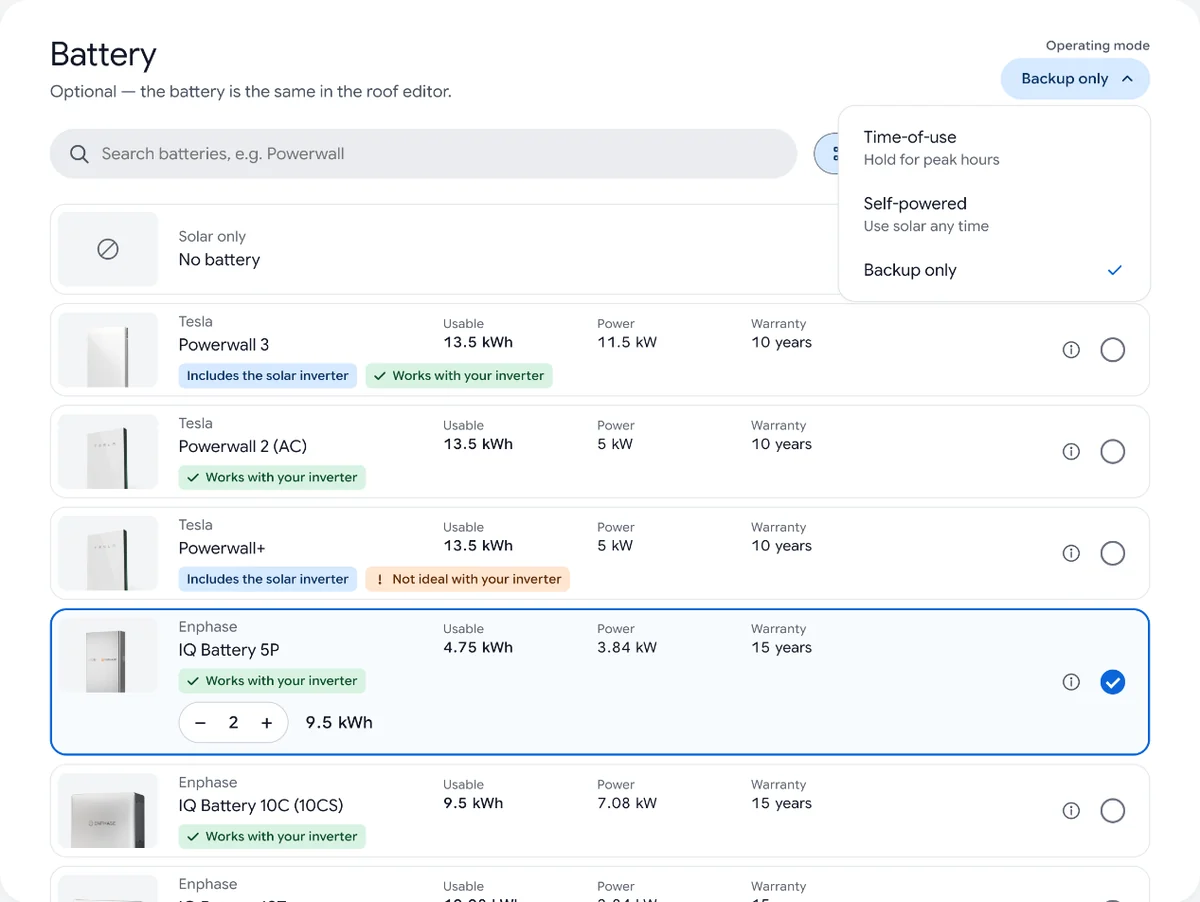
In every mode the battery keeps 20% of its energy for outages, and the energy lost going in and out is counted. Cali-Graf runs the battery through every hour of the year, the way the battery's own software runs it, and compares the bills with and without it.
What the customer sees
- The result: a third bill, With battery, next to today and with solar. When the battery changes the savings, the headline becomes Estimated savings with solar and battery; otherwise All numbers says Battery doesn't change the bill — backup value.
- For SCE: How solar is used shows how much more of the solar the home uses with the battery.
- The 25 years tab: a line With solar + battery.
- The proposal: a battery sheet that follows the mode — backup during outages, using more of your own solar, or saving on peak hours — and the battery's price as its own line on the price sheet, counted in the payback.
Estimating backup during an outage
The battery sheet estimates how long essentials keep running. The estimate assumes a steady essentials load of about 300 watts: on cloudy days, the hours are the battery's energy divided by that load; on sunny days, if solar on an average day of the darkest month can refill a day of essentials, the sheet says 7+ days. On Cali-Graf's sample proposal for a made-up LADWP home with 10 kWh of storage, that comes to 32 hours on cloudy days and 7+ days on sunny ones.
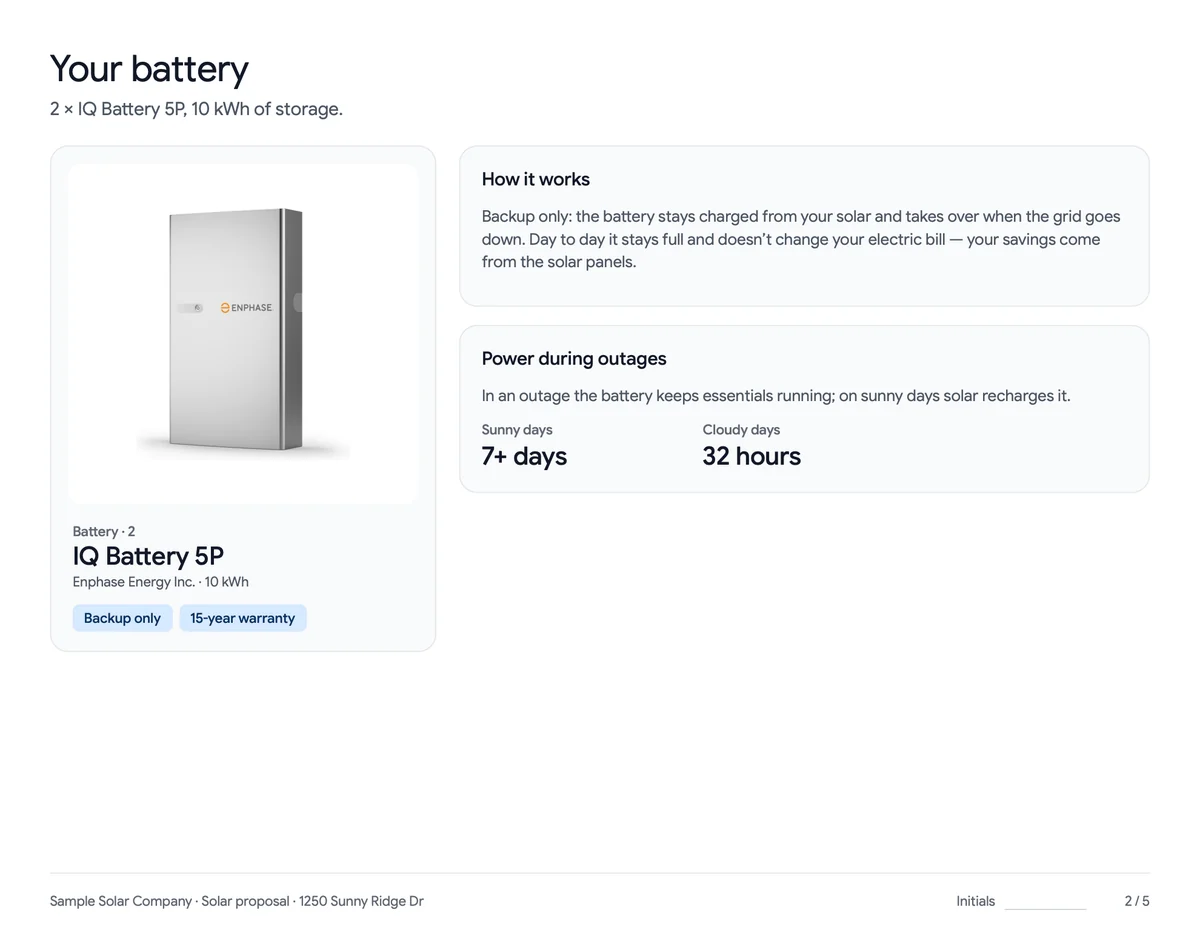
It's an estimate for essentials, not the whole house. Which circuits stay on depends on how the battery is wired — the choice is explained in whole-home vs critical-loads backup.
Selling it on an LADWP home
Say it straight: "Under LADWP's net metering, the battery won't lower your bill — your solar already gets full credit for what it sends to the grid. What the battery buys you is power when the grid is down." Then show it as an option: solar alone, and solar with a battery in Backup only — the same savings and a higher price, with the battery sheet describing the outage coverage. A customer who wants backup will choose it for the right reason; one who expected savings won't feel misled later.
Selling it on an SCE home
Here the battery has two jobs. In Time-of-use mode, it stores midday solar that would earn little as export and uses it in the 4–9 PM peak, and the result shows what that adds each year. Show solar alone and solar with the battery as two options with everything else the same, and point to the difference in the bill — and to the backup on top. Whether a battery pencils out for a particular household under NEM 3.0 is discussed in do I need a battery with NEM 3.0.
Run the same home with and without a battery and show the customer both — on SCE the bill moves, on LADWP the outage hours do.
What isn't in the numbers
- Rebates. Cali-Graf doesn't add SGIP or local battery rebates; if one applies, lower the price by it yourself and say so. See SGIP battery incentives.
- Compatibility. The battery is checked against the inverter from the manufacturers' datasheets; a mismatch stops the calculation until you pick matching equipment.
- The installation. Where the battery goes, the electrical work and permits are the installer's — and fire-safety placement rules apply; see home battery fire safety.
Frequently asked
Does a home battery lower an LADWP bill?
Does a home battery save money with SCE?
Which battery mode should I choose?
How long will a battery last in a power outage?
Does Cali-Graf include SGIP battery rebates?
Related reading
Sources & methodology
Product facts on this page come from Cali-Graf's own help center and the pages linked below; figures in examples come from the stated inputs. Features, limits and supported utilities change; each was verified October 16, 2026.
- Cali-Graf Help — Battery operating modes
- Cali-Graf Help — The battery in the results
- Cali-Graf Help — Add a battery
- Cali-Graf Help — Equipment compatibility check
- Cali-Graf Help — How the bill after solar is calculated: SCE NEM 3.0
- Cali-Graf Help — How the bill after solar is calculated: LADWP
- Cali-Graf — Sample proposal (made-up demo home)
- CPUC — Net Billing Tariff
- SCE — Time-of-use rate plans (4–9 PM peak)
- LADWP — Net energy metering rates
- Self-Generation Incentive Program — 2026 Handbook
Quote the battery the way the utility bills it
Add a battery, pick the mode and Cali-Graf simulates it hour by hour — savings on SCE, backup hours on LADWP — with a battery sheet the customer can follow. Free, with daily fair-use limits. Rebates such as SGIP aren't included; check eligibility separately.
Prepared by Cali Energy, October 16, 2026. This article is for general educational purposes only and is not legal, tax, financial, engineering, or utility advice. Rates, incentives, codes, permit requirements, equipment specifications, prices, and program terms may change; figures and timelines are estimates, not guarantees. Confirm current requirements with the applicable utility, AHJ, program administrator, manufacturer, or a licensed professional. See our Content Disclaimer. Cali Energy · 19201 Parthenia St, Unit E, Northridge, CA 91324 · CSLB #1032379 (B, C-10, C-39)