

Can Solar Recharge a Home Battery in Winter? December vs. June in Southern California
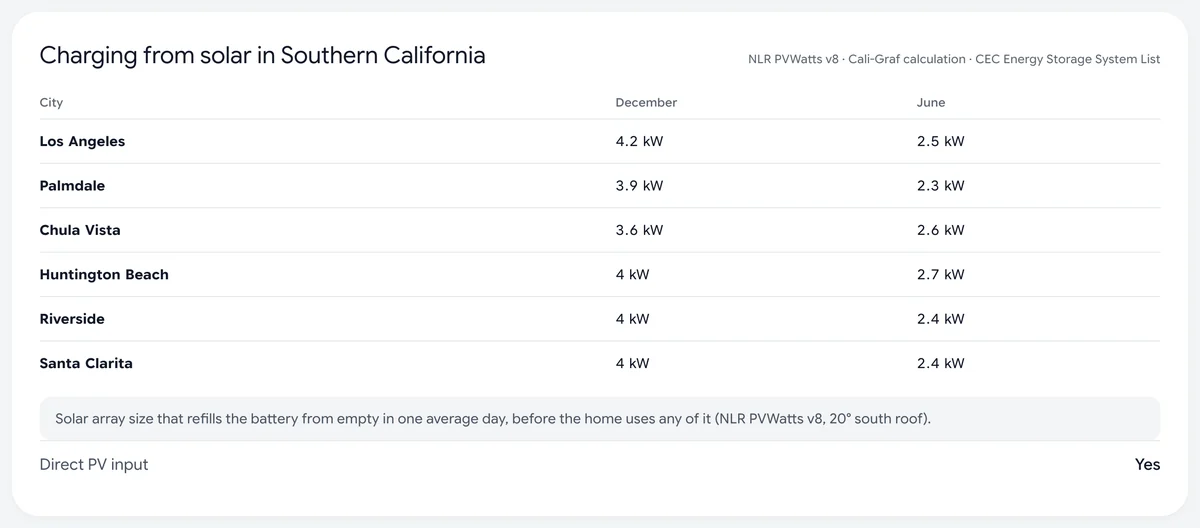
In a long outage, a home battery is only as useful as the solar that refills it. In Southern California's sunny climate, the panels needed to refill a battery from empty in one average day are modest — but they roughly double from June to December, when days are short and the sun is low. For a 13.5 kWh battery in Los Angeles, that's about 4.2 kW of south-facing panels in December against 2.5 kW in June; for a 5 kWh battery, about 1.6 kW against 0.9 kW. A typical home system is larger than that, so on an average winter day it can refill one battery — before the home uses any of the power. Real outages are harder: the house keeps running, winter storms bring cloudy days, and the panels must be set up to keep working when the grid is down. The numbers here come from the battery pages and backup calculator of Cali-Graf, the free directory built by Cali Energy, a Los Angeles solar and roofing contractor.
December vs. June, by city
Solar array (south-facing, 20° tilt) that refills the battery from empty in one average day:
| City | 13.5 kWh battery — December | June | 5 kWh battery — December | June |
|---|---|---|---|---|
| Los Angeles | 4.2 kW | 2.5 kW | 1.6 kW | 0.9 kW |
| Palmdale | 3.9 kW | 2.3 kW | 1.4 kW | 0.8 kW |
| Santa Clarita | 4.0 kW | 2.4 kW | 1.5 kW | 0.9 kW |
| Riverside | 4.0 kW | 2.4 kW | 1.5 kW | 0.9 kW |
| Huntington Beach | 4.0 kW | 2.7 kW | 1.5 kW | 1.0 kW |
| Chula Vista | 3.6 kW | 2.6 kW | 1.3 kW | 1.0 kW |
The 13.5 kWh figures are for Tesla's Powerwall 3 and the 5 kWh figures for Enphase's IQ Battery 5P, as shown on their pages in Cali-Graf's equipment directory; they're examples of size, not a recommendation. Coastal cities need a bit more in June — the marine layer cuts midday sun — while inland and high-desert cities need the least.
What "refills in a day" leaves out
- The home is still using power. The table assumes all the day's solar goes into the battery. During an outage the fridge, lights and anything else running draw on the same solar first.
- Cloudy and stormy days. A typical-year average smooths out the bad days. A winter storm can cut a day's solar to a fraction of the average, several days in a row.
- Shade and direction. The figures are for an unshaded south-facing roof. East- or west-facing faces and winter shade from trees or neighbors — longer shadows when the sun is low — need more panels.
- The battery's reserve and losses. Batteries keep some energy in reserve and lose a little on each charge and discharge.
The outage setup matters as much as the size
A grid-tied solar system without a battery shuts down when the grid goes down, for the safety of line workers. To recharge a battery during an outage, the panels have to keep working with the battery while the home is disconnected from the grid — something to confirm with the installer for your specific system. Which circuits stay on is a separate choice; see whole-home vs critical-loads backup.
Putting it together
| Question | How to think about it |
|---|---|
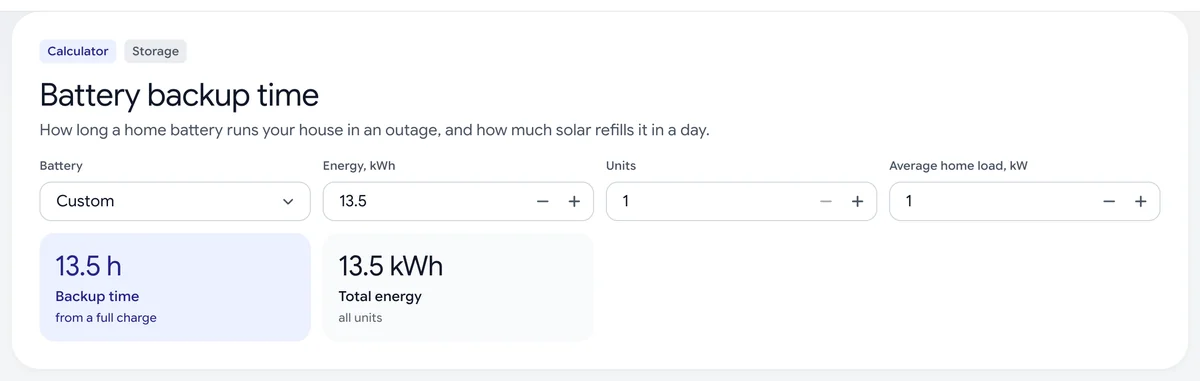
| How long does a full battery last? | Energy ÷ average load: a 13.5 kWh battery runs about 13.5 hours at 1 kW, longer with only essentials on |
| Will solar refill it in winter? | On an average sunny December day, a typical home system can refill one battery if the home uses little during the day |
| What about several cloudy days? | Plan for less: cut loads to essentials and expect the battery to drain over a stormy stretch |
| Do I need more batteries or more panels? | More panels help the refill; more battery helps get through nights and cloudy days |
Cali-Graf's free battery backup calculator runs these numbers for common batteries and the six cities. What the other battery specs mean is in how to read home battery specs.
Want panels and a battery sized for your winter? Ask Cali Energy for a free estimate.
Frequently asked
Can solar panels charge a battery in winter?
How many solar panels do I need to recharge a Powerwall in one day?
Why does winter need more solar?
Will my solar work during a power outage?
How long will a home battery last in an outage?
Related reading
Sources & methodology
Product facts on this page come from Cali-Graf's own help center and the pages linked below; figures in examples come from the stated inputs. Features, limits and supported utilities change; each was verified October 16, 2026.
Size the battery for your home and your winter
Try the free backup calculator for your city, then ask Cali Energy (CSLB #1032379), which develops Cali-Graf, for a design that sizes panels and battery on your roof. Figures here use NLR PVWatts typical-year weather, a south-facing roof at 20°, 14% losses and no shade; real days vary, so they aren't a guarantee of backup time.
Prepared by Cali Energy, October 16, 2026. This article is for general educational purposes only and is not legal, tax, financial, engineering, or utility advice. Rates, incentives, codes, permit requirements, equipment specifications, prices, and program terms may change; figures and timelines are estimates, not guarantees. Confirm current requirements with the applicable utility, AHJ, program administrator, manufacturer, or a licensed professional. See our Content Disclaimer. Cali Energy · 19201 Parthenia St, Unit E, Northridge, CA 91324 · CSLB #1032379 (B, C-10, C-39)