

Why Your Online Solar Estimate Differs From a Roof-Specific Design
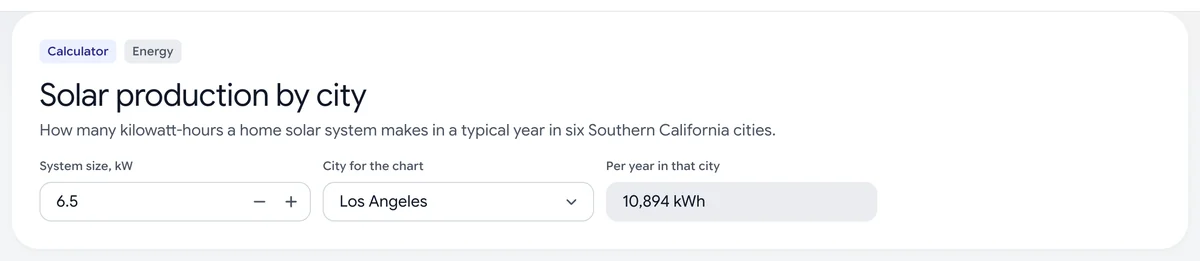
A quick online solar calculator answers "how much would a system make in my city?" — and to do that it assumes a textbook roof: panels tilted 20°, facing due south, with no shade and a standard allowance for losses. A design for your roof answers a different question: how much will these panels make on these faces, under these trees? It measures each roof face's real tilt and direction, works out the shade on every panel spot, and models the exact panel and inverter. On the made-up Los Angeles demo home in Cali-Graf, the free solar design app built by Cali Energy, a Los Angeles solar and roofing contractor, a city calculator would put a 9.46 kW system at about 15,850 kWh a year; the roof-specific design says 13,478 kWh — about 15% less, mostly because more than half the panels face west. Neither number is wrong. The first is a ballpark; the second is what a proposal should rest on.
What each approach assumes
| Input | City calculator | Roof-specific design |
|---|---|---|
| Weather | A typical year for the city (NSRDB) | A typical year for the home's location (NSRDB) |
| Tilt | 20° | Each roof face's measured pitch |
| Direction | Due south | Each face's measured direction |
| Shade | None modeled | Trees, chimneys and neighbors at each panel's spot, hour by hour |
| Losses | 14% standard system losses | 7.77% for real-world losses, plus the measured shade |
| Equipment | A standard module | The exact panel and inverter, including panel heating and the inverter's limit |
| Result | kWh per kW × system size | Hour-by-hour production for each roof face |
Cali-Graf's public solar production calculator works the first way, for six Southern California cities; Cali-Graf's design tool for installers works the second way.
A worked example
Cali-Graf's sample proposal is for a made-up Los Angeles home with 22 panels (9.46 kW) on two roof faces, both pitched about 23°: 13 panels facing west (269°) and 9 facing south (179°).
| Calculation | Yearly production | |
|---|---|---|
| City calculator, Los Angeles | 1,676 kWh per kW × 9.46 kW | ≈ 15,850 kWh |
| Roof-specific design | Each face modeled hour by hour with its shade | 13,478 kWh |
| Difference | about 15% lower |
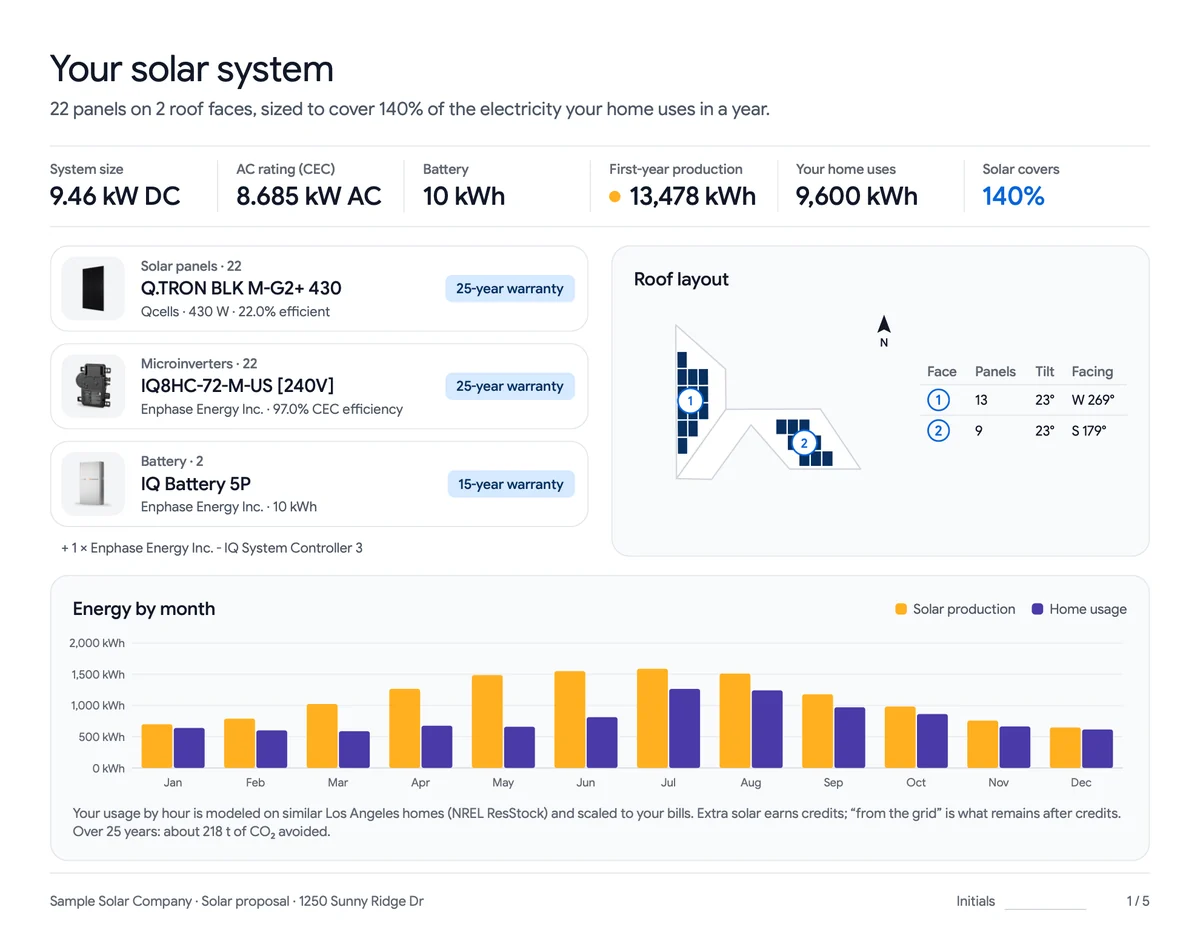
Much of the gap comes from direction: in Los Angeles a south-facing face makes the most power, and west-facing faces less over a year — though they help most in the evening. Tilt, the measured shade and the exact equipment account for the rest.
When the city number is close — and when it isn't
- Close: a clean, south-facing roof near 20° with no trees or tall neighbors.
- Too high: east- or west-facing faces, a roof split across several directions, trees to the south or west, a chimney shading part of the array, very low or steep pitches.
- Too low, occasionally: a clean, south-facing roof with little shade — the roof-specific model's standard losses (7.77%) are smaller than the calculator's 14%.
Most Los Angeles roofs fall in the middle group, which is why a design for the actual roof usually comes in below a city-level estimate.
Production is only half of the savings
Even an exact production number doesn't give the bill. On SCE, savings depend on when the home uses power and when the panels make it; on LADWP, on two-month billing periods and a credit that's never paid out. A west-facing array that makes less in total can still be worth more under SCE's time-of-day prices. See how Cali-Graf models an LADWP bill and SCE Net Billing, hour by hour.
Want the roof-specific number for your home? Ask Cali Energy for a free estimate.
How far to trust either number
Both rest on a typical weather year, so a real year can come in higher or lower. What separates them is the roof: a design measures your faces, shade and equipment, and Cali-Graf's bill calculations match real LADWP and SCE bills — within ±3 cents on LADWP, most SCE bills to the cent. More in how accurate Cali-Graf is and hour-by-hour production per roof face.
Frequently asked
Why is my solar quote's production lower than an online calculator?
Which number should I trust?
How much does a west-facing roof lose compared with south?
Do online solar calculators include shade?
Is production the same as savings?
Related reading
Sources & methodology
Product facts on this page come from Cali-Graf's own help center and the pages linked below; figures in examples come from the stated inputs. Features, limits and supported utilities change; each was verified October 16, 2026.
Get a number for your own roof
A city estimate is a start. Cali Energy (CSLB #1032379), which develops Cali-Graf, designs on your actual roof faces and shade and models your LADWP or SCE bill. The calculator figures come from Cali-Graf's public solar production calculator (NLR PVWatts); the design figures from its sample proposal for a made-up demo home.
Prepared by Cali Energy, October 16, 2026. This article is for general educational purposes only and is not legal, tax, financial, engineering, or utility advice. Rates, incentives, codes, permit requirements, equipment specifications, prices, and program terms may change; figures and timelines are estimates, not guarantees. Confirm current requirements with the applicable utility, AHJ, program administrator, manufacturer, or a licensed professional. See our Content Disclaimer. Cali Energy · 19201 Parthenia St, Unit E, Northridge, CA 91324 · CSLB #1032379 (B, C-10, C-39)