

Solar Payback Period in California (2026): LADWP vs SCE
Straight answer: in 2026, in illustrative cash-purchase scenarios, most California solar systems pay for themselves in about 6–13 years, and the biggest swing factor is your utility. On LADWP’s near–retail net metering a solar–only system pays back faster (~6–8 years); on SCE under NEM 3.0, exported power earns little, so payback (~9–13 years) leans on self–consumption. Use the calculator below to estimate yours.
Get a free estimate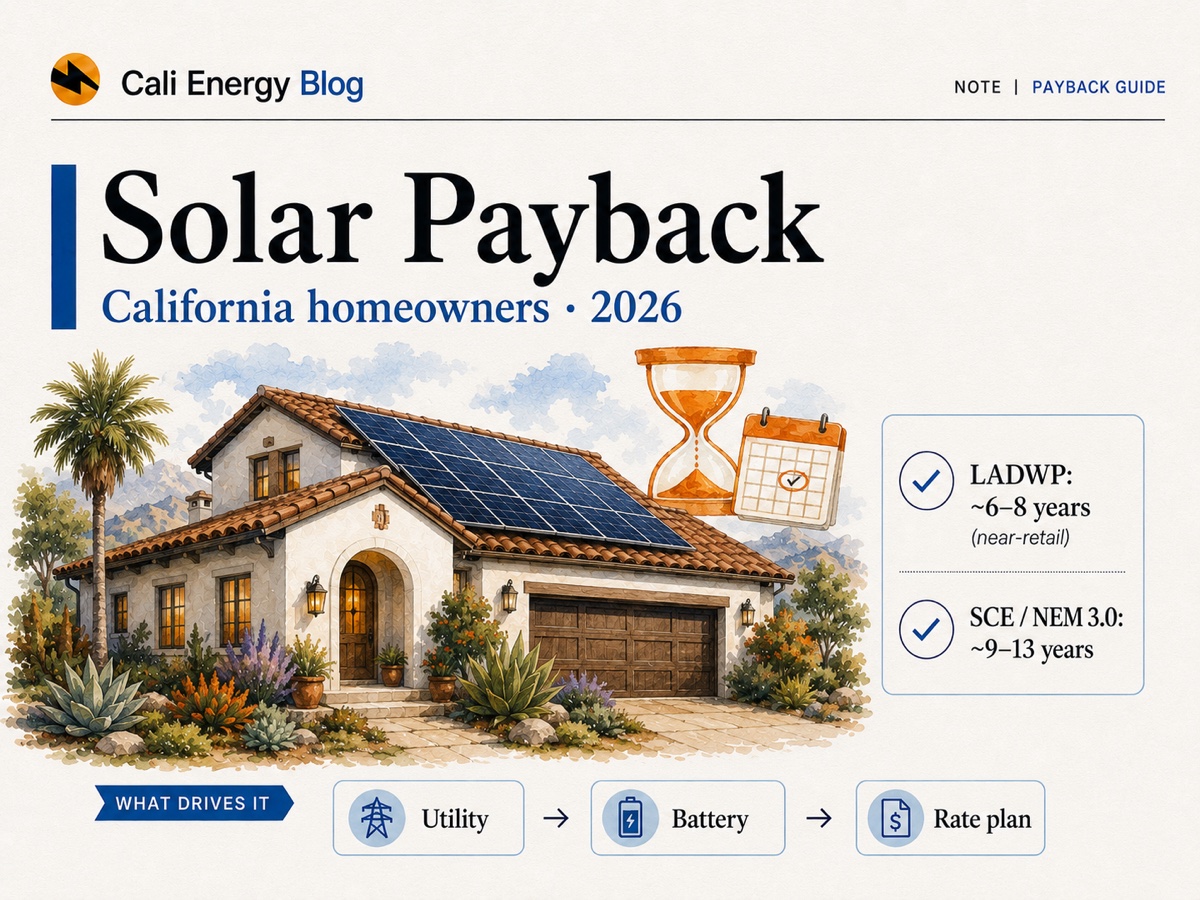
- Payback is how long your energy savings take to pay back what the system cost — after that, the power is essentially free.
- The single biggest factor in Los Angeles is which utility you have. LADWP still credits solar at near–retail rates, so a solar–only system pays back faster. SCE is on NEM 3.0, where exported power earns little, so savings lean on self–consumption.
- There is no 30% federal tax credit for owner–bought systems in 2026, so the full price now counts toward payback.
Estimate your solar payback in about 20 seconds
Enter your average monthly bill, pick your utility, and adjust the system cost if you have a quote. The tool sizes a system for your usage, then estimates annual savings, simple payback, and a rough 25–year net. It’s a ballpark — a site visit and your actual rate plan give the real number.
Assumptions: monthly bill converted to usage at about 26¢/kWh (LADWP) or 34.5¢/kWh (SCE); system sized for a full offset at 1,600 kWh per kW–year and 400 W panels; solar–only, no battery. Bill–value offset assumed at about 88% on LADWP (near–retail credit) and 62% on SCE (low NEM 3.0 export credit — savings come mainly from self–consumption). Owner–bought, no federal tax credit. The 25–year net is nominal: it doesn’t model rate escalation, panel degradation, fixed charges or an inverter replacement — factors that can move the result either way. A ballpark, not a quote.
Get a real payback estimate for your roofWhat “payback period” actually means
Your payback period is the number of years it takes for the money solar saves on your electric bills to add up to what you paid for the system. Spend $18,000 and save about $2,600 a year, and you break even in roughly seven years — after that, the electricity the panels make is essentially free for the rest of their 25–plus–year life.
Payback is the cleanest way to compare going solar against doing nothing, because it turns one big up–front number and a stream of monthly savings into a single figure. It is not the same as a quote, and it is not a guarantee: your real payback depends on your exact rate plan, how much power you use during daylight hours, future rate increases, and whether you add a battery. Use the estimate above as a starting point, then check it against a real proposal. For the broader “is it worth it” question, see is solar still worth it in California?
Why LADWP and SCE payback are so different
This is the part most homeowners miss. In Los Angeles you may be served by LADWP or by SCE, and they treat solar very differently — which changes your payback more than almost anything else.
| LADWP | SCE | |
|---|---|---|
| Regulated by CPUC? | No — municipal utility | Yes — investor–owned |
| Solar billing rule | Near–retail net metering | NEM 3.0 (Net Billing Tariff) |
| Credit for exported power | Roughly full retail rate | Low, time-varying — ~5–8¢/kWh typical |
| How you get value | Export freely, credit rolls over | Use it as you make it (or store it) |
| Battery needed to pay off? | No — solar–only works well | Helps a lot — often key to strong returns |
| Typical solar–only payback | ~6–8 years | ~9–13 years |
Sources: DSIRE — LADWP Net Metering · EnergySage — LADWP net metering · EnergySage — SCE net metering
On SCE, when you use the power matters as much as how much you make
Under LADWP’s near–retail net metering, a kilowatt–hour you export at noon is worth roughly the same as one you pull from the grid at night — so a solar–only system can offset most of your bill. Under SCE’s NEM 3.0, that exported noon kilowatt–hour is worth only about 5–8¢, while the evening one you buy back can cost 40¢+. That gap is why SCE savings depend on self–consumption — running your AC, pool pump, or EV charger during the day — and why a battery, which stores cheap daytime solar for expensive evening use, does so much more for an SCE home than an LADWP one.
What shortens — or lengthens — your payback
Your utility (biggest factor)
LADWP’s near–retail net metering pays back faster than SCE’s NEM 3.0 for a solar–only system. Same panels, different math.
A battery
On SCE, a battery stores midday solar for pricey evening hours and can meaningfully shorten payback. On LADWP the case is more about backup than payback. Check SGIP before you count on a rebate.
Self–consumption
The more of your solar you use as you make it — daytime AC, EV charging, pool pump — the more you save, especially on NEM 3.0.
Your rate plan
Time–of–use plans reward daytime solar and battery use. The wrong plan can quietly stretch payback. See SCE TOU plans compared.
System price
Payback is cost divided by savings, so overpaying — often via financing or rate-buydown fees rolled into the price — directly lengthens it. Compare quotes on price per watt.
Future rate increases
California electricity rates have climbed for years. Every increase raises the value of the power you make — shortening real–world payback versus a flat–rate estimate.
What payback looks like on an LADWP roof in Northridge
One of our LADWP–area jobs was a 7.4 kW system on a composition–shingle roof in Northridge, sized for daily bill offset. We don’t publish contract prices, but on LADWP’s near–retail net metering a solar–only system like this typically lands in the ~6–8–year payback range at 2026 rates. On the same bill under SCE’s NEM 3.0, you’d usually add a battery or lean harder on daytime use to reach comparable returns. See it next to our other Northridge installs.
Honest caveats about any payback number
Any payback figure — ours included — rests on assumptions, so treat it as a range, not a promise. A few things that move it:
Fixed charges don’t disappear. Both utilities keep a minimum monthly connection charge that solar can’t erase, so no solar–only system takes your bill to exactly zero. Panels degrade slowly — roughly half a percent a year — so year–25 output is a bit lower than year one. Rates change. Our 25–year net leaves out both future rate increases (which shorten payback) and degradation and fixed charges (which lengthen it); we don’t assume they cancel out — a conservative view uses 0% rate escalation, while 3–4% annual increases (closer to California’s recent history) would shorten payback and lift the 25-year net. Your mileage will vary. And financing changes everything: a cash purchase pays back fastest, while a loan or lease adds interest or escalating payments that push the break–even out. This is general information, not tax or financial advice — for the full cost picture, see what solar panels cost in Los Angeles.
The bottom line
For most Los Angeles homeowners in 2026, solar still pays for itself — the question is how fast, and that hinges on your utility. On LADWP, a straightforward solar–only system tends to break even in the high single digits of years. On SCE under NEM 3.0, plan around self–consumption and possibly a battery to get there. Run your own numbers in the tool above, then get a real proposal so you can compare a ballpark against an actual quote.
Frequently asked
How long does solar take to pay for itself in California in 2026?
In illustrative cash-purchase scenarios, roughly 6–13 years for an owner–bought system — the range is wide mainly because of your utility. On LADWP’s near–retail net metering a solar–only system often pays back in about 6–8 years; on SCE under NEM 3.0 it’s more like 9–13 years without a battery. A loan or lease lengthens it because of interest or escalating payments.
Why is solar payback faster on LADWP than on SCE?
LADWP is a municipal utility not regulated by the CPUC, so it still credits exported solar at roughly full retail rates — a kilowatt–hour you send to the grid is worth about what you’d pay for one. SCE is on NEM 3.0, where exports earn a time-varying credit — an illustrative 5–8¢/kWh at midday, well below the evening retail price you pay to buy power back. That gap means SCE savings depend on using your solar as you make it, which slows payback for a solar–only system.
Does a battery shorten my solar payback?
On SCE (NEM 3.0) it can — a battery stores cheap midday solar for expensive evening hours, capturing value you’d otherwise export for little — though the battery’s own cost has to earn its keep. On LADWP, a battery is usually more about backup during outages than about payback, since near–retail credit already values your exports well. Batteries add cost, so weigh the SGIP rebate status before counting on it.
Is there still a tax credit to help solar pay off faster in 2026?
Not for owner–bought systems. The 30% federal Residential Clean Energy Credit ended December 31, 2025, so cash and loan buyers in 2026 get no federal credit and the full price counts toward payback. With a lease or PPA a third party owns the system and may claim a separate business credit, but you don’t claim it directly. This is general information, not tax advice.
Is the payback calculator a quote?
No. It’s a ballpark estimate built from public 2026 rate and production data, and it assumes a cash, owner–bought, solar–only system. Your real payback depends on your exact rate plan, daytime usage, roof orientation, future rate changes, and financing. Use it to get oriented, then compare it against a real proposal — we’ll give you an itemized one.
What lengthens a solar payback the most?
Overpaying for the system (often financing or rate-buydown fees in financed deals), being on SCE without a battery or much daytime usage, a poor rate plan, and heavy financing costs. Because payback is simply cost divided by annual savings, a padded price directly stretches it — always compare quotes on price per watt.
Related reading
Sources & methodology
Figures on this page come from the primary sources below and, where noted, from Cali Energy calculations using the stated assumptions. Rates, incentives, and program terms change; each was verified July 13, 2026.
Find out how fast solar pays off on your roof
Tell us your utility and a recent bill and we’ll give you a real, itemized payback estimate — no dealer fees, no door-to-door pressure.
Get a free estimatePrepared by Cali Energy, July 13, 2026. This article is for general educational purposes only and is not legal, tax, financial, engineering, or utility advice. Rates, incentives, codes, permit requirements, equipment specifications, prices, and program terms may change; figures and timelines are estimates, not guarantees. Confirm current requirements with the applicable utility, AHJ, program administrator, manufacturer, or a licensed professional. See our Content Disclaimer. Cali Energy · 19201 Parthenia St, Unit E, Northridge, CA 91324 · CSLB #1032379 (B, C-10, C-39)