

Do Solar Panels Work in Winter?
Short answer: yes. Panels run on light, not heat, and cool weather slightly helps them. What drops in winter is sunlight: in NREL’s PVWatts model a south-facing roof in Northridge receives about half of August’s sunlight in December and produces about 57% as much electricity (60% in Santa Monica) — cooler cells win back a few points. How summer surplus covers the gap depends on your utility: LADWP carries it forward as a credit that never expires; SCE credits exports by the hour and settles once a year.
Get a free estimate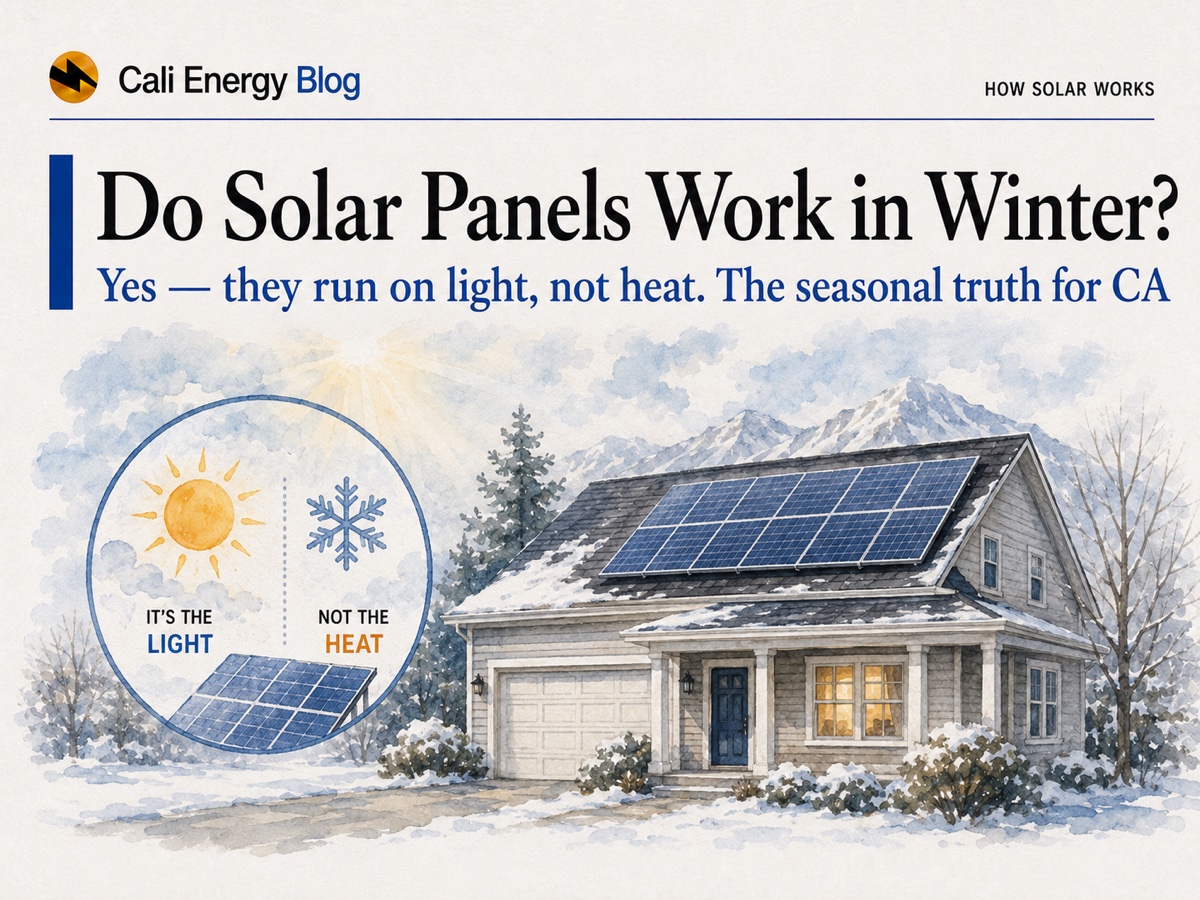
- Solar works every day of a California winter; the monthly total drops. December is the low month: about 100 kWh per installed kW in Northridge against 175 in August.
- The cause is light: shorter days, a noon sun at about 33° instead of 79°, and the rainy season. Cold itself helps — modern modules lose only about 0.3% per °C above 25°C, so cool winter cells recover some output.
- A steeper roof face catches more winter sun: at 34° instead of 20°, PVWatts gives Northridge 16% more in December but only 1.6% more over the year.
- On LADWP, summer surplus becomes a dollar credit that carries forward with no time limit; on SCE, credits roll month to month and are settled once a year.
Month by month: what a Los Angeles roof actually makes
| Month | Northridge, kWh per kW | % of best month | Santa Monica, kWh per kW | % of best month |
|---|---|---|---|---|
| Jan | 104 | 60% | 104 | 63% |
| Feb | 110 | 63% | 113 | 69% |
| Mar | 142 | 81% | 144 | 87% |
| Apr | 157 | 90% | 153 | 93% |
| May | 156 | 89% | 162 | 98% |
| Jun | 172 | 98% | 152 | 92% |
| Jul | 172 | 99% | 164 | 100% |
| Aug | 175 | 100% | 165 | 100% |
| Sep | 153 | 88% | 138 | 84% |
| Oct | 140 | 80% | 134 | 81% |
| Nov | 117 | 67% | 104 | 63% |
| Dec | 100 | 57% | 98 | 60% |
| Year | 1,700 | 1,630 |
Source: NREL PVWatts v8 runs for 4 kW systems (model defaults), divided by 4 — Cali Energy calculation. A typical-weather year, not a forecast; a stormy winter comes in lower, a dry one higher. December averages about 3.2 kWh per kW a day at both sites, against 5.6 (Northridge) and 5.3 (Santa Monica) in August.
Why winter output is lower — and why it is not the cold
Shorter days
Los Angeles gets 9 hours 53 minutes of daylight on December 21, 2026, against 14 hours 26 minutes on June 21 (US Naval Observatory).
A lower sun
At LA’s latitude, about 34°N, the noon sun stands about 33° above the horizon at the winter solstice and about 79° at the summer solstice, so winter light arrives at a shallow angle through more atmosphere.
Less light on the panel
Put together, PVWatts puts December’s sunlight on a 20° Northridge roof at 52% of August’s — yet output reaches 57%. Most of the difference is temperature.
Cold helps
In the same model, cells average about 30°C while producing in December and about 49°C in August. Modules lose power above 25°C: the median CEC-listed 350 W+ module from 2024–2026 loses 0.30% per °C (CEC), so winter’s cooler cells give back several points. More on the summer side in how heat affects solar output.
What changes winter output — and what doesn’t
Tilt. A steeper face catches more of the low winter sun. Running the same Northridge system at a 34° tilt instead of 20°, PVWatts gives 16% more in December but only 1.6% more across the year — so on a home the roof pitch usually decides, and seasonal re-tilting is rarely worth the hardware. Orientation and shade. Winter’s low sun lengthens shadows from trees, chimneys and neighboring buildings; a spot that is clear in June can be shaded in December — see solar and shade. Snow. In the Los Angeles basin and the San Fernando Valley winter weather means rain; snow on roofs matters only at mountain elevations. Size. Because the year is uneven, a system is sized on twelve months of use, not one — see how many panels you need.
How your bill carries summer into winter
LADWP
LADWP nets the kilowatt-hours you export against those you buy over each billing period. Excess becomes a dollar credit that carries forward with no time limit, so summer surplus pays down winter bills — but it is never paid out and cannot cover taxes or the R-1A minimum charge (LADWP; details in LADWP net metering).
SCE
On the Solar Billing Plan each export earns an hourly credit; unused credits roll to the next month and the account is settled once a year, when surplus earns about 2¢ per kWh (SCE; details in SCE solar billing). Because midday exports earn little, a battery that shifts solar into the evening matters more on SCE than on LADWP.
Frequently asked
Do solar panels work in winter in California?
Yes. They generate from light, so they produce every winter day. The monthly total falls: in NREL’s PVWatts model a south-facing 20° roof in Northridge makes about 100 kWh per installed kW in December against 175 in August — 57% as much (60% in Santa Monica).
Does cold weather reduce solar panel efficiency?
No — cold raises it. Modules lose power as the cells heat above 25°C; the median CEC-listed 350 W+ module listed in 2024–2026 loses 0.30% per °C. In PVWatts, Northridge cells average about 30°C while producing in December against 49°C in August, which is why December output (57% of August) runs ahead of December sunlight (52%).
How much less do solar panels produce in winter versus summer?
About 40% less in the lowest month. PVWatts puts December at 57% of August in Northridge and 60% in Santa Monica; December through February together come to about 61% (Northridge) and 66% (Santa Monica) of June through August. A stormy winter comes in lower.
Will I run out of electricity in the winter with solar?
No — a grid-tied home draws from the grid whenever the panels fall short. On the bill, LADWP carries summer surplus forward as a credit with no time limit; SCE rolls credits month to month and settles once a year. Neither pays you retail for surplus.
Should I tilt my panels steeper for winter?
Usually not. PVWatts gives a Northridge array at 34° instead of 20° about 16% more in December but only 1.6% more over the year, so the roof pitch you have normally decides. Shade from low winter sun matters more — check it in December, not June.
Do I need to worry about snow on solar panels in Los Angeles?
In the Los Angeles basin and San Fernando Valley, winter weather means rain rather than snow; snow load matters at mountain elevations, where tilted panels shed light snow once the sun reaches them.
Related reading
Sources & methodology
Figures on this page come from the primary sources below and, where noted, from Cali Energy calculations using the stated assumptions. Rates, incentives, and program terms change; each was verified September 29, 2026.
- NREL (NLR) — PVWatts Calculator, v8 runs for Northridge and Santa Monica (monthly AC output, plane-of-array irradiance, cell temperature)
- NREL (NLR) — PVWatts V8 API documentation (defaults and inputs)
- NREL (NLR) — SAM help: PVWatts module types and temperature coefficients
- US Naval Observatory — Sun and Moon data for one day (Los Angeles, December 21 and June 21, 2026)
- California Energy Commission — PV Module List (temperature coefficients)
- LADWP — Service Rider NEM
- SCE — Solar Billing Plan
Curious how your roof does year-round?
Send us your address and a recent bill and we'll model your production month by month — summer surplus, winter dip, and what a right-sized system covers across all twelve months.
Get a free estimatePrepared by Cali Energy, September 29, 2026. This article is for general educational purposes only and is not legal, tax, financial, engineering, or utility advice. Rates, incentives, codes, permit requirements, equipment specifications, prices, and program terms may change; figures and timelines are estimates, not guarantees. Confirm current requirements with the applicable utility, AHJ, program administrator, manufacturer, or a licensed professional. See our Content Disclaimer. Cali Energy · 19201 Parthenia St, Unit E, Northridge, CA 91324 · CSLB #1032379 (B, C-10, C-39)