

Solar Inverter Replacement: Cost & Warning Signs
Straight answer: if the inverter is under warranty, the part is free and you pay for the visit — SolarEdge covers its inverters for 12 years and Enphase its microinverters for 25, and both exclude the labor to swap them. Out of warranty, the part itself sold for $687–$813 for SolarEdge’s current Home Hub inverter and $165–$210 for an Enphase IQ8+ microinverter at online solar retailers on October 1, 2026, before installer labor and any permit. On SCE, a like-for-like swap keeps a NEM 1.0 or 2.0 system on its legacy tariff; growing it past the allowance can cost you that.
Get a free estimate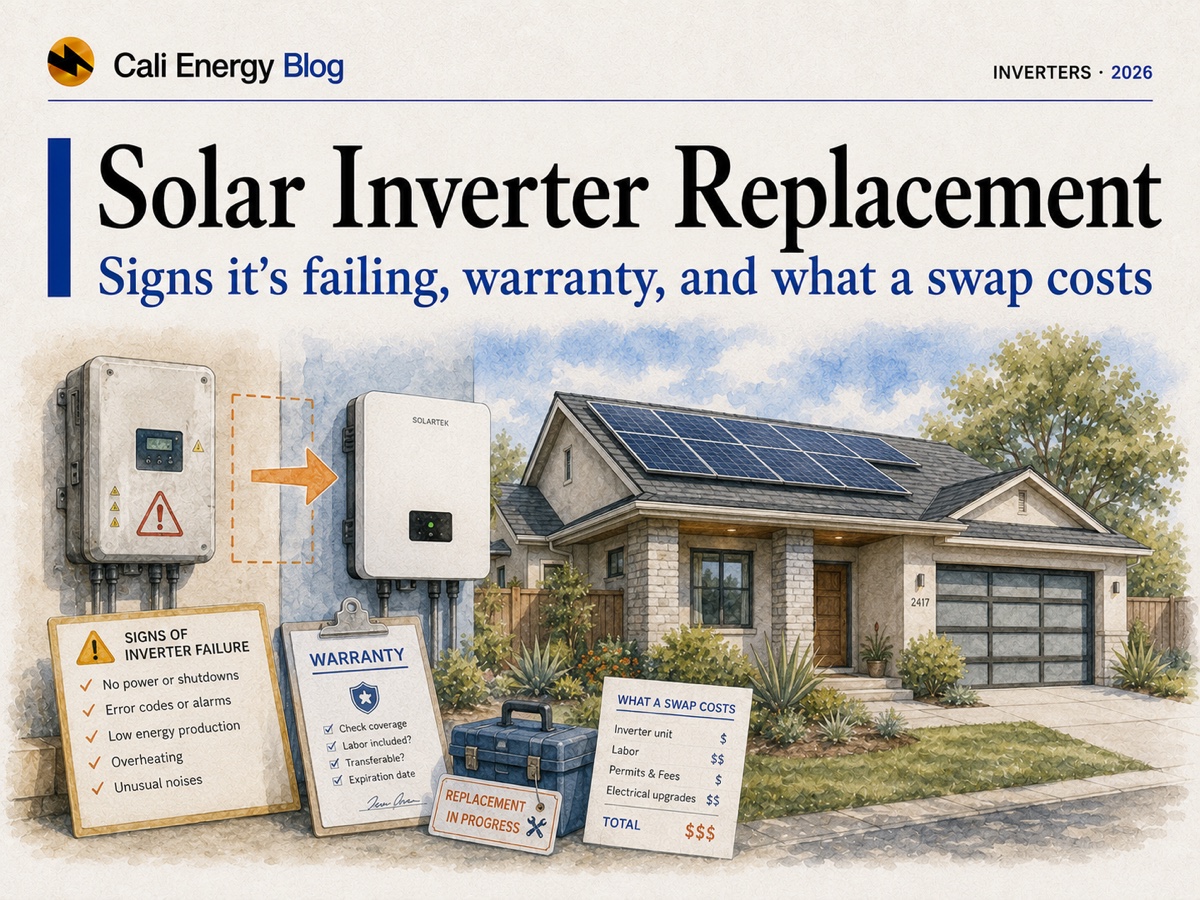
- The inverter may need replacing sooner than the rest of the system, the CPUC’s consumer guide warns, and NREL’s 2025 residential cost model budgets 1.6% of microinverter capacity a year for out-of-warranty repair or replacement, against 0.2% for panels.
- Check the warranty first. SolarEdge inverters: 12 years (Nexis: 10). Enphase microinverters: 25 years. Both makers send the part but exclude on-site labor; Enphase pays installers $200 a visit plus $25 a unit only in the first two years.
- Out of warranty, the part costs $687–$813 for a SolarEdge Home Hub at three online sellers (one lists $2,608) or $165–$210 for an Enphase IQ8+. The model in an older system is often discontinued, so you get its successor.
- On SCE NEM 1.0 or 2.0, keep the system’s growth within the greater of 10% or 1 kW of its original rating, or it can leave the legacy tariff.
- Rule out a tripped breaker, a Wi-Fi dropout and a grid outage before you buy anything.
Is it the inverter?
A failing inverter usually announces itself. Confirm it before you pay for one.
A fault light or error code
A red or blinking status light, or a code on the screen or in the app — isolation, ground fault, over-temperature, grid. Write it down; it’s what the manufacturer will ask for.
Zero on a sunny day
A whole string system reading zero at midday usually means the inverter faulted out. With microinverters, one or a few panels drop out while the rest keep producing.
Afternoon shutdowns
A unit that cuts out in the afternoon heat and recovers later, buzzes, or keeps restarting is worth a technician’s look, especially once it is out of warranty.
Gaps in monitoring
Blank stretches in the app can mean the inverter keeps dropping offline — or just a Wi-Fi problem, which is harmless but still matters for the warranty (below).
A tripped breaker, a Wi-Fi dropout, shade or a grid outage can all look like a dead inverter. Walk through why your solar isn’t producing first — it can save a service call.
Check the warranty before you pay
The CPUC tells solar owners to keep the inverter warranty where they can find it, because the inverter may need replacing sooner than other equipment (CPUC). The part is the manufacturer’s problem; the labor usually isn’t.
| Product | Warranty | Clock starts | Labor to swap it |
|---|---|---|---|
| SolarEdge inverter (Home Hub, Home Wave) | 12 years | Installation, or 4 months after shipment if earlier | Not covered |
| SolarEdge Nexis inverter | 10 years | Same | Not covered |
| SolarEdge power optimizers | 25 years | Same | Not covered |
| Enphase IQ7, IQ8 and IQ9 microinverters | 25 years | Activation (registration or installer activation) | Not covered; Enphase pays installers $200 a visit + $25 a unit in the first 2 years |
| Enphase IQ Gateway and IQ Combiner | 5 years | Activation | Not covered |
Sources: SolarEdge Limited Product Warranty (January 2026), Enphase US Limited Warranty, IQ Microinverters, Enphase labor reimbursement (February 2026). Older or other brands carry their own terms; check the document that came with your system.
Both makers ship the replacement part — SolarEdge at its own cost for shipping — and both exclude the labor to take the old unit down and put the new one up, so an in-warranty swap still means paying for the service call. Enphase’s reimbursement goes to the installer, requires an Enphase-diagnosed return, and applies only in the first two years after activation (Enphase).
Two conditions catch owners out. SolarEdge’s warranty applies only if the products stay connected to its monitoring platform, and Enphase asks for a continuous internet connection during the warranty period (SolarEdge, Enphase). SolarEdge’s warranty passes to a new owner for the time remaining; Enphase’s does if the new owner files its change-of-ownership form and pays the transfer fee within 30 days. More on all four solar warranties in solar warranties explained.
What a replacement costs in 2026
The part and the labor are separate lines. Under warranty you pay only the second.
| What fails | The part (online retail) | Also on the bill | Watch for |
|---|---|---|---|
| A SolarEdge string inverter | Home Hub inverter, set from 3.8 to 11.4 kW: $687, $800 and $813 at three sellers; $2,608 at a fourth | Service call, swap and commissioning; a permit where your city requires one | It needs SolarEdge optimizers on every panel; the Home Hub is battery-ready |
| One Enphase microinverter | IQ8+: $165–$210 | A roof visit, usually the bigger share | Compatibility with your gateway and microinverter generation |
| Switching a string system to microinverters | One per panel: about $3,300–$4,200 in IQ8+ parts for 20 panels | Every panel is touched; a new gateway | Usually worth it only alongside a re-roof or an upgrade |
Prices for SolarEdge USE11400H-USSKBEZ8 and Enphase IQ8PLUS-72-M-US at US Solar Supplier, NAZ Solar Electric, Platt Electric Supply and EcoDirect (Home Hub) and US Solar Supplier and NAZ Solar Electric (IQ8+; $210 is the regular price, $165 a sale). Parts only, before tax, shipping and installer markup; prices change often.
We don’t put one all-in number on it: the part alone varied almost fourfold between sellers on the same day, and labor depends on roof access, whether the system needs new optimizers or a gateway, and your city’s permit rules. Ask for a quote that lists the part and the labor separately.
The exact model in a ten-year-old system is often gone. One retailer lists SolarEdge’s SE7600H HD-Wave and Enphase’s IQ8PLUS-72-2-US as discontinued and points to the Home Hub and the IQ8PLUS-72-M-US instead (NAZ Solar Electric). If you buy a new SolarEdge inverter, SolarEdge sells warranty extensions to 20 or 25 years within a set window after shipment; to 25 years cost $170 for units up to 6 kW and $225 for 7.6–11.4 kW on its early-2026 price list (SolarEdge). Whatever you buy should be on the California Energy Commission’s Grid Support Inverter List.
Don’t upsize by accident
SCE’s tariff lets a legacy system be repaired or modified and keep the rest of its 20-year period as long as the work doesn’t increase it by more than the greater of 10% of its original nameplate rating or 1 kW, and doesn’t push it past your annual use. Go further and the additions must be connected separately as non-export, or the whole system moves to another tariff (SCE Schedule NEM-ST). A like-for-like swap is fine. If the new inverter’s output rating is larger than the old one’s, have the installer confirm in writing that the system stays inside the allowance. More in NEM 2.0 grandfathering.
Replace like-for-like, or upgrade?
When a string inverter dies out of warranty, you can keep the architecture or change it.
The successor model
The fastest, usually cheapest fix: the current model in the same family, sized to your array, on the same optimizers or wiring.
Battery-ready
If a battery is realistically coming, a battery-ready inverter now saves a second change later. SolarEdge’s Home Hub is one.
Microinverters
Panel-level monitoring, and one failure takes out one panel rather than the whole system, but every panel is touched. Compare the two systems in Enphase vs SolarEdge.
Repair the old unit
Rarely worth it on an aging string inverter; electronics that failed once tend to fail again. A single failed microinverter or optimizer is the exception — a small, targeted swap.
Any replacement has to match your array’s voltage and string sizing and the rapid-shutdown rules your building department applies, and some cities require a permit and inspection for the swap. A licensed contractor should confirm compatibility before ordering the part. Panels usually outlast the inverter by years; see how solar panels degrade.
Getting it done in Los Angeles
Cali Energy is a licensed California solar and electrical contractor (CSLB #1032379), and we replace and upgrade inverters across Los Angeles and the San Fernando Valley, including on systems we didn’t install. Send us the fault code or a photo of the light: we’ll read it, check the warranty dates and the monitoring connection, and quote the part and the labor separately. See our Los Angeles installs, call +1-323-844-7777 or get an inverter replacement estimate.
Frequently asked
How long does a solar inverter last?
Manufacturers’ warranties are the clearest guide: 12 years on SolarEdge’s Home Hub and Home Wave inverters, 10 on its Nexis, and 25 on Enphase’s IQ microinverters. The CPUC warns the inverter may need replacing sooner than other equipment, and NREL’s 2025 residential cost model budgets 1.6% of microinverter capacity a year for out-of-warranty repair or replacement, against 0.2% for panels.
How much does it cost to replace a solar inverter in 2026?
Under warranty, the part is free and you pay the service call. Out of warranty, the part sold for $687–$813 for SolarEdge’s Home Hub inverter at three online solar retailers on October 1, 2026 (one listed $2,608), and $165–$210 for an Enphase IQ8+ microinverter. Installer labor, commissioning and any permit come on top; ask for a quote that lists them separately.
What are the signs my solar inverter is failing?
A red or blinking fault light, an error code, a system reading zero on a sunny day, afternoon shutdowns in the heat, buzzing, frequent restarts, or long gaps in monitoring. Rule out a tripped breaker, a Wi-Fi dropout and a grid outage first — see why your solar isn’t producing.
Does the warranty cover inverter replacement?
The part, yes, within the term: SolarEdge sends a replacement inverter for 12 years, Enphase a microinverter for 25. Neither warranty covers the labor to remove and reinstall it; Enphase reimburses installers $200 a visit plus $25 a unit only in the first two years. SolarEdge also requires the system to stay connected to its monitoring.
Will replacing my inverter affect my NEM 2.0 status?
Not if it’s like-for-like. On SCE, a NEM 1.0 or 2.0 system keeps its 20-year legacy period after repairs or modifications as long as it grows by no more than the greater of 10% of its original nameplate rating or 1 kW and stays within your annual use. If the new inverter is larger, get written confirmation first.
Should I replace like-for-like or upgrade to microinverters?
The successor model in the same family is usually the fastest and cheapest fix. Switching a string system to microinverters means a unit on every panel — about $3,300–$4,200 in IQ8+ parts for 20 panels before labor — so it usually makes sense only with a re-roof or another upgrade. A battery-ready inverter is worth it if a battery is coming. Compare in Enphase vs SolarEdge.
Related reading
Sources & methodology
Figures on this page come from the primary sources below and, where noted, from Cali Energy calculations using the stated assumptions. Rates, incentives, and program terms change; each was verified October 1, 2026.
- SolarEdge — Limited Product Warranty (effective January 1, 2026)
- SolarEdge — North America warranty extension price list
- Enphase — US Limited Warranty, IQ Microinverters and balance of system (effective May 2, 2026)
- Enphase — Labor reimbursement for warranty service, North America (effective February 1, 2026)
- NREL — Q1-2025 Solar Photovoltaic System Cost Benchmarks, residential PV model (inverter and module loss rates)
- SCE — Schedule NEM-ST, Special Condition: modifications to legacy systems
- California Energy Commission — Grid Support Inverter List
- CPUC — California Solar Consumer Protection Guide (keep the inverter warranty; it may need replacing sooner)
- US Solar Supplier — SolarEdge Home Hub USE11400H-USSKBEZ8 (price observed October 1, 2026)
- NAZ Solar Electric — SolarEdge Home Hub USE11400H-USSKBEZ8 (price observed October 1, 2026)
- Platt Electric Supply — SolarEdge Home Hub USE11400H-USSKBEZ8 (price observed October 1, 2026)
- EcoDirect — SolarEdge Home Hub USE11400H-USSKBEZ8 (price observed October 1, 2026)
- US Solar Supplier — Enphase IQ8PLUS-72-M-US (price observed October 1, 2026)
- NAZ Solar Electric — Enphase IQ8PLUS-72-M-US (price observed October 1, 2026)
- NAZ Solar Electric — SolarEdge SE7600H HD-Wave (listed as discontinued, successor named)
Inverter acting up? Get a straight answer
Send us the fault code or a photo of the light plus your recent production, and the Cali Energy team will read it, check your warranty dates, and quote the part and the labor separately — estimates, not guarantees.
Get a free estimatePrepared by Cali Energy, October 1, 2026. This article is for general educational purposes only and is not legal, tax, financial, engineering, or utility advice. Rates, incentives, codes, permit requirements, equipment specifications, prices, and program terms may change; figures and timelines are estimates, not guarantees. Confirm current requirements with the applicable utility, AHJ, program administrator, manufacturer, or a licensed professional. See our Content Disclaimer. Cali Energy · 19201 Parthenia St, Unit E, Northridge, CA 91324 · CSLB #1032379 (B, C-10, C-39)