

Can You Add Solar Panels to Existing Solar in California?
Yes — but on NEM 1.0 or 2.0 the limit is small. SCE lets a legacy system grow by the greater of 1 kW or 10% of its original size and keep its tariff. With today’s typical 405 W panels, 1 kW is two panels, not three. Go past it and the extra panels must be connected as non-export, or the whole system moves to the Solar Billing Plan. On that plan, the size cap is your yearly use plus up to 50%.
Get a free estimate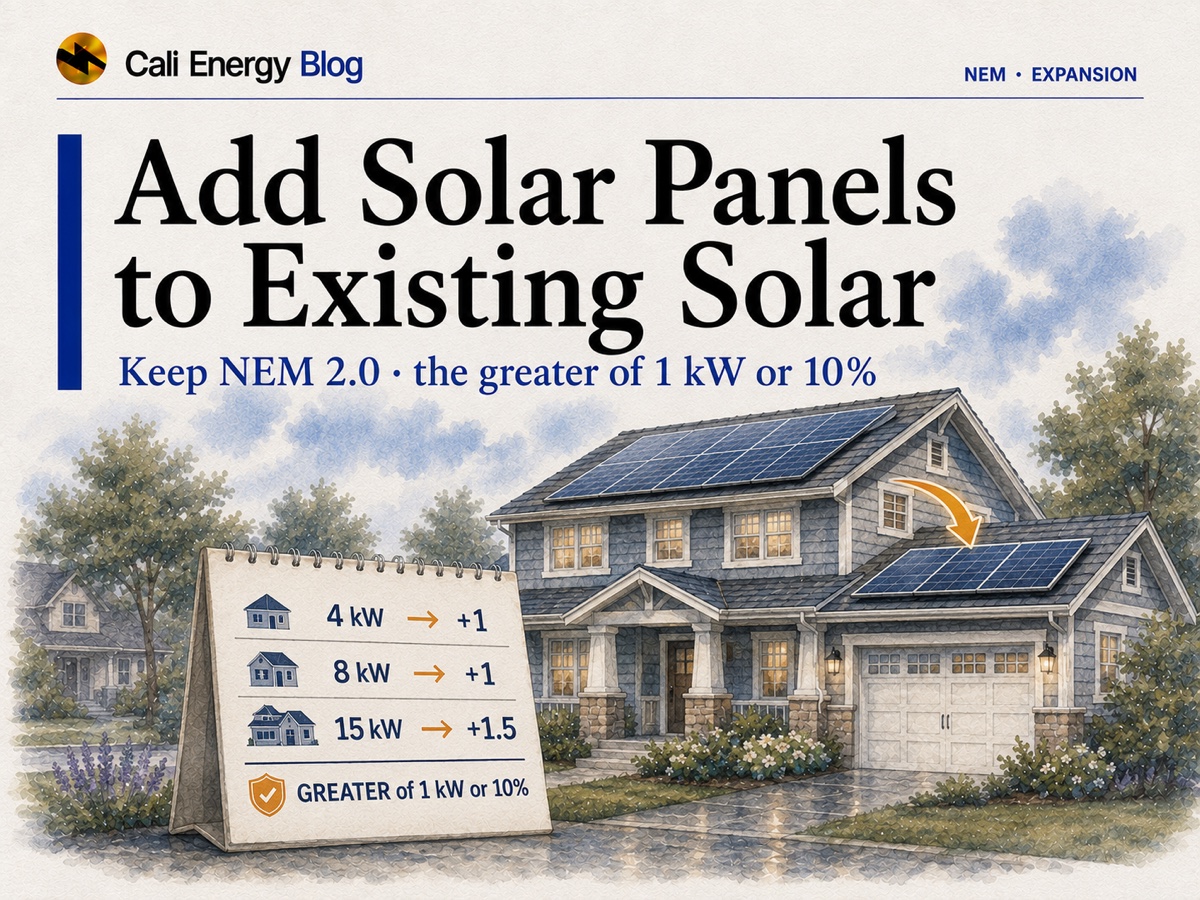
- The limit: the greater of 1 kW or 10% of the original size, counted against the size at first interconnection and within your yearly use.
- In panels: two 405 W panels for any system up to 12 kW; three for 15 kW; four for 20 kW.
- File it right: SCE requires the “NEM 1.0/2.0 Expansion” application type; the wrong one moves the account to the Solar Billing Plan, and SCE does not guarantee a reversal.
- Bigger additions have a legal route: connect the extra panels as non-export under Rule 21 and the original system keeps its 20 years.
How much you can add on NEM 1.0 or 2.0
SCE’s NEM FAQ and Schedule NEM-ST set the same rule: a legacy system may grow by no more than the greater of 1 kW or 10% of its nameplate rating as originally interconnected, and not beyond the home’s yearly use. Several small additions count together, and PG&E’s NEM2 schedule sets the same limit. In panels:
| Original system | Allowed growth | 405 W panels | Added |
|---|---|---|---|
| 3 kW | 1.0 kW | 2 | 0.81 kW |
| 5 kW | 1.0 kW | 2 | 0.81 kW |
| 8 kW | 1.0 kW | 2 | 0.81 kW |
| 10 kW | 1.0 kW | 2 | 0.81 kW |
| 12 kW | 1.2 kW | 2 | 0.81 kW |
| 15 kW | 1.5 kW | 3 | 1.22 kW |
| 20 kW | 2.0 kW | 4 | 1.62 kW |
Rule: SCE NEM FAQ · SCE NEM-ST, Special Condition 8.b. 405 W is the median panel on 2025 LA installs. Cali Energy arithmetic.
Two practical consequences. Small systems gain the most relative to their size — 1 kW on a 3 kW system is a third more. And a single big modern panel can use up the allowance: a 460 W panel and a 405 W panel together are 0.87 kW, three of either are over. See NEM 2.0 grandfathering.
The paperwork that protects the tariff
A new application
Any change needs a revised interconnection application with the new configuration, even within the limit (SCE).
The right type
Choose “NEM 1.0/2.0 Expansion.” Filed any other way, SCE moves the account to the Solar Billing Plan and “cannot guarantee a reversal back to NEM.”
Over the limit, option 1
Interconnect the extra panels separately under a Rule 21 non-export agreement, with a relay or control that stops them exporting; the original system keeps its 20 years (NEM-ST).
Over the limit, option 2
Move the whole system to the Solar Billing Plan on a new application; SCE puts the account on a time-of-use rate.
What SCE customers actually do
| Year | All SCE | Los Angeles County |
|---|---|---|
| 2023 | 450 | 185 |
| 2024 | 1,564 | 564 |
| 2025 | 2,328 | 523 |
| 2026 (Jan–Aug) | 2,317 | 532 |
Source: California DG Stats, Interconnected Project Sites, SCE, data through August 31, 2026; spelling variants of the program name combined. Cali Energy count.
The striking part is what those expansions contain: of the 4,645 approved from January 2025 to August 2026, 98% included a battery, with a median of 13.5 kWh. For most legacy customers, “expanding” now means adding storage. SCE’s FAQ says the same capacity limits also apply to added storage, so the installer should confirm how SCE will count yours; see adding a battery to existing solar.
If you are already on the Solar Billing Plan
There is no legacy tariff to protect, so the question is size and value. The CPUC’s tariff comparison caps a Net Billing Tariff system at the home’s yearly use plus up to 50% if the customer attests to a need, such as a new EV or heat pump. Extra panels only pay if the house uses the power: a summer midday export on SCE’s Solar Billing Plan earns a few cents. See panels to charge an EV and NEM 3.0 explained.
The physical checks
Inverter headroom
Microinverter systems add a microinverter per new panel; a string inverter has a maximum input and may need a second unit. See what an inverter does.
Matching panels
Older models are often discontinued. On a plain string the weakest panel limits the rest; microinverters or optimizers let different panels work side by side. See Enphase vs SolarEdge.
Electrical panel
The added breaker has to fit the main panel’s bus rating. See do you need a panel upgrade?
Roof and permit
New panels need room outside the fire pathways and a city permit. See roof space and permits in LA.
On LADWP, the rules above don’t apply: LADWP runs its own net metering, so ask LADWP how an addition is reviewed. See LADWP solar and battery incentives.
Where to go next
Cali Energy plans additions to existing solar in Los Angeles around your tariff, inverter and panel. Call +1-323-844-7777 or ask about adding panels — the utility decides each application, so treat any plan as an estimate until it is approved.
Frequently asked
Can I add solar panels to my existing system in California?
Yes. On SCE’s NEM 1.0 or 2.0 you can add the greater of 1 kW or 10% of the original size and keep the tariff, with a revised application filed as a “NEM 1.0/2.0 Expansion.” On the Solar Billing Plan the cap is your yearly use plus up to 50% with an attestation.
How many panels can I add without losing NEM 2.0?
With 405 W panels, two on any system up to 12 kW, three on a 15 kW system and four on 20 kW. Three 405 W panels are 1.2 kW, over the 1 kW floor.
Will adding panels make me lose NEM 2.0?
Only if you go past the limit or file the wrong application type. Past the limit, the extra panels can be interconnected separately as non-export under Rule 21 and the original system keeps its 20 years; otherwise the whole system moves to the Solar Billing Plan.
Does adding a battery count toward the expansion limit?
SCE’s FAQ says the capacity limits also apply when storage is added, while the CPUC ruled that adding storage does not alter NEM 2.0 status. In SCE’s data, 98% of 2025–26 “NEM 1.0/2.0 Expansion” projects included a battery. Confirm with SCE how yours will be counted.
Do I need the same panels I already have?
No, but mixing matters on a plain string inverter, where the weakest panel limits the string. Microinverters or optimizers let different panels work independently.
Can I add more than the limit and keep NEM 2.0?
Yes, for the original system: SCE’s tariff lets the extra panels be interconnected under a Rule 21 non-export agreement, with a relay or control that keeps them from exporting.
Does this apply to LADWP?
No. LADWP has its own net metering program; ask LADWP how an addition is reviewed.
Related reading
Sources & methodology
Figures on this page come from the primary sources below and, where noted, from Cali Energy calculations using the stated assumptions. Rates, incentives, and program terms change; each was verified October 5, 2026.
- SCE — Net Energy Metering FAQ (greater of 1 kW or 10%; storage; “NEM 1.0/2.0 Expansion” application)
- SCE — Schedule NEM-ST, Special Condition 8.b (modifications; Rule 21 non-export option)
- CPUC — Net Energy Metering and Net Billing (tariff comparison, NBT size limit)
- California DG Stats — Interconnected Project Sites (SCE, data through August 31, 2026; Cali Energy count)
- SCE — How the Solar Billing Plan works
- LADWP — Service Rider NEM, Net Energy Metering
Expand your solar without losing your rate
Get an expansion planned around your tariff, inverter, electrical panel and roof, with the right application type. Estimates until the utility approves.
Get a free estimatePrepared by Cali Energy, October 5, 2026. This article is for general educational purposes only and is not legal, tax, financial, engineering, or utility advice. Rates, incentives, codes, permit requirements, equipment specifications, prices, and program terms may change; figures and timelines are estimates, not guarantees. Confirm current requirements with the applicable utility, AHJ, program administrator, manufacturer, or a licensed professional. See our Content Disclaimer. Cali Energy · 19201 Parthenia St, Unit E, Northridge, CA 91324 · CSLB #1032379 (B, C-10, C-39)