

Solar Warranties Explained: Product, Performance, Inverter & Workmanship
Straight answer: a solar system is covered by several warranties from different companies, not one. The panel maker covers defects (product) and output (performance) — product terms run from 12 to 40 years on current panels, depending on the brand and the installer; the inverter maker covers the inverter — 25 years on Enphase microinverters, 12 on a SolarEdge inverter; your installer covers the installation (workmanship); and a battery brings its own. The gap to check is labor: some equipment warranties pay the crew that swaps a failed part, others cover only the part.
Get a free estimate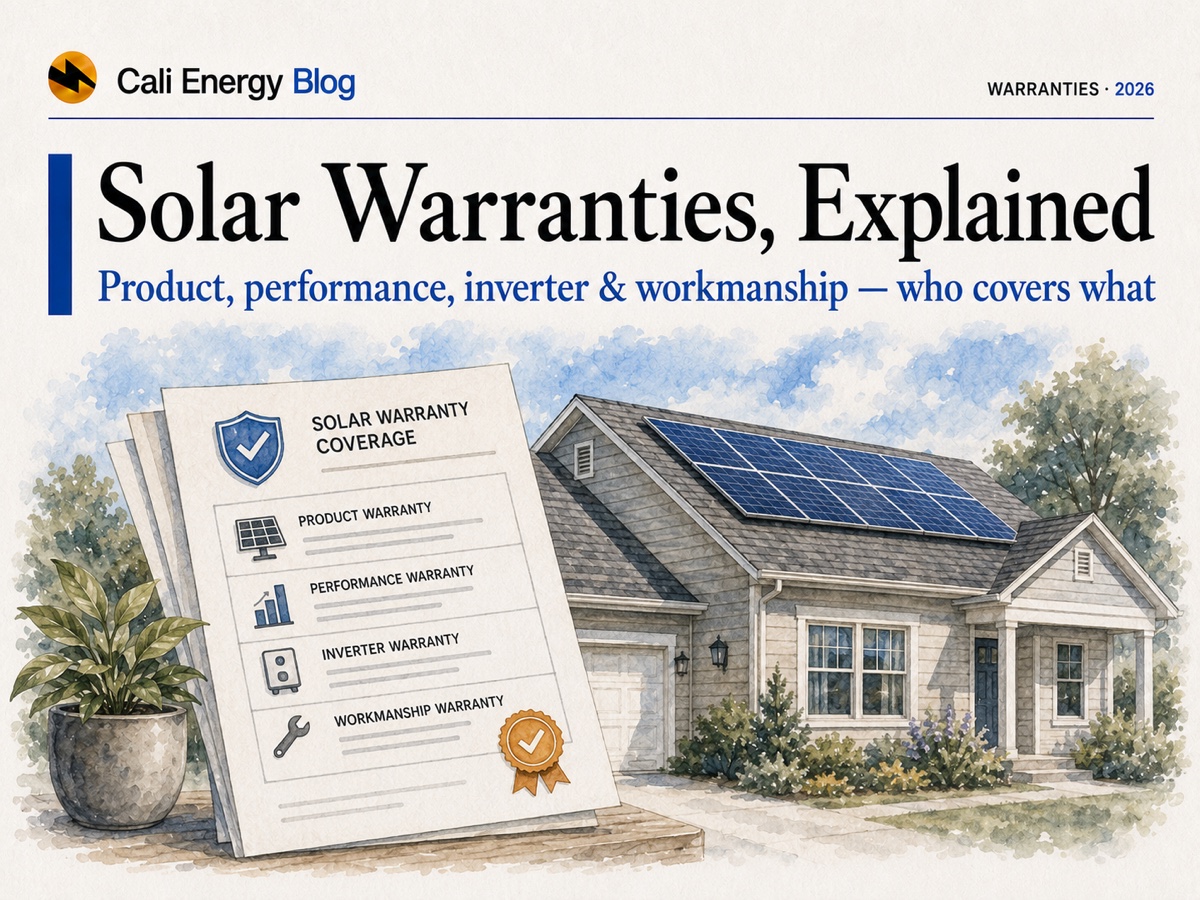
- A solar system carries four warranties — panel product, panel performance, inverter and installer workmanship — and a battery adds a fifth. Manufacturers honor the equipment; your installer honors the installation.
- Long terms often come with conditions: REC’s 20-year product warranty becomes 25 with an REC Certified Solar Professional, and Maxeon’s 40 years needs registration and an authorized installer.
- Labor is the gap to check. Enphase and SolarEdge warranties exclude on-site labor (Enphase reimburses installers in the first two years); Tesla and REC ProTrust pay certified installers for approved work.
- Keep the system online and the paperwork current: equipment left offline can lose coverage, and some transfers to a new owner need a form and a fee.
A solar system isn’t one warranty — it’s four
When a proposal says “25-year warranty,” ask which one. A rooftop system is several products from several companies — panels, an inverter or microinverters, racking, sometimes a battery — plus the labor that ties them to your roof, and each carries its own warranty, term and company behind it. The terms below come from the manufacturers’ own 2026 warranty documents.
| Warranty | What it covers | 2026 terms (examples) | Who honors it |
|---|---|---|---|
| Panel product | Defects in the panel — cells, glass, frame, junction box | 12–40 years: REC 20 (25 with an REC Certified Solar Professional), Qcells 25, Maxeon 40 if registered (otherwise 25) | Panel maker |
| Panel performance | A minimum power output as the panel ages | Straight-line floors: REC at least 92% and Qcells at least 90.58% at year 25; Silfab 89.3% at year 30 | Panel maker |
| Inverter | The inverter, microinverters or optimizers | Enphase IQ microinverters 25; SolarEdge optimizers 25, inverters 12 (Nexis 10), Home Hub and Home Wave extendable to 20 or 25 for a fee | Inverter maker |
| Installer workmanship | The installation — mounting, roof penetrations, wiring, and often the labor to swap parts | Set by your contract; SGIP requires at least 10 years on the solar projects it funds | Your installer |
| Battery (if added) | Defects plus a minimum retained capacity | Powerwall 3: 10 years, 70% at year 10; Enphase IQ Battery 5P: 15 years or 6,000 cycles; FranklinWH aPower 2: 15 years or 60 MWh | Battery maker |
Sources: REC · Qcells · Maxeon · Silfab · Enphase · SolarEdge · Tesla · FranklinWH · SGIP Handbook 2026.
1. Panel product warranty: defects
The product warranty covers the panel itself failing from a defect in materials or workmanship — a bad cell, junction box, frame or glass. It is honored by the panel maker, and terms now vary widely: 12 years on some lines, 25 on others, 40 on one. The longer terms often depend on who installs and registers the panels, so ask which term applies to your install, in writing. What you receive on a valid claim — repair, replacement (sometimes with a refurbished unit) or a refund — is set by each warranty document.
| Panel | Product warranty | Performance guarantee |
|---|---|---|
| REC Alpha Pure-RX | 20 years; 25 with an REC Certified Solar Professional | At least 92% at year 25 (0.25%/yr) |
| Qcells Q.TRON BLK M-G2+ | 25 years | At least 90.58% at year 25 |
| Maxeon | 40 years if registered within 6 months and installed by an authorized installer; otherwise 25 | 98% in year 1, −0.25%/yr, 88.25% at year 40 (92% at year 25 if not registered) |
| Silfab Prime QD | 12 years, extendable to 25 through a registered Silfab installer | 98% in year 1, then no more than 0.30%/yr to year 30 (89.3%) |
| Canadian Solar TOPHiKu6 | 12 years; 25 only for rooftop installs in certain regions | No more than 1% in year 1, then 0.4%/yr to year 30 |
Sources: REC · Qcells · Maxeon · Silfab · Canadian Solar. The same data, with measured degradation rates, is in solar panel degradation.
2. Panel performance warranty: a straight-line output floor
The performance warranty guarantees a minimum power output as the panel ages. Current ones are linear: a floor for year 1, then a fixed maximum loss each year — Maxeon 98% in year 1 and then 0.25% a year, Silfab 98% and then no more than 0.30% a year to year 30, REC 0.25% a year to at least 92% in year 25. The test is the panel’s own power under standard test conditions, so dirt, shade and heat on your roof don’t count against it; solar panel degradation shows how real systems compare with these floors.
Not the same as a production guarantee. A performance warranty covers one panel’s rated power. A minimum-energy (production) guarantee covers the kilowatt-hours the whole system makes; the CPUC’s consumer guide notes it is common with leases and power purchase agreements and suggests asking how you would be compensated if the system underproduces (CPUC).
3. Inverter warranty
The inverter maker covers the electronics that turn panel power into household power. Enphase covers its IQ7, IQ8 and IQ9 microinverters for 25 years from activation, but the monitoring and control parts around them for less: 5 years on the IQ Gateway and IQ Combiner, 10 on the IQ System Controller (Enphase). SolarEdge covers its power optimizers for 25 years and its inverters for 12 — 10 for the new Nexis — with communication devices at 5 (SolarEdge); Home Hub and Home Wave inverters can be extended to 20 or 25 years within a set window after shipment, $170–$225 to take a Home Hub to 25 years on its early-2026 price list. The CPUC’s guide singles out the inverter as the part that may need replacing sooner than the rest, so keep that warranty where you can find it. How the two systems compare is in Enphase vs SolarEdge.
4. Workmanship warranty: the installation
The workmanship warranty covers the installation itself — mounting, flashing and sealing of roof penetrations, wiring — and it is the only one backed by your installer rather than a manufacturer. Its term is whatever your contract says, so get it in writing: the Contractors State License Board tells consumers to get any labor and material warranty in writing (CSLB), and the CPUC’s guide lists “Are there warranties for labor/construction?” among the questions to ask. Two roof questions from the same guide belong in that conversation: what steps the installer will take to make sure the roof won’t leak, and roughly what it would cost to remove and reinstall the panels if the roof needs replacing later (see removing and reinstalling panels for a new roof).
For a public benchmark, California’s Self-Generation Incentive Program sets minimums for solar in the projects it funds: a 10-year workmanship warranty for no-cost repair and replacement of anything the manufacturer doesn’t cover, a 20-year installer warranty against more than a 10% output loss caused by faulty installation, and 20-year performance warranties on panels and inverters against more than a 15% loss (SGIP Handbook 2026, §8.1). Those rules bind only SGIP-funded projects, but they show what a complete package covers.
A workmanship warranty is only as good as the company behind it
Manufacturer warranties follow the equipment and depend on the maker still standing behind them; a workmanship warranty follows the installer, and if the company closes, that promise can go with it. One manufacturer program addresses this directly: REC says its ProTrust coverage still applies if the certified installer goes out of business (REC). What to do if yours has closed: when your solar installer goes out of business.
Who pays the labor when a part fails
A replacement microinverter or panel is only half the job; someone has to get on the roof. The documents differ sharply.
| Equipment | Labor under the manufacturer’s warranty |
|---|---|
| Enphase microinverters | Excluded from the warranty; a separate Enphase program pays installers $200 per visit plus $25 per microinverter in the first two years |
| SolarEdge inverters and optimizers | Not covered unless SolarEdge agrees in writing in advance |
| Tesla Powerwall | Reasonable labor costs reimbursed to the Tesla Certified Installer that does the repair or replacement |
| REC panels with ProTrust | A fixed labor fee paid to an REC Certified Solar Professional on approved claims: 25 years for systems up to 25 kW, 10 years for 25–500 kW |
| Anything else | Your installer’s workmanship warranty — or you |
Sources: Enphase warranty · Enphase labor reimbursement · SolarEdge · Tesla · REC ProTrust.
REC ProTrust and one contractor behind the work
Cali Energy is an REC Certified Solar Professional, so REC panels we install and register qualify for REC ProTrust: 25 years on product, performance and labor for systems up to 25 kW, under REC’s terms. Our crews are in-house, so the workmanship warranty is backed by the licensed contractor that did the work (CSLB #1032379). Ask us to walk through every warranty on any proposal, ours or a competitor’s.
Battery warranties: years, cycles and retained capacity
A battery wears with use, so its warranty has three limits — years, a cycle or throughput cap, and a minimum retained capacity — and coverage ends at whichever comes first. Tesla covers Powerwall 3 for 10 years and guarantees 70% of its 13.5 kWh at year 10, with unlimited cycles for solar self-consumption, time-based control and backup, and a 37.8 MWh throughput cap for other uses (Tesla). Enphase covers the IQ Battery 5P for 15 years or 6,000 discharged cycles, guaranteeing 70% at year 10 and 60% at the end (Enphase). FranklinWH covers the aPower 2 for 15 years or 60 MWh, with 70% at the end (FranklinWH). For batteries it funds, SGIP requires at least a 10-year performance warranty guaranteeing 60% of the starting capacity at year 10. The three side by side: Powerwall vs Enphase vs FranklinWH.
What can void or shrink a warranty
Each item below is written into at least one current warranty document.
Buying outside authorized channels
Enphase covers products sold by Enphase or an authorized reseller; SolarEdge requires purchase from SolarEdge or an authorized seller; Tesla, from Tesla or a Tesla certified installer.
Going offline
SolarEdge says it cannot honor its warranty if the product stays disconnected from its monitoring platform, beyond temporary outages, and security updates aren’t installed. Tesla may not honor the full 10 years for a Powerwall offline for an extended period or unregistered — but at least 4. Enphase asks for a continuous connection.
Work outside the manual
Tesla excludes damage from installation, operation or repair that doesn’t follow its manuals, and repairs by anyone other than Tesla or a certified installer; SolarEdge requires installation per its documentation.
Opening or modifying equipment
Tesla excludes opening a Powerwall’s casing by anyone other than Tesla, and any modification without its written consent.
Moving the system
Enphase covers products at their original location; SolarEdge’s warranty follows a transfer only while the products stay in their original country; Tesla excludes reinstallation elsewhere without its written consent.
Missing a deadline
Enphase requires claims within 90 days of discovering a defect, and a new owner’s transfer form and fee within 30 days of the sale.
Check your proposal’s warranties for completeness
A warranty is only as good as its details. Enter the terms from a proposal and tick the coverage points it actually spells out. The tool scores completeness — not just years — and lists what to ask about. It reads the proposal, not the fine print of every manufacturer, so confirm the written warranty for remedies, exclusions and transfer rules.
Warranty completeness checklist
Enter each term (0 if not listed) and tick what the proposal spells out.
Benchmarks: 25 years for panel product and performance (Qcells; REC with a certified installer), 12 years for an inverter (SolarEdge’s standard term; Enphase microinverters carry 25) and 10 years for workmanship (the minimum SGIP requires on the projects it funds). Reference points, not legal requirements — the written warranty governs remedies, labor and exclusions.
How to read the warranty section of a proposal
A clear proposal names, for each layer, the term and who honors it: panel product years, the performance floor, inverter years (and whether an extension is included), workmanship years, and a battery’s three limits. Then ask the questions from the CPUC’s consumer guide: whom you contact to replace a failed part, what an inverter costs to replace after its warranty, whether labor and construction are warranted, and whether repairs and maintenance are included (CPUC). A vague “25-year warranty” is a reason to ask for the itemized version before you sign, not proof of anything by itself.
Get a proposal with every warranty spelled outFrequently asked
How many warranties does a solar system have?
Four, plus one with a battery: the panel product warranty (defects), the panel performance warranty (output as it ages), the inverter warranty and the installer’s workmanship warranty. The first three and the battery are honored by manufacturers; workmanship is honored by your installer.
What's the difference between a product and a performance warranty?
The product warranty covers a panel failing from a defect; the performance warranty guarantees a minimum output as it ages — for example at least 92% at year 25 on the REC Alpha Pure-RX and 90.58% on the Qcells Q.TRON BLK M-G2+. A panel can reach its output floor without ever failing, so the two cover different problems.
What is a linear performance warranty?
One that sets a floor for year 1 and then a fixed maximum loss each year, so the guaranteed output falls in a straight line — Maxeon 98% in year 1 and then 0.25% a year, Silfab 98% and then no more than 0.30% a year to year 30. It is measured on the panel’s own power under standard test conditions.
Does a solar warranty cover the labor to replace a failed part?
It depends on the manufacturer. Enphase and SolarEdge warranties exclude on-site labor, though Enphase pays installers $200 per visit plus $25 per microinverter in the first two years. Tesla reimburses reasonable labor to a Tesla Certified Installer, and REC ProTrust pays a fixed labor fee to an REC Certified Solar Professional. Otherwise labor falls to the installer’s workmanship warranty.
How long should a solar workmanship warranty be?
The term is set by your contract. As a benchmark, California’s SGIP requires contractors on the solar projects it funds to provide at least a 10-year workmanship warranty covering repair and replacement the manufacturer doesn’t. Whatever the term, get it in writing, as CSLB advises.
How long is a solar inverter warranty?
Enphase IQ7, IQ8 and IQ9 microinverters: 25 years from activation. SolarEdge: 12 years on its inverters (10 on Nexis) and 25 on its optimizers, with paid extensions to 20 or 25 years for Home Hub and Home Wave inverters, bought within a set window after shipment.
Are solar warranties transferable if I sell my house?
Usually, with conditions. SolarEdge’s transfers to any new owner as long as the equipment stays in the same country; Tesla lets a later owner claim with proof of ownership; Enphase requires the new owner to file a change-of-ownership form and pay a fee within 30 days of the sale. Check your installer’s workmanship terms separately.
Is a production guarantee the same as a performance warranty?
No. A performance warranty covers one panel’s rated power; a production (minimum-energy) guarantee covers the kilowatt-hours the whole system makes and is a contract term from the provider. The CPUC’s consumer guide notes it is common with leases and power purchase agreements.
Related reading
Sources & methodology
Figures on this page come from the primary sources below and, where noted, from Cali Energy calculations using the stated assumptions. Rates, incentives, and program terms change; each was verified September 29, 2026.
- REC — Alpha Pure-RX series (20-year product warranty, 25 with ProTrust; at least 92% at year 25)
- REC — ProTrust warranty (25 years product, performance and labor up to 25 kW; 10-year labor for 25–500 kW)
- Qcells — Q.TRON BLK M-G2+ (25-year product warranty, at least 90.58% at year 25)
- Maxeon — Limited Warranty for PV Modules (document 545700, Rev G, effective May 1, 2026)
- Silfab Solar — Limited Product and Linear Performance Warranty (SIL-CS-WRTY-010, Rev Q)
- Canadian Solar — TOPHiKu6 datasheet and warranty terms
- Enphase — US Limited Warranty, IQ Microinverters and balance of system (effective May 2, 2026)
- Enphase — Labor reimbursement for warranty service, North America (effective February 1, 2026)
- Enphase — US Limited Warranty, IQ Battery 5P (effective May 2, 2026)
- SolarEdge — Limited Product Warranty (effective January 1, 2026)
- SolarEdge — North America warranty extension price list
- Tesla — Powerwall Limited Warranty (USA), Rev. 2.6
- FranklinWH — system limited warranty for end users
- SGIP — 2026 Handbook (V3), §8.1 warranty requirements (resources page)
- CPUC — California Solar Consumer Protection Guide
- CSLB — Home improvement contracts (get labor and material warranties in writing)
Know who stands behind every warranty on your system
Cali Energy is an REC Certified Solar Professional and installs with in-house crews — one licensed contractor behind the workmanship (CSLB #1032379), plus the manufacturer warranties on your panels, inverter and battery. Call +1-323-844-7777 and we'll walk through every line before you sign.
Get a free estimatePrepared by Cali Energy, September 29, 2026. This article is for general educational purposes only and is not legal, tax, financial, engineering, or utility advice. Rates, incentives, codes, permit requirements, equipment specifications, prices, and program terms may change; figures and timelines are estimates, not guarantees. Confirm current requirements with the applicable utility, AHJ, program administrator, manufacturer, or a licensed professional. See our Content Disclaimer. Cali Energy · 19201 Parthenia St, Unit E, Northridge, CA 91324 · CSLB #1032379 (B, C-10, C-39)