

Bidirectional EV Charging (V2H & V2G) in California
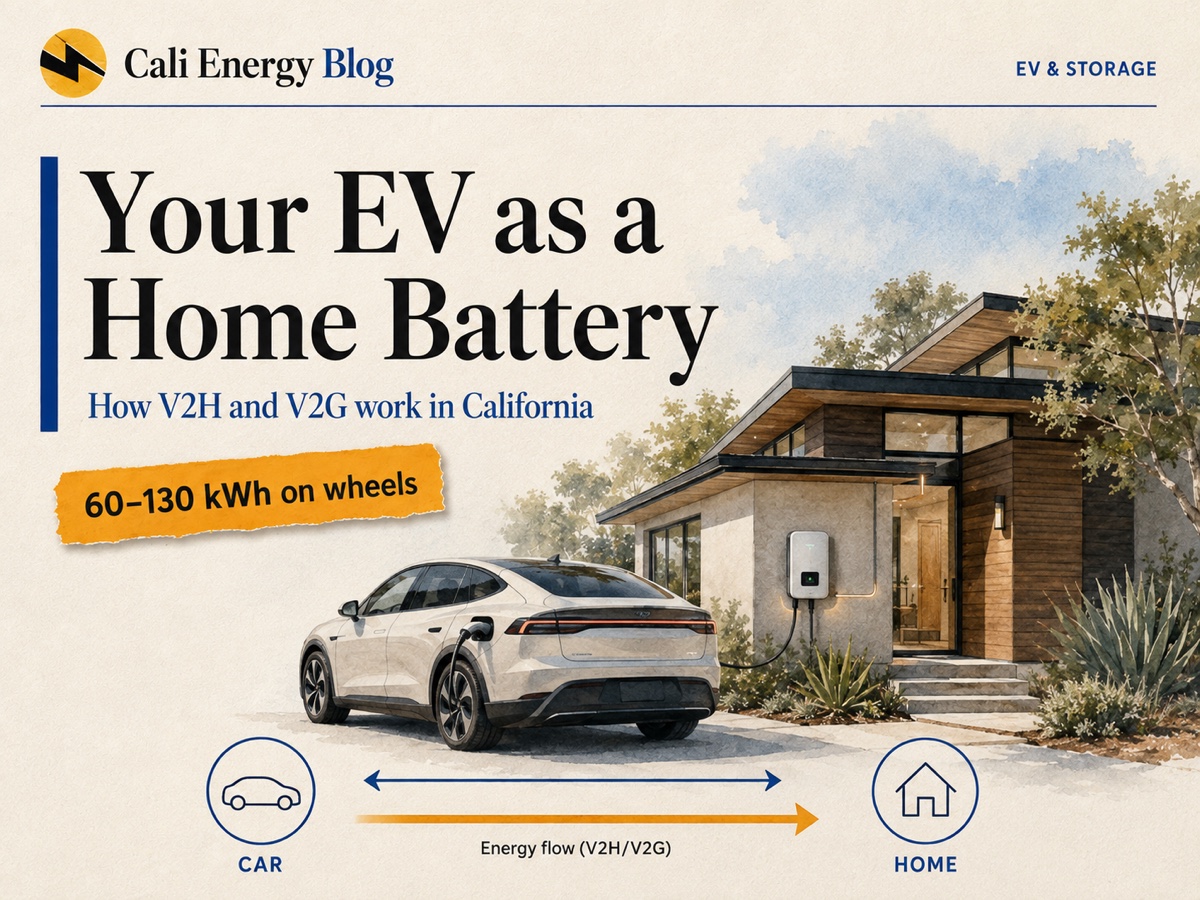
A growing number of electric vehicles can send power back out — to run your home in an outage (V2H) or to the grid (V2G). In Los Angeles it is still a minority: about one in ten new EVs registered in the county in 2025 was a model with confirmed V2H, and the two best sellers are not. This guide explains the terms, lists the vehicles officially confirmed in the US, compares V2H with a home battery, and clears up what California’s law actually requires.
- Bidirectional capability is model- and model-year-specific. Never assume a whole brand supports it — confirm the exact vehicle, model year, and required equipment with the manufacturer.
- V2H can be a lower-cost backup for an owner who already has a compatible EV, but it is not universally cheaper than a dedicated home battery, and it only works when the car is home and plugged in.
- Installed pricing requires a property-specific quote. Bidirectional equipment must be installed by qualified professionals under manufacturer instructions, codes, permits, and utility rules.
- About one in ten new EVs registered in Los Angeles County in 2025 was a model with manufacturer-confirmed vehicle-to-home capability; the two best sellers, the Tesla Model Y and Model 3, are not.
- GM has the longest list: twelve 2026–2027 models across Chevrolet, GMC and Cadillac work with its PowerShift charger and V2H kit.
- V2H needs the car at home: it backs up the house only while plugged in, and only through approved equipment.
- No 30% credit in 2026: some product pages still advertise it, but the federal residential credit ended for equipment installed after 2025.
The four terms
- V2L (Vehicle-to-Load): plug appliances directly into the car through an outlet or adapter. Simplest; no home wiring.
- V2H (Vehicle-to-Home): the EV backs up your house through a bidirectional charger and a transfer switch/gateway, powering circuits when the grid is down. Not exported to the grid.
- V2G (Vehicle-to-Grid): the EV exports energy back to the grid. Requires utility interconnection and approval.
- V2X (Vehicle-to-Everything): the umbrella term for all of the above.
Which EVs are confirmed V2H-capable in the US
The table below lists vehicles with manufacturer-confirmed US vehicle-to-home capability: GM and Kia rows checked on October 6, 2026, Ford and Tesla on August 4, 2026. Availability, firmware, and required equipment change — confirm the current details for your exact vehicle and model year with the manufacturer.
| Vehicle | Model years | Required hardware | Status |
|---|---|---|---|
| Ford F-150 Lightning | Current | Ford Charge Station Pro + Home Integration System (~9.6 kW backup) | Available |
| Chevrolet Silverado EV | 2024–2026 | GM Energy PowerShift Charger + V2H Enablement Kit | Available (some 24MY need dealer/OTA update) |
| Chevrolet Blazer EV | 2024–2026 | GM Energy PowerShift Charger + V2H Enablement Kit | Available |
| Chevrolet Equinox EV | 2024–2026 | GM Energy PowerShift Charger + V2H Enablement Kit | Available |
| GMC Sierra EV | 2024–2026 | GM Energy PowerShift Charger + V2H Enablement Kit | Available |
| Cadillac LYRIQ, OPTIQ, VISTIQ, ESCALADE IQ, CELESTIQ; GMC HUMMER EV SUV and SUT; Chevrolet Bolt EV | 2026 (Bolt EV 2027) | GM Energy PowerShift Charger + V2H Enablement Kit | Available, per GM Energy’s list |
| Kia EV9 (eligible owners) | 2024–2025 | Wallbox Quasar 2 + Power Recovery Unit | Available (pre-order/waitlist by state) |
| Kia EV6 | — | Wallbox Quasar 2 + Power Recovery Unit (per Kia) | Manufacturer-announced for late 2026 — not yet treated as currently available |
| Tesla Cybertruck | Current | Tesla Powershare (Universal Wall Connector + Gateway) | Available |
Sources: GM Energy V2H-capable list · Kia Vehicle-to-Home · Ford Home Backup Power · Tesla Powershare · verified August 4, 2026.
Not confirmed for US V2H home backup (do not assume these work): the Ford Mustang Mach-E and electric Explorer (Ford states these are not capable of home backup — it is F-150 Lightning only); the Hyundai Ioniq 5/6 (they support V2L and the platform has the hardware, but native US V2H is not officially enabled); and Tesla Model S/3/X/Y (Powershare is Cybertruck-only). The Kia EV6 is manufacturer-announced for late 2026 and is listed above as not-yet-available. Ecosystems are brand-locked — a Ford charger pairs with a Ford truck, and so on. Because this space changes fast, this matrix is scheduled for monthly review.
How many new LA EVs can do it
The California Energy Commission counts new EV registrations by county and model. Of the 96,891 battery-electric cars registered in Los Angeles County in 2025, these models appear on the V2H lists we checked (GM, Ford, Kia, Tesla); other makers may add V2H, so check your own model:
| Model | Registered |
|---|---|
| Chevrolet Equinox EV | 2,854 |
| Tesla Cybertruck | 1,377 |
| Ford F-150 Lightning | 1,192 |
| Chevrolet Blazer EV | 1,011 |
| Cadillac LYRIQ | 929 |
| Kia EV9 | 892 |
| Cadillac OPTIQ | 490 |
| Cadillac VISTIQ | 470 |
| GMC HUMMER EV | 428 |
| Cadillac Escalade IQ | 379 |
| Chevrolet Silverado EV | 308 |
| GMC Sierra EV | 217 |
| Total | 10,547 (10.9%) |
Source: CEC New ZEV Sales (data as of June 30, 2026). Capability depends on model year: a 2025 registration may be an earlier model year than the one on today’s list. Cali Energy count.
The two best-selling EVs in the county, the Tesla Model Y and Model 3, made up 41% of 2025 registrations and do not offer V2H. For most LA EV owners today, a car is a load to charge rather than a backup source; see panels to charge an EV.
Hardware and cost
Costs vary widely by ecosystem, so a single “installed price” is misleading. Hardware and installation are separate, and published hardware prices exclude some or all permitting, electrical upgrades, gateway equipment, labor, taxes, and utility requirements. Installed pricing requires a property-specific quote.
| Ecosystem | Required hardware | Notes |
|---|---|---|
| Ford | Charge Station Pro + Home Integration System | Home Integration System listed around $3,895 (hardware only); charger sold separately |
| GM | PowerShift Charger + V2H Enablement Kit | GM Energy bundle pricing; confirm current cost |
| Kia | Wallbox Quasar 2 + Power Recovery Unit | Quasar 2 retail around $6,440 (excl. tax/install) |
| Tesla | Universal Wall Connector + Gateway | Bundle pricing via Tesla |
If you already own a compatible EV, a V2H setup can cost less than adding a dedicated home battery — because the large battery is the car you already bought. A dedicated home battery such as a Powerwall 3 is typically a larger installed cost (a Cali Energy market estimate is roughly $12,000–15,000, but Tesla and installers price it per property). The exact all-in cost for either option is ecosystem- and site-specific and requires a property-specific quote.
Hardware sources: Wallbox Quasar 2 store · Ford Home Backup Power · Tesla Powerwall · installed pricing requires a quote · verified August 4, 2026.
Watch for outdated claims: GM’s V2H product page still advertises a 30% federal tax incentive for its home battery, but the federal Residential Clean Energy Credit is not available for property placed in service after December 31, 2025.
V2H vs a home battery (Powerwall)
| Powerwall 3 | Typical EV (V2H) | |
|---|---|---|
| Approx. battery-pack capacity | 13.5 kWh (usable) | 60–130 kWh (pack capacity; usable energy for backup is lower and model-specific) |
| Power output | ~11.5 kW | ~9.6 kW (Ford) |
| Available when you’re away? | Yes, always | No — car must be home and plugged in |
| Dedicated to the home? | Yes | No — it’s also your transportation |
An EV holds far more energy — a full F-150 Lightning battery is several times a Powerwall’s usable capacity — but that is a capacity comparison only, not equivalent power output or availability. The core trade-off: the car is a bigger battery, but only when it’s parked and plugged in, and you can’t drive it and back up the house at the same time. A dedicated battery is smaller but always there.
Battery aging and warranty
Using an EV for backup adds some cycling. How much that matters depends on cycling depth, temperature, power level, and each vehicle’s battery-management system. Warranty treatment varies by vehicle, model year, software, and whether manufacturer-approved bidirectional equipment is used. Cali Energy does not determine warranty coverage — obtain current written confirmation from the vehicle and charging-equipment manufacturer before enabling V2H or V2G. Tesla describes its Powershare as a designed, approved use case managed by the vehicle’s battery-management system.
Standards and California law
- UL 9741 is the safety standard for bidirectional EV charging equipment; UL 1741 SB covers grid-interactive smart inverters (relevant when exporting to the grid).
- California SB 59 (Skinner), signed September 27, 2024, authorizes the California Energy Commission — after the required analysis and consultation with the CPUC and CARB — to require a class of battery EVs to be bidirectional-capable if it finds a sufficiently compelling use case. It does not itself impose a universal “all new EVs by 2027” mandate. (An earlier bill, SB 233, was not enacted — don’t confuse the two.)
- Interconnection. Exporting to the grid (V2G) requires utility interconnection and Permission to Operate. Non-export backup and grid-export operation are treated differently: export compensation and interconnection requirements depend on the utility tariff, the equipment configuration, and the approval received for the site.
Sources: CARB — SB 59 (2024) · CEC — vehicle-grid integration & interconnection · verified August 4, 2026.
Practical limitations, honestly
- The car has to be home and plugged in to back up the house — it’s no help if you drove somewhere during the outage.
- You can’t drive and provide backup at the same time.
- Ecosystems are fragmented and brand-locked; availability differs by region.
- For most Los Angeles homeowners in 2026, V2H is a real and fast-maturing option but not yet a drop-in replacement for a dedicated home battery — it’s a complement, best when you already own a compatible EV and want backup on a budget.
Safety: bidirectional equipment must be installed and configured in accordance with the manufacturer’s instructions, applicable electrical and building codes, permit requirements, and utility rules, by appropriately qualified professionals. Do not attempt DIY wiring, back-feeding, or bypassing transfer equipment.
Third-party product and company names are used for identification and comparison only. Cali Energy is not affiliated with or endorsed by the manufacturers or utilities discussed unless expressly stated.
Frequently asked
Which EVs can power a home (V2H) in the US in 2026?
Can a Tesla Model Y or Model 3 do vehicle-to-home?
Is V2H cheaper than a Powerwall?
Does using my EV for backup void the battery warranty?
Does California require bidirectional charging by 2027?
Can I earn credits by sending EV power to the grid (V2G)?
Related reading
Sources & methodology
Figures on this page come from the primary sources below and, where noted, from Cali Energy calculations using the stated assumptions. Rates, incentives, and program terms change; each was verified October 6, 2026.
- CARB — SB 59 (2024, chaptered)
- Ford — Home Backup Power support
- GM Energy — V2H
- Kia — Vehicle to Home (EV9)
- Tesla — Powershare
- California Energy Commission — New ZEV Sales by county and model (data as of June 30, 2026)
- IRS — Residential Clean Energy Credit (ended for property placed in service after 2025)
- Tesla — Powerwall 3 datasheet (13.5 kWh, 11.5 kW)
About this guide
This reference is maintained by the Cali Energy research team to explain bidirectional EV charging for California homeowners. Vehicle compatibility, hardware, pricing, and program rules change — verify the current details for your exact vehicle and model year with the manufacturer and your utility before making a decision.
Prepared by Cali Energy, October 6, 2026. This article is for general educational purposes only and is not legal, tax, financial, engineering, or utility advice. Rates, incentives, codes, permit requirements, equipment specifications, prices, and program terms may change; figures and timelines are estimates, not guarantees. Confirm current requirements with the applicable utility, AHJ, program administrator, manufacturer, or a licensed professional. See our Content Disclaimer. Cali Energy · 19201 Parthenia St, Unit E, Northridge, CA 91324 · CSLB #1032379 (B, C-10, C-39)