

A Tree Fell on Your Roof: What to Do and Who Pays
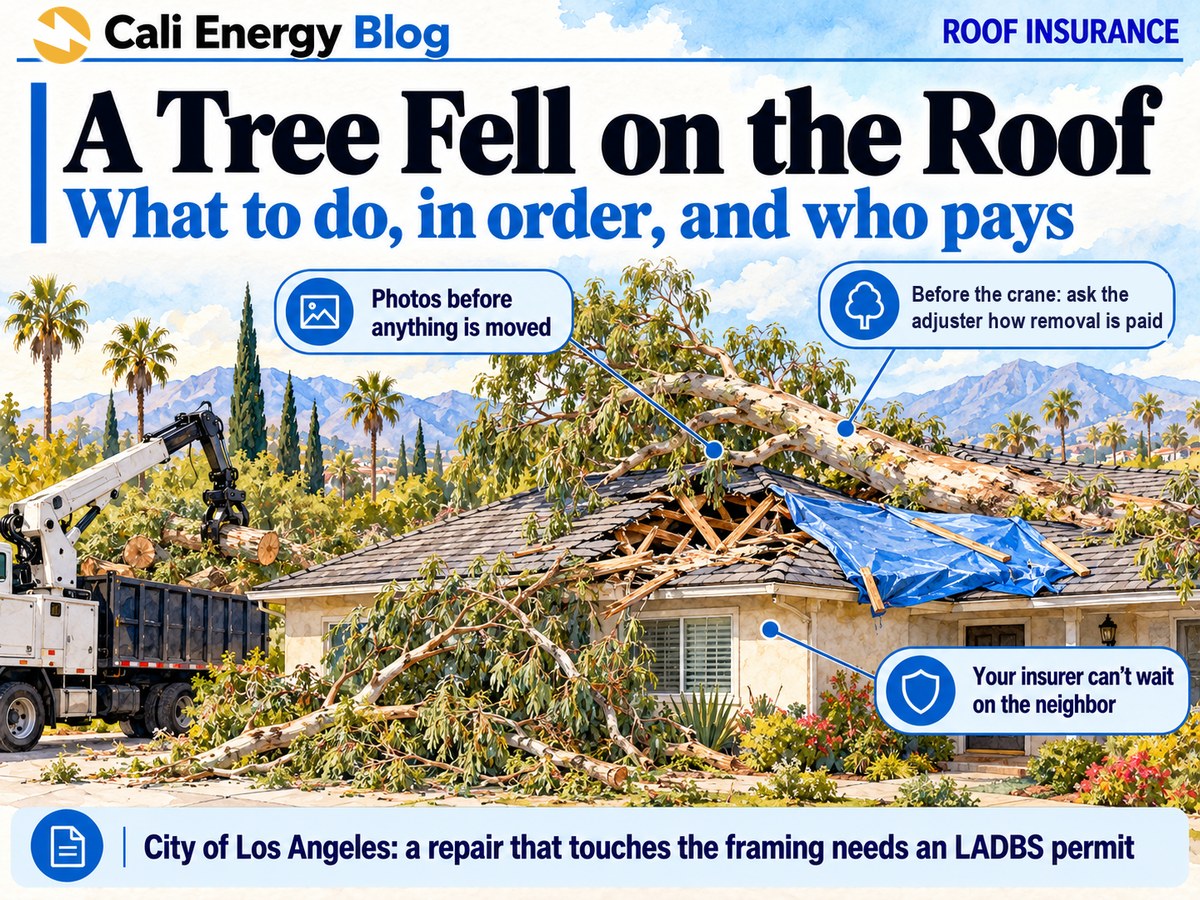
Get everyone out of the damaged part of the house and away from any downed wires first. Then, in order: call 911 if anyone is hurt or lines are down, report a fallen street tree to the city, photograph everything before it's moved and call your insurer, have a licensed tree crew take the tree off, have the opening made safe and covered and keep the receipts, and repair the roof with a permit. The California Department of Insurance says fallen-tree damage is generally covered under standard homeowners policies, with exceptions; under a typical policy form the house is covered whoever owned the tree, and California's claim rules bar your insurer from delaying or denying settlement because someone else should pay, except as the policy or the law provides (10 CCR 2695.7(e)). Hauling the tree away is a small, separate allowance in a typical policy (for your own tree, only if wind, hail or ice brought it down), and replanting it usually isn't covered when wind brought it down; before the crew starts, ask the adjuster how the cost of lifting the tree off the house will be paid. In the City of Los Angeles, a repair that touches the rafters or other roof framing needs a building permit, and the building code has no fix-first, permit-later rule for it. This page sets out the steps as of October 2026.
Leaks and power lines in a storm are covered in roof leaking in a storm, and the claim process in how to file a roof insurance claim in California.
In order
Safety comes first, then the record of the damage, then the tree, the opening and the repair.
| Step | What to do | Why now |
|---|---|---|
| 1. Safety | Get everyone out of the damaged rooms and away from the tree; don't touch any wire; call 911 if anyone is in danger, and report downed lines to the utility | A broken roof can keep moving, and a wire can be live |
| 2. A street tree | In the City of Los Angeles, report a tree that stood in the parkway through MyLA311 as a "tree emergency"; elsewhere, call the city or county that maintains the street | In the City of Los Angeles, StreetsLA handles tree emergencies in the public right-of-way |
| 3. Photos and the insurer | Photograph the tree, the roof and every damaged room, from the doorway or another safe spot rather than under the break, before anything is moved, then report the claim | The adjuster needs to see the damage as it was |
| 4. The tree off | Hire a licensed tree contractor (CSLB C-49, or an older C-61/D-49 tree service license) to cut the tree off the roof; ask for lifting it off the house and hauling it away as separate lines on the bill | Cutting and lifting the tree is tree work; the roofer starts once it's off |
| 5. Make it safe, then cover it | Have the roofer or the tree crew check whether the framing around the break can take weight, then tarp or board the opening, from a ladder or lift if it can't; don't go onto the roof yourself; keep every receipt | Broken framing can give way under a person; the policy pays reasonable protection costs and can refuse damage that follows if you don't protect the house |
| 6. The structure | Have the rafters, sheathing and ceiling inspected from the attic and the roof | Broken framing turns a re-roof into a structural repair, and it may need an engineer's design |
| 7. Permit and repair | Get the estimate, the permit and the repair; don't make large permanent repairs before the adjuster has seen the damage | The California Department of Insurance advises waiting for the adjuster |
If the house can't be lived in, keep receipts for the extra cost of living elsewhere: a typical policy's loss-of-use coverage pays the increase in living expenses for the shortest time needed to repair. In the City of Los Angeles, native California oaks (other than scrub oak), Southern California black walnut, western sycamore and California bay measuring 4 inches or more across at 4.5 feet above the ground need a Board of Public Works permit to remove (LAMC 46.01, 46.02); if one of those is down, ask StreetsLA through 311 before the trunk is hauled away.
What a homeowners policy pays
The California Department of Insurance says damage from fallen trees is generally covered under standard homeowners policies, with exceptions, and that a claim below the deductible won't be paid. What each part of the loss falls under depends on the policy; the standard ISO HO-3 form is a common model.
| What | What the typical form says | Watch for |
|---|---|---|
| The house: roof, framing, ceilings | Covered for direct physical loss unless an exclusion applies; there's no tree exclusion | If the tree was dead or rotting, an insurer may point to wear and tear, neglect or another exception; any denial has to list every reason in writing (10 CCR 2695.7(b)(1)) |
| Belongings inside | Covered for a falling object only if the roof or an outside wall was damaged first | A tree that hits the roof and breaks through qualifies |
| Covering the opening | The reasonable cost of protecting the house from further damage | It counts inside the dwelling limit, not on top of it |
| Hauling the tree away | Up to $1,000 per loss and $500 per tree, on top of the dwelling limit, for removing it from the property if it damaged a covered structure (the house, a detached garage, a shed or a fence), or blocks a car from using the driveway or blocks a ramp for a person with a disability | Your own tree counts if wind, hail or the weight of ice, snow or sleet felled it; a neighbor's tree, if a peril the policy names for belongings, such as wind, did. Ask the adjuster whether lifting the tree off the house is paid with the house repair or only within this allowance |
| Replacing the tree | Paid only for fire, lightning, explosion, riot or civil commotion, aircraft, a vehicle not owned or driven by someone living there, vandalism or theft; up to 5% of the dwelling limit, $500 a tree | Not for a tree blown down by wind; some policies limit a tree to $250 |
| Living elsewhere | The increase in living costs while the house is unfit to live in | For the shortest time needed to repair |
Many California insurers write their own forms, so check your policy's wording for each line. If the insurer denies any part, it has to give every reason in writing (10 CCR 2695.7(b)(1)). How the adjuster's numbers are built is in how to read an insurance roof estimate.
Whose tree was it?
You file with your own insurer either way; who owned the tree matters for who your insurer, or you, can go after.
- File with your own insurer first. California's claim rules bar it from delaying or denying settlement on the basis that someone else should pay, except as the policy or the law provides (10 CCR 2695.7(e)). California's court self-help guide also says to talk to your insurer first.
- Who owns it. A tree belongs to the owner of the land its trunk stands on, even if its roots grow next door; a trunk on the property line belongs to both owners (Civil Code 833, 834).
- A neighbor's tree. If the neighbor's negligence caused the fall, such as leaving a dying tree standing, the court guide says you may sue for the damage your insurance didn't cover, such as the deductible, and generally have three years to do it (Code of Civil Procedure 338).
- A street tree. In the City of Los Angeles, report it through MyLA311 as a tree emergency. To recover from a city or county, a written claim comes first: within one year for damage to the house and within six months for damage to belongings or a car (Government Code 911.2). In the City of Los Angeles, the Claim for Damages form is filed with the City Clerk and asks whether you've also claimed with your insurer; if the City denies the claim, you generally have six months from the denial notice to sue (Government Code 945.6).
Getting the roof fixed in Los Angeles
The repair is a roofing job with a structural part, and the permit follows the structural part.
- The permit. In the City of Los Angeles, repair work needs a permit from the Department of Building and Safety (LABC 91.106.1.1). The exemption for work valued at $2,500 or less doesn't apply when the work affects the structural stability of the building (91.106.2), and the certified-contractor re-roof route without LADBS inspections doesn't apply once the roof support system has to be altered (91.108.12.1). Work started without a permit carries an investigation fee of double the permit fee, at least $400 (LAMC 98.0402). Outside the City of Los Angeles, the permit comes from that city's building department, or from LA County in unincorporated areas, and the rules differ. How the LADBS permit works is in roof permits in Los Angeles.
- The structure. Cracked rafters, a broken ridge or a sagging section can call for an engineer's design before the roof goes back on; what to look for is in why a roof sags.
- The roof around the break. New shingles or tile next to old ones raise the question of matching, and the estimate should list the deck, underlayment, flashing and edge work as separate lines.
- The contractor. After a storm, door-to-door crews follow fallen trees; how to check a license and what a contract has to say are in how to spot a roofing scam after a fire or storm.
If the insurer is paying for a new roof and you're thinking about solar, how the two fit together is in adding solar when insurance pays for the roof.
Frequently asked
Does homeowners insurance cover a tree falling on my roof in California?
What if it was my neighbor's tree?
Who pays to remove a tree that fell on my house?
Does insurance pay if a tree fell but didn't hit the house?
Do I need a permit to repair tree damage to my roof in Los Angeles?
Related reading
Sources & methodology
Code sections, rules and figures on this page come from the primary sources below. Codes, local requirements and product terms change; each was verified October 14, 2026.
- Insurance Services Office, Homeowners 3 – Special Form, HO 00 03 05 11 (public copy on the Maine Bureau of Insurance website)
- California Department of Insurance, Residential Property Claims Guide (updated February 2025)
- California Department of Insurance, press release, September 22, 2026
- California Department of Insurance, Top Ten Tips for People Affected by Winter Storms
- California Code of Regulations, title 10, §2695.7
- California Civil Code §833 and §834
- California Code of Civil Procedure §338
- Judicial Council of California, Self-Help Guide, Property damage cases
- California Government Code §911.2
- California Government Code §945.6
- Los Angeles City Attorney, Claims
- StreetsLA, Policies and Guidelines (When Street Trees Cause Damage)
- Los Angeles Municipal Code §§91.106.1.1, 91.106.2, 91.108.12.1, 98.0402 and 46.01–46.02
- Contractors State License Board, C-49 Tree and Palm Contractor
- Contractors State License Board, Industry Bulletin 23-07, Tree and Palm Contractor (November 13, 2023)
We look at the damage once the tree is off and price the repair
Call (323) 844-7777. Once a tree crew has the tree off, we check the sheathing, rafters and roofing around the break, write the repair as line items you can send to your insurer, and pull the permit the structural repair needs. Whether the framing can be repaired or needs an engineer shows only once the tree is off and we're in the attic. Have ready your photos from before the tree was moved and the claim number.
Prepared by Cali Energy, October 14, 2026. This article is for general educational purposes only and is not legal, tax, financial, engineering, or utility advice. Rates, incentives, codes, permit requirements, equipment specifications, prices, and program terms may change; figures and timelines are estimates, not guarantees. Confirm current requirements with the applicable utility, AHJ, program administrator, manufacturer, or a licensed professional. See our Content Disclaimer. Cali Energy · 19201 Parthenia St, Unit E, Northridge, CA 91324 · CSLB #1032379 (B, C-10, C-39)