

Roof Leaking in a Storm: What to Do Right Now
When the roof leaks in a storm, deal with the inside of the house first and leave the roof for later. Keep away from wet wiring, catch the water, move what it can ruin, and if the ceiling sags, drain it from the edge while standing out from under it. Photograph everything before you clean up. Have a roofer cover the damaged area once the rain and wind have eased; nobody should be on a wet roof in a storm. In California, the Department of Insurance (CDI) tells homeowners to make temporary repairs that prevent further damage, keep the receipts, and hold off on permanent repairs until the insurance adjuster has seen the damage.
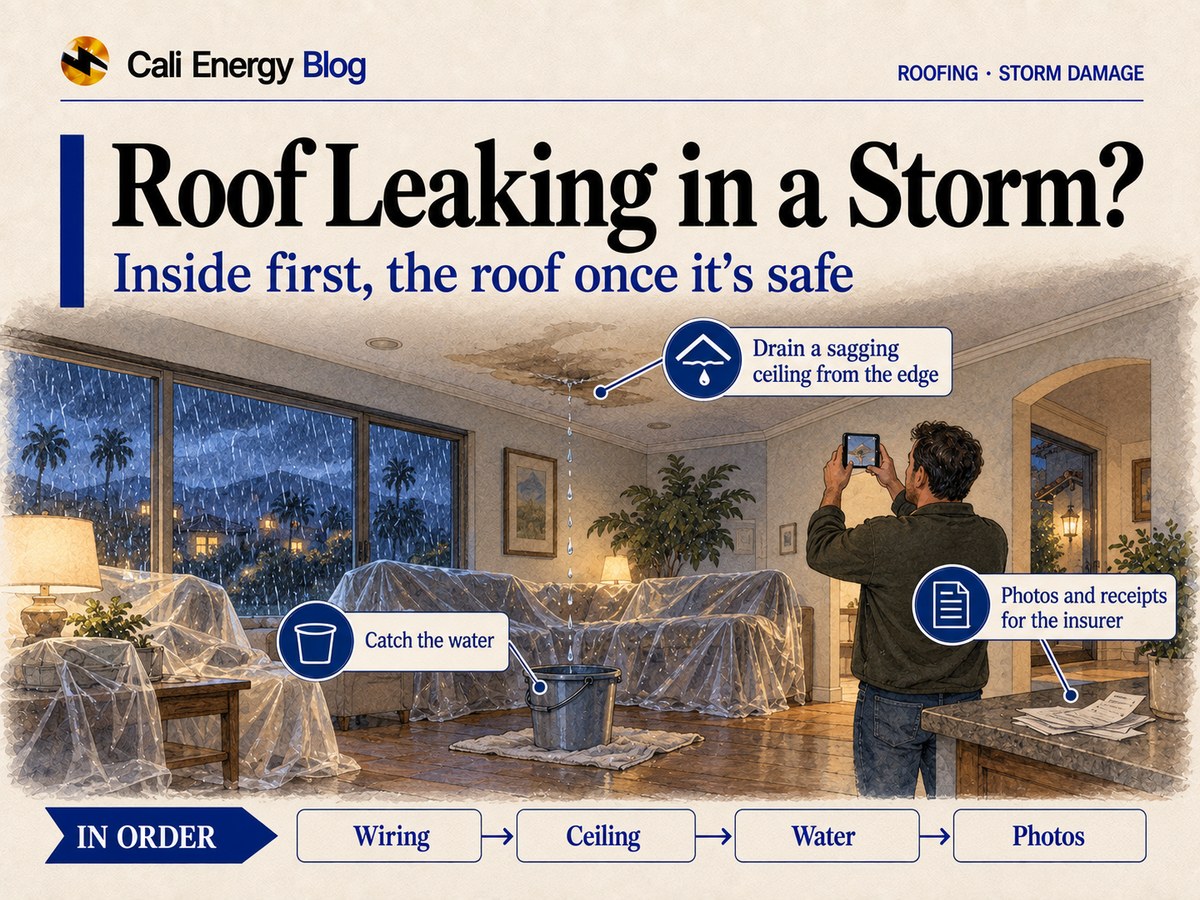
This page is for a house in the Los Angeles area during a storm or just after it. It covers the first hours and the first days. Finding the exact point where the water gets in, and fixing it, is a roofer's job once the roof is dry. Getting a roof ready before the season starts is in preparing a roof for the Los Angeles rainy season.
At a glance
What you see in the house decides what comes first. The sections below explain each step and where it comes from.
| What you see | Do this now | Then |
|---|---|---|
| Water at a light fixture, ceiling fan, outlet or the electrical panel | Don't touch it; switch off that circuit only if you can reach the panel from a dry spot | Keep everyone out of the room until it's dry and checked |
| A ceiling that sags or bulges | Keep everyone out from under it; drain it from the edge, standing in a doorway | The wet section comes out in the repair |
| A steady drip | Buckets and towels, move what it can ruin, plastic sheeting over the rest | Photograph it; a roofer covers the roof once the weather allows |
| A tree through the roof, or power lines down | Get everyone out of that part of the house; don't touch any wire | Report downed lines to the utility, and call 911 if anyone is in danger |
| Wet floors, walls, rugs or insulation | Mop up, open the room, run fans and a dehumidifier | Dry it within 24 to 48 hours to keep mold from growing |
In the first hour
Work from the most dangerous thing to the least. The order below puts people first, then the house, then the paperwork.
- Check the ceiling and the wiring before anything else. If water is dripping from a light fixture or a ceiling fan, or running near outlets or the electrical panel, leave them alone. The federal government's preparedness guidance, Ready.gov, says not to touch electrical equipment if it's wet or if you're standing in water, and to turn off the electricity only if it's safe to do so. If you can reach the panel from a dry spot, switch off the circuit for that part of the house; if you can't, keep everyone away from that room.
- Keep people out from under a sagging ceiling. A ceiling that bulges or sags may be holding water, and wet plaster or drywall is very heavy and dangerous if it falls, as FEMA and the American Red Cross put it in their guide to repairing a flooded home.
- Catch the water. Buckets, pots and towels under each drip; empty them before they fill. Move furniture, electronics, rugs and boxes out of the way, and cover what can't be moved with plastic sheeting.
- Photograph it before you clean up. The drip, the ceiling, the wet floor and anything damaged, with the time. The CDI tells homeowners to take pictures and keep records of all clean-up and repair costs.
- Stay off the roof. The CDI's own guidance on temporary repairs warns against risking your safety to make them. On a roof in rain and wind, that means not going up at all. A tarp over the damaged area is a job for a roofer once the weather allows.
- If a tree has come through the roof or power lines are down, get everyone out of that part of the house. Los Angeles's utility, LADWP, says never to touch a downed or dangling wire or anyone or anything in contact with it, to assume a downed line is still energized, to report it at 1-800-DIAL-DWP (1-800-342-5397), and to call 911 if anyone is in danger. Outside LADWP's area, report it to your own utility.
Draining a sagging ceiling the safe way
Many guides say to poke a hole at the lowest point of a bulging ceiling. FEMA and the Red Cross describe a more careful order, because a waterlogged ceiling can come down all at once:
- Make a poker: a nail or another pointed object on the end of a long stick, such as a finishing nail hammered into a broomstick.
- Stand away from the sag, not under it; a doorway is the safest place.
- Poke the first hole at the edge of the sag, not in the center, so the trapped water starts to drain without the ceiling collapsing on top of you. Put a bucket, or a tarp and a bucket, underneath.
- When it stops draining, poke another hole lower down the sag, and keep working toward the lowest point.
FEMA's guide notes that a sagging ceiling will have to be replaced anyway; draining it this way limits how far the water spreads and keeps anyone from being under it when it gives.
Getting the roof covered
The temporary repair the CDI describes is covering the damage in the roof, walls, doors and windows with plastic sheeting or plywood. On a roof, that means a tarp or sheeting fastened over the damaged area, done by a roofer once the rain and wind have eased, and left in place until the permanent repair. A broken window or a damaged wall you can reach from the ground can be covered sooner.
What to keep in mind when you hire someone in the middle of it:
- The license. The Contractors State License Board (CSLB) requires a state license for any construction job of $1,000 or more, counting labor and materials, and tells homeowners to check the license number on its website before hiring; after a declared disaster the rules tighten, as covered in roofing scams after a fire or storm. How to check a roofer more fully is in how to choose a roofing contractor in California.
- The money. A down payment on a home improvement contract can't exceed $1,000 or 10% of the contract price, whichever is less (Business and Professions Code 7159.5). The CSLB also says not to sign over any payment checks from your insurance company.
- The receipts. The CDI says your insurer will reimburse all reasonable costs to protect the property as long as you save the receipts, and warns about contractors who encourage you to spend a lot on temporary repairs: payments for temporary repairs are part of the total loss settlement.
- A declared emergency. When the governor, the president or the city or county has declared an emergency for the storm, a contract to repair storm damage to a home carries a seven-business-day right to cancel (Business and Professions Code 7159).
Calling your insurer
Report the damage to your insurance company or agent promptly; the CDI says to report any water damage claim immediately. California's standard form fire policy in the Insurance Code (section 2071) begins the insured's duties after a loss with the same two: give written notice without unnecessary delay and protect the property from further damage. Your own policy's section on duties after a loss sets the details for a storm claim.
Whether the leak is covered depends on what let the water in. The CDI explains that homeowners policies don't cover flood, but generally pay for damage from rain coming through a hole in the roof or a broken window, as long as the hole was caused by strong winds or another covered exposure listed in the policy. Its 2024 winter-weather alert notes that policies may cover water damage from wind-driven rain during a storm. Mold damage caused by a covered peril may be covered too. What a claim pays for, and how California's rules shape the payout, is in does insurance cover roof replacement?
The CDI's other storm tips, in short:
- Check your deductible. If the damage is below it, the insurer isn't obligated to pay.
- Get the whole policy. Your insurer has to give you a complete copy, including the declarations page, free of charge within 30 days of your request.
- Keep a claim diary. Write down every conversation with the insurer and the adjuster. If something is said to be excluded or limited, ask for the policy provision.
- No permanent repairs yet. Temporary repairs, yes; permanent ones wait until the adjuster has seen the damage.
- Get an estimate of your own. At least one repair estimate, to compare with the one the insurer's adjuster prepares.
Drying out
The EPA's guidance on mold is to dry water-damaged areas and items within 24 to 48 hours to prevent mold growth. The CDI adds that after sudden water damage you should dry all wet areas with good air circulation, since drying and dehumidifying help keep mold from following the water. Open the room up, run fans and a dehumidifier, and pull up soaked rugs.
If the stain is old and the damage shows a leak that has gone on for a while, mold may already be there. In that case the CDI warns that trying to clean it up yourself can spread the spores, and that testing and cleanup should be done as soon as mold is found.
After the storm: finding the leak and fixing it
Where water shows inside is often not where it gets in: it can run along the deck, the rafters or the underlayment before it drips. A roofer traces it back once the roof is dry; how to narrow it down yourself first, without going on the roof, is in how to find a roof leak. It helps to tell them when it leaked (in any rain, or only in wind-driven storms), which way the wind was blowing, where it shows inside, and what you photographed.
What comes next depends on the roof:
- Repair or replacement. One failed flashing or a damaged section is usually a repair; leaks in several places on a worn-out roof point the other way. How to decide is in repair or replace a roof.
- Tile roofs often leak through the underlayment under tiles that look fine; see why a tile roof leaks when the tiles look fine.
- Flat roofs have their own options: flat roof repair, coating or replacement.
- A roof with solar panels raises the question of who answers for a leak near the mounts: roof warranty vs solar warranty.
- A permit. Whether the permanent repair needs one depends on the work; for the City of Los Angeles, see getting a roof permit in the City of Los Angeles.
Frequently asked
Should I put a tarp on the roof during the storm?
Should I poke a hole in a ceiling that's bulging with water?
Does homeowners insurance cover a roof leak in a storm?
Can I fix the roof before the adjuster comes?
How quickly do wet ceilings, walls and carpet need to dry?
Who should I call first, the roofer or the insurance company?
Related reading
Sources & methodology
Code sections, rules and figures on this page come from the primary sources below. Codes, local requirements and product terms change; each was verified October 9, 2026.
- California Department of Insurance, Residential Property Claims Guide (Form 405, February 2025)
- California Department of Insurance, Top Ten Tips for People Affected by Winter Storms
- California Department of Insurance, Consumer Alert for Winter Weather (February 2, 2024)
- California Insurance Code, section 2071 (standard form fire insurance policy, requirements in case loss occurs)
- FEMA and the American Red Cross, Repairing Your Flooded Home (FEMA 234 / ARC 4477), Step 2
- U.S. EPA, A Brief Guide to Mold, Moisture and Your Home
- Ready.gov, Floods
- LADWP, Electric Safety
- Contractors State License Board, CSLB Urges Homeowners to Hire Licensed Contractors Following Storm Damage (January 17, 2023)
- Contractors State License Board, CSLB Urges Homeowners to Hire Licensed Contractors Following Southern California Wildfires, press release #25-01…
- California Business and Professions Code, sections 7159 and 7159.5
We find where the water gets in, then fix that section
Call (323) 844-7777. Once the rain stops, we trace where the water is getting in, which often isn't where it shows inside, and repair that section, or tell you plainly if the roof is past repairing. Have ready when it leaked and how hard it was raining, where it shows inside, your photos, the roof type and whether there's solar on it.
Prepared by Cali Energy, October 9, 2026. This article is for general educational purposes only and is not legal, tax, financial, engineering, or utility advice. Rates, incentives, codes, permit requirements, equipment specifications, prices, and program terms may change; figures and timelines are estimates, not guarantees. Confirm current requirements with the applicable utility, AHJ, program administrator, manufacturer, or a licensed professional. See our Content Disclaimer. Cali Energy · 19201 Parthenia St, Unit E, Northridge, CA 91324 · CSLB #1032379 (B, C-10, C-39)