

How to Read an Insurance Roof Estimate in California
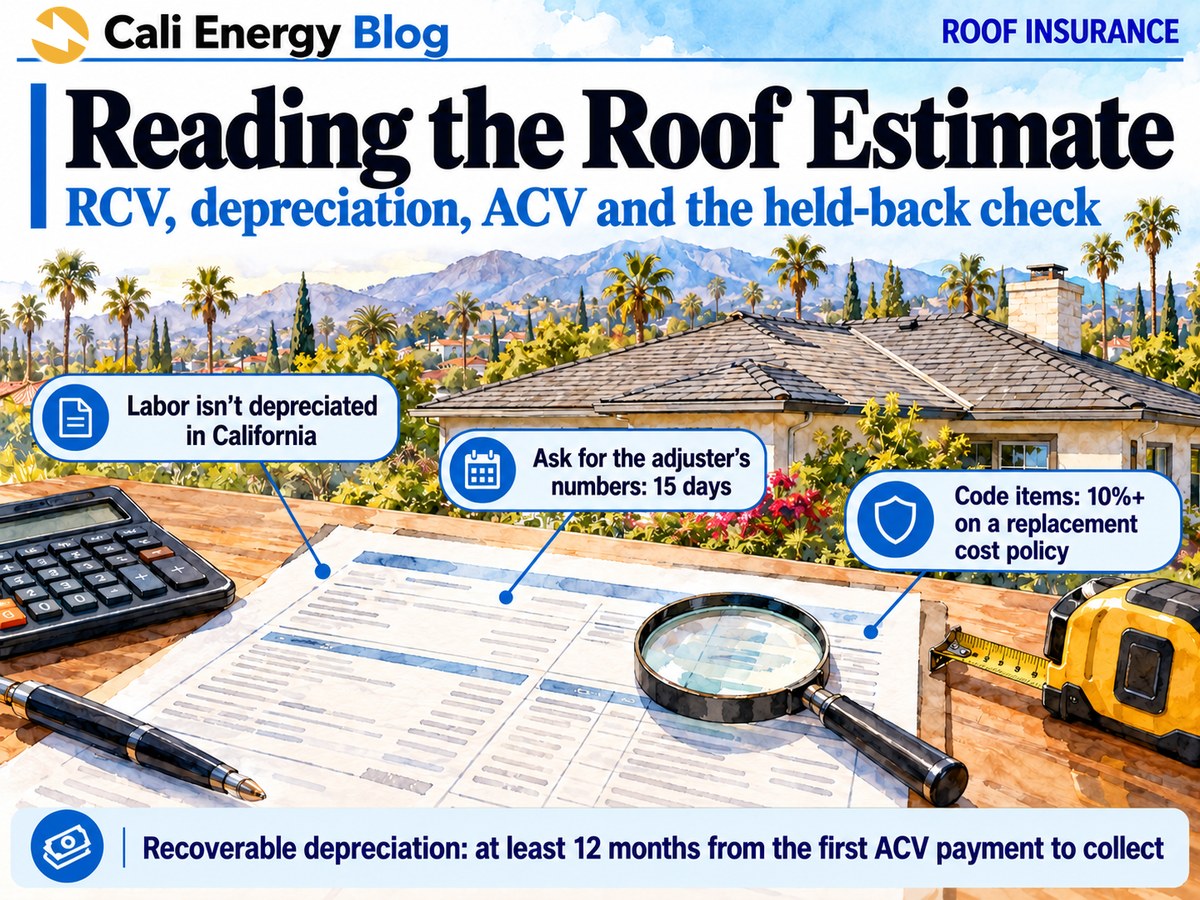
An insurer's roof estimate runs from the replacement cost value (RCV), the cost to redo the roof with like kind and quality, down to the check: RCV minus depreciation is the actual cash value (ACV), and the deductible usually comes out of that first payment. On a replacement cost policy that pays ACV until the work is done, unless an endorsement settles the roof at ACV, the depreciation held back is paid once the roof is replaced, up to what you reasonably spend, and California gives you at least 12 months from the first ACV payment to collect it, or at least 36 months from that payment if the loss relates to a declared state of emergency. California also sets rules that change the math: the labor to tear off and install can't be depreciated, any depreciation has to be itemized in dollars and explained in writing, on a replacement cost claim mismatched shingles or tile mean replacing the damaged area so it looks reasonably uniform, and a replacement cost policy carries code upgrade coverage of at least 10 percent of the dwelling limit on top of it. This page walks through the estimate as of October 2026.
How to file and the deadlines are in how to file a roof insurance claim in California, and what a policy covers in does insurance cover roof replacement?
The estimate, line by line
Most roof estimates end with the same short stack of lines, whatever software the adjuster uses.
| Line | Example | What it means | California rule |
|---|---|---|---|
| Replacement cost value (RCV) | $20,000: materials $9,000, labor $11,000 | The cost to repair or replace without deducting depreciation, up to the policy limit | Insurance Code 2051.5(a)(1); prices representative of the local market (10 CCR 2695.9(d)) |
| Depreciation | $3,600: 40% of the materials, $0 on labor | The deduction for age and condition | Itemized in dollars and explained in writing; labor isn't depreciated (10 CCR 2695.9(f)) |
| Actual cash value (ACV) | $16,400 | RCV minus depreciation | Insurance Code 2051(b) |
| Deductible | −$2,500 | Usually taken from the first payment | For the covered repair on a replacement cost claim, you pay no depreciation and no other cost except the deductible (10 CCR 2695.9(a)(1)); upgrades, excluded damage, amounts over the policy limits and a price above what the insurer reasonably allows for the repair aren't included |
| First payment | $13,900 | The ACV check, often an advance rather than the final payment | Due immediately, and no later than 30 days after the insurer accepts the claim and gets a signed release if one is needed (10 CCR 2695.7(h)) |
| Recoverable depreciation | $3,600 | The held-back amount, paid after the roof is replaced | Up to what you reasonably paid; at least 12 months to collect (Insurance Code 2051.5) |
| Code upgrade items | Listed separately | Work the current code requires that the old roof didn't have | At least 10% of the dwelling limit, on top of it, on a replacement cost policy (Insurance Code 10103(c)) |
The figures are invented to show the arithmetic. If the same estimate had depreciated the labor as well, the depreciation would be $8,000 and the first check $9,500 instead of $13,900; that line is the first one to check. On a replacement cost policy the difference comes back after the work, but you carry it until then.
On an actual cash value policy, or when an endorsement settles the roof at actual cash value even on a replacement cost policy, the depreciation is non-recoverable: estimates usually label it that way, and it isn't paid back after the work. Your declarations page and endorsements show which you have, and which insurers settle older roofs this way is in roof age and home insurance. The labor rule applies either way, and on an actual cash value roof wrongly depreciated labor is money that never comes back.
The estimate's header and summary may also show sales tax on materials, overhead and profit, and the date and area of the price list; the prices should be current for your area.
What to check on the estimate
The adjuster's estimate has to restore the roof to no less than its condition before the loss, in a way that meets accepted trade standards, and the insurer has to take reasonable steps to make sure its prices are accurate and representative of your local market (10 CCR 2695.9(d)).
- The measurements. Squares of roof area, pitch, the number of layers and the waste allowance drive every quantity; how roofers count squares is in roofing squares: how roofers measure.
- Every part of the job. Tear-off down to the deck, since a roof replacement removes the existing layers, with limited exceptions (CRC 2025 R908.3), deck repair, underlayment, drip edge at eaves and rakes on a shingle roof (R905.2.8.5), flashings, vents, ridge, disposal and the permit. A line that's missing can't be paid.
- Labor without depreciation. Apart from labor built into the price of manufactured materials, the labor to repair or replace the roof isn't depreciable in California (10 CCR 2695.9(f)(1)). Most estimate lines combine material and labor in one unit price, so ask the adjuster in writing for each line's depreciation split between material and labor; removal and tear-off lines are mostly labor and disposal, so depreciation there is a red flag. If labor carries depreciation, ask in writing for a corrected estimate, citing that rule.
- Depreciation you can follow. It has to be measurable, itemized, stated in dollars, reflect a real difference in market value from the roof's condition and age, and be explained to you in writing (10 CCR 2695.9(f)).
- Matching. On a replacement cost claim, if new shingles or tile don't match in quality, color or size, the insurer replaces all items in the damaged area so they look reasonably uniform (10 CCR 2695.9(a)(2)). Ask in writing how the damaged area was drawn.
- Code items on their own lines. A replacement cost policy in California has to carry building code upgrade coverage of at least 10 percent of the dwelling limit, and using it doesn't reduce that limit (Insurance Code 10103(c)). A policy without it has to say so on the declarations page (10103(e)(3)).
- Damage caused by the repair. On a replacement cost claim, physical damage that happens while the repair is made, such as gutters or stucco disturbed at the edge, is part of the loss unless the policy excludes it (10 CCR 2695.9(a)(1)).
When your roofer's number is higher
California's rules give the claim a way to reconcile two estimates; roofers call it a supplement.
- Get the insurer's numbers. You can ask for the claim-related documents, including estimates, scopes, measurements and every loss calculation, and the insurer has 15 calendar days to send them (Insurance Code 2071).
- Send a written estimate. If a written estimate you get shows that the necessary repairs cost more than the insurer's estimate, the insurer has to do one of three things: pay the difference; if you ask, name at least one contractor who'll do the work for its estimate; or reasonably adjust your roofer's estimate and send you the adjusted copy (10 CCR 2695.9(d)). An upgrade you choose isn't a necessary repair. If the insurer reasonably adjusts your roofer's estimate, the adjusted amount is what it pays: ask in writing for the reason behind each change, and if you still disagree on the amount, demand appraisal; anything your roofer charges above the amount agreed or awarded is yours to pay. The insurer can't require you to use a particular contractor (2695.9(b)).
- Send it as proof of claim. Photos, invoices and estimates that support the amount you claim are proof of claim (10 CCR 2695.2(s)). The insurer has 40 calendar days from receiving them to accept or deny, in whole or in part, unless it tells you in writing within that time that it needs more time and why, and then every 30 days; an accepted amount is paid within 30 days (2695.7(b), (c)(1), (h)). A denial, in whole or in part, comes in writing with every reason and tells you the Department of Insurance can review it (2695.7(b)(1), (b)(3)).
- Damage found at tear-off. If damage from the same covered event, such as deck broken or soaked in the storm, turns up once the old roof is off, tell the insurer right away; the Department of Insurance's claims guide says you can usually reopen the claim for additional damage found later. Rot from long-term leaks or age is generally treated as wear, which policies usually exclude, as does insurance cover roof replacement? explains; how a roofer handles rotted deck under the contract is in rotted roof decking and the change order.
- A dispute over the amount. If you and the insurer can't agree on the actual cash value or the amount of loss, either side can demand appraisal in writing; each names a disinterested appraiser, and the appraisal states actual cash value and loss separately for each item (Insurance Code 2071).
- Who can negotiate for you. A licensed public adjuster or an attorney can negotiate the claim on your behalf. Anyone else who does it for pay, a roofer included, needs a public adjuster license from the Department of Insurance (Insurance Code 15006, 15007), and a public adjuster can't have a financial interest in the company doing the repair (15028(b)); the department takes questions at 1-800-927-4357. What a roofer can and can't do on the claim is in your roofer and your insurance claim.
Collecting the held-back depreciation
The rest of a replacement cost claim is paid once the work is done.
- What it pays. The difference between the ACV already paid and the full replacement cost reasonably paid to replace the roof, up to the policy limits (Insurance Code 2051.5(a)(2)). Send the final invoice and proof the roof was completed.
- How long you have. At least 12 months from the first ACV payment, or at least 36 months from it for a loss relating to a declared state of emergency (2051.5(b)(1)), plus six-month extensions for good cause when, acting in good faith and with reasonable diligence, you're held up by delays beyond your control, such as unavoidable permit delays, a lack of materials or no contractor available (2051.5(b)(2)). Your policy can give you more time.
- Your lender. The check for the house usually names you and your mortgage lender, and lenders generally hold the money and release it as the work is finished.
Frequently asked
What is recoverable depreciation on a roof claim?
Can an insurer depreciate labor on a roof estimate in California?
What if my roofer's estimate is higher than the adjuster's?
Does my homeowners policy pay for code upgrades on a new roof?
Is the first check from the insurer the final payment?
Related reading
Sources & methodology
Code sections, rules and figures on this page come from the primary sources below. Codes, local requirements and product terms change; each was verified October 15, 2026.
- California Insurance Code §2051 (actual cash value)
- California Insurance Code §2051.5 (replacement cost, as amended by SB 495, effective January 1, 2026)
- California Insurance Code §2071 (claim-related documents, appraisal)
- California Insurance Code §10103 (building code upgrade coverage)
- California Insurance Code §15006 (public adjuster license)
- California Insurance Code §15007 (public adjuster defined)
- California Insurance Code §15028
- California Code of Regulations, title 10, §2695.9 (Fair Claims Settlement Practices Regulations)
- California Code of Regulations, title 10, §2695.7
- California Department of Insurance, Fair Claims Settlement Practices Regulations, including §2695.2 (definitions)
- California Department of Insurance, Residential Property Claims Guide (updated February 2025)
- California Residential Code 2025, Chapter 9, Roof Assemblies (R905.2.8.5, R908.3) (UpCodes)
We write a roof estimate your adjuster can compare line by line
Call (323) 844-7777. We measure the roof, list tear-off, deck, underlayment, flashing, vents, disposal and permit as separate lines, and note any code-required items, so the estimate can be set beside the adjuster's. We don't negotiate the claim for you. Have ready the adjuster's estimate and any photos of the damage.
Prepared by Cali Energy, October 15, 2026. This article is for general educational purposes only and is not legal, tax, financial, engineering, or utility advice. Rates, incentives, codes, permit requirements, equipment specifications, prices, and program terms may change; figures and timelines are estimates, not guarantees. Confirm current requirements with the applicable utility, AHJ, program administrator, manufacturer, or a licensed professional. See our Content Disclaimer. Cali Energy · 19201 Parthenia St, Unit E, Northridge, CA 91324 · CSLB #1032379 (B, C-10, C-39)